Disclosure: myactivetribe.com is reader-supported. When you purchase through links on our site, we may earn an affiliate commission at no extra cost to you.
Quick Answer: Slat belt treadmills use individual rubber slats instead of a continuous belt, delivering a more natural running feel, better shock absorption, and significantly longer lifespan than standard treadmills. They are the preferred choice for serious runners and commercial gym use. The AssaultRunner Pro is among the best-known curved slat belt options. Of the two motorized machines covered here, the Peloton Tread+ Vision suits home runners who want coaching, and the Matrix Performance Plus LED suits commercial gyms and serious private training spaces.
This guide covers the most thorough slat belt treadmill reviews available… If you’ve ever stepped onto a slat belt treadmill at a high-end gym or physical therapy clinic, you know immediately that something feels different. That smooth, cushioned, almost track-like feel beneath your feet isn’t marketing hype — it’s the result of a fundamentally different design that’s changing indoor running.
And yet, if you search for a dedicated guide to slat belt treadmills, you’ll mostly find them buried inside generic “best treadmill” roundups alongside budget belt machines. That doesn’t help you if slat belt technology is specifically what you’re after.
This guide covers only slat belt treadmills — what they are, why they matter, and the two best options available right now, ranging from a serious home gym investment to full commercial grade. Every spec below was checked against official or authorized-dealer product pages.
Slat Belt vs Traditional Treadmill: Key Differences
A traditional treadmill uses a single continuous rubber belt running over a flat deck. A slat belt treadmill replaces that with individual rubber or composite slats linked together in a loop — each one acting as its own independent cushioning element.
The result is a running surface that behaves more like a high-quality outdoor track than a rubber conveyor belt. Here’s what that means practically:
Better shock absorption. Each slat flexes independently as your foot strikes, reducing impact on knees, hips, and ankles. This is why slat belt machines are the preferred choice in physical therapy and professional sports training facilities.
More natural running mechanics. The slat surface allows for proper toe-off and slight lateral movement — much closer to what happens when you run outdoors.
Longer lifespan. Commercial slat belt machines are rated for 100,000+ miles of use. A traditional treadmill belt typically needs replacement every 3–5 years.
Lower routine maintenance. No belt lubrication, no deck waxing. The main maintenance is periodic slat inspection and cleaning.
The trade-off: slat belt treadmills cost significantly more upfront. But for serious runners and commercial facilities, the performance difference justifies it.
Quick Comparison: Both Slat Belt Treadmills
| Peloton Tread+ Vision | Matrix Performance Plus LED | |
|---|---|---|
| Best For | Connected-fitness runners at home | Commercial facilities and serious private gyms |
| Running Surface | 67″ × 20″ slat belt (59 slats) | 62″ × 24″ slat belt |
| Speed Range | 0–12.5 mph | 0.5–16 mph |
| Incline Range | 0–15% | 0–20% |
| Drive System | 2 HP AC | 5.0 hp Dynamic Response Drive System |
| Max User Weight | 300 lb (user weight range 105–300 lb) | 500 lb |
| User Height Range | 4′11″–6′4″ | Not specified by Matrix |
| Console | 23.8″ Full HD swivel touchscreen | LED console, 12 programs |
| Self-Powered Mode | Yes: Free Mode, plus Sled Mode | No |
| Connectivity | Bluetooth 5.2; heart rate monitor, Apple Watch, Wear OS, Fitbit, Garmin, WHOOP | No Bluetooth; Ethernet connectivity; optional Wi-Fi and RFID login |
| Subscription Required | Peloton All-Access, sold separately | No |
| Dimensions (L × W × H) | 75″ × 37″ × 70″ | 89.4″ × 36.5″ × 66.5″ |
| Machine Weight | 460 lb | 479.7 lb assembled |
| Step-Up Height | 11″ | 10.5″ |
| Power Requirement | Dedicated grounded circuit, 15 A or more | Dedicated, non-looped grounded circuit, 20 A |
| Warranty | 12-month limited, 5-year belt and motor guarantee, 5-year frame guarantee | Commercial: 7-year frame, lifetime drive motor, 3-year parts and labor, 90-day wear items |
| Best Feature | Smart coaching, Free Mode and Sled Mode | Commercial durability |
1. Peloton Tread+ Vision — Best for Connected Fitness
Warranty: 12-month limited, 5-year belt and motor guarantee, 5-year frame guarantee.
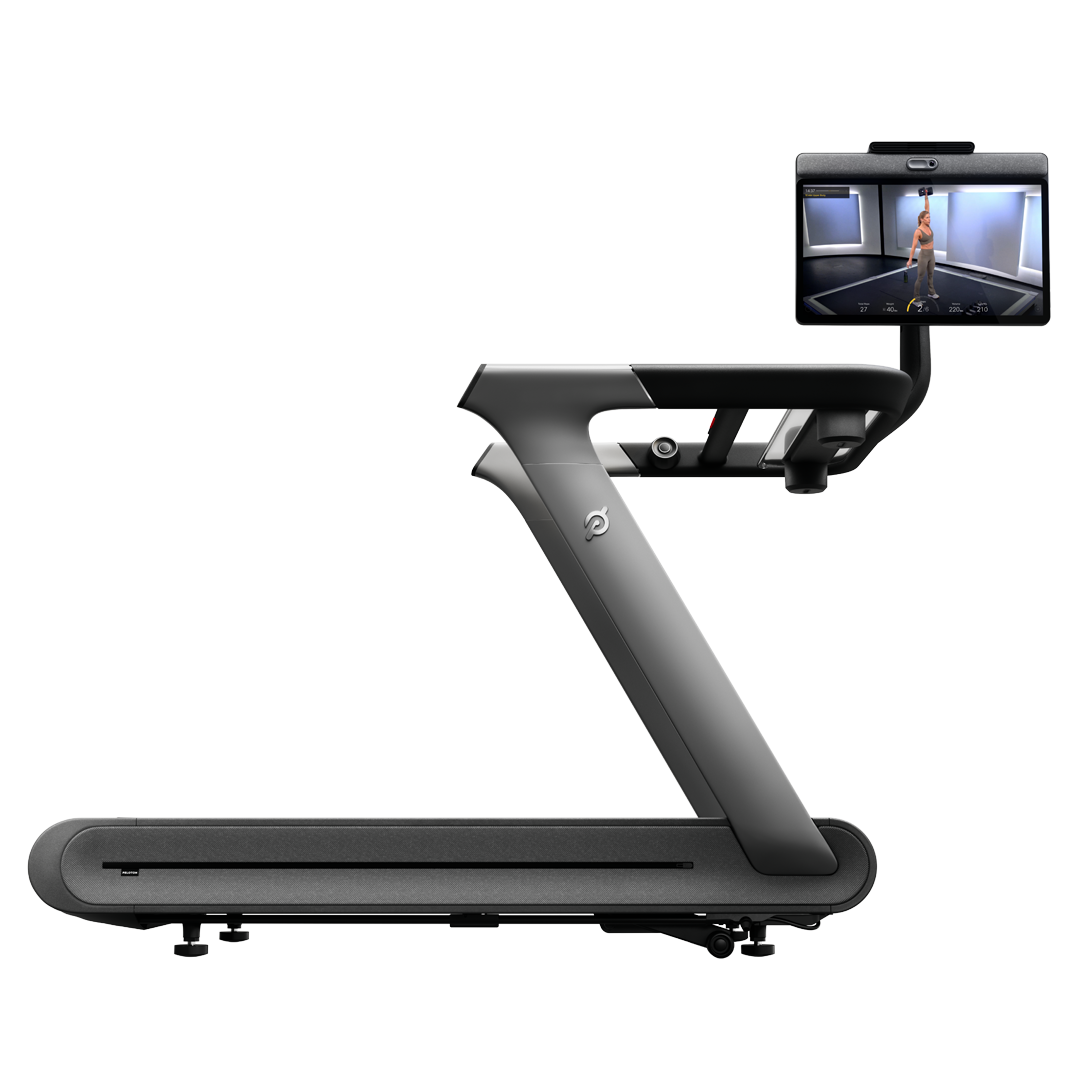
The Peloton Tread+ Vision is a home slat belt treadmill built around coaching and data. It adds Peloton IQ — a smart coaching layer that analyzes your running form, tracks reps, and adapts your training plan over time.
What Makes It Stand Out
The belt is made of 59 individual rubberized slats and gives you 67 inches of running space, with a 20-inch width. That makes it the longest running surface of the two machines in this guide. Peloton designed the slats to soften every mile and return energy to your stride.
Free Mode is a feature worth highlighting specifically. Switch off the motor and the belt moves entirely by the force of your own feet — turning the Tread+ Vision into a self-propelled training tool. Peloton says this lets you move from a walk to a full sprint in seconds. The Matrix does not offer it.
Sled Mode goes the other way. It adds up to 300 lbs of resistance, so the treadmill doubles as a strength station for sled-style pushes. Between the two modes, one machine covers easy miles, hard intervals and strength work.
Peloton IQ uses an optional movement-tracking camera. Run Analysis measures your vertical oscillation and cadence and gives you a single efficiency score with post-workout tips. In strength classes the same camera counts reps and gives real-time form feedback. Personalized plans and speed recommendations adjust as your progress changes.
Control knobs and jump buttons let you change speed and incline without breaking stride, and auto-incline can follow instructor cues. You can set speed in 0.1 mph steps from 0 to 12.5 mph, and the incline runs from 0 to 15%.
Screen, Sound and Connectivity
The 23.8-inch Full HD swivel screen rotates 360 degrees, so when you step off the belt for strength work, yoga, or Pilates, the screen follows you. The 2.1 audio system pairs front-facing speakers with a rear woofer and carries Sonos tuning, and hands-free control lets you pause a class or update your weights by voice.
Bluetooth 5.2 connects your heart rate monitor, Apple Watch, Wear OS watch, Fitbit, Garmin or WHOOP. The console shows speed, mileage, pace splits, heart rate zones and elevation, and it adds a fan, an accessories tray and a USB-C charging port.
What the Membership Adds
The Peloton All-Access Membership is sold separately. It unlocks live and on-demand classes (running, walking, strength, yoga and more), scenic classes, Peloton Entertainment streaming, individual profiles for your household, and the Leaderboard. Without it, the Tread+ Vision loses most of what makes it special.
Space, Power and Who Can Use It
Peloton lists the Tread+ Vision at 75 inches long, 37 inches wide and 70 inches tall, with a 7-foot by 3-foot footprint and a machine weight of 460 lb. The step-up height is 11 inches. Peloton recommends 24 inches of clear space on the left, right and front, 79 inches behind it, and a ceiling 20 to 24 inches higher than the user.
You need a dedicated, grounded circuit rated for 15 amps or more. Peloton lists user requirements of 4′11″ to 6′4″ in height, 105 to 300 lb in weight, and age 16 or older.
The Honest Caveat
The membership is a real ongoing cost on top of the purchase, so budget for it. The Tread+ Vision is a new 2026 model, so there is no long-term owner record on reliability yet. The 300 lb user ceiling and the height range rule out some buyers, and the 460 lb frame needs a permanent spot.
Who It’s For
The Tread+ Vision is built for runners who want coaching, community, and content alongside their slat belt hardware. If you would use the Peloton classes, the membership is easily justified. If you just want to run without a platform, the Matrix gives you slat belt technology with no subscription, though it is a commercial machine.
Best for: Home runners and walkers up to 300 lb who want guided classes, form feedback, and the option to train in Free Mode or Sled Mode.
Key Specs
- Membership: Peloton All-Access, sold separately
- Running surface: 67″ × 20″ (59 individual slats)
- Speed: 0–12.5 mph in 0.1 mph steps
- Incline: 0–15%
- Motor: 2 HP AC
- Modes: Free Mode and Sled Mode (up to 300 lbs of resistance)
- Screen: 23.8″ Full HD swivel touchscreen
- Audio: 2.1 system with front-facing speakers and a rear woofer
- Connectivity: Bluetooth 5.2, USB-C charging port
- Dimensions: 75″ L × 37″ W × 70″ H; step-up height 11″
- Machine weight: 460 lb
- User requirements: 4′11″–6′4″, 105–300 lb, age 16+
- Power: dedicated grounded circuit, 15 A or more
- Warranty: 12-month limited, 5-year belt and motor guarantee, 5-year frame guarantee
Pros
- Free Mode and Sled Mode add self-powered running and strength work to one machine.
- Peloton IQ gives Run Analysis, rep tracking and form feedback through an optional camera.
- The 67-inch slat belt is the longest running surface in this guide.
- A large 23.8-inch swivel screen and Sonos-tuned audio make classes immersive.
- The belt and motor carry a 5-year guarantee, matching the 5-year frame guarantee.
Cons
- A separate paid membership is needed for most features.
- The 300 lb user limit and 4′11″–6′4″ height range exclude some buyers.
- It is a 460 lb machine that needs a dedicated circuit and a permanent spot.
- It is a new 2026 model with no long-term reliability record.
2. Matrix Performance Plus LED — Best Commercial-Grade Slat Belt Treadmill
Warranty: Commercial: 7-year frame, lifetime drive motor, 3-year parts and labor, 90-day wear items.
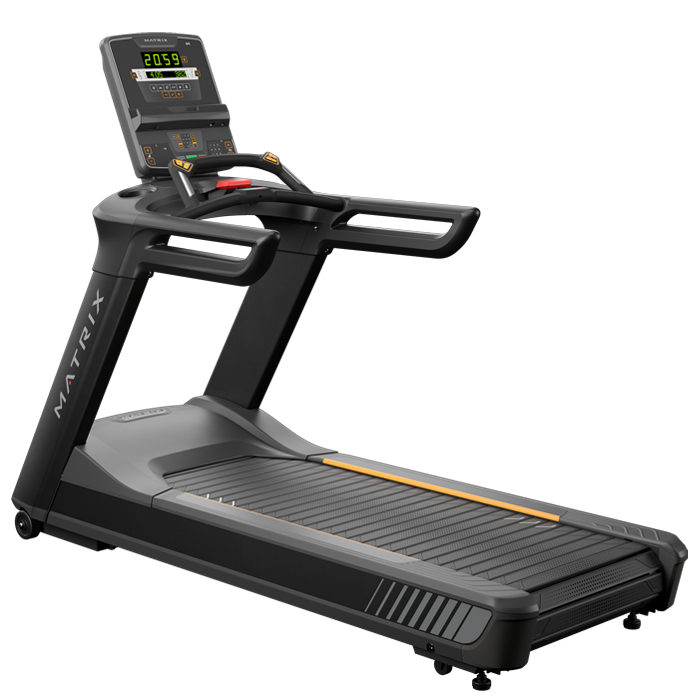
The Matrix Performance Plus LED is a different category of machine. It’s not trying to compete with the Peloton on smart features. It’s built for environments where treadmills run eight to twelve hours a day, every day — commercial gyms, rehabilitation centers, hotel fitness rooms, and serious private training facilities.
What Makes It Stand Out
The Pure Stride Cushioning System is Matrix’s proprietary slat belt technology, rated for up to 100,000 miles of use. To put that in context: if someone ran 10 miles a day on this machine every single day, it would last over 27 years before the slat system needed attention. Matrix builds each slat with an aluminium core and a rubberized coating.
The running surface at 62″ × 24″ is the widest of the two machines, accommodating every stride width and running style. The speed range runs from 0.5 to 16 mph, and the incline from 0 to 20% with a 1,650-lb thrust-elevation motor. Both figures are well beyond the Peloton.
The 5.0 hp Dynamic Response Drive System is built for continuous operation. The 500 lb user weight limit — well above the Peloton’s 300 lb — reflects the commercial construction throughout.
Continuous multi-grip handlebars give you many hand positions during hard efforts. Crossbar controls, contact and telemetric heart rate, and a 10.5-inch step-on height are standard.
The LED Console
The LED console is deliberately simple. It has a large-number display with a message center, and there are no streaming apps, no touchscreen and no subscription. Programs include Go, manual, interval training, fat burn, rolling hills, target heart rate and fitness tests.
There is a headphone jack, a USB port for charging and software updates, and a reading rack for your own device. This console has no Bluetooth and no built-in fan. Optional extras include Wi-Fi, RFID login and attachable TV add-ons, and the console is CSAFE ready and has Ethernet connectivity.
Built to Be Serviced
Easily removable side rails, a front-accessible component cover, and built-in service casters mean maintenance technicians can service it quickly without major disassembly. Cast aluminium end caps and a robust steel frame are built to withstand years of heavy use without degrading.
Space, Power and Home Use
Matrix lists the assembled size at 89.4 inches long, 36.5 inches wide and 66.5 inches tall. Assembled weight is 479.7 lb, and shipping weight is 538.8 lb. It needs a dedicated, non-looped, grounded 20-amp circuit, so ask an electrician before you buy.
The warranty listed for this model is a commercial one: 7 years on the frame, a lifetime drive motor, 3 years on parts and labor, and 90 days on wear items. If you plan to use it at home, confirm the terms that apply to your purchase with the seller.
Who It’s For
The Matrix is the right choice for commercial gym owners, physical therapy clinics, hotel fitness facilities, or anyone building a serious private training space where durability and daily operational reliability matter more than connected features. For home gym use, the price is hard to justify unless budget truly isn’t a constraint — in which case, you’re getting a machine that will genuinely outlast everything else.
Best for: Commercial facilities, clinics and serious private training spaces that need a heavy-duty slat belt machine with no subscription.
Key Specs
- No subscription required
- Running surface: 62″ × 24″ slat belt
- Speed: 0.5–16 mph
- Incline: 0–20% (1,650-lb thrust-elevation motor)
- Drive system: 5.0 hp Dynamic Response Drive System
- Max user weight: 500 lb
- Console: LED, large-number display with 12 programs (no Bluetooth, no fan)
- Cushioning: Pure Stride slat belt system, rated up to 100,000 miles
- Step-on height: 10.5″
- Dimensions: 89.4″ L × 36.5″ W × 66.5″ H; assembled weight 479.7 lb
- Power: dedicated, non-looped grounded 20 A circuit
- Warranty: commercial; 7-year frame, lifetime drive motor, 3-year parts and labor, 90-day wear items
Pros
- Built for commercial durability, with a rated life of up to 100,000 miles.
- It has the widest running surface and the highest weight limit of the two.
- A 5.0 hp drive system and a 16 mph top speed suit fast running.
- A lifetime drive motor warranty backs the drive system.
- There is no subscription, and the removable side rails make servicing easy.
Cons
- It has no smart features, no entertainment and no fan on the LED console.
- It needs a dedicated 20 A circuit.
- It is large and heavy at about 480 lb assembled.
- The warranty listed is a commercial one, and it is built for commercial rather than home use.
Peloton Tread+ Vision vs Matrix Performance Plus LED: Head-to-Head
Running feel and surface. Both machines use a slat belt with a rubberized, cushioned surface. The Matrix is wider at 24 inches and the Peloton is longer at 67 inches, so choose by stride: a long-legged runner may prefer the extra length, while a runner who moves side to side may prefer the extra width.
Speed and incline. The Matrix tops out at 16 mph and 20% incline. The Peloton reaches 12.5 mph and 15%, which still covers most home training, from easy walks to hard intervals.
Technology and coaching. The Peloton is the connected machine, with a large screen, Run Analysis, form feedback and classes. The Matrix offers a clean LED console with 12 programs and no connectivity built in, which suits a gym floor.
Self-powered training. Only the Peloton offers Free Mode and Sled Mode. If you want to train power and strength on the same belt, that settles it.
Durability and warranty. The Matrix is rated for up to 100,000 miles and carries a commercial warranty with a lifetime drive motor. The Peloton carries a 12-month limited warranty plus 5-year belt, motor and frame guarantees.
Cost of ownership. The Peloton needs a separate All-Access membership to unlock its classes. The Matrix has no subscription, but it needs a 20 A dedicated circuit and more floor space.
Space, Power and Delivery: What to Check Before You Buy a Slat Belt Treadmill
Slat belt treadmills are heavy, long and power-hungry. A few checks before you order save a lot of trouble later.
- Measure the room. The Peloton needs about 7 × 3 feet of floor plus the clearances Peloton recommends. The Matrix is 89.4 inches long, so allow more length.
- Check the ceiling. Peloton asks for a ceiling at least 24 inches above the user’s height. Both machines stand 66 to 70 inches tall.
- Check the circuit. The Peloton needs a dedicated grounded circuit of 15 amps or more, and the Matrix needs a dedicated, non-looped grounded 20-amp circuit.
- Think about the floor. At 460 and about 480 lb, both are heavy. Place them on a solid floor, ideally on the ground level.
- Check the doorways. Both machines are about 37 inches wide, so confirm the delivery route before the machine arrives.
- Ask about delivery and assembly. Terms vary by seller, so confirm what is included before you buy.
How to Get the Most From a Slat Belt Treadmill
A slat belt feels different from a regular belt, and a few habits make the switch easier.
- Start with walking. Spend your first sessions at an easy pace so you learn how the belt responds.
- Build mileage slowly. Softer surfaces are easier on your joints, but your tendons and muscles still need time to adapt.
- Use incline for variety. Add grade before you add speed, especially on the Matrix, which climbs to 20%.
- Try Free Mode gradually (Peloton). Begin with short, easy efforts and wear shoes you trust, because you control the belt with your own stride.
- Keep it clean. Slat systems skip belt lubrication and deck waxing, but periodic slat inspection, cleaning and bolt checks keep them in shape.
How to Choose the Right Slat Belt Treadmill
Choose the Peloton Tread+ Vision if: You want a smart home slat belt treadmill, you will genuinely use Peloton classes, you are within the 105–300 lb and 4′11″–6′4″ range, and the monthly membership fits your budget.
Choose the Matrix Performance Plus LED if: You’re equipping a commercial facility, a physical therapy clinic, or a private training space where the machine needs to run hard every day for years without issues, and you have a dedicated 20 A circuit.
Consider your ongoing costs. The Peloton adds a membership. The Matrix adds none, but it may add an electrician’s visit.
Consider your space. The Peloton is more compact at 75 × 37 inches. The Matrix is longer at 89.4 inches.
Self-Powered Curved Slat Belt Treadmills: A Different Kind of Slat Belt
The Peloton and the Matrix are motorized, but they are not the only slat belt treadmills. A second group uses a curved frame and no motor at all. You power the belt with your own stride, and the curve of the deck sets the pace.
Curved machines use the same slat idea: a loop of individual slats that gives under your foot. The difference is how the belt moves. On a motorized slat belt you set a speed and the motor holds it. On a curved machine you push the belt yourself, so speed comes from effort rather than a button.
- No motor: the belt moves only when you drive it, so the work starts the moment you step on.
- Effort sets the pace: you speed up or slow down by changing how you run.
- Simple console: most show time, distance, speed and calories, and many need no wall outlet.
- Fixed shape: the curve replaces the incline motor, so you do not set a grade.
That makes them a strong fit for sprint work, interval training and athletes who want a hard session in a short time. They are less suited to someone who wants an easy, steady walk at a set speed. If that is you, a motorized slat belt is the better choice.
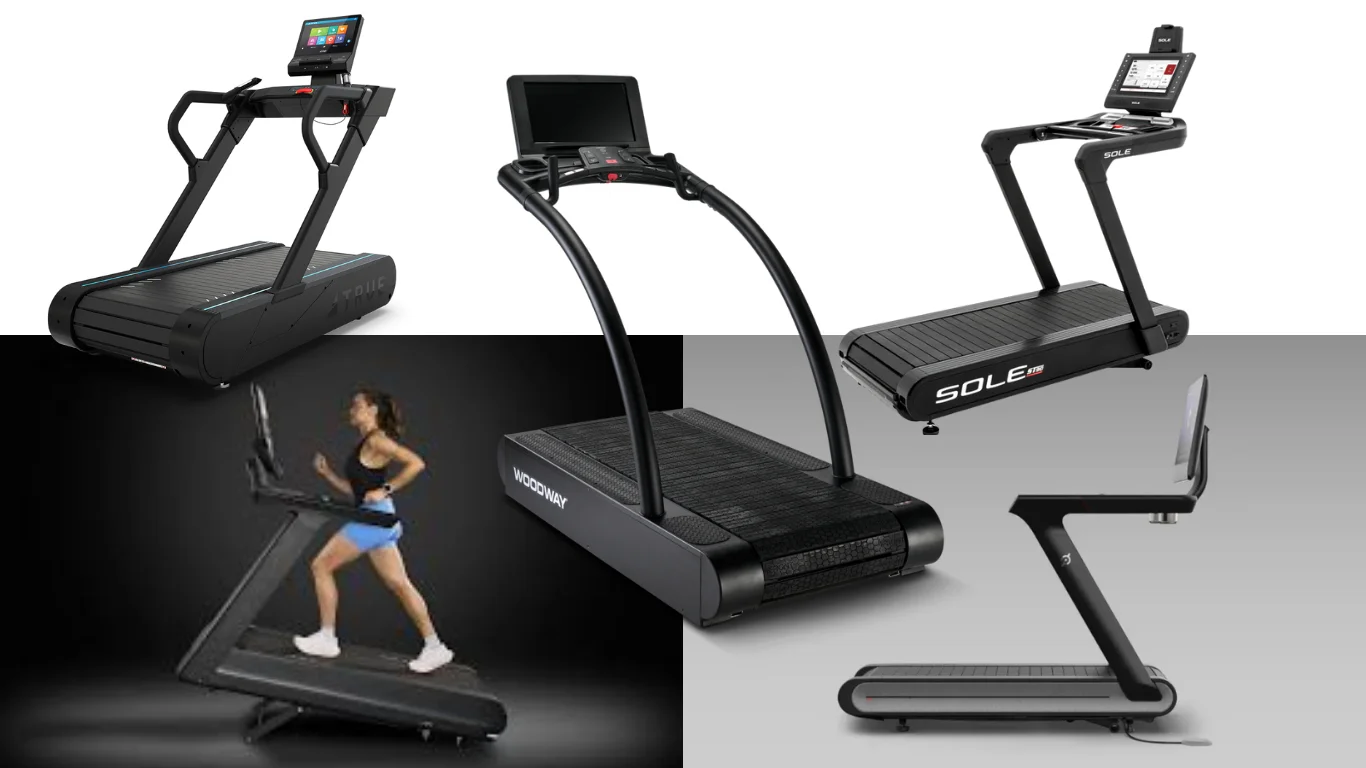
We cover the main options in our guide to the best curved treadmills, including the SB Fitness CT400 and CT700, the Sunny Health SF-X7110, the AssaultRunner Pro and the Tru Grit Runner Elite. I do not rank them here, because they work differently from the two machines above.
Related reading: Treadmill Power Requirements
Frequently Asked Questions
Are slat belt treadmills worth the extra cost?
For serious runners, yes. The joint protection alone is worth it if you run 20+ miles per week indoors. The more natural running mechanics also make slat belt machines significantly better for injury prevention and recovery compared to traditional belt treadmills.
How long do slat belt treadmills last?
Commercial-grade machines like the Matrix are rated for 100,000 miles. Peloton does not publish a mileage rating for the Tread+ Vision, but its belt and motor carry a 5-year guarantee, and slat belts still outlast traditional belts when properly maintained.
Do slat belt treadmills need lubrication?
No. This is one of their key advantages over traditional belt treadmills. Slat systems don’t require belt lubrication or deck waxing. Routine maintenance is limited to periodic slat inspection, cleaning, and bolt checks.
What is Free Mode on the Peloton Tread+ Vision?
Free Mode disables the motor and lets the belt move entirely from the force of your own feet. This makes the Tread+ Vision self-propelled, similar to a curved manual treadmill, and is useful for specific speed and power development training. Sled Mode does the opposite and adds up to 300 lbs of resistance.
Can I use a slat belt treadmill for walking?
Yes, both machines in this guide work perfectly well for walking. The joint benefits of slat belt technology are actually particularly useful for walkers who may already have knee or hip sensitivities.
Is the Peloton membership mandatory?
The Peloton All-Access Membership is sold separately and is needed to access Peloton classes and most Peloton IQ features on the Tread+ Vision. Without it, the machine functions as a basic treadmill but loses most of what you’re paying for.
Which slat belt treadmill has the biggest running surface?
The Matrix Performance Plus LED has the widest surface at 24″ wide. For length, the Peloton Tread+ Vision offers the longest at 67 inches.
Do slat belt treadmills need a dedicated circuit?
Yes, both machines in this guide do. Peloton lists a dedicated, grounded circuit capable of 15 amps or more for the Tread+ Vision, and Matrix lists a dedicated, non-looped, grounded 20-amp circuit for the Performance Plus LED. Ask a qualified electrician to check your wiring before you buy.
What is the weight limit on each slat belt treadmill?
The Matrix Performance Plus LED lists a 500 lb maximum user weight. Peloton lists a user weight range of 105 to 300 lb for the Tread+ Vision, plus a height range of 4’11” to 6’4″ and a minimum age of 16.
Can I use the Matrix Performance Plus LED at home?
Yes, if you have the space and wiring, but it is built for commercial use. It is 89.4 inches long, weighs 479.7 lb assembled and needs a dedicated 20-amp circuit. The warranty listed for it is a commercial one, so confirm the terms with the seller if you plan to use it at home.
What is the difference between the Peloton Tread+ Vision and the Tread Vision?
The Tread+ Vision has a slat belt with 59 slats and 67 inches of running space, reaches 15% incline, and offers Free Mode and Sled Mode. The Tread Vision has a cushioned belt with 59 inches of running space, a 12.5% maximum incline, and a lower machine weight of 316 lb. The Tread+ Vision also carries a 5-year belt and motor guarantee, against 3 years for the Tread Vision.
What is the difference between a motorized and a curved slat belt treadmill?
A motorized slat belt treadmill, like the Peloton Tread+ Vision or the Matrix Performance Plus LED, uses a motor to hold the speed you choose. A curved slat belt treadmill has no motor, so you move the belt with your own stride and the curve of the deck sets the feel. Curved machines suit sprint and interval work, while motorized machines suit steady running and walking.
myactivetribe.com is supported by its readers. When you purchase through links on our site, we may earn an affiliate commission. This does not affect our editorial independence or the products we recommend.