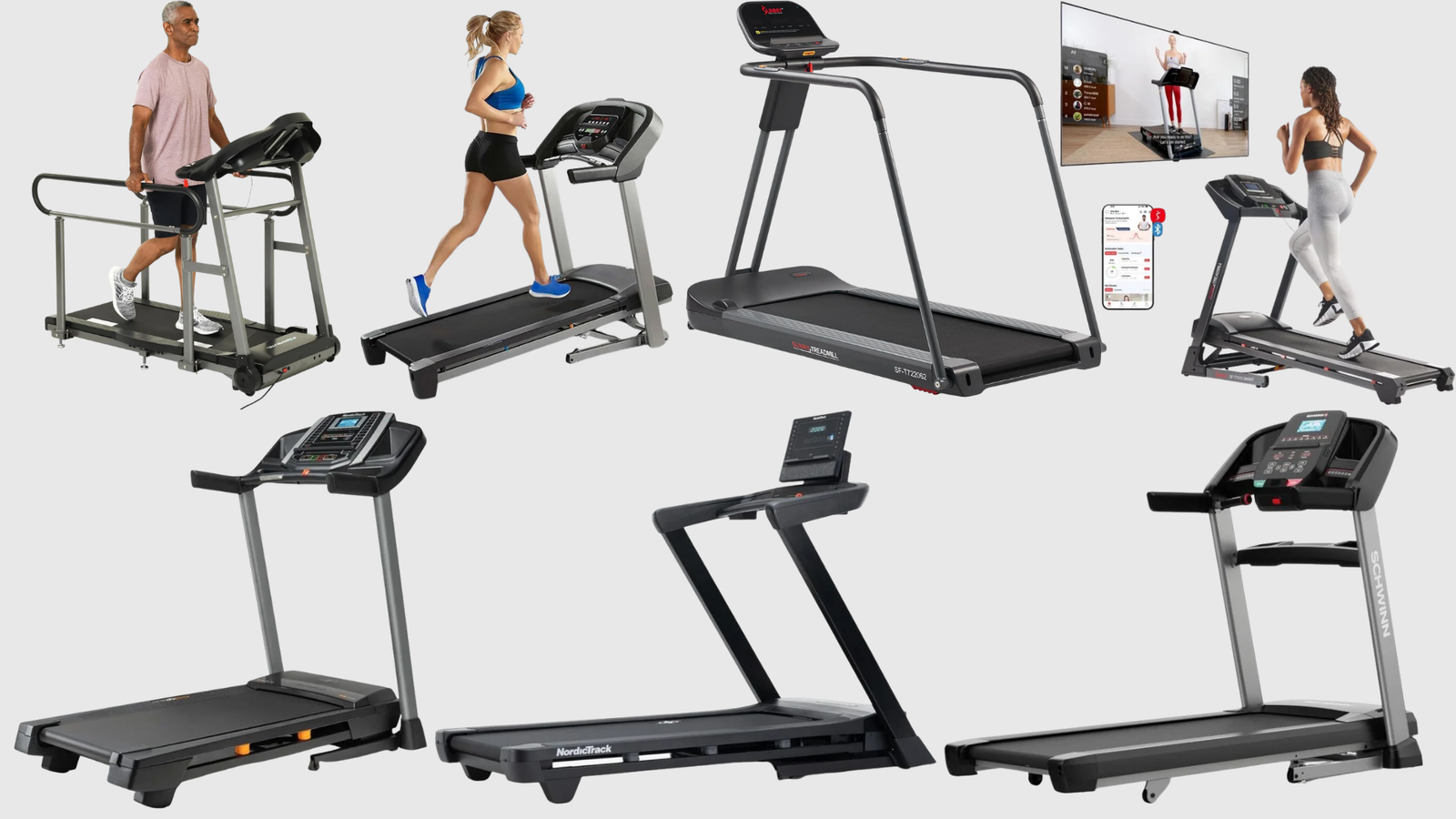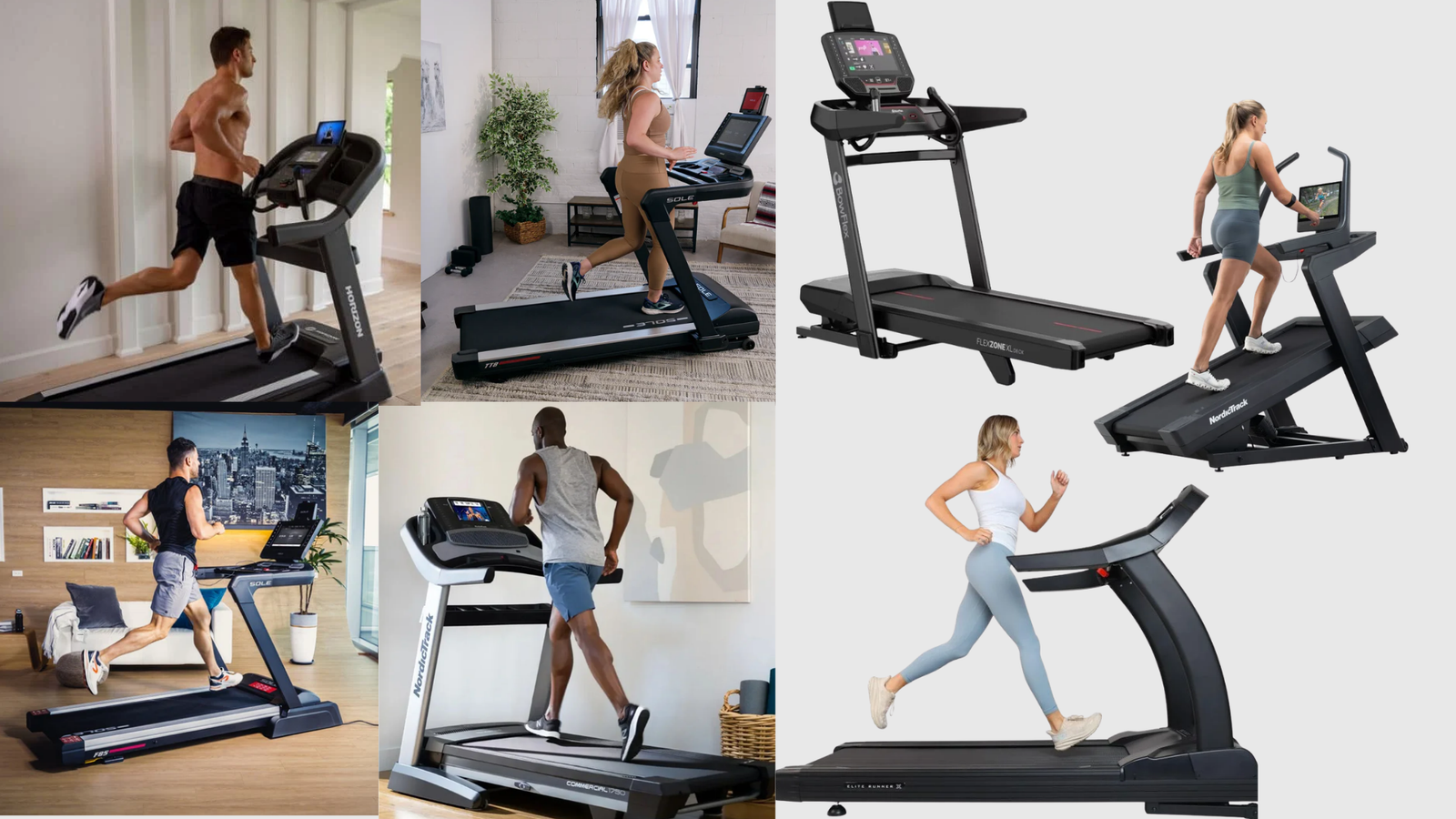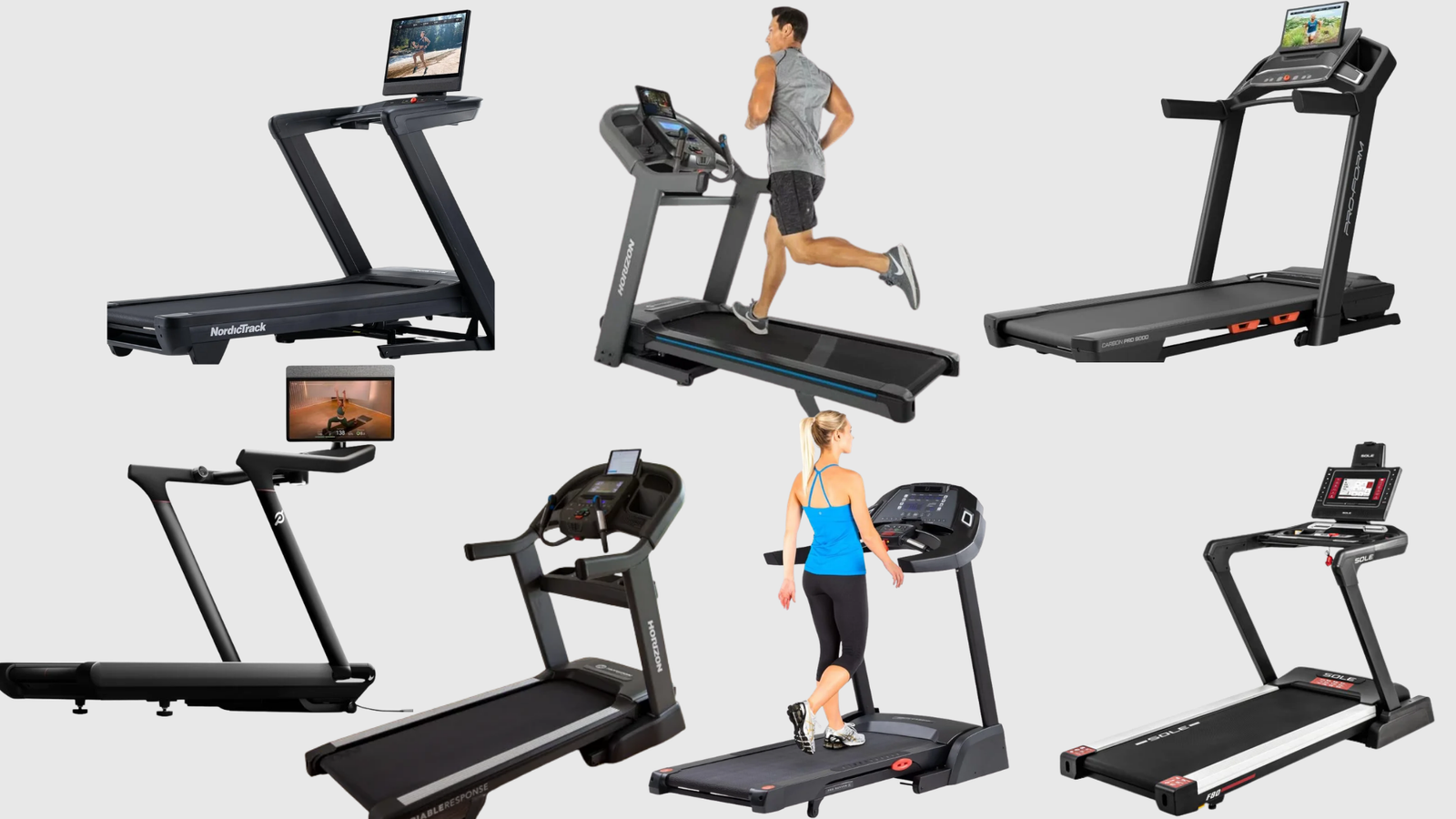
Quick Answer: The best treadmills for runners need a minimum 60-inch belt, 3.0+ CHP continuous motor, and rollers of at least 2.5 inches for smooth high-speed operation. The Sole F80 is the best overall pick — 60″ belt, 3.5 CHP, 375 lb capacity, lifetime motor warranty. For incline and decline training, the NordicTrack Commercial 1750 adds −3% decline at a competitive price. For maximum performance, the Horizon 7.8 AT offers a brushless motor and the smoothest ride in the category.
The best treadmill for runners is not the same machine as the best treadmill for walking — and buying the wrong one is a costly mistake. A runner’s treadmill needs a belt long enough for a full running stride, a motor powerful enough to sustain high speeds without strain, and cushioning that protects joints across thousands of foot strikes. I have been running for 24 years, tested over 250 treadmills, and these seven machines were selected specifically on motor quality, belt dimensions, roller size, cushioning system, speed range, and real-world running feel.
Every product here is verified against official brand specifications and confirmed in stock on Amazon. Selection criteria: continuous horsepower rating, belt length and width, roller diameter as a durability signal, incline and decline range, and warranty depth as a measure of manufacturer confidence.
Table of Contents
Quick Comparison: 7 Best Treadmills for Runners (2026)
| Product | Motor CHP | Belt Size” | Weight Capacity lbs | Speed mph | Runner’s Edge | Warranty |
|---|---|---|---|---|---|---|
| Sole F80 | 3.5 | 22×60 | 350 | 0.5–12 | Cushion Flex Whisper Deck reduces impact 40% vs asphalt — no subscription | Lifetime frame & motor |
| Horizon 7.4 AT | 3.5 | 22×60 | 325 | 0.5–12 | QuickDial controls — fastest speed and incline transitions for interval training | Lifetime frame & motor / 5-yr parts |
| NordicTrack Commercial 2450 | 4.25 | 22×60 | 300 | 0–14 | 14 mph top speed + -3% decline — only machine on this list that goes downhill | 10-yr frame / 2-yr parts |
| Peloton Tread | 3.8 | 22×59 | 300 | 0–12.5 | Lanebreak gamified running + world-class instructor-led community sessions | 5-yr frame / 12 mo parts |
| 3G Cardio Pro Runner X | 3.0 | 20.5×58 | 350 | 0.5–12 | Ortho Flex Shock suspension + 6.5″ step-up height — no subscription, ever | Lifetime frame & motor / 5-yr parts |
| ProForm Carbon Pro 9000 | 3.6 | 20×60 | 350 | 0–12 | iFIT SmartAdjust + -3% decline at mid-range price — best value decline trainer | 10-yr frame / 2-yr parts |
| Horizon 7.8 AT | 4.0 | 22×60 | 375 | 0.5–12 | Highest weight capacity on this list — 4.0 CHP with no app lock-in | Lifetime frame & motor / 5-yr parts |
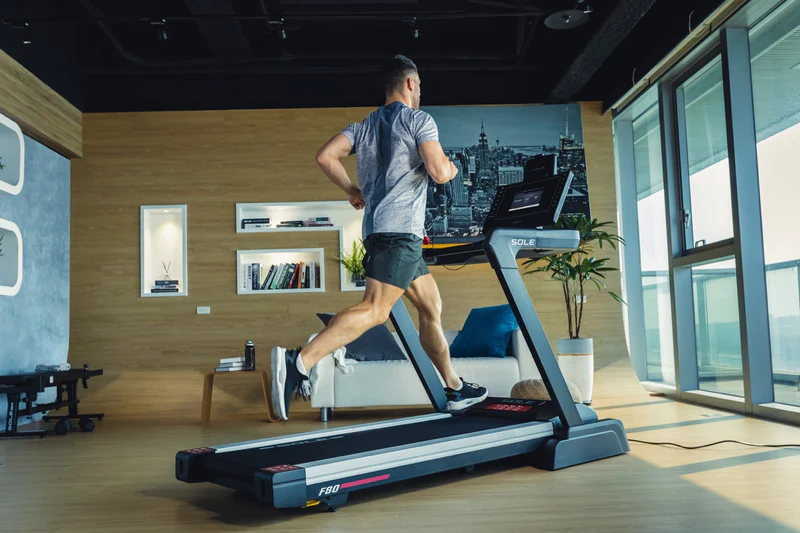
1. Sole F80 — Best Overall Treadmill for Serious Home Runners
Warranty: Lifetime frame / Lifetime motor / 3-year parts / 1-year labor.
Key Specs:
- Motor: 3.5 CHP
- Speed: 0.5–12 mph
- Belt size: 22″ × 60″
- Weight capacity: 350 lbs
- Incline: 0–15%, automatic
- Decline: None
- Rollers: 2.5″ precision-machined, balanced, non-flex
- Belt: Two-ply woven
- Cushioning: Cushion Flex Whisper Deck — 40% impact reduction vs asphalt
- Display: 10.1″ touchscreen — streams Netflix, YouTube, Hulu
- App: Sole+ free + any third-party Bluetooth app
- Folds: Yes — EasyLift Assist hydraulic
The Sole F80 is the machine I would recommend to any serious home runner who does not want a monthly subscription to use their own equipment. A 3.5 CHP motor, 22″ × 60″ deck, 2.5″ precision-machined rollers, and the Cushion Flex Whisper Deck make this one of the most complete running treadmills available under $2,000. The lifetime frame and motor warranty tells you exactly what Sole thinks of their own engineering.
The Cushion Flex deck is firmer than most treadmill cushioning systems — and for road runners, that is deliberate. A firmer deck more accurately replicates outdoor running conditions, so the pace and effort you generate translates directly to outdoor performance. It softens impact without the bouncy, over-cushioned feel that masks effort and undermines race preparation.
What Makes It Different
The F80 is the only machine on this list combining a lifetime motor warranty, 2.5″ precision-machined rollers, a two-ply woven belt, and no-subscription streaming in a single package under $2,000. Larger rollers rotate more slowly at the same belt speed, reducing friction and extending belt and motor life — a quality signal most buyers overlook. Every other machine here either requires a paid app or uses smaller rollers that wear faster under sustained running loads.
The 10.1″ touchscreen streams Netflix, YouTube, and Hulu for free using your existing logins — no subscription, no account creation. For runners logging 45–90 minutes per session, free entertainment access makes a genuine difference to session completion. The wireless charging pad and Bluetooth speakers add polish at a price where polish is not guaranteed. For how the F80 compares across the full Sole range, the best treadmill for home use guide covers it in detail.
The honest limitation is the 12 mph top speed — sufficient for most runners, but elite speed trainers will hit the ceiling. The F80 also has no decline, limiting its ability to replicate downhill race conditions.
Best for: Serious home runners who want commercial-grade build quality, a firm road-feel deck, and a lifetime warranty — without paying a monthly subscription.
Pros:
- Lifetime frame and motor / 3-year parts: The strongest warranty on this list — covers every component, not just the frame.
- 2.5″ precision-machined rollers: Rotate more slowly at running speeds, reducing belt and motor wear and producing a smoother, quieter run.
- Cushion Flex — 40% impact reduction vs asphalt: Independently verified cushioning without the bouncy instability that compromises road race preparation.
- No subscription — ever: Streams Netflix, YouTube, and Hulu free from day one using your existing logins.
- 22″ × 60″ two-ply belt: Full-width commercial running surface tested at double user weight for one million cycles before release.
Cons:
- 12 mph top speed: Adequate for most runners — sub-5-minute milers and elite speed trainers will need the NordicTrack 2450’s 14 mph ceiling.
- No decline: Flat-to-incline only — runners preparing for hilly races need the NordicTrack 2450 or ProForm Carbon Pro 9000.
2. Horizon 7.4 AT — Best Treadmill for Interval Training and Speed Work
Warranty: Lifetime frame / Lifetime motor / 5-year parts / 2-year labor.
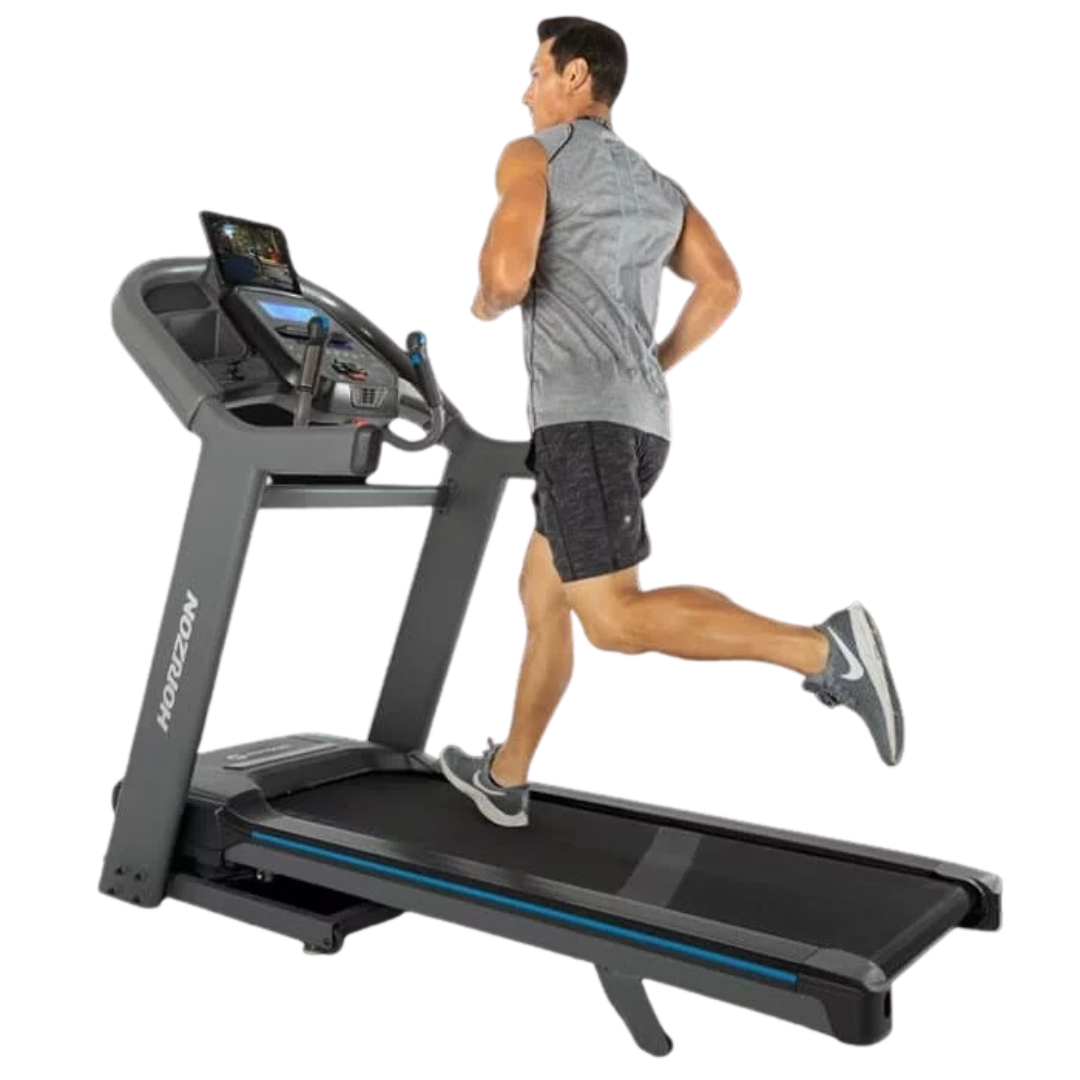
Key Specs:
- Motor: 3.5 CHP Rapid Sync
- Speed: 0.5–12 mph
- Belt size: 22″ × 60″
- Weight capacity: 325 lbs
- Incline: 0–15%, automatic
- Decline: None
- Controls: QuickDial — rotating handlebar dials for speed and incline
- Cushioning: 3-Zone Variable Response Cushioning + Ortho-Lite belt
- Display: 8.5″ LCD + device shelf
- App: Any Bluetooth app — Peloton, Zwift, Kinomap — no lock-in
- Folds: Yes — FeatherLight hydraulic
The Horizon 7.4 AT is built specifically for runners who do structured interval sessions — and the QuickDial controls are the reason. A rotating dial on the left handlebar instantly adjusts incline; another on the right adjusts speed. No button pressing, no breaking stride, no looking down — your intervals happen at the exact moment you want them.
The Rapid Sync motor shortens the lag between a speed command and belt response — standard motors take one to two seconds to adjust, the Rapid Sync responds faster. For interval training, where the transition from recovery pace to effort pace is part of the stimulus, the response time matters. Roll the QuickDial forward, and the belt accelerates almost immediately.
What Makes It Different
QuickDial is exclusive to Horizon’s Studio Series and is not available on any other machine on this list. Every other treadmill here uses console buttons or touchscreen taps — all requiring you to break posture, find the right control, and press at the right moment. QuickDial keeps your hands on the bars, your eyes forward, and your adjustments happening in real time with a natural wrist rotation.
The 3-Zone Variable Response Cushioning and Ortho-Lite belt provide joint protection across high-mileage training blocks. The 5-year parts warranty is stronger than the Sole F80’s 3-year equivalent — meaningful for runners logging 5+ hours per week. Horizon’s open Bluetooth connectivity works with Peloton, Zwift, Kinomap, or any fitness app without platform lock-in.
Best for: Runners who do structured interval training, HIIT, and tempo runs — and need instant, hands-free speed and incline adjustment without breaking stride.
Pros:
- QuickDial — exclusive to Horizon Studio Series: Rotating handlebar dials adjust speed and incline instantly without breaking posture — the most runner-specific control system on this list.
- Rapid Sync motor: Faster belt response to speed commands — critical for interval training where transition timing is part of the training stimulus.
- Lifetime frame and motor / 5-year parts: Strongest parts coverage on this list — reflects genuine confidence in long-term durability under heavy running use.
- No app lock-in: Works with Peloton, Zwift, Kinomap, or any Bluetooth app — use whatever platform you already prefer.
- 22″ × 60″ Ortho-Lite belt: Full-width running surface with an orthopaedic-grade belt that reduces repetitive stress during sustained high-mileage training.
Cons:
- No decline: Incline-only — runners needing downhill training for race prep should look at the NordicTrack 2450 or ProForm Carbon Pro 9000.
- 318 lbs — plan the final position carefully: Heavy enough that repositioning after delivery is a two-person job.
3. NordicTrack Commercial 2450 — Best for Marathon Runners Who Need 14 mph and Decline Training
Warranty: 10-year frame / 2-year parts / 1-year labor.
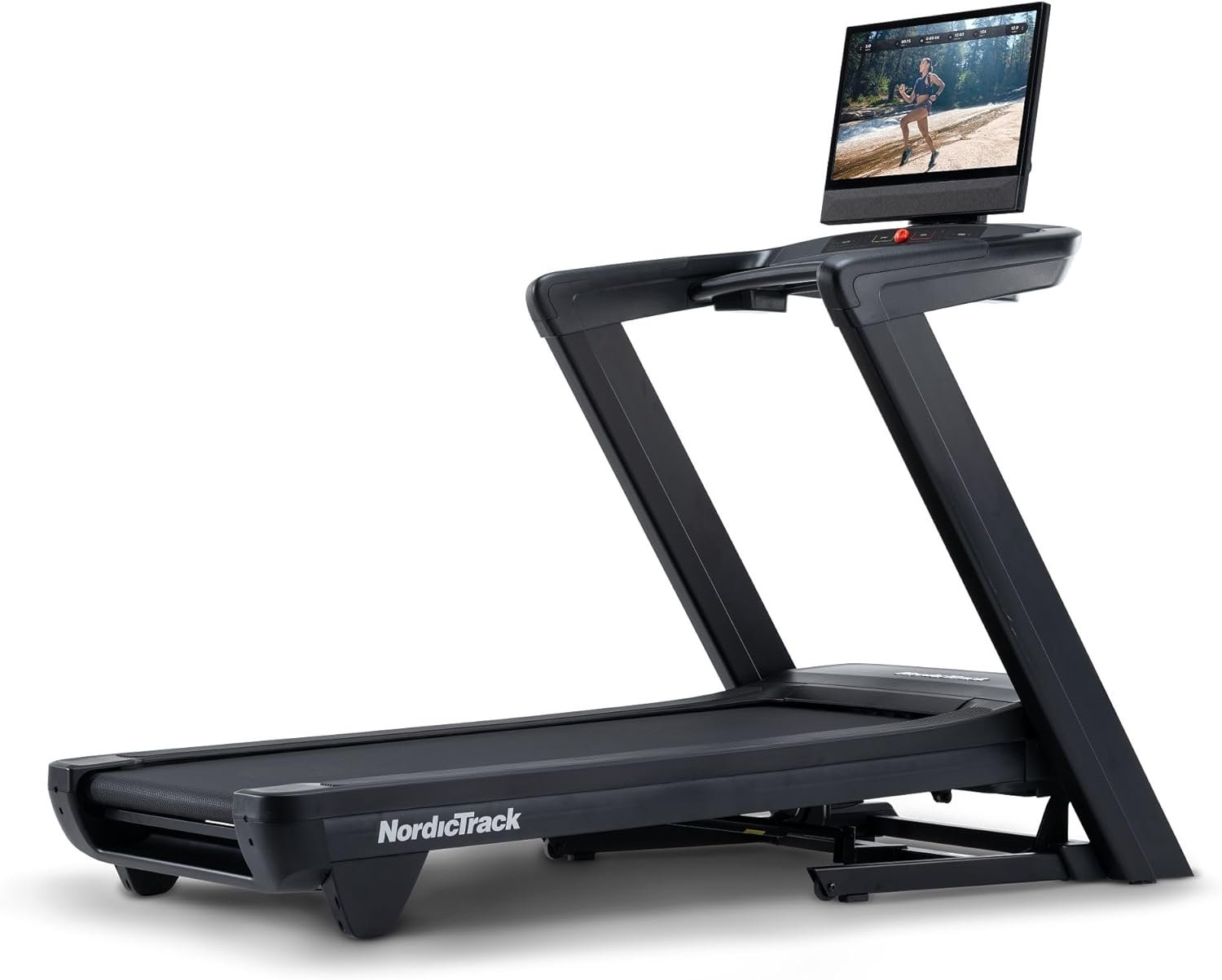
Key Specs:
- Motor: 4.25 CHP
- Speed: 0–14 mph
- Belt size: 22″ × 60″
- Weight capacity: 300 lbs
- Incline: 0–12%, automatic
- Decline: -3%, automatic
- Cushioning: RunFlex — adjustable soft or firm
- Display: 24″ HD Tilt and Pivot touchscreen
- App: iFIT — SmartAdjust, ActivePulse, Google Maps (30-day included)
- Folds: Yes — SpaceSaver with EasyLift Assist
- Machine weight: 332 lbs
The NordicTrack Commercial 2450 is the fastest machine on this list at 14 mph — a 4:17 mile pace. It is also the only machine here offering -3% decline, enabling runners to train the eccentric quad loading that downhill racing demands. For serious marathon and race preparation, it is the most technically capable treadmill on this list.
When you run downhill, your quads absorb braking force at each foot strike in a way that flat and uphill running cannot replicate. Most road and trail races include significant descents, and runners who never train downhill arrive at those descents unprepared. The 2450’s -3% decline trains that specific loading pattern at home.
What Makes It Different
The 2450 is the only machine on this list with both 14 mph speed and -3% decline. At 14 mph, you can replicate a 4:17 mile pace; at -3% decline, you train the eccentric quad loading race courses demand. No other machine here offers both.
RunFlex cushioning lets you switch between a softer recovery setting and a firmer road-feel setting — the same machine serves different training purposes across your weekly plan. iFIT SmartAdjust automatically follows your trainer’s route, adjusting speed and incline in real time. After the included 30-day membership, SmartAdjust requires a paid subscription.
The 300 lb weight capacity is the lowest on this list. With the recommended 20–30 lb buffer, this suits runners up to approximately 270–280 lbs — heavier runners should consider the Horizon 7.8 AT instead. For a full NordicTrack Commercial comparison, the heavy duty treadmill guide covers the full range.
Best for: Marathon runners and competitive age groupers who need 14 mph speed, decline training, and iFIT’s interactive coaching for race-specific preparation.
Pros:
- 14 mph — fastest on this list: Supports a 4:17 mile pace — sufficient for competitive interval training for virtually all home runners.
- -3% decline — unique on this list: Trains the eccentric quad loading downhill race sections demand — no other machine here provides this.
- RunFlex adjustable cushioning: Switch between soft recovery and firm road-feel settings — one machine serves multiple training purposes.
- iFIT SmartAdjust: Hands-free speed and incline control following real trainer routes — the most immersive connected running experience on this list.
- 24″ HD pivot touchscreen: Largest display on this list — clear enough to follow coach cues and route video at full running pace.
Cons:
- 300 lb capacity — lowest on this list: With the 20–30 lb buffer applied, suits runners up to approximately 270–280 lbs — heavier runners should look at the Horizon 7.8 AT.
- Full iFIT requires a subscription after 30 days: SmartAdjust is subscription-gated — the machine works in manual mode without it but loses its primary competitive advantage.
4. Peloton Tread — Best for Community-Driven Runners Who Need Coaching and Competition
Warranty: 5-year frame / 12-month parts and labor
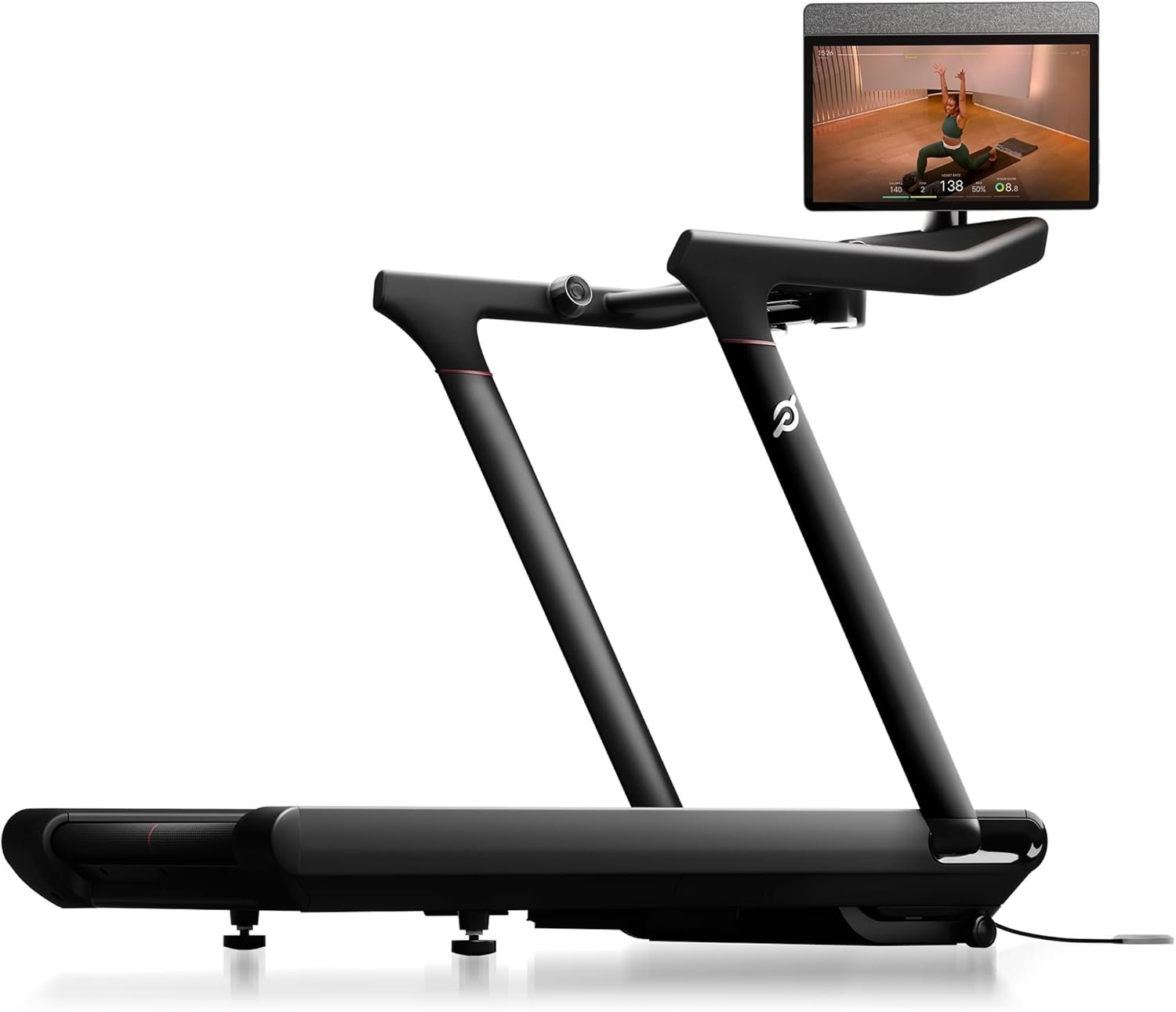
Key Specs:
- Motor: 3.8 CHP
- Speed: 0–12.5 mph
- Belt size: 22″ × 59″
- Weight capacity: 300 lbs
- Incline: 0–12.5%, automatic
- Decline: -3%, automatic
- Cushioning: Tread Shock Absorbing Deck
- Display: 24″ HD rotating touchscreen
- App: Peloton All-Access — live classes, Lanebreak, leaderboard
- Folds: No — fixed footprint
- Machine weight: 290 lbs
The Peloton Tread is for runners who are motivated by community, competition, and instructor energy — not solitary metrics. Lanebreak gamified running, live classes led by world-class coaches, and a leaderboard measuring you against thousands of other Peloton runners in real time are features no other machine on this list replicates. If running alone in a room feels pointless to you, the Peloton Tread solves that at a fundamental level.
Lanebreak is a rhythm-based running game where you steer between lanes by adjusting your speed — sprint faster to move right, ease off to move left. You collect points and hit targets as the music drives the session. It sounds gimmicky until you realise you just ran a harder interval session than any countdown timer would have produced.
What Makes It Different
Peloton’s instructor ecosystem is the differentiator no other brand has replicated. Their coaches are professional athletes and certified running coaches who lead live classes — and thousands of riders join simultaneously on a shared leaderboard. The community motivation this generates is measurably different from following a pre-recorded iFIT session.
The -3% decline matches the NordicTrack 2450, making the Peloton Tread one of only two machines on this list capable of downhill training. The 12.5 mph top speed sits between the 12 mph Horizon machines and the 14 mph 2450 — enough for all but the fastest competitive runners. The Peloton does not fold, so it needs a permanent floor position — if that is a concern, the compact folding options in the best treadmill for apartment guide cover space-saving alternatives.
The honest trade-off is the warranty: 5-year frame and 12-month parts is the shortest structural coverage on this list. At this price point, that gap is worth factoring against the mandatory All-Access subscription cost in your total ownership calculation.
Best for: Runners motivated by live community, instructor coaching, and competition — whose biggest barrier to treadmill consistency is the isolation of solo indoor training.
Pros:
- Lanebreak gamified running — unique on this list: A rhythm-based running game that drives harder interval efforts through engagement rather than willpower.
- Live community leaderboard: Train alongside thousands of Peloton runners simultaneously — community motivation that no other machine here replicates.
- -3% decline: One of only two machines on this list capable of downhill training — a genuine race preparation advantage.
- 24″ HD rotating touchscreen: Pivots for off-treadmill strength and yoga classes included in the All-Access membership.
- 3.8 CHP motor: Handles sustained 12.5 mph interval sessions without motor strain.
Cons:
- Shortest warranty on this list — 5-year frame, 12-month parts: Significantly shorter than the Sole F80 (lifetime) or NordicTrack 2450 (10-year frame) at a comparable price point.
- All-Access subscription required for the full experience: Lanebreak, live classes, and leaderboard — the reasons to choose a Peloton — are all subscription-gated.
5. 3G Cardio Pro Runner X — Best Folding Treadmill for Runners Who Refuse Subscriptions
Warranty: Lifetime frame / Lifetime motor / 5-year parts / 1-year labor
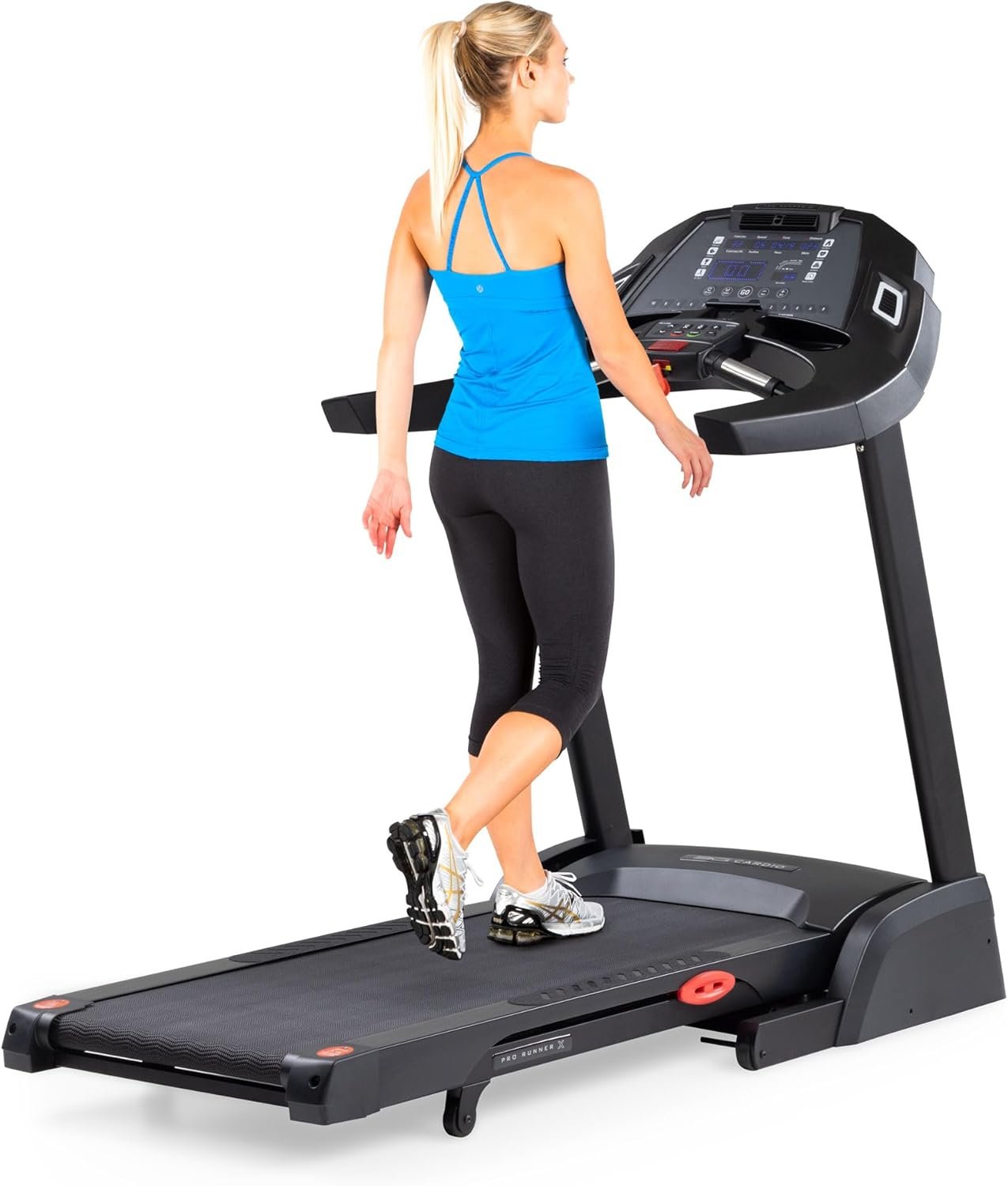
Key Specs:
- Motor: 3.0 HP continuous duty
- Speed: 0.5–12 mph
- Belt size: 20.5″ × 58″
- Weight capacity: 350 lbs
- Incline: 0–15% (15 levels), automatic
- Decline: None
- Cushioning: Ortho Flex Shock suspension + orthopedic belt
- Step-up height: 6.5″ flat / 10″ at full incline
- Connectivity: FreeSync FTMS Bluetooth — control via Zwift, Kinomap, QZ Fitness, free
- Folds: Yes — 40″ × 35″ stored footprint
- Machine weight: 216 lbs
The 3G Cardio Pro Runner X is built around one philosophy: spend the budget on hardware, not software. A 3.0 HP motor, Ortho Flex Shock suspension, 20.5″ × 58″ orthopedic belt, 2″ rollers, and a 6.5″ step-up height — no touchscreen, no subscription, no app that bricks the machine if you cancel. For runners who want a machine that performs without an ecosystem attached, the Pro Runner X is the most honest option on this list.
The Ortho Flex Shock suspension is specifically engineered to reduce the cumulative joint loading that high-mileage running accumulates. Research published by the National Institutes of Health identifies repetitive impact loading as the primary driver of overuse running injuries. A properly cushioned treadmill surface reduces that loading at each foot strike compared to road running.
What Makes It Different
FreeSync FTMS Bluetooth is 3G Cardio’s answer to the subscription problem. FTMS is an open Bluetooth protocol allowing any compatible app — Zwift, Kinomap, QZ Fitness — to read and control the treadmill directly, adjusting speed and incline automatically during workouts. No proprietary subscription, no app install requirement, no ongoing cost.
The 6.5″ step-up height is the lowest on this list — stepping on and off mid-interval is meaningfully easier than at the 8″–10″ heights on heavier machines. At 216 lbs it is also the lightest full-size runner’s treadmill here, folding to 40″ × 35″ — genuinely storable in a corner. The 20.5″ × 58″ belt is the narrowest and shortest on this list; taller runners over 6’1″ may feel the 58″ length at speeds above 9 mph.
Best for: Serious runners who want commercial-grade cushioning, a lifetime warranty, and full app flexibility — without ever paying a subscription or being tied to a proprietary ecosystem.
Pros:
- Ortho Flex Shock — purpose-built for high-mileage runners: Reduces cumulative joint loading across training blocks — more targeted than generic deck cushioning systems.
- FreeSync FTMS — no subscription ever: Open protocol connects to Zwift, Kinomap, and QZ Fitness for free — full app control with no proprietary ecosystem.
- Lifetime frame and motor / 5-year parts: Joint-strongest warranty on this list alongside the Horizon machines — reflects commercial-grade component confidence.
- 6.5″ step-up height — lowest on this list: Easiest deck to mount and dismount mid-session — a practical advantage for high-frequency interval efforts.
- 216 lbs — lightest full-size runner’s treadmill here: One person can move it; folds to 40″ × 35″ with 350 lb capacity and commercial-grade suspension.
Cons:
- 20.5″ × 58″ belt — smallest on this list: Works well for most runners to around 6’1″ — taller runners with longer strides will feel the shorter deck above 9 mph.
- No built-in screen: LED display shows metrics only — bring your own tablet for streaming, which requires a separate stand not included.
6. ProForm Carbon Pro 9000 — Best Value Treadmill with iFIT and Decline for Runners
Warranty: 10-year frame / 2-year motor and parts / 1-year labor
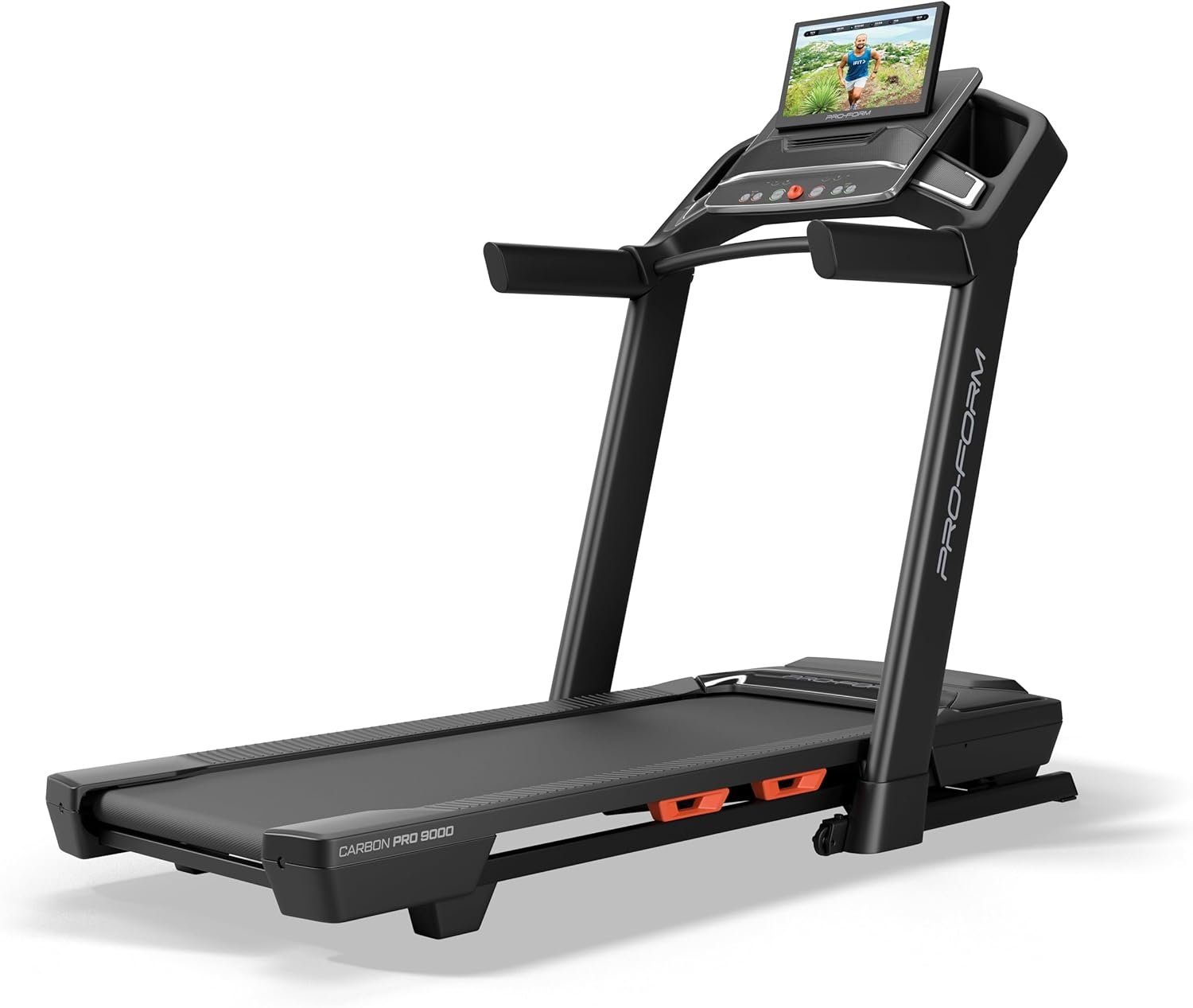
Key Specs:
- Motor: 3.6 CHP
- Speed: 0–12 mph
- Belt size: 20″ × 60″
- Weight capacity: 350 lbs
- Incline: 0–12%, automatic
- Decline: -3%, automatic
- Cushioning: ProShox deck cushioning
- Display: 16″ Smart HD touchscreen
- App: iFIT — SmartAdjust, ActivePulse, Google Maps (30-day included)
- Fan: CoolAire — two speed settings
- Folds: Yes — EasyLift Assist hydraulic
The ProForm Carbon Pro 9000 delivers iFIT SmartAdjust, -3% decline, a 3.6 CHP motor, a 20″ × 60″ belt, and a 16″ HD touchscreen at a price significantly below the NordicTrack 2450. For runners who want decline training and iFIT’s automatic coach control without paying the 2450’s premium for 14 mph speed and a 24″ screen, the Carbon Pro 9000 delivers the most important running features at a more accessible entry point. The 350 lb weight capacity also gives heavier runners structural headroom the 2450 and Peloton Tread do not offer.
Both the Carbon Pro 9000 and NordicTrack 2450 run iFIT SmartAdjust, offer 3% decline, and carry 10-year frame and 2-year parts warranties. The 2450 adds 14 mph speed, a 24″ pivoting screen, and a 4.25 CHP motor. For runners whose training does not require 14 mph — which is most runners — those differences do not justify the price gap.
What Makes It Different
The Carbon Pro 9000 is the most affordable way onto a decline-capable iFIT treadmill on this list. The -3% decline combined with SmartAdjust means the machine automatically replicates real terrain profiles during coach-led sessions — hills up and down — without touching a control. That hands-free terrain simulation is available on only three machines across this entire list.
ProShox cushioning sits in the middle of the firmness range — softer than the Sole F80’s road-feel deck, firmer than the RunFlex soft setting on the 2450. The CoolAire fan delivers meaningful airflow during interval sessions where body temperature rises quickly. The EasyLift Assist fold makes daily storage manageable solo once the machine is positioned.
Best for: Runners who want iFIT automatic coach control and decline training at a price below the NordicTrack 2450 — and whose training does not require 14 mph.
Pros:
- -3% decline with iFIT SmartAdjust — most affordable decline trainer on this list: Replicates downhill terrain automatically during coach-led sessions at a lower price than the 2450.
- 350 lb weight capacity: More structural headroom than the NordicTrack 2450 and Peloton Tread — comfortable for heavier runners who also want decline capability.
- 10-year frame / 2-year parts: Matches the 2450’s warranty structure at a lower price.
- iFIT SmartAdjust and ActivePulse: Automatic speed and incline control following trainer routes, plus heart rate zone targeting — the full iFIT toolkit without the 2450 premium.
- CoolAire fan: Two-speed airflow that makes a measurable difference during hard interval and tempo sessions.
Cons:
- 12 mph top speed: Sufficient for most runners — those training at sub-5-minute pace should upgrade to the NordicTrack 2450’s 14 mph ceiling.
- iFIT subscription required after 30 days: SmartAdjust is subscription-gated — the machine works manually without it but loses its primary advantage over simpler machines.
7. Horizon 7.8 AT — Best for Heavier Runners Who Want Power Without a Subscription
Warranty: Lifetime frame / Lifetime motor / 5-year parts / 2-year labor
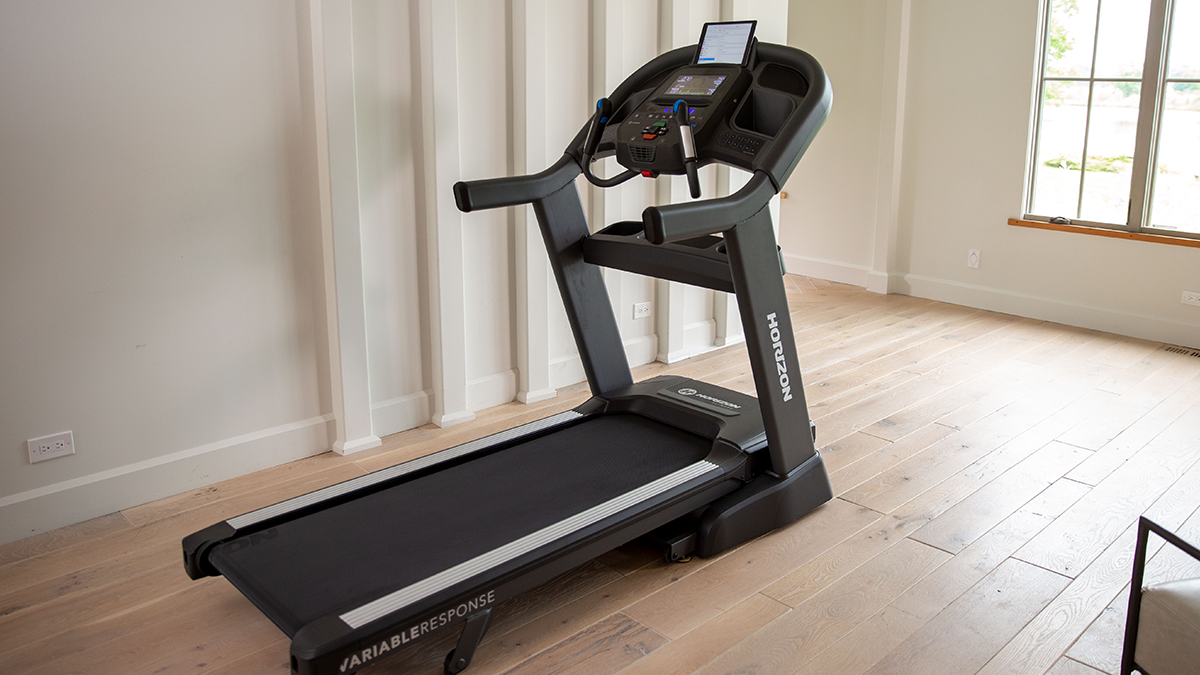
Key Specs:
- Motor: 4.0 CHP
- Speed: 0.5–12 mph
- Belt size: 22″ × 60″
- Weight capacity: 375 lbs
- Incline: 0–15%, automatic
- Decline: None
- Controls: QuickDial — rotating handlebar dials for speed and incline
- Cushioning: 3-Zone Variable Response Cushioning + Ortho-Lite belt
- Display: 9.3″ LCD + device shelf
- App: Any Bluetooth app — no lock-in
- Folds: Yes — FeatherLight hydraulic
The Horizon 7.8 AT is the step up from the 7.4 AT — larger motor, higher weight capacity, and the same QuickDial controls in a more structurally capable package. At 4.0 CHP, 22″ × 60″, and 375 lb capacity with lifetime frame and motor coverage, it is the most powerful no-subscription treadmill on this list. For heavier runners or multi-user households who need more weight headroom than the 300 lb machines offer, the 7.8 AT covers that need without any platform commitment.
The 4.0 CHP motor is the most powerful no-subscription motor on this list. For heavier runners who also run fast — combining 300+ lb body weight with regular 8–10 mph sessions — the motor headroom on the 7.8 AT is a meaningful operational advantage. The American College of Sports Medicine recommends vigorous-intensity training at 70–85% of maximum heart rate for cardiovascular fitness gains, and a motor with adequate power for your weight and target speed is the mechanical foundation that makes those sessions possible.
What Makes It Different
The 7.8 AT combines QuickDial interval controls with 4.0 CHP and 375 lb capacity — the same hands-free interval responsiveness as the 7.4 AT in a package built for more load. No other machine on this list offers QuickDial, 4.0+ CHP, 375 lb capacity, and no subscription requirement together. The Horizon 7.4 AT gives you QuickDial at 325 lb and 3.5 CHP; the 7.8 AT upgrades both without changing the control system you already trust.
Open Bluetooth connectivity means Zwift, the Peloton app, Kinomap, or any FTMS-compatible platform connects directly without a proprietary subscription. The 5-year parts and 2-year labor warranty match the 7.4 AT — the strongest parts coverage on this list. The lifetime frame and motor warranty reflects Horizon’s confidence that this machine will outlast the coverage period substantially.
Best for: Heavier runners and multi-user households who want QuickDial interval controls, 4.0 CHP, and 375 lb structural capacity — without any subscription commitment.
Pros:
- 375 lb capacity — highest on this list: The only machine here giving heavier runners comfortable structural headroom with the 20–30 lb buffer applied.
- 4.0 CHP — most powerful no-subscription motor here: Sustains high-speed running at full weight capacity without motor strain.
- QuickDial controls: Rotating handlebar dials for instant speed and incline adjustment — the best interval training control system on this list, now at a higher capacity.
- Lifetime frame and motor / 5-year parts / 2-year labor: Joint-strongest warranty on this list — comprehensive coverage for the full machine.
- No app lock-in: Works with any Bluetooth-compatible fitness app — use the platform you already prefer at no additional cost.
Cons:
- No decline: Incline-only — runners needing downhill training should look at the NordicTrack 2450 or ProForm Carbon Pro 9000.
- 9.3″ LCD display is basic for the price: Shows metrics only — bring your own device for content streaming.
Which Is the Best Treadmill for Serious Runners? A Plain-English Decision Guide
If you want the best all-round running treadmill with no subscription and commercial-grade build quality, choose the Sole F80. The 22″ × 60″ belt, 2.5″ rollers, Cushion Flex deck, and lifetime warranty make it the most complete subscription-free running machine on this list.
If interval training and speed work are the core of your programme, choose the Horizon 7.4 AT. The QuickDial handlebar controls give you instant speed and incline adjustment without breaking stride — no other machine on this list offers that responsiveness for structured sessions.
If you are preparing for a race and need both 14 mph speed and decline training, choose the NordicTrack Commercial 2450. It is the only machine on this list that trains downhill running at 14 mph — a combination no competitor here can match for race-specific preparation.
If community, live coaching, and competition are what keep you consistent, choose the Peloton Tread. Lanebreak, live leaderboards, and world-class instructors solve the motivation problem that no amount of hardware on any other machine can replicate.
If you want serious running capability with no subscription — ever — and need to store the machine when not in use, choose the 3G Cardio Pro Runner X. The Ortho Flex Shock suspension, FreeSync FTMS open Bluetooth, lifetime warranty, and 216 lb folding frame make it the most capable subscription-free folding runner on this list.
If you want iFIT’s automatic coach control and decline training at a mid-range price, choose the ProForm Carbon Pro 9000. It delivers the same -3% decline and SmartAdjust capability as the NordicTrack 2450 — without paying the premium for 14 mph speed and a 24″ screen.
If you are a heavier runner — or your household has multiple heavy users — and you refuse to pay a subscription, choose the Horizon 7.8 AT. The 375 lb capacity, 4.0 CHP motor, QuickDial controls, and lifetime warranty cover every need a heavier runner has without any platform commitment.
Treadmill for Marathon Training: What CHP Actually Means — and Why Peak HP Is Misleading
The single most misleading number in treadmill marketing is peak horsepower. Manufacturers advertise “4.0 HP motors” on machines that could never sustain that output for more than a few seconds. Understanding the difference between peak HP and continuous horsepower — CHP — is the first thing any serious runner should know before buying.
Peak HP is the maximum output a motor can produce for a brief moment — like a car engine at full throttle. It tells you very little about real-world performance. A motor rated at 4.0 peak HP might only sustain 2.0 CHP under continuous load, and sustained load is exactly what running creates.
Continuous horsepower (CHP) is the output a motor can sustain indefinitely under real operating conditions. For running, CHP is the only number that matters. A 3.5 CHP motor running at 10 mph for 60 minutes is working hard but within its range — a 2.5 CHP motor marketed as “4.0 HP peak” doing the same will run hot, wear faster, and fail earlier.
Every machine on this list is rated by CHP — not peak HP. The Horizon 7.8 AT’s 4.0 CHP and the NordicTrack 2450’s 4.25 CHP are genuine continuous-duty ratings. When you see a budget machine advertising “4.0 HP” without the CHP designation, the real sustained output is typically 40–50% lower.
Runners evaluating the full home treadmill market should also check our best treadmill for home use guide for a complete comparison.
Roller Diameter — The Quality Signal Most Buyers Miss
Roller diameter is the second most overlooked spec in running treadmill research. The rollers are the cylinders at each end of the belt — their size directly affects how long the belt and motor last under sustained running loads.
Larger rollers rotate more slowly at the same belt speed. A 2.5″ roller turning the belt at 8 mph completes fewer rotations per minute than a 1.9″ roller — fewer rotations means less friction, less heat, less belt wear, and less motor strain. Over thousands of running miles, that difference compounds into meaningfully longer component life.
The Sole F80’s 2.5″ precision-machined rollers are the standout on this list — larger than the 2″ rollers on the 3G Cardio Pro Runner X and the 1.9″ rollers found on most budget running machines. If you plan to log serious weekly mileage, roller diameter is worth checking before you buy.
Road Feel vs Cushioned Deck: Which Type of Runner Are You?
The feel of a treadmill deck under your feet matters more than most buyers realise — and choosing the wrong cushioning profile can undermine your training in ways that only show up on race day. This affects two distinct runner types.
Road runners training for outdoor events should prioritise a firmer deck that replicates outdoor running conditions. An overly soft deck absorbs energy at each foot strike that the road will not, meaning your effort on the treadmill does not accurately translate to outdoor pace. The Sole F80’s Cushion Flex deck and the 3G Cardio Pro Runner X’s Ortho Flex Shock system both sit on the firmer end — joint-protective without being so soft that they distort the training stimulus.
Runners managing injury or joint sensitivity should prioritise maximum cushioning, particularly on recovery runs. The NordicTrack 2450’s RunFlex system is adjustable — dial in soft cushioning for recovery days and firmer feel for speed work. Having both modes in one machine is the most practical solution for runners whose weekly plan mixes hard efforts and easy recovery running.
The worst outcome is buying a maximally cushioned machine for outdoor race preparation. Your legs adapt to the forgiving surface, your race pace feels harder than expected, and your quads are underprepared for descents. Match the deck feel to your primary training goal — not just to what feels comfortable on the first run.
How to Choose the Best Treadmill for Running at Home: What Actually Matters
Motor Power — CHP, Not Peak HP
For running, 3.0 CHP is the practical minimum for sustained sessions at 8+ mph. Below that, the motor labours under load, runs hot, and wears faster. For heavier runners or those logging 60+ minutes daily, 3.5–4.0 CHP gives meaningful headroom above the operational ceiling.
Belt Length — The Most Important Spec for Runners
Belt length determines whether your natural running stride fits comfortably on the deck. A 55″ belt suits most runners up to around 6’1″ at moderate pace; 58″–60″ suits all heights at any speed. Six of the seven machines on this list use 58″–60″ belts — the 3G Cardio Pro Runner X at 58″ is the shortest, and taller runners should factor that in.
Incline and Decline Range
Incline training builds posterior chain strength and replicates uphill race effort. Decline training — available on the NordicTrack 2450, Peloton Tread, and ProForm Carbon Pro 9000 — trains the eccentric quad loading that most treadmill runners never prepare for. If your race courses include downhill sections, decline is not optional — it is a race preparation tool.
Cushioning System
Match the cushioning to your training purpose. Firmer decks replicate road conditions and transfer pace training more accurately to outdoor events. Adjustable systems — RunFlex on the 2450, SelectFlex on the T Series 7 — give you both modes in one machine and are worth the premium if your training mixes hard and easy sessions.
Weight Capacity and Structural Headroom
Always choose a machine with at least 20–30 lbs of headroom above your body weight. Running generates higher instantaneous foot-strike loads than walking — a machine at its rated maximum under walking conditions will experience greater stress when running. The Horizon 7.8 AT at 375 lb capacity is the strongest structural option on this list for heavier runners.
Subscription vs No Subscription
Three machines on this list require a subscription for their best features: NordicTrack 2450 and ProForm Carbon Pro 9000 (iFIT), and Peloton Tread (All-Access). Four machines — Sole F80, Horizon 7.4 AT, Horizon 7.8 AT, and 3G Cardio Pro Runner X — are fully capable without any ongoing cost. Factor subscription fees into the 3-year total cost of ownership, not just the purchase price.
Warranty as a Quality Signal
Lifetime frame and motor warranties — on the Sole F80, Horizon 7.4 AT, Horizon 7.8 AT, and 3G Cardio Pro Runner X — signal that the manufacturer does not expect the structure to fail under normal home running use. The parts warranty matters separately — 5-year parts coverage on the Horizon machines and 3G Cardio Pro Runner X is the strongest on this list. The Peloton Tread’s 5-year frame and 12-month parts is the weakest structural commitment at the highest price.
Frequently Asked Questions
What speed should a treadmill have for running?
For most recreational runners, 10–12 mph is sufficient — that covers a 5-minute mile pace, which is faster than the vast majority of home runners will ever train. For competitive runners doing speed work, 12 mph is the practical minimum. Only runners targeting sub-5-minute mile paces or doing elite-level sprint training will benefit from the NordicTrack 2450’s 14 mph ceiling.
Is a 3.0 HP treadmill enough for running?
Yes — for most runners at most speeds, 3.0 CHP is adequate for sustained sessions. The 3G Cardio Pro Runner X on this list runs a 3.0 HP continuous-duty motor and handles running sessions comfortably. Users over 250 lbs running at 9+ mph regularly should look at 3.5 CHP or higher to keep the motor working within its comfortable range rather than at its ceiling.
What is the difference between a running treadmill and a walking treadmill?
Running treadmills are built around three things walking treadmills typically are not: longer belts (58″–60″ vs 48″–55″), more powerful motors (3.0+ CHP vs 2.0–2.5 HP), and more robust cushioning systems built for higher impact forces. If you plan to run regularly, prioritise belt length first — a 48″ walking belt will feel cramped at jogging pace for most users.
Does decline training on a treadmill actually help race performance?
Yes — specifically for races with significant downhill sections. When you run downhill, your quadriceps absorb braking force eccentrically at each foot strike — a loading pattern that flat and uphill training does not replicate. Runners who train exclusively on flat or uphill treadmills arrive at downhill race sections with underprepared quads, leading to the soreness and cramping that ruins the back half of hilly road and trail races.
Can I train for a marathon on a treadmill?
Yes — with one important adjustment. Treadmill running eliminates wind resistance, so perceived effort at a given pace is slightly lower than outdoors — setting the treadmill to 1% incline compensates for this and brings the metabolic cost closer to outdoor running. For marathon training, a machine with at least a 60″ belt, 3.5+ CHP, and adjustable cushioning — like the Sole F80 or Horizon 7.4 AT — provides everything you need for long runs, tempo sessions, and intervals.
How do I replicate outdoor running on a treadmill?
Three adjustments bring treadmill running closer to outdoor conditions. First, set a 1% incline as your baseline to compensate for the absence of wind resistance. Second, choose a firmer cushioning setting if your machine offers adjustment — a softer surface reduces the energy return your legs experience outdoors. Third, vary your pace within sessions rather than running at a fixed speed, which trains the micro-adjustments that outdoor running demands.
What treadmill belt size do I need for running?
Width: 20″ is the minimum comfortable running width for most adults; 22″ gives your natural gait full room without stride narrowing. Length: 58″ suits runners up to around 6’1″ at a moderate pace; 60″ suits all heights at any speed. The 3G Cardio Pro Runner X at 20.5″ × 58″ is the most compact running belt on this list — adequate for most users, but taller runners should choose a 22″ × 60″ machine.
Disclosure: This article contains affiliate links. If you purchase through these links, we may earn a commission at no additional cost to you. All recommendations are based on independent research and AnilKK’s direct experience testing fitness equipment.