A recumbent cross trainer combines a reclined bike seat with a low-impact, dual-motion stepping or elliptical stride — a genuinely different category from a standard recumbent bike. AnilKK, an INFS-certified fitness coach with 24 years of experience and 1,000+ weight management clients, breaks down 7 current models spanning budget to rehab-grade, verified against official specs and confirmed in-stock, so you know exactly what you’re getting before you buy.
Quick Answer
The Marcy JX-7301 is the best value pick for most home users, delivering genuine dual-motion training at a fraction of the cost of rehab-grade machines. The Teeter FreeStep LT1 and LT3 (formerly sold under HCI Fitness) offer a step up in build quality with a patented zero-impact stride. For serious rehab or clinical-level use, the NuStep T4r and HCI PhysioStep are the gold standard, though both carry a much higher price and premium positioning.
Table of Contents
What Is a Recumbent Cross Trainer?
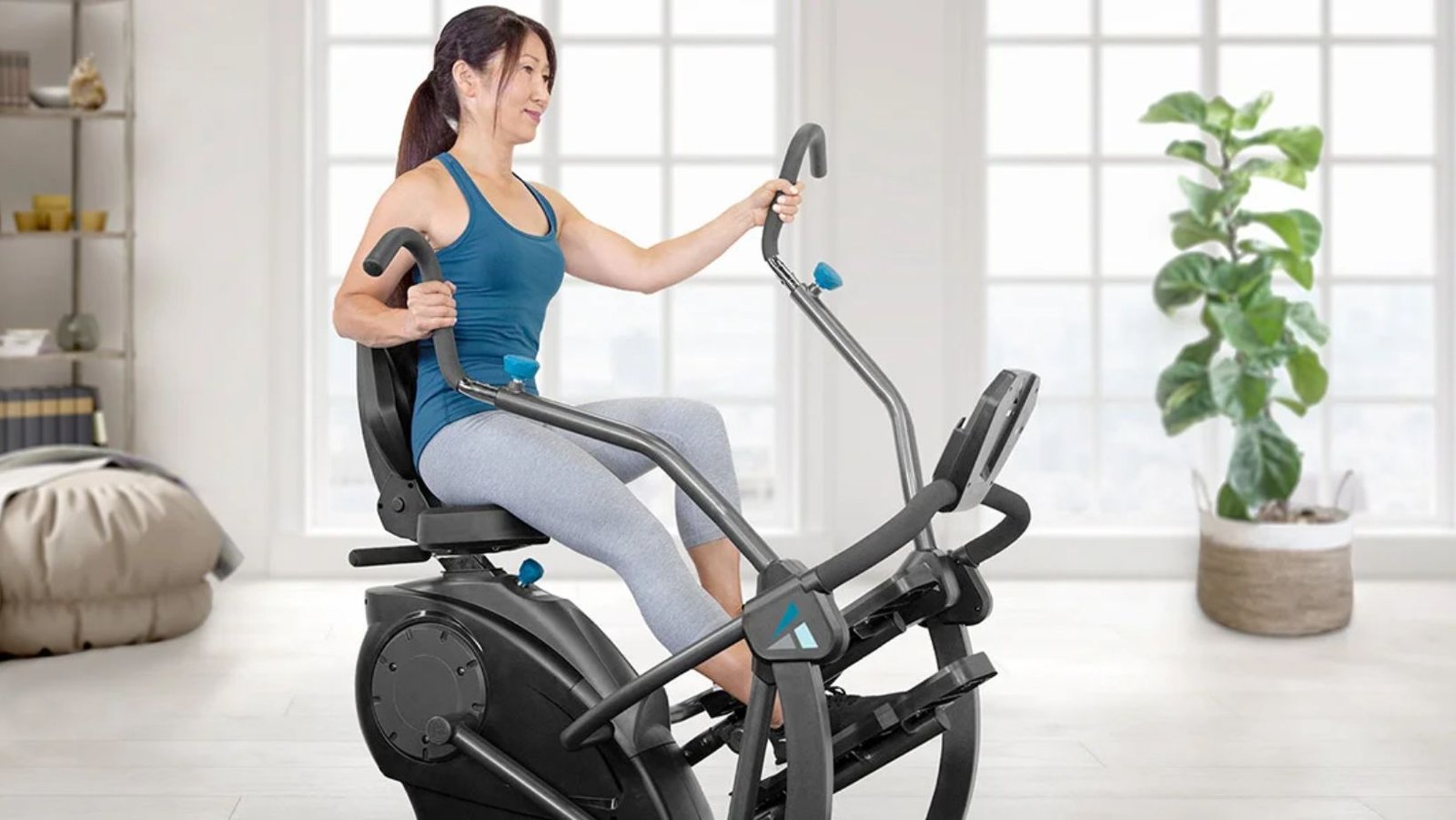
A recumbent cross trainer combines a reclined, supportive seat with a stepping or elliptical-style leg motion, plus moving handles that engage the upper body at the same time. It’s a genuinely different machine from a standard recumbent bike, which only has your legs pedaling in a circular motion — the cross trainer’s linear or elliptical stride, combined with dual-motion arms, delivers a fuller-body workout while staying just as gentle on the joints. Clinical research on recumbent cross trainers has specifically studied this seated, dual-motion format for its safety and accessibility in rehabilitation settings, including for patients with significant mobility limitations.
This category has deep roots in physical therapy and cardiac rehab settings, which is why several of the models here — particularly the NuStep and HCI PhysioStep — are still priced and built like clinical equipment rather than typical home gym gear. That’s not a downside if rehab-grade durability and safety features are what you need, but it does mean the price range in this category is unusually wide. If your main goal is broader low-impact cardio rather than rehab specifically, our weight-loss workout guide covers structured routines that also work well on this equipment type.
Quick Comparison: 7 Best Recumbent Cross Trainers
| Model | Motion Type | Weight Capacity | Positioning |
|---|---|---|---|
| Teeter FreeStep LT1 | Zero-impact dual-power stride | 300 lb | Mid-range |
| Teeter FreeStep LT3 | Zero-impact dual-power stride | 300 lb | Mid-range, premium seat |
| Marcy JX-7301 | Dual-action pedal + arm handles | 300 lb | Budget |
| Sunny SF-RBE4886SMART | Elliptical stride + arm exercisers | 300 lb | Mid-range, app-connected |
| HCI Fitness PhysioStep | Patented linear stepping motion | 400 lb | Rehab / clinical grade |
| NuStep T4r | Contralateral stepping motion | 400 lb | Rehab / clinical grade |
| Birdfeel Recumbent Cross Trainer | Elliptical stride + hand-crank arms | 300 lb | Entry-level budget |
1. Teeter FreeStep LT1 — Best Overall
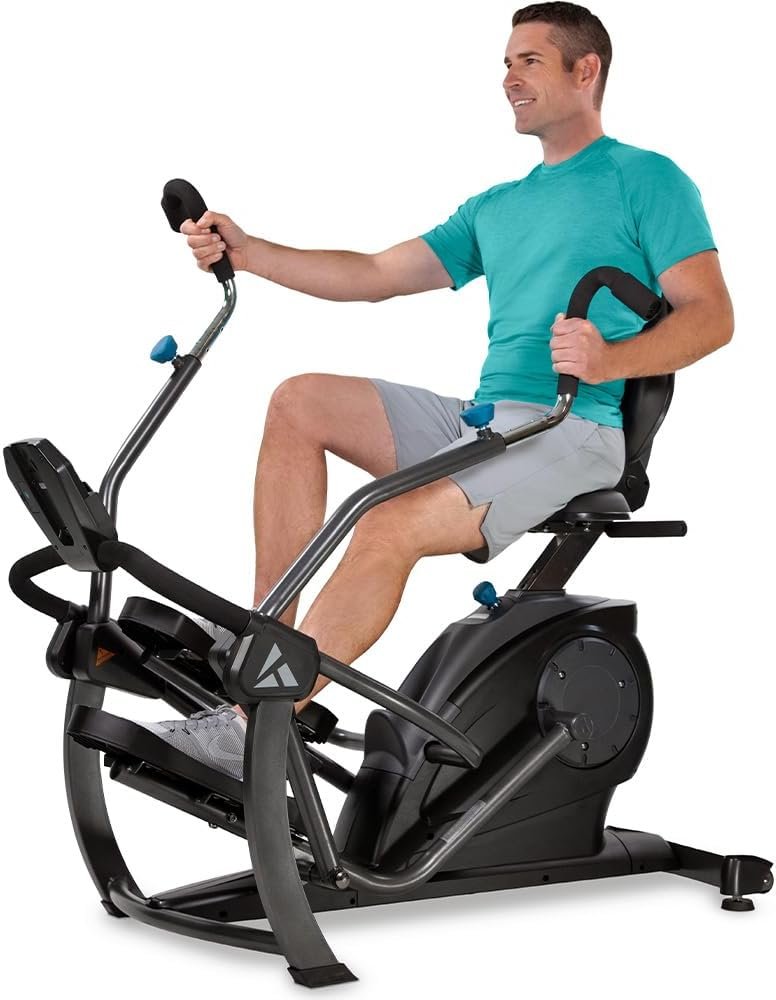
- Patented zero-impact linear stride, licensed from commercial physiotherapy steppers
- 13 levels of magnetic resistance
- 3-position recline seat with height adjustability
- 300 lb weight capacity, heights 4’11″–6’6″
- 2-year structural frame warranty, 1-year mechanical/electrical parts (standard)
- Free Teeter Move app with trainer-led workouts
Note: this model was previously sold under the HCI Fitness brand name and is now manufactured and sold directly by Teeter (the inversion table company) — same product, different current branding.
The single biggest reason to consider the LT1 is the patented stride pattern itself — it prevents your knee from traveling past your toes during the step, which is the specific movement that causes joint stress on standard ellipticals and steppers.
What Makes It Different
Most budget recumbent cross trainers just bolt arm handles onto a recumbent bike. The LT1’s dual-power motion is genuinely synchronized — push-pull mechanics engage both the upper and lower body simultaneously, distributing muscle exertion rather than making your legs do all the work while your arms just come along for the ride.
At 4.5 stars across nearly 2,000 Amazon reviews, this has a genuinely large, verified track record — rare in this category, where most models have only a few hundred reviews at most.
Best for: Anyone who wants a genuine dual-motion cross trainer with a large proven track record, without paying rehab-clinic pricing.
| Pros | Cons |
|---|---|
| Patented zero-impact stride reduces knee and joint stress | 300 lb weight capacity is lower than the rehab-grade NuStep and HCI models |
| Nearly 2,000 Amazon reviews at 4.5 stars — a large, proven track record | Standard warranty (2-yr frame, 1-yr parts) is shorter than the extended coverage available at extra cost |
| Free trainer-led app included, no subscription required | |
| Transport wheels make it easy to reposition despite the sturdy frame |
2. Teeter FreeStep LT3 — Best Premium Seat & Warranty
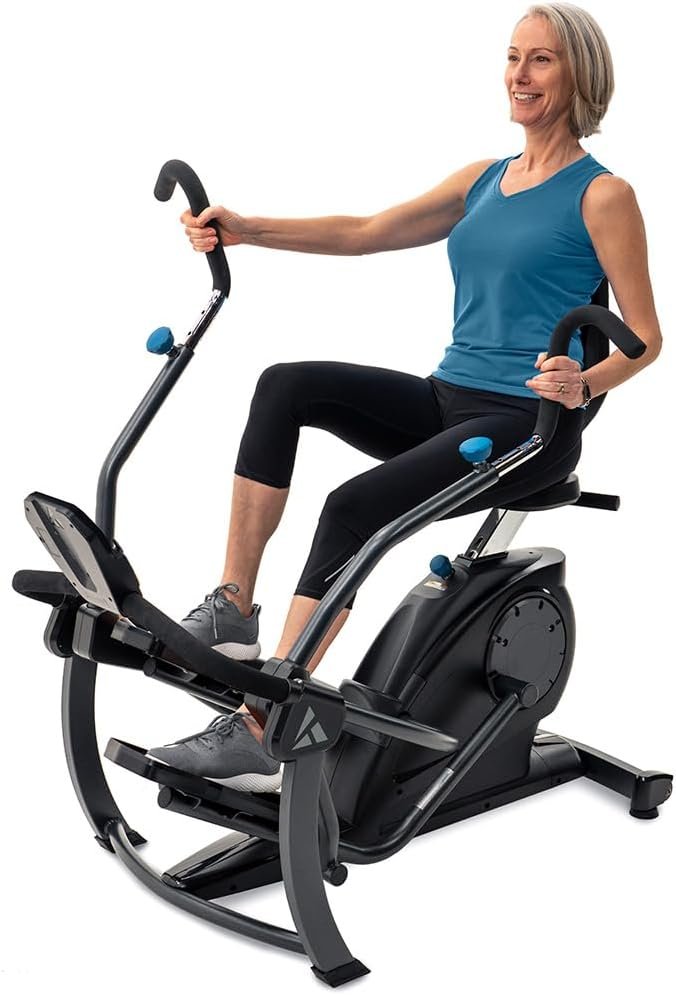
- Same patented zero-impact linear stride as the LT1
- UltraGlide bearings for smoother pivot-point motion
- ComfortSelect seat with 2 mounting positions plus recline and height adjustment
- 300 lb weight capacity
- 3-year structural frame warranty, 2-year mechanical/electrical parts (standard) — a full year longer than the LT1 on both
- SoftStep rubberized pedals, SureGrip sweat-resistant handles
The LT3’s biggest upgrade over the LT1 is the warranty — a full extra year of coverage on both frame and parts — plus a noticeably more refined seat and pedal feel for daily use.
What Makes It Different
The core mechanism is identical to the LT1 — same patented stride, same zero-impact design. What you’re paying extra for is refinement: UltraGlide bearings smooth out the transition at each pivot point, the ComfortSelect seat has a genuinely thicker cushion with more adjustment range, and the pedals and handles use upgraded materials that hold up better to sweat and daily wear.
If you’re using this daily rather than occasionally, that extra warranty year and the more refined touchpoints are worth the price jump over the LT1 — but if budget is the deciding factor, the core workout experience is essentially the same on both.
Best for: Daily users who want the longest standard warranty in the FreeStep line and are willing to pay more for seat and pedal refinements.
| Pros | Cons |
|---|---|
| 3-year frame / 2-year parts warranty — a full year longer than the LT1 | Meaningfully more expensive than the LT1 for the same core mechanism |
| Higher-quality seat cushioning and pedal materials | Same 300 lb weight capacity as the cheaper LT1 — no capacity upgrade for the higher price |
| 4.6-star rating across 1,000+ reviews | |
| Same proven zero-impact stride mechanism as the LT1 |
3. Marcy JX-7301 — Best Value
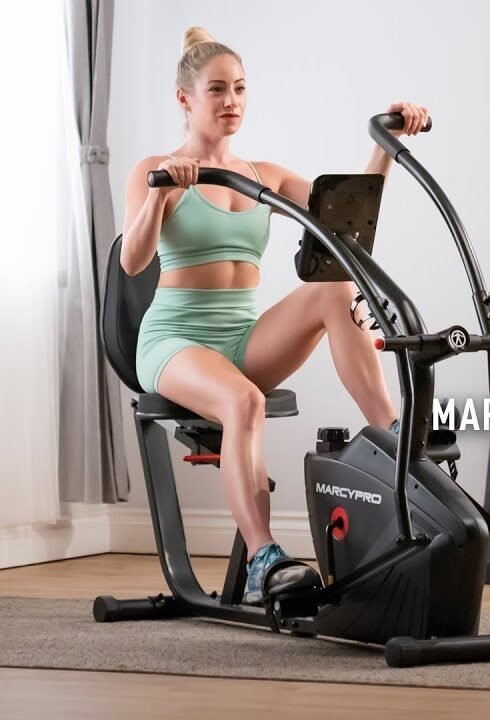
- 8 preset magnetic resistance levels
- Dual handles move in tandem with pedals for upper/lower body engagement
- Adjustable padded seat with contoured backrest
- 14-gauge powder-coated steel frame construction
- 300 lb weight capacity (implied by frame class; confirm on current listing)
- LCD monitor tracks speed, distance, calories, time, odometer
The JX-7301’s biggest strength is price — it delivers genuine dual-action arm-and-leg training at a fraction of what the Teeter or rehab-grade models cost.
What Makes It Different
This isn’t a stripped-down bike with arm handles tacked on — the dual handles genuinely move in tandem with the pedals, giving you real upper-body engagement rather than just something to hold onto. For most home users who want a full-body low-impact workout without a clinical-grade price tag, this is the practical entry point into the category.
The tradeoff shows up in the review data — a 3.8-star average is noticeably lower than the Teeter models, generally reflecting a less refined feel and lighter-duty construction than the premium options above it. It’s a fair machine for the price, not a match for the build quality of the pricier picks on this list.
Best for: Budget-conscious buyers who want genuine dual-action cross training rather than a basic recumbent bike, and can accept a less refined feel than the premium options.
| Pros | Cons |
|---|---|
| Lowest price point of any genuine dual-action cross trainer on this list | 3.8-star rating is noticeably lower than the Teeter models |
| Real synchronized arm-and-leg motion, not just static handles | Less refined resistance feel than the pricier options on this list |
| Durable 14-gauge steel frame construction | |
| Adjustable seat fits a range of body types |
4. Sunny Health & Fitness SF-RBE4886SMART — Best App Connectivity
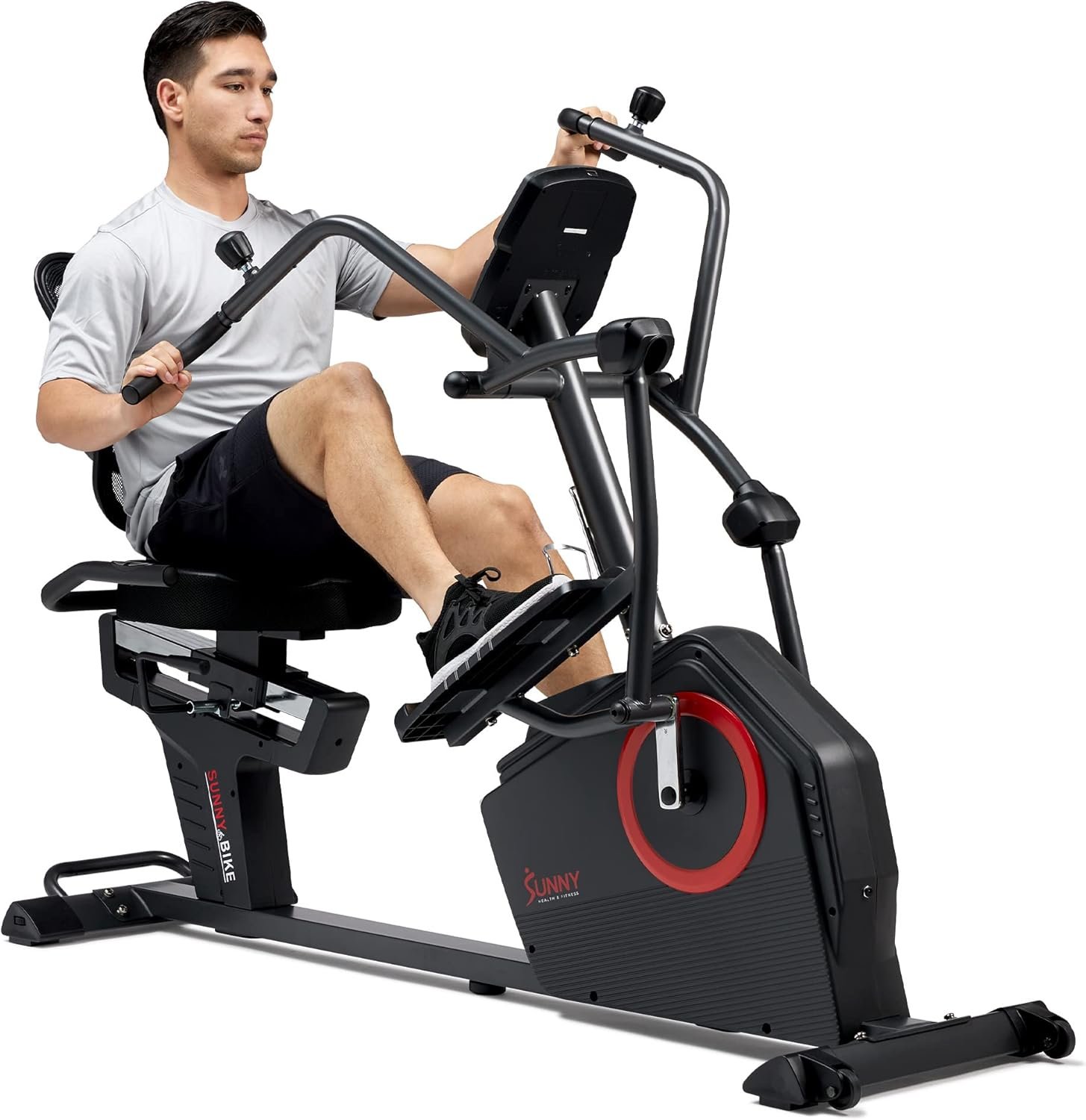
- 16 levels of electromagnetic resistance
- Elliptical-style pedal motion with dual-motion arm exercisers
- Step-through frame design for easier access
- 3-year structural frame warranty, 180-day parts and components
- Free SunnyFit app via Bluetooth — 1,000+ trainer-led workouts, 12 built-in programs
- 4.4-star rating, Amazon’s Choice badge
The single biggest reason to consider this model is the SunnyFit app integration — 12 built-in programs plus over 1,000 additional trainer-led workouts and virtual scenic tours, at a price well below the Teeter or rehab-grade options.
What Makes It Different
Most models in this list treat app connectivity as an afterthought or skip it entirely. Sunny built the SunnyFit ecosystem specifically to compete on content variety — the leaderboard and progress-tracking features add a gamified element that some users find genuinely motivating for long-term consistency, which is often the harder problem to solve than the machine itself.
The step-through frame design is also worth calling out specifically — it’s a real accessibility feature for anyone with limited mobility or balance concerns, making it easier to get on and off safely compared to models that require stepping over a higher frame rail.
Best for: Anyone who wants structured, app-guided workouts and a step-through design for easier access, at a mid-range price.
| Pros | Cons |
|---|---|
| Free SunnyFit app with over 1,000 trainer-led workouts | 180-day parts warranty is shorter than the Teeter models’ standard coverage |
| Step-through frame design improves accessibility | Full app experience benefits from a phone or tablet nearby, less useful if you prefer a fully standalone machine |
| 16 resistance levels — more granular than most in this list | |
| Amazon’s Choice badge with a strong 4.4-star rating |
5. HCI Fitness PhysioStep — Best for Rehab & Clinical-Grade Use
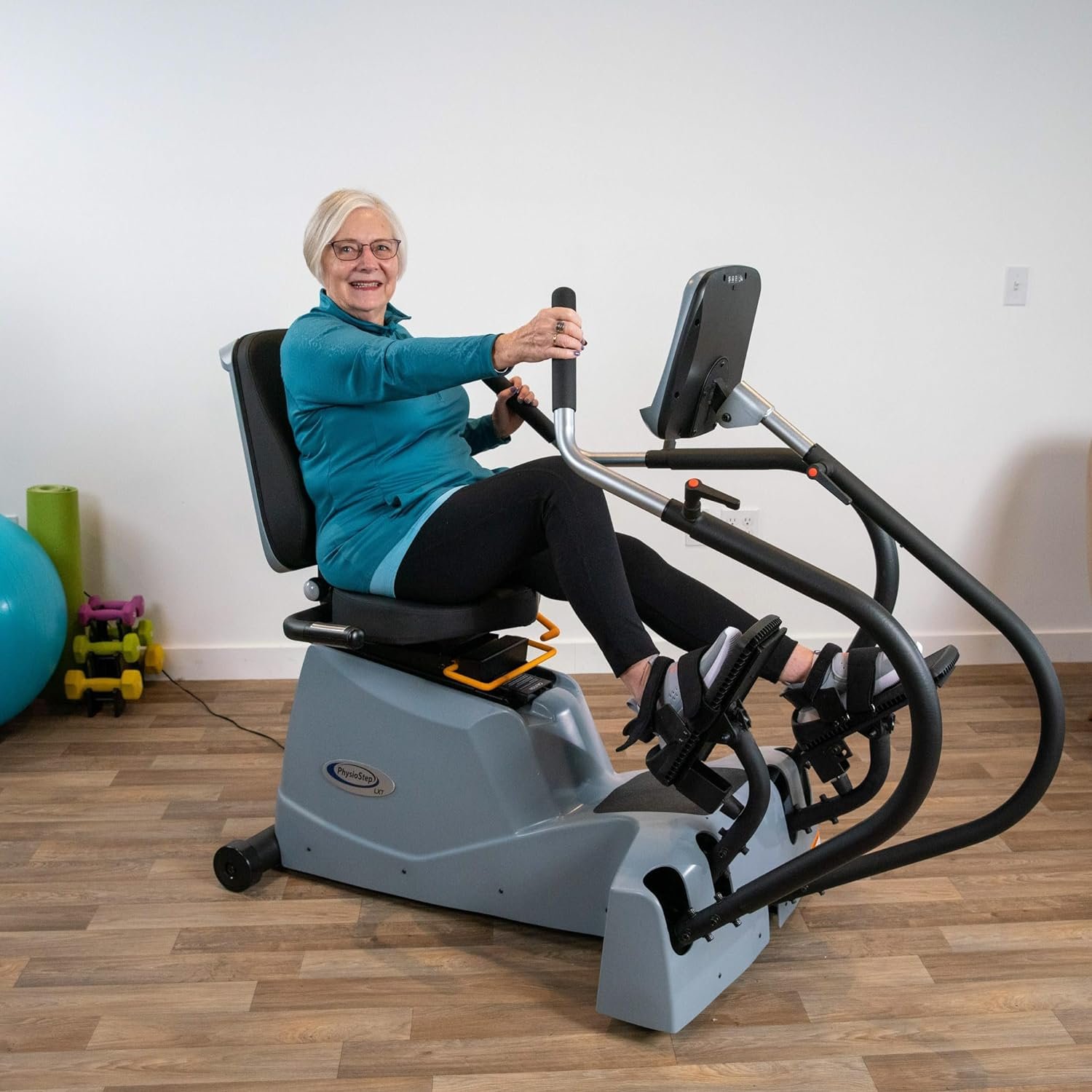
- Patented linear stepping motion, designed and engineered in the USA
- 360° swivel seat with lumbar support for easy transfers
- Up to 32 resistance levels depending on model variant
- 400 lb weight capacity, accommodates users 4’6″–6’4″
- FDA registered as a Class I medical device, CE safety certified
- Compact 2.5′ x 5′ footprint despite full commercial-grade construction
Note: current Amazon stock on this model has been running low — worth confirming availability before you commit, since rehab-grade equipment like this doesn’t restock as predictably as consumer fitness gear.
The single biggest reason to consider the PhysioStep is its FDA Class I medical device registration — a formal certification level nothing else on this list carries, reflecting genuine clinical-grade engineering rather than home-gym marketing language.
What Makes It Different
This is one of only two models on this list, alongside the NuStep, actually used inside physical therapy clinics and cardiac rehab programs rather than just marketed toward that audience. The 360° swivel seat is a genuine functional feature for anyone transferring from a wheelchair or with significant mobility limitations, not just a comfort add-on.
The 400 lb weight capacity and reinforced commercial-grade frame reflect the same rehab-clinic engineering standard — this is built to handle daily, sometimes multiple-user, clinical use, which is a meaningfully higher bar than a home fitness machine typically needs to clear.
Best for: Anyone recovering from surgery or injury, managing significant mobility limitations, or specifically wanting clinical-grade equipment at home.
| Pros | Cons |
|---|---|
| FDA registered Class I medical device — a certification level unique to this and the NuStep | Significantly more expensive than every other model on this list |
| 360° swivel seat genuinely aids safe transfers, not just comfort | Stock availability has been limited — confirm before ordering |
| 400 lb weight capacity, higher than every non-clinical model on this list | |
| Compact footprint despite commercial-grade construction |
6. NuStep T4r — Best Overall Rehab-Grade Option
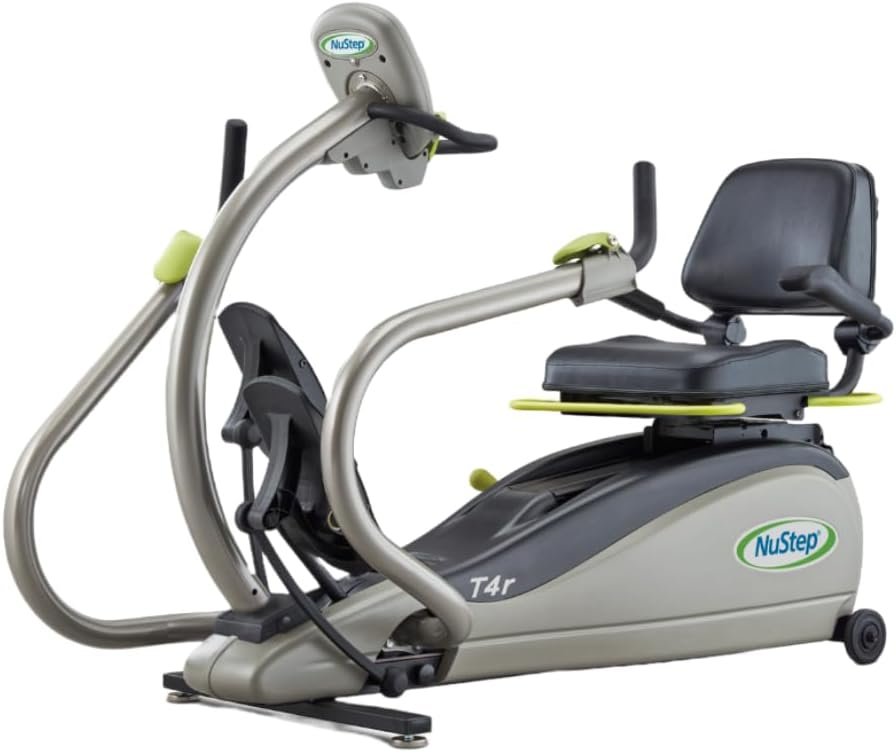
- Contralateral (opposite arm/leg) stepping motion for natural coordination
- 10 resistance levels, low-inertia startup
- 360° swivel seat, locks every 45 degrees, StrideLock stability feature
- 400 lb weight capacity, arrives fully assembled
- Compact 60″L x 27″W x 45″H footprint, ideal for apartments or small spaces
- 4.7-star rating across 111 Amazon reviews
Note: current shipping runs 2-3 weeks rather than immediate delivery — factor that into your timeline if you’re buying for a specific need date.
The single biggest reason to consider the T4r is its reputation as the category standard — it’s the machine most other recumbent cross trainers in this list explicitly compare themselves against.
What Makes It Different
NuStep essentially created this equipment category, and decades of clinical use show in details competitors still copy — the StrideLock feature that secures the handles and pedals for safer access, the 45-degree seat-locking positions, and a low-inertia startup specifically engineered so users with limited strength can start moving without a jarring first push.
Despite the clinical pedigree, the footprint is genuinely compact — smaller than several of the “budget” home models on this list — which is why it remains popular even for apartment-dwelling home users who specifically want the rehab-grade motion quality without needing a dedicated large room.
Best for: Anyone who wants the category-defining, clinically-proven option and is willing to pay a premium price and accept a longer shipping window for it.
| Pros | Cons |
|---|---|
| 4.7-star rating — the highest of any model on this list | Highest price on this list by a wide margin |
| Compact footprint despite rehab-grade construction and 400 lb capacity | 2-3 week shipping window rather than immediate delivery |
| StrideLock and low-inertia startup specifically aid users with limited strength | |
| Arrives fully assembled |
7. Birdfeel Recumbent Elliptical Cross Trainer — Best Entry-Level Budget
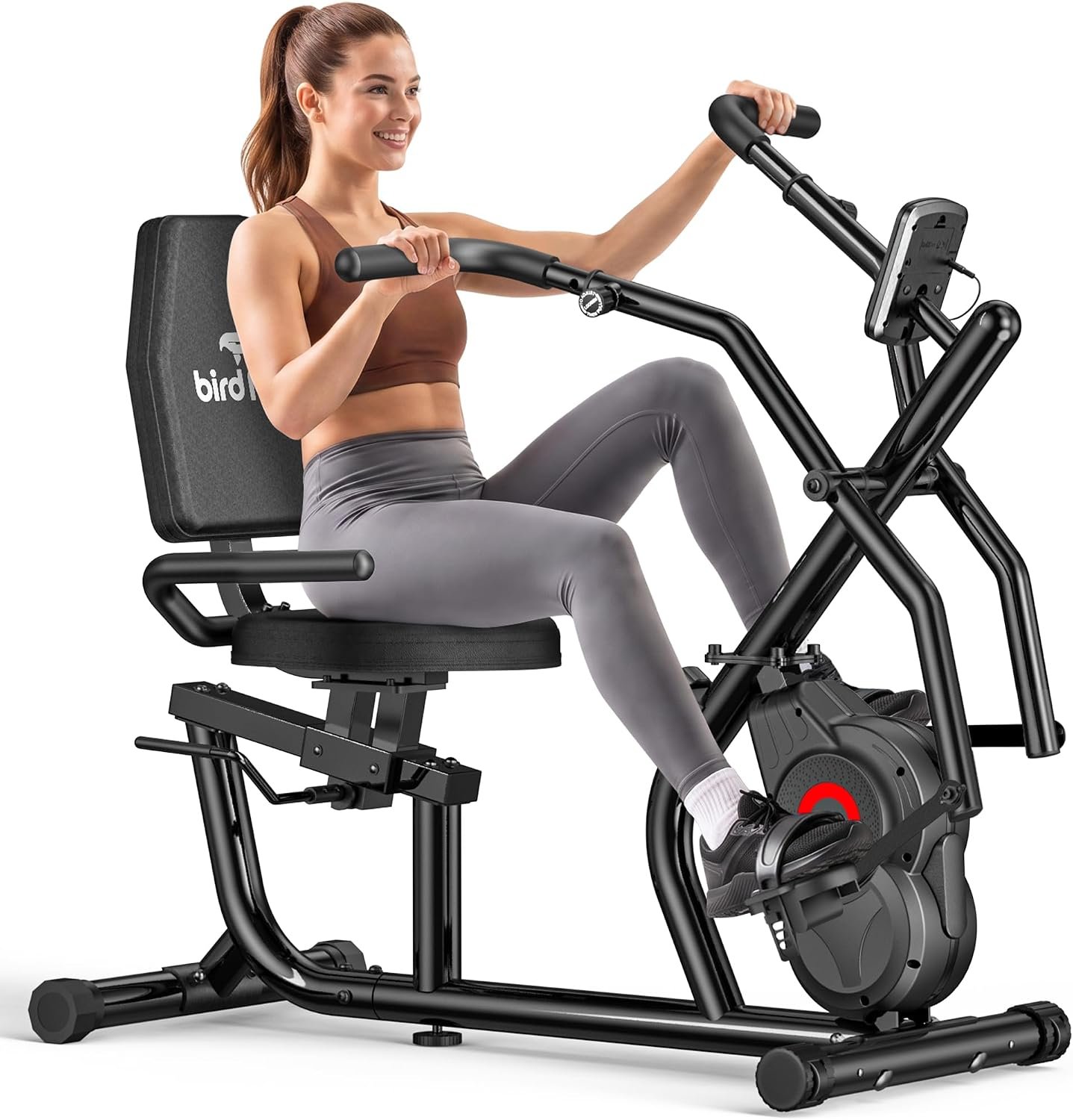
- 8-level magnetic resistance
- Hand-cranked arm exerciser synced with elliptical-style leg motion
- Adjustable seat, whisper-quiet magnetic drive
- Can be used arms-only, legs-only, or synced together
The single biggest reason to consider this option is price accessibility — it’s the least expensive genuine cross-training option on this list, well below even the Marcy.
What Makes It Different
Worth being upfront about the tradeoff here: the arm mechanism is hand-cranked rather than the synchronized push-pull motion the Teeter and Marcy models use. That’s a real difference in workout quality and upper-body engagement, not just a minor spec difference — this is a genuinely entry-level machine, not a budget version of the premium options.
That said, for someone testing whether recumbent cross-training suits them before committing to a bigger purchase, or with genuinely limited budget, it delivers the core zero-impact, low-strain workout format at the lowest possible entry cost.
Best for: First-time buyers testing whether recumbent cross-training suits them, or anyone with a strictly limited budget who still wants the basic format.
| Pros | Cons |
|---|---|
| Lowest price of any model on this list | Hand-cranked arm mechanism is a real step down from the synchronized dual-motion designs above it |
| Zero-impact elliptical-style motion protects joints | Much smaller review base than the established brands on this list — track record is still limited |
| Whisper-quiet magnetic resistance | |
| Can isolate arms-only or legs-only training |
How to Choose a Recumbent Cross Trainer: 5 Factors That Matter
1. Whether you need genuine rehab-grade equipment. If you’re recovering from surgery, managing a significant mobility limitation, or need FDA-registered medical device equipment specifically, the NuStep and HCI PhysioStep are worth the premium price. Research on low-intensity exercise in cardiac rehabilitation shows this accessible, low-strain style of training delivers real strength and endurance benefits without the participation barriers higher-intensity programs create. For general fitness and joint-friendly cardio, the mid-range and budget options deliver most of the same core benefit.
2. The arm mechanism type. Synchronized dual-motion arms (Teeter, Marcy, Sunny) engage your upper body as a real part of the workout. Hand-cranked mechanisms (Birdfeel) work but deliver less consistent upper-body engagement. If total-body training is your main goal, prioritize synchronized motion over a lower price tag.
3. Seat swivel and transfer needs. If you or anyone using the machine has limited mobility or transfers from a wheelchair, a 360° swivel seat (NuStep, HCI PhysioStep) is a genuine functional necessity, not a luxury feature. For general fitness use without mobility concerns, a fixed or limited-recline seat works fine.
4. App and content needs. If structured, trainer-led workout variety matters to you long-term, the Sunny’s SunnyFit integration or the Teeter’s free app add real value. If you prefer a simple, standalone machine without needing a phone nearby, the Marcy or Birdfeel work fine without any app dependency.
5. Weight capacity and warranty together. Don’t evaluate these separately — a higher weight capacity paired with a short warranty (like the Sunny’s 180-day parts coverage) tells a different story than a lower capacity with strong coverage. Check both numbers side by side before deciding, and if you need higher-capacity options generally, our guide to ellipticals for heavier users covers the broader equipment landscape.
Who a Recumbent Cross Trainer Is NOT the Right Choice For
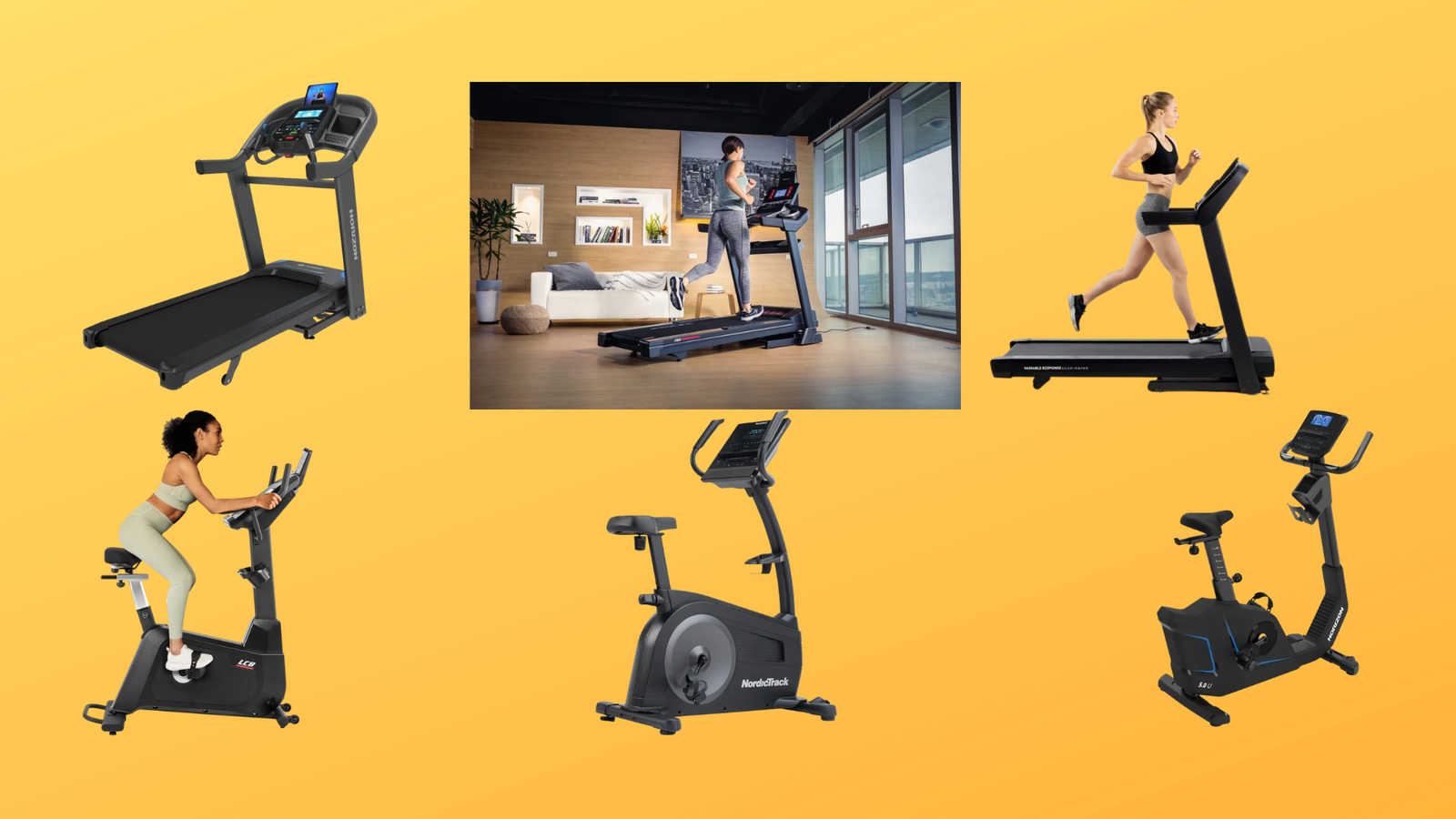
If your main goal is building serious cardiovascular fitness or training for a running event, a recumbent cross trainer’s low-impact design works against you — the reduced joint stress that makes it ideal for rehab also means less resistance and impact overall than a treadmill or upright bike delivers. Our senior-friendly treadmill picks are worth comparing if higher-intensity cardio is genuinely the goal.
It’s also not the right pick if floor space is extremely tight — even the more compact models here have a larger footprint than a simple exercise bike or under-desk elliptical. If space is the primary constraint rather than joint comfort, our under-desk elliptical guide covers genuinely compact alternatives.
Anyone specifically wanting to train arms and legs completely independently, rather than in a connected or synchronized pattern, may also find the fixed mechanical linkage on most of these machines limiting — a standard recumbent bike paired with separate resistance band work might suit that goal better.
Related reading: Best Recumbent Exercise Bike with Arm Exerciser
Frequently Asked Questions
What advantages do recumbent cross trainers offer?
Recumbent cross trainers deliver a low-impact, full-body workout that’s easier on the spine, hips, knees, and ankles than standing cardio equipment. This makes them especially useful for rehabilitation, chronic joint pain, or anyone with mobility limitations.
What is the difference between a recumbent cross trainer and a recumbent bike?
A recumbent bike only involves circular leg pedaling, while a recumbent cross trainer adds a stepping or elliptical-style leg motion combined with moving arm handles for a full-body workout. The dual-motion design is the key distinction between the two categories.
Are recumbent cross trainers appropriate for home use?
Yes. Most manufacturers, including Teeter, Marcy, and Sunny Health & Fitness, design models specifically for home use, offering a compact footprint and simple assembly. Rehab-grade options like the NuStep and HCI PhysioStep are also sold for home use, though at a significantly higher price.
How is PhysioStep different from NuStep?
Both are rehab-grade recumbent cross trainers with FDA registration and 360-degree swivel seats, but they differ in stride mechanics: PhysioStep uses a patented linear stepping motion, while NuStep uses a contralateral (opposite arm and leg) stepping pattern. Both are considered category leaders for clinical and home rehab use.
Can recumbent cross trainers help with weight loss?
Yes, when used consistently as part of a broader calorie-conscious routine. The full-body engagement burns more calories than leg-only equipment at a comparable intensity, though the low-impact nature means it’s typically less calorie-intensive per minute than higher-impact cardio like running.
What weight capacity should I look for in a recumbent cross trainer?
Most home models support 300 lb, while rehab-grade options like the NuStep and HCI PhysioStep support up to 400 lb. Always choose a capacity with meaningful headroom above your actual weight rather than buying right at the stated limit.
Is a recumbent cross trainer good for seniors?
Yes, this is one of the primary use cases for the category. The reclined seat reduces fall risk, the low-impact motion protects joints, and models with a swivel seat make it easier and safer to get on and off compared to standing equipment.
Do recumbent cross trainers require assembly?
It varies by model. The NuStep T4r and similar rehab-grade machines typically arrive fully assembled, while budget and mid-range options like the Marcy JX-7301 and Birdfeel usually require some assembly, generally taking one to two hours.
Affiliate Disclosure: myactivetribe.com is reader-supported. Some links on this page are affiliate links, meaning we may earn a commission at no extra cost to you if you make a purchase. This never affects our recommendations, which are based on AnilKK’s independent research and testing.