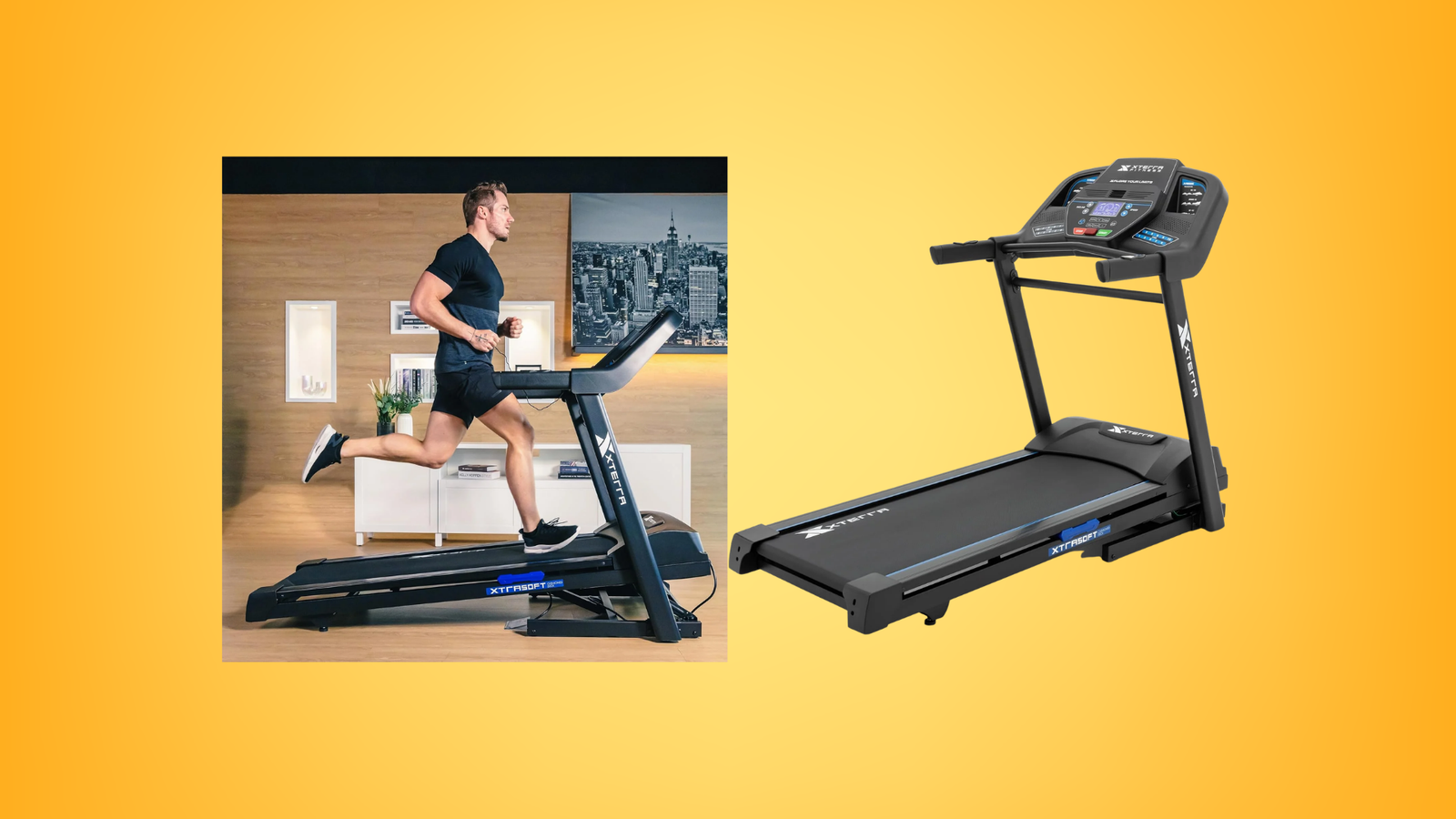
The XTERRA TR75 treadmill sits at the sweet spot of XTERRA’s Sport Series — a 3.25 HP motor, 20″ × 60″ running deck, 12-level power incline, Bluetooth FTMS, and a lifetime frame and motor warranty, all without a subscription requirement. With 24 years of running and 253 machines tested, I can tell you it punches well above its price class on build quality. This review covers the TR75 in full, a direct comparison with the TR65 for buyers deciding between the two, and honest guidance on who each machine is actually built for.
Quick Answer: The XTERRA TR75 is the better choice for most buyers between these two models. Its 3.25 HP motor, 12 MPH top speed, 20″ × 60″ belt, 350 lb weight capacity, and advanced training programs, including 5K, 10K, and target-based workouts, make it the clear step up. The TR65 is worth considering only if budget is the primary constraint and your needs don’t exceed 10 MPH or 300 lbs. Both are on Amazon, both use Bluetooth FTMS for Zwift and Kinomap, and neither requires a subscription.
Table of Contents
| Spec | XTERRA TR75 | XTERRA TR65 |
|---|---|---|
| Motor | 3.25 HP | 2.5 HP |
| Speed Range | 0.5 – 12 MPH | 0.5 – 10 MPH |
| Incline Levels | 12 levels (motorised) | 10 levels (motorised) |
| Belt Size | 20″ × 60″ | 20″ × 55″ |
| Weight Capacity | 350 lbs | 300 lbs |
| Machine Weight | 216 lbs | 200 lbs |
| Display | 6.5″ blue backlit LCD | 5.5″ blue backlit LCD |
| Bluetooth Speakers | Yes | No |
| Bluetooth FTMS | Yes (Zwift, Kinomap) | Yes (Zwift, Kinomap) |
| Advanced Programs | 5K, 10K, target time/distance/calories | Not included |
| Subscription Required | No | No |
| Set-Up Dimensions | 77″ L × 35″ W × 55.5″ H | 71.8″ L × 35″ W × 55.5″ H |
| Warranty | Lifetime frame + motor | Lifetime frame + motor |
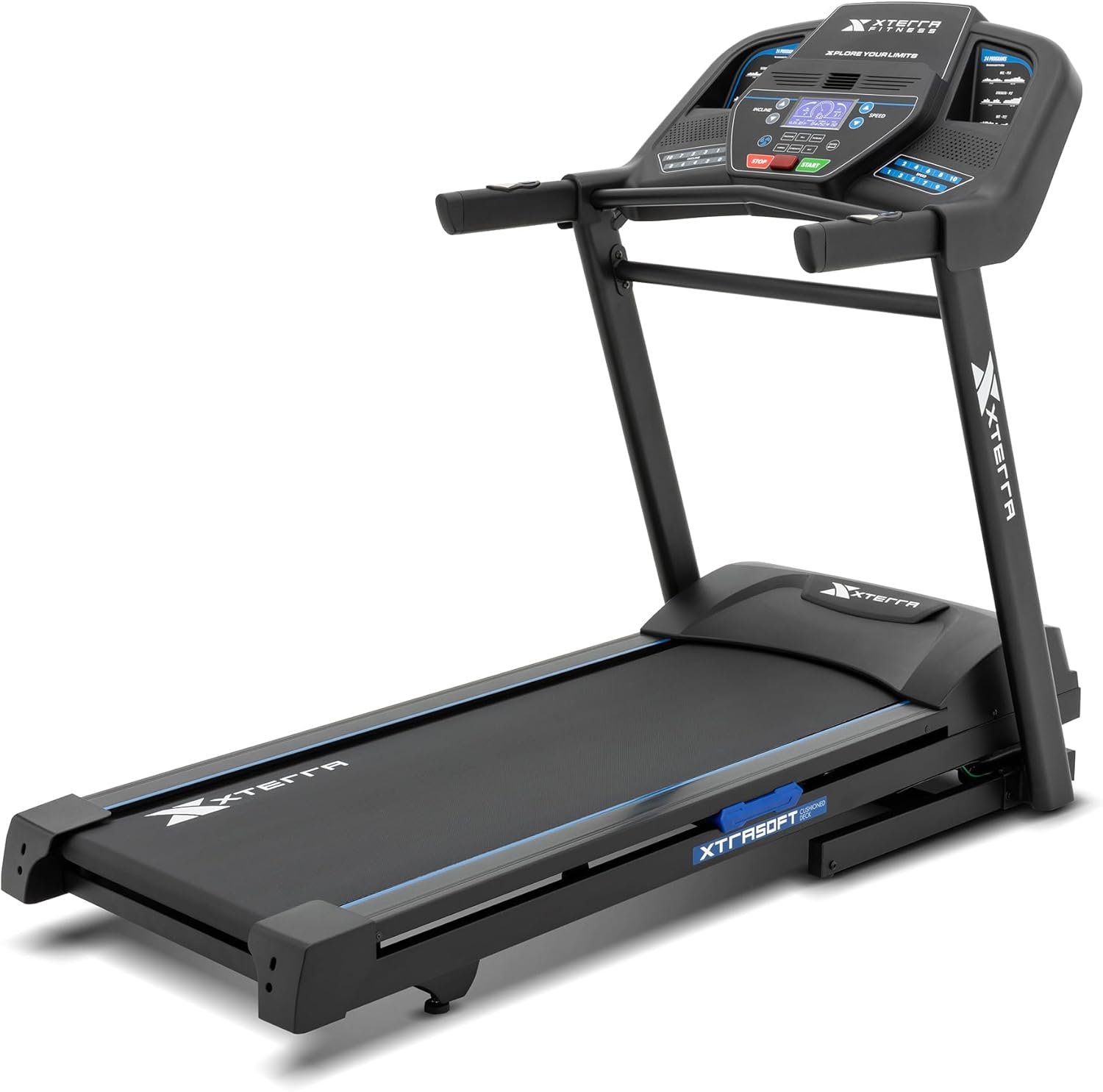
XTERRA TR75 Treadmill Review: Motor, Deck, and Running Feel
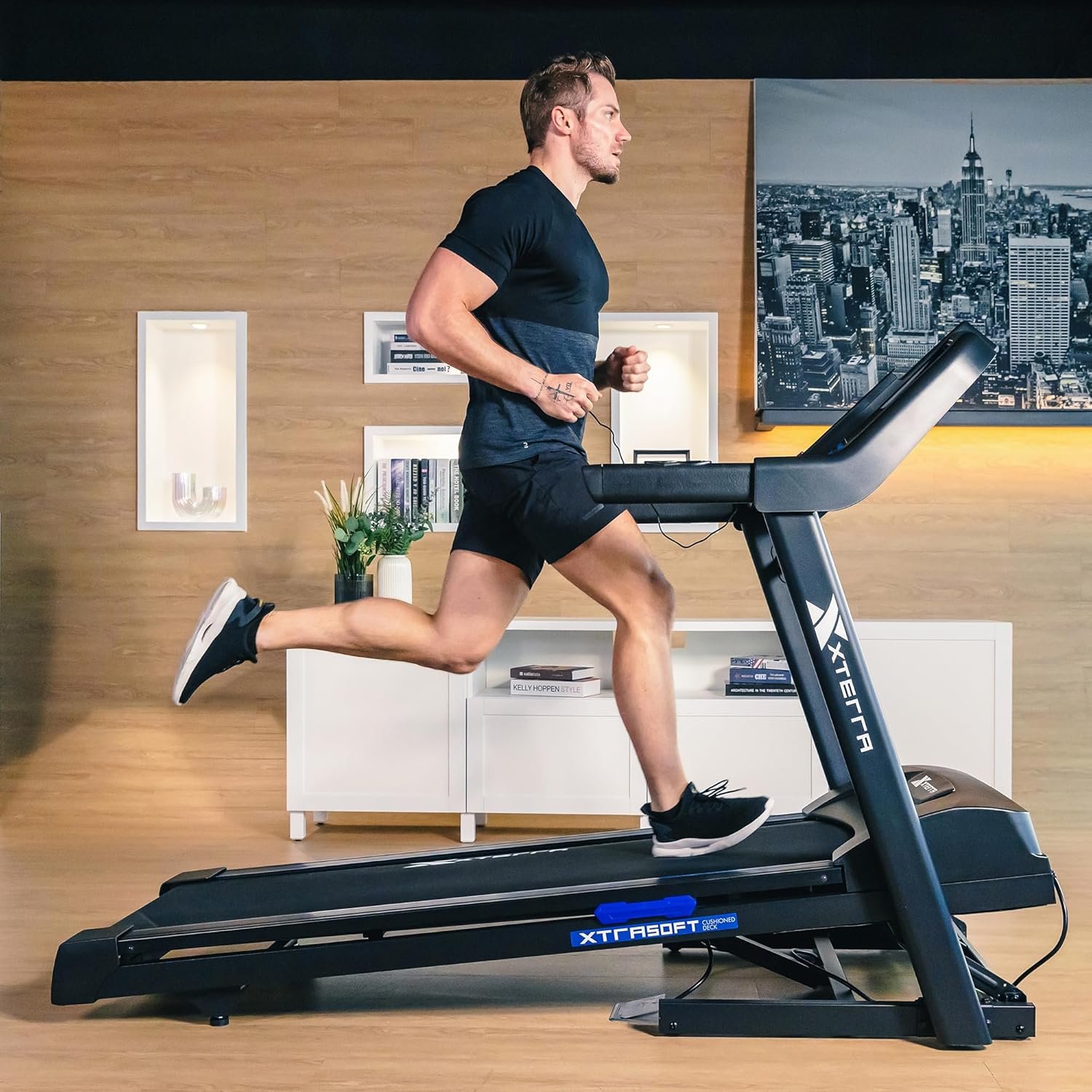
The 3.25 HP high-torque motor is the foundation of everything the TR75 does well. At walking and jogging speeds it runs quietly — noticeably so, especially compared to lower-powered machines in its price range that compensate for weaker motors by running at higher RPM and generating more noise. At running speeds of 7–10 MPH it handles sustained sessions without strain. The “high-torque” rating means the motor maintains consistent belt speed under load rather than slowing when you push hard into your stride — the practical test of motor quality that matters most during actual training.
The 20″ × 60″ running surface gives tall runners with long strides enough room to move naturally at speed. Most treadmills at this price point offer a 20″ × 55″ belt — the TR75’s extra 5 inches of length is one of its key physical advantages over the TR65 and several competitors in its price range. The XTRASoft deck cushioning absorbs impact effectively across the full belt length, which matters for anyone running more than 3–4 miles per session. NIH-published research consistently links reduced impact loading during running with lower rates of knee and hip stress injury — deck cushioning at this price point is a genuine health consideration.
The frame weighs 216 lbs — heavy enough to stay stable at all speeds without rocking. The steel uprights and crossbar construction keeps the console still even at 10+ MPH, which is worth noting for anyone who uses Bluetooth to connect to Zwift or other apps mid-run. Handlebar-mounted speed and incline controls let you adjust without breaking stride or reaching for the console.
Training Programs: More Advanced Than the Numbers Suggest
The TR75’s program list looks shorter than the TR65’s on paper — 18 preset programs vs 24 — but the TR75’s programs are significantly more advanced. The TR65 has standard preset profiles. The TR75 adds goal-based programs that the TR65 does not have: dedicated 5K and 10K training modes, Target Time, Target Distance, and Target Calories. These are the programs that actually change how you train rather than simply varying speed and incline randomly.
The four Heart Rate Control programs (55%, 65%, 75%, 85% of max HR) are worth highlighting for older runners and anyone managing cardiovascular health. The treadmill auto-adjusts speed and incline to keep you within the target heart rate zone, which removes the guesswork from zone-based training. ACSM guidelines on cardiovascular training consistently recommend heart rate zone training for aerobic base building and weight management — having this built into the machine removes the need for a separate app or wearable to manage it.
Manual mode lets you set speed and incline freely with no program structure at all. For runners who build their own workouts, this is often the most-used mode — and the handlebar controls make mid-run adjustments fast and natural. For a broader look at how the TR75 fits into a structured running programme, our treadmill workouts for weight loss guide covers training structures that pair well with these program types.
Bluetooth FTMS: Zwift and Kinomap Without a Subscription
The TR75 uses Bluetooth FTMS — an open standard that lets any compatible app receive speed and incline data from the treadmill in real time. Zwift, Kinomap, and Tacx all connect natively. You run on the TR75 and your pace feeds into Zwift’s virtual environment without any XTERRA account or paid intermediary. The XF Connect app (free) handles basic workout tracking and syncs with Apple Health and Fitbit.
The built-in Bluetooth speakers are a practical bonus — you can pair your phone directly to the treadmill and hear your audio through the machine rather than wearing earbuds during a long run. The TR65 does not have Bluetooth speakers, so this is a genuine quality-of-life difference between the two models for anyone who trains without headphones.
XTERRA TR65 vs TR75 — Which One Should You Buy?
This is the question every buyer comparing these two models needs answered directly. Here it is without hedging.
The TR65 and TR75 share the same XTERRA build philosophy — heavy-gauge steel frame, XTRASoft deck cushioning, Bluetooth FTMS, Lift Assist folding, and a lifetime frame and motor warranty. On these fundamentals, both machines deliver the same standard. The differences are meaningful but specific.
The TR75 is better in every measurable performance spec: stronger motor (3.25 HP vs 2.5 HP), higher top speed (12 MPH vs 10 MPH), longer belt (60″ vs 55″), higher weight capacity (350 lbs vs 300 lbs), more incline levels (12 vs 10), bigger display (6.5″ vs 5.5″), Bluetooth speakers (TR75 only), and advanced training programs including 5K, 10K, and target-based modes (TR75 only).
The TR65 makes sense if: your maximum running speed is 9–10 MPH, you weigh under 250 lbs and walk or jog rather than run hard, and budget is the primary consideration. At its price point the TR65 delivers solid build quality and Bluetooth FTMS connectivity that most cheaper competitors don’t match.
The TR75 makes sense if: you run above 10 MPH, want the longer belt for stride comfort, weigh over 250 lbs, want Bluetooth speakers, or intend to use structured goal-based training programs. The price premium between the two models is modest relative to the spec difference — the TR75 is the better long-term investment for most buyers.
One thing the TR65 has more of: 24 preset programs vs the TR75’s 18. This sounds like an advantage until you look at what those programs actually are. The TR65’s 24 programs are standard speed/incline variation profiles. The TR75’s 18 include 5K, 10K, four target-based modes, and four HRC zones — fewer programs that are genuinely more useful for structured training. Do not use the program count as a buying criterion between these two machines.
XTERRA TR75 vs Sole F65 — Two Different Priorities
The Sole F65 is the most common alternative buyers consider at a similar price to the TR75. Both fold, both run at 12 MPH, and neither locks features behind a subscription. The differences are meaningful and buyer-specific.
The F65 has a wider 22″ × 60″ belt (vs the TR75’s 20″ × 60″), a heavier 267 lb frame that runs notably quieter under sustained load, a 9″ LCD display, and a 2.36″ roller. Its 3.0 HP motor is slightly weaker than the TR75’s 3.25 HP, and its weight capacity is 325 lbs vs the TR75’s 350 lbs. The F65’s Cushion Flex Whisper Deck is engineered specifically for noise reduction — a real advantage for apartments and shared homes. It does not list Bluetooth FTMS on its official spec page, which means Zwift and Kinomap connectivity is not confirmed on the F65 the way it is on the TR75. Our best treadmill for home use guide covers both machines in broader context for buyers still comparing options.
The TR75 wins on motor size, weight capacity, Bluetooth FTMS connectivity, and advanced training programs. The F65 wins on belt width, frame weight, noise reduction, and display size. If you run in a shared space or apartment and noise is a priority, the F65’s quieter operation is worth the comparison. If you want verified Zwift compatibility, a higher weight limit, and structured goal-based training programs, the TR75 is the cleaner choice.
The Real Truth About the TR75’s 350 lb Weight Capacity
The 350 lb rated capacity is the maximum static load — not the optimal running weight. Running generates 2–3× your body weight in impact force per stride, meaning the motor and deck experience far more than your standing weight during a run. For the TR75, my practical guidance is: walkers and joggers up to 320–330 lbs are within a comfortable operating margin. Runners above 280–300 lbs doing frequent high-speed sessions should factor in that the 3.25 HP motor is working near its upper range at that weight and speed combination.
This is also why the TR65’s 300 lb capacity matters more than it first appears. The TR65’s 2.5 HP motor and 300 lb limit work together — the motor is sized for that user profile. Putting a 280 lb runner on a TR65 at 10 MPH regularly is pushing both the motor and the rated capacity simultaneously. For heavier users who run, the TR75 is the correct choice between these two models. Our best treadmills for heavy people guide covers machines specifically engineered for users near or above 300 lbs who run regularly.
Folding, Space, and Storage
The Lift Assist mechanism makes folding the TR75 manageable solo — a gas-assisted strut handles most of the 216 lb frame weight. The Slow Deploy feature controls the deck descent when unfolding, so it lowers gradually rather than dropping. Both work reliably. Set up for use, the TR75 needs a clear floor area of approximately 83″ × 42″ — the machine length plus a 3-foot safety buffer behind the belt. Folded, the footprint drops to 50″ × 35″, roughly the size of a large suitcase stood upright. The TR65 folds smaller at 48.8″ × 35″ × 61″ — a marginal difference that won’t affect most home setups.
Who the TR75 Is NOT For
- Runners above 300 lbs doing daily high-speed sessions: The 3.25 HP motor handles this combination, but if you’re running at 10+ MPH regularly at 300 lbs+, a machine with a 3.5–4.0 HP motor gives more comfortable long-term performance and less motor wear.
- Buyers who need a touchscreen or entertainment system: The TR75 has a 6.5″ LCD — clear and functional, but not a touchscreen.
- Apartment dwellers above ground floor: At speeds above 9–10 MPH the TR75 generates audible belt noise. The XTRASoft deck reduces joint impact but not belt surface noise. A rubber isolation mat helps but this is not a whisper-quiet machine at running speeds.
Pros and Cons
| Pros | Cons |
|---|---|
| Lifetime frame and motor warranty — among the strongest warranties at this price point. A manufacturer offering lifetime motor coverage has tested it to hold up under regular home use. | No touchscreen or entertainment system — the 6.5″ LCD is clear and functional but this is a training-focused machine. If built-in streaming matters to you, the TR75 is not the right choice. |
| 3.25 HP motor with 12 MPH top speed — handles walkers through serious runners without strain. More than adequate for the majority of home users who run at 8–10 MPH. | 12 incline levels — adequate for most training needs but new treadmills now a days have upto 15 incline levels. |
| 20″ × 60″ XTRASoft deck — generous running surface with meaningful joint cushioning. The 60″ belt length gives tall runners with long strides room to move naturally at speed. | Noisy above 10 MPH — belt surface contact noise increases at high speeds. Not ideal for shared spaces or light sleepers nearby. |
| Bluetooth FTMS — no subscription — connects to Zwift, Kinomap, and Tacx out of the box, free, forever. No XTERRA account or content paywall. | |
| Built-in Bluetooth speakers — absent on the TR65; a genuine daily-use convenience for runners who prefer audio through the machine over earbuds. | |
| Advanced training programs — 5K, 10K, target distance, target time, target calories, and four HRC zones are genuinely useful for structured training, not just variety for its own sake. |
What to Expect in the First 30 Days
Assembly takes 45–60 minutes for two people. The frame is heavy and the uprights need aligning before bolting — a second pair of hands makes a real difference. The manual is clear and all hardware is included. First run: the XTRASoft deck will feel noticeably softer than a gym treadmill. Runners used to hard commercial decks sometimes take a week to adjust their foot strike timing to the softer surface — this normalises quickly and is a feature, not a flaw.
At the 30-day mark, lubricate the belt with silicone lubricant as directed in the manual. This is the single most impactful maintenance task for long-term belt and deck life — do it on schedule and the lifetime warranty on the motor becomes largely academic because the machine will run cleanly for years. Also check belt tension: a belt that slips under hard foot strike or feels stiff to rotate by hand when the machine is off needs adjusting via the two rear bolts. Our muscles involved in treadmill workouts guide is useful context for the first 30 days — starting at moderate incline (levels 3–5) and building up protects your calves and Achilles from early overload.
Related reading: XTERRA TRX1400 Treadmill · XTERRA TR200 Treadmill
Frequently Asked Questions
What is the difference between the XTERRA TR65 and TR75?
The TR75 has a stronger 3.25 HP motor (vs 2.5 HP), higher top speed (12 MPH vs 10 MPH), a longer 20″ × 60″ belt (vs 20″ × 55″), higher weight capacity (350 lbs vs 300 lbs), more incline levels (12 vs 10), Bluetooth speakers (absent on TR65), and advanced training programs including 5K, 10K, and target-based modes. The TR65 has more total preset programs (24 vs 18) but they are standard profiles rather than goal-based. Both use Bluetooth FTMS, both fold, and both carry a lifetime frame and motor warranty.
What is the difference between the XTERRA TR65 and TR75?
The TR75 has a stronger 3.25 HP motor (vs 2.5 HP), higher top speed (12 MPH vs 10 MPH), a longer 20″ × 60″ belt (vs 20″ × 55″), higher weight capacity (350 lbs vs 300 lbs), more incline levels (12 vs 10), Bluetooth speakers (absent on TR65), and advanced training programs including 5K, 10K, and target-based modes. The TR65 has more total preset programs (24 vs 18) but they are standard profiles rather than goal-based. Both use Bluetooth FTMS, both fold, and both carry a lifetime frame and motor warranty.
Is the XTERRA TR75 good for running?
Yes, for most home runners. The 3.25 HP motor, 12 MPH top speed, and 20″ × 60″ XTRASoft deck handle walkers through serious runners comfortably. For runners consistently above 10 MPH or weighing over 280–300 lbs who train at high intensity daily, a machine with a larger 3.5–4.0 HP motor provides more comfortable long-term performance. The TR75 is well-suited for the majority of home users who run at 7–10 MPH.
Does the XTERRA TR75 work with Zwift?
Yes. The TR75 uses Bluetooth FTMS — an open standard that sends speed and incline data to Zwift, Kinomap, Tacx, and other compatible apps in real time. No XTERRA subscription or account is required. The TR65 also has Bluetooth FTMS and works with the same apps.
What is the warranty on the XTERRA TR75?
Lifetime frame + motor / 5-year parts / 3-year electronics / 1-year labor / 90-day high-wear items The lifetime frame and motor coverage is the standout warranty element and reflects manufacturer confidence in the machine’s long-term durability.
Should I buy the XTERRA TR65 or TR75?
The TR75 is the better choice for most buyers. It has a stronger motor, longer belt, higher weight capacity, Bluetooth speakers, and more advanced training programs at a modest price premium over the TR65. The TR65 makes sense if your maximum running speed is 9–10 MPH, you weigh under 250 lbs and walk or jog primarily, and budget is the deciding factor. If you run regularly above 10 MPH or weigh over 250 lbs, the TR75 is the correct investment.
Does the XTERRA TR75 require a subscription?
No. The TR75 requires no paid subscription for any of its features. All 18 preset programs, the advanced 5K, 10K, and target-based modes, and the Bluetooth FTMS connectivity to Zwift and Kinomap are included at no ongoing cost. The free XF Connect app handles workout tracking and syncs with Apple Health and Fitbit.
How loud is the XTERRA TR75 during use?
At walking speeds (3–4 MPH) the TR75 is quiet enough for normal conversation in the same room. At running speeds above 9–10 MPH it generates audible belt surface noise — comparable to a running dishwasher in the next room. It is not recommended for apartments above ground floor without a rubber isolation mat. The XTRASoft cushioning reduces impact noise, but belt contact noise at high speed is the main source.
Disclosure: myactivetribe.com earns from qualifying purchases. This does not affect which products are recommended — all specs are verified from official brand sources and all opinions are based on AnilKK’s direct testing experience.