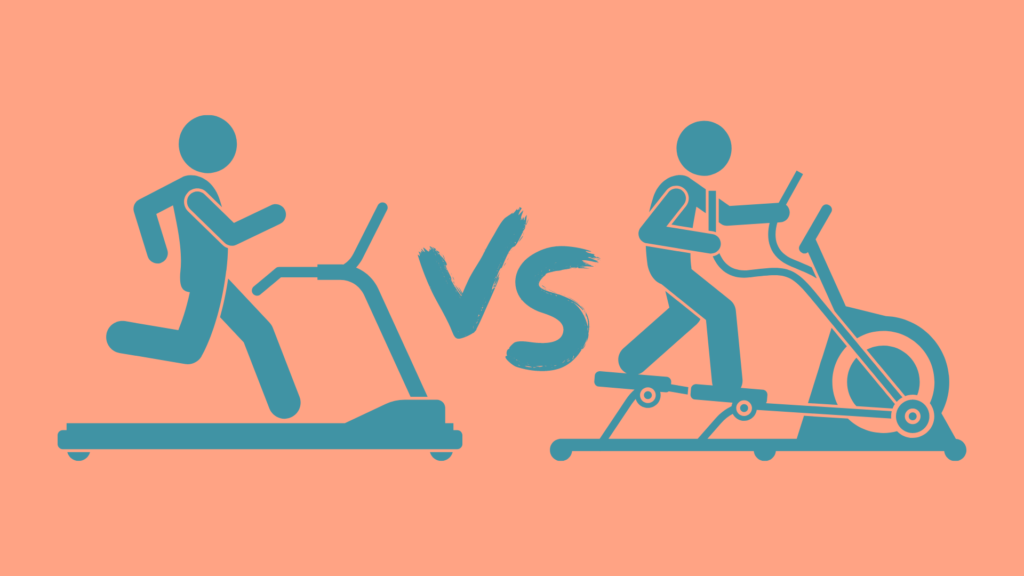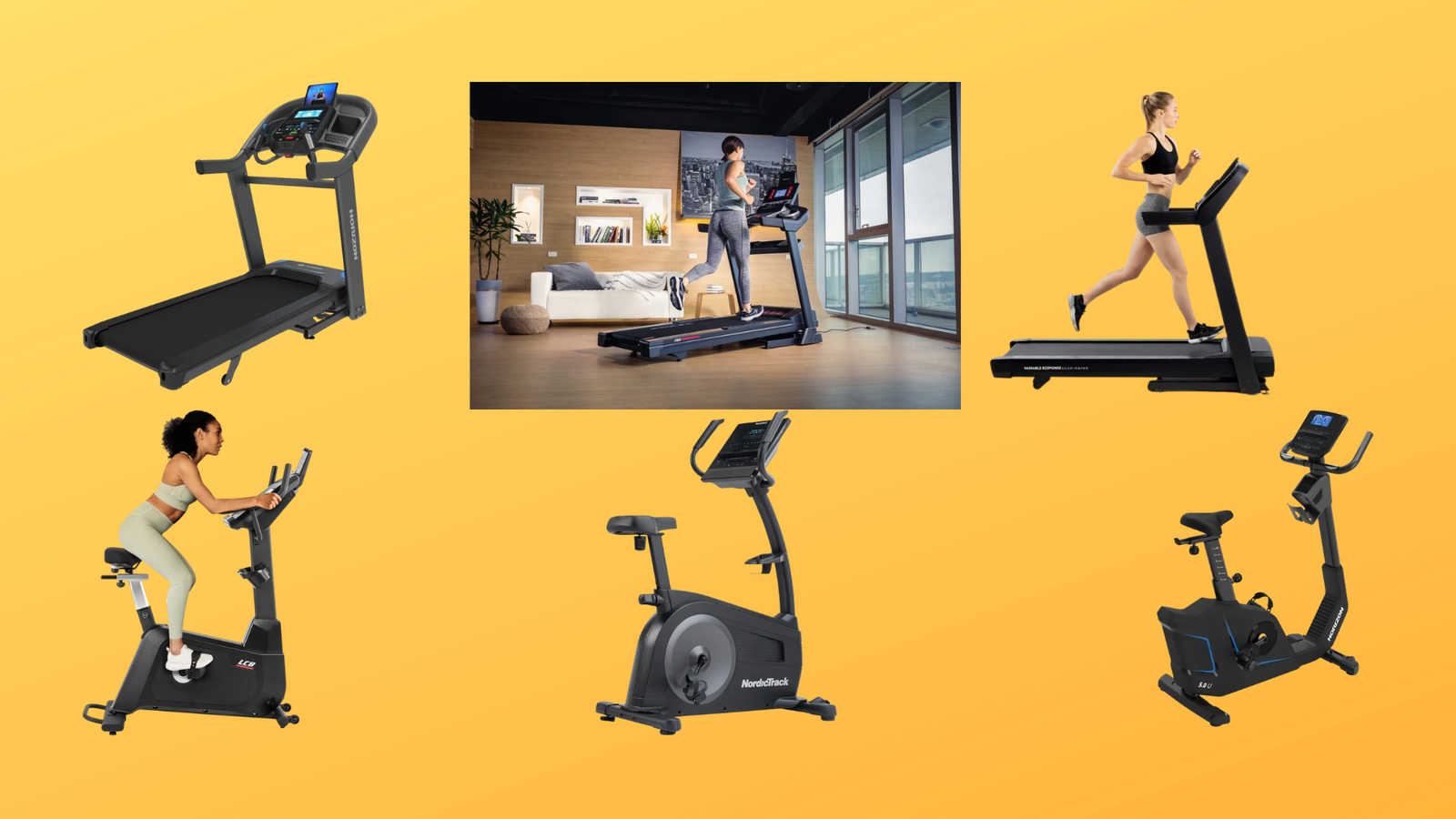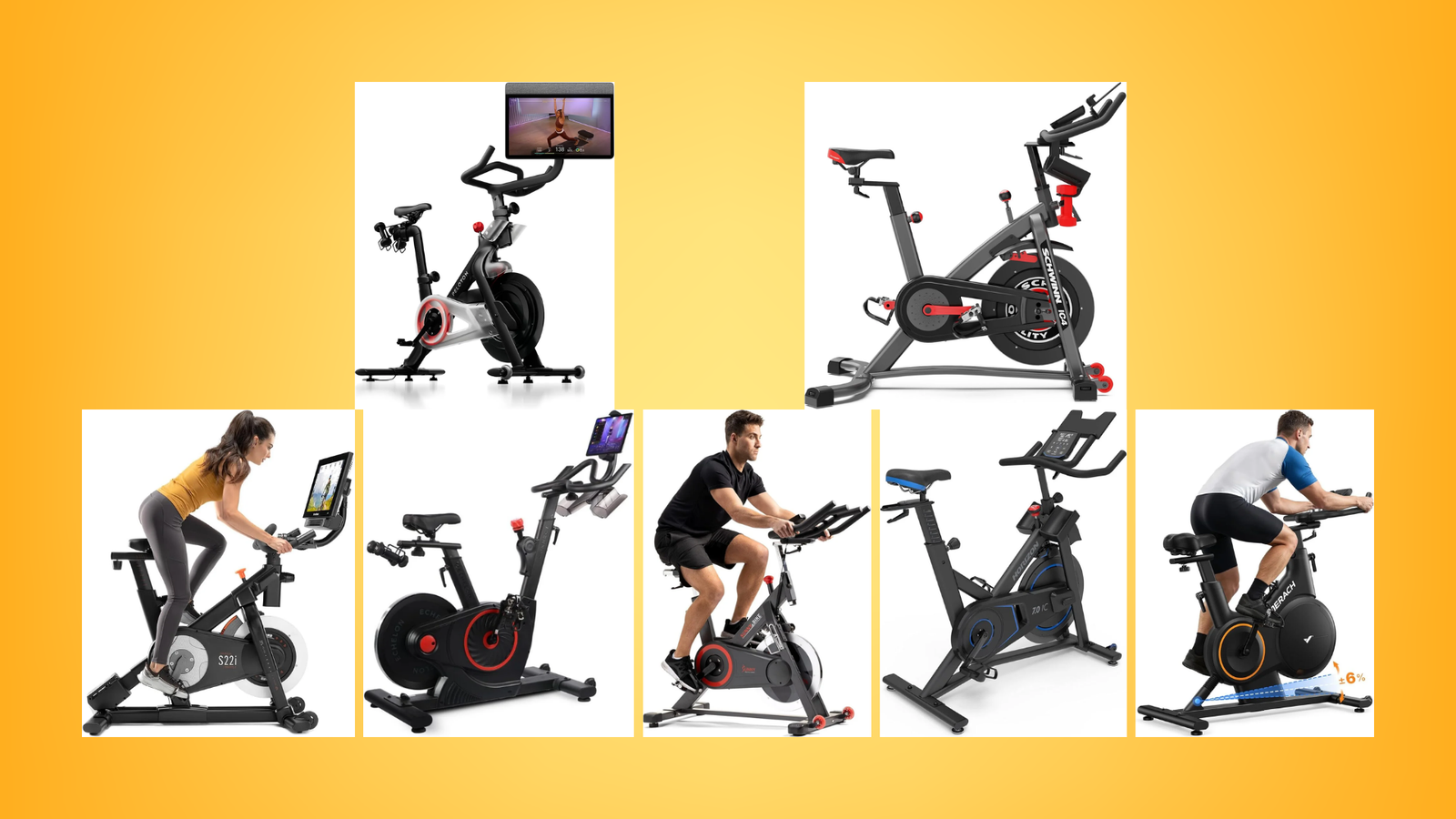
The best indoor cycling bikes deliver a studio-quality workout without the commute, the class schedule, or the gym membership. After 24 years of running and coaching more than 1,000 weight-management clients, I’ve seen firsthand how consistent cycling transforms cardiovascular fitness — particularly for people whose joints can’t handle the impact of running. But not every spin bike delivers what it promises. The wrong flywheel weight, a mandatory subscription you didn’t budget for, or pedals that require special shoes you don’t own can turn a good purchase into a frustrating one.
Quick Answer
The Schwinn IC4 is the best indoor cycling bike for most people — 40 lb flywheel, connects to Peloton and Zwift without any subscription, and a 10-year frame warranty at a mid-range price. For the best studio experience with a built-in screen, the Peloton Bike remains the benchmark. Budget buyers who want serious flywheel weight without subscriptions should look at the Sunny SF-B1805SMART with its class-leading 44 lb flywheel.
Table of Contents
Best Indoor Cycling Bikes: Quick Comparison
| Bike | Flywheel Weight | Resistance Levels | Weight Capacity | Built-in Screen | Subscription Required | Warranty (Frame) |
|---|---|---|---|---|---|---|
| Schwinn IC4 | 40 lbs | 100 electromagnetic | 330 lbs | No — BYOD | None | 10 years |
| Peloton Bike | 38 lbs | 100 magnetic | 297 lbs | 21.5″ HD touchscreen | All-Access required | 5 years |
| NordicTrack S22i | Inertia-enhanced | Auto-adjusts via iFIT | 350 lbs | 22″ HD touchscreen | iFIT required | 10 years |
| Echelon EX-5 | 28.6 lbs | 32 magnetic | 300 lbs | No — BYOD | Echelon optional | 1 year |
| Sunny SF-B1805SMART | 44 lbs | Micro-adjustable magnetic | 300 lbs | No — BYOD | None | 3 years |
| Horizon 7.0 IC | 28.6 lbs aluminum | 100 electronic magnetic | 300 lbs | LCD display only | None | Lifetime |
| Merach S28 | 22 lbs | 16 auto magnetic | 350 lbs | No — BYOD | None | 2 years |
1. Schwinn IC4 — Best Overall Indoor Cycling Bike
Warranty: Frame — 10 years | Mechanical Parts — 3 years | Electronics — 3 years | Labor — 1 year
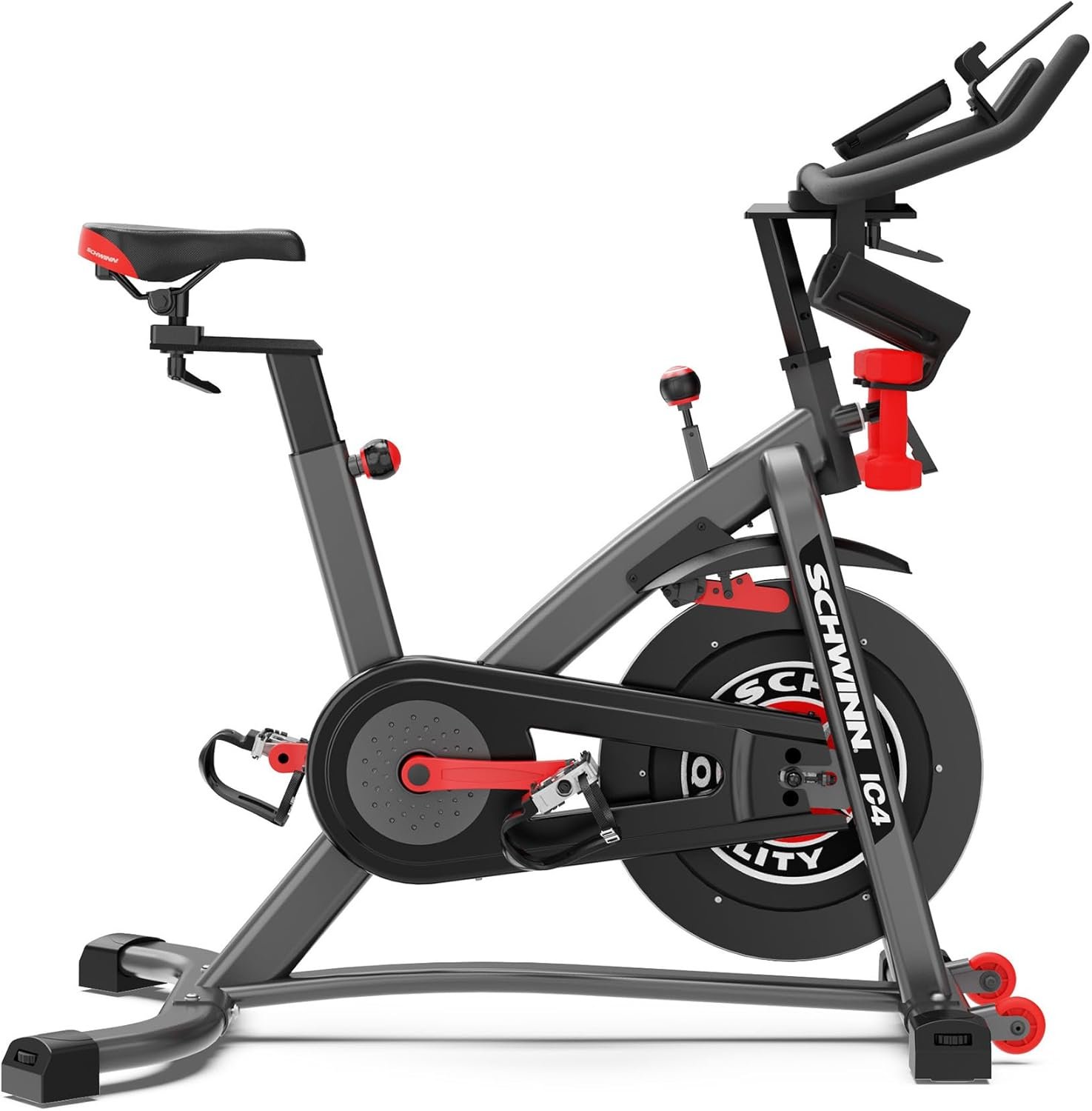
- Flywheel: 40 lbs, electromagnetic resistance
- Resistance: 100 levels, magnetic
- Weight capacity: 330 lbs
- Dimensions: 54.6″ L × 30.7″ W × 51.8″ H
- Machine weight: 113.6 lbs
- User height range: 5’1″–6’4″ (inseam 29″–39″)
- Pedals: Dual-sided — SPD clips + toe cages
- Connectivity: Bluetooth — JRNY, Peloton, Zwift, Kinomap, Sufferfest, Rouvy, Apple Health, Google Fit
- Includes: 3 lb dumbbells, Bluetooth HR armband, media holder, USB charging port
The Schwinn IC4 sits in a unique position in the spin bike market: it connects to Peloton, Zwift, JRNY, and Kinomap without requiring a subscription to any of them. You buy the bike, you choose the app, and you pay nothing extra until you decide you want structured coaching. After working with over a thousand clients, I can tell you this flexibility is exactly what most home cyclists need — not everyone wants to commit to a monthly fitness platform before they’ve established a consistent cycling habit.
What Makes It Different
The IC4 uses electromagnetic resistance — a step above standard magnetic resistance. A dedicated electromagnet precisely controls the resistance field, resulting in smoother transitions between levels and more accurate resistance matching when following app-based workouts. When you’re doing a Peloton class and the instructor calls for resistance level 45, the IC4 actually reflects that number on your display. Most budget spin bikes have manual knobs with no level readout at all. The included Bluetooth heart rate armband completes this picture — your heart rate shows live on the Peloton app, Zwift, or wherever you’re training, without needing a separate chest strap purchase.
The 40 lb flywheel is the sweet spot for home indoor cycling. Heavy enough to feel like real road cycling at all resistance levels — no dead spots in the pedal stroke, no jerky acceleration. Light enough that the bike itself weighs a manageable 113.6 lbs and ships via standard parcel rather than requiring white-glove delivery. The dual-sided pedals deserve specific mention: one side accepts SPD cycling shoes, the other has a standard toe cage for trainers. You can start riding in whatever shoes you own and upgrade to cycling shoes later without needing new pedals.
The three-year electronics warranty is genuinely unusual on a spin bike at this price. Electronics on indoor bikes — the console, the resistance controller, the Bluetooth module — are typically covered for one year. Schwinn covers them for three, which reflects confidence in the build quality. The IC4 is one of the few bikes on this list that will still be under warranty coverage for parts if something goes wrong in year two or three. For a dedicated cardio tool that gets used daily, that matters more than most buyers realise at purchase time.
Best for: Riders who want maximum app flexibility — Peloton, Zwift, JRNY, or Kinomap — without being locked into a subscription, with professional-grade resistance accuracy and a strong 10-year frame warranty.
| Pros | Cons |
|---|---|
| Connects to Peloton, Zwift, JRNY, and Kinomap simultaneously — no subscription required for any of them | No built-in screen — you must provide your own phone or tablet for video workouts |
| Electromagnetic resistance — more accurate level matching than standard magnetic resistance | 330 lb weight capacity — users close to this limit should apply the 20–30 lb headroom rule and look at the NordicTrack S22i or Merach S28 instead |
| 3-year electronics warranty — rare at this price and category | |
| Includes 3 lb dumbbells and HR armband — genuinely useful additions, not just box-filler |
2. Peloton Bike — Best Studio Experience
Warranty: Frame — 5 years | Screen — 1 year | Parts — 1 year | Labor — 1 year
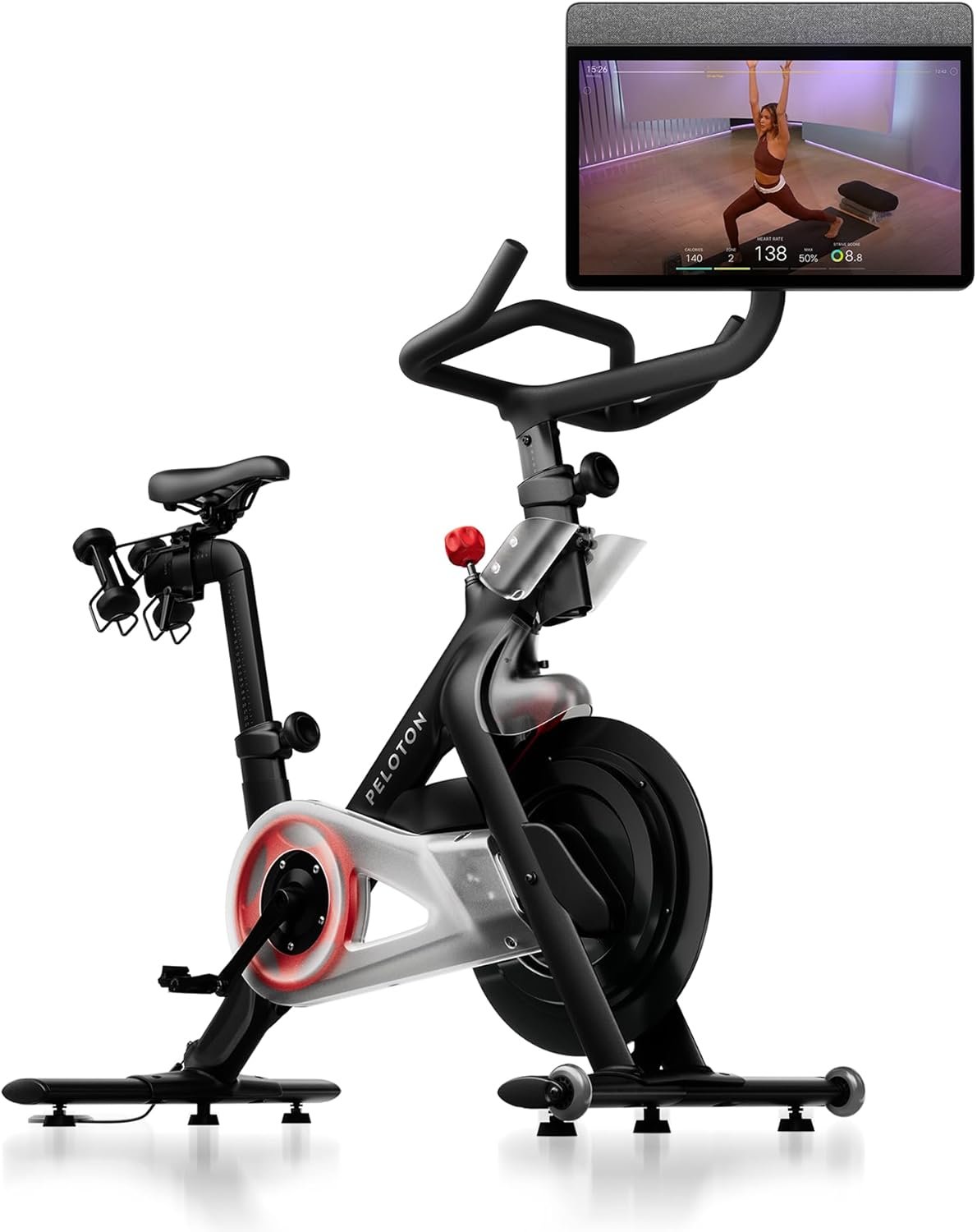
- Flywheel: 38 lbs, magnetic
- Resistance: 100 levels, magnetic knob
- Weight capacity: 297 lbs
- Dimensions: 60″ L × 24″ W × 48″ H
- Machine weight: 135 lbs
- Display: 21.5″ 1080p HD touchscreen
- Pedals: Delta cleat compatible only — cycling shoes required
- Connectivity: Proprietary Peloton — All-Access Membership required for full functionality
The Peloton Bike defined the connected fitness category and it remains the benchmark against which everything else is measured. The 21.5″ HD touchscreen, the live leaderboard, the 50+ world-class instructors, and the community of millions of riders create a training environment that no other bike on this list fully replicates. If you are the type of person who is motivated by competition, by instructor energy, and by belonging to a fitness community, the Peloton’s ecosystem genuinely delivers things that a phone propped against a generic tablet holder cannot.
What Makes It Different
The Peloton’s output metric system is what separates it from every other bike on this list. When you ride a Peloton class, your output is measured in watts and displayed on a leaderboard alongside thousands of other riders doing the same class at the same time or on-demand. This makes every session objectively measurable in a way that “resistance level 42” on other bikes cannot match. Over months of training, you can track genuine fitness improvement — your average output on the same class increases as you get fitter. This feedback loop is what keeps Peloton riders coming back in a way that generic app workouts often don’t.
The build quality is premium throughout — the welded steel frame, the 38 lb flywheel, the smooth belt drive. The resistance knob gives 100 micro-adjustable levels with a satisfying, precise feel. The 21.5″ screen is genuinely large enough to feel immersive during a class. Three things to state honestly before you buy: first, the All-Access Membership costs a significant monthly fee, and without it, the screen shows only basic metrics. Second, the 297 lb weight capacity is the lowest on this list — the 20–30 lb headroom rule applies strictly here. Third, the pedals are Delta cleat only — you will need to buy compatible cycling shoes or a pedal adapter to ride in regular trainers.
The 5-year frame warranty is notably weaker than the industry standard 10-year coverage offered by Schwinn, NordicTrack, and Horizon. You are paying a premium primarily for the content ecosystem and the screen — the hardware warranty does not reflect the bike’s price. That said, according to the American College of Sports Medicine, adherence is the single biggest predictor of long-term exercise outcomes — and if the Peloton community keeps you riding daily, the premium is justified.
Best for: Riders who are motivated by live classes, leaderboard competition, and community — and who will genuinely use the All-Access Membership consistently enough to justify its ongoing cost.
| Pros | Cons |
|---|---|
| 21.5″ HD touchscreen with live leaderboard — the most immersive home cycling experience available | All-Access Membership required to unlock full screen functionality — significant ongoing monthly cost |
| Output (watts) metric system enables objective fitness tracking over time | 297 lb weight capacity — lowest on this list; Delta cleats required, no toe cage option |
| 50+ world-class instructors, live classes daily, 50,000+ on-demand workouts | 5-year frame warranty — below the 10-year standard offered by several competitors at lower prices |
| 38 lb flywheel delivers a smooth, consistent ride across all resistance levels |
3. NordicTrack S22i — Best for Incline Training
Warranty: Frame — 10 years | Parts — 2 years | Labor — 1 year
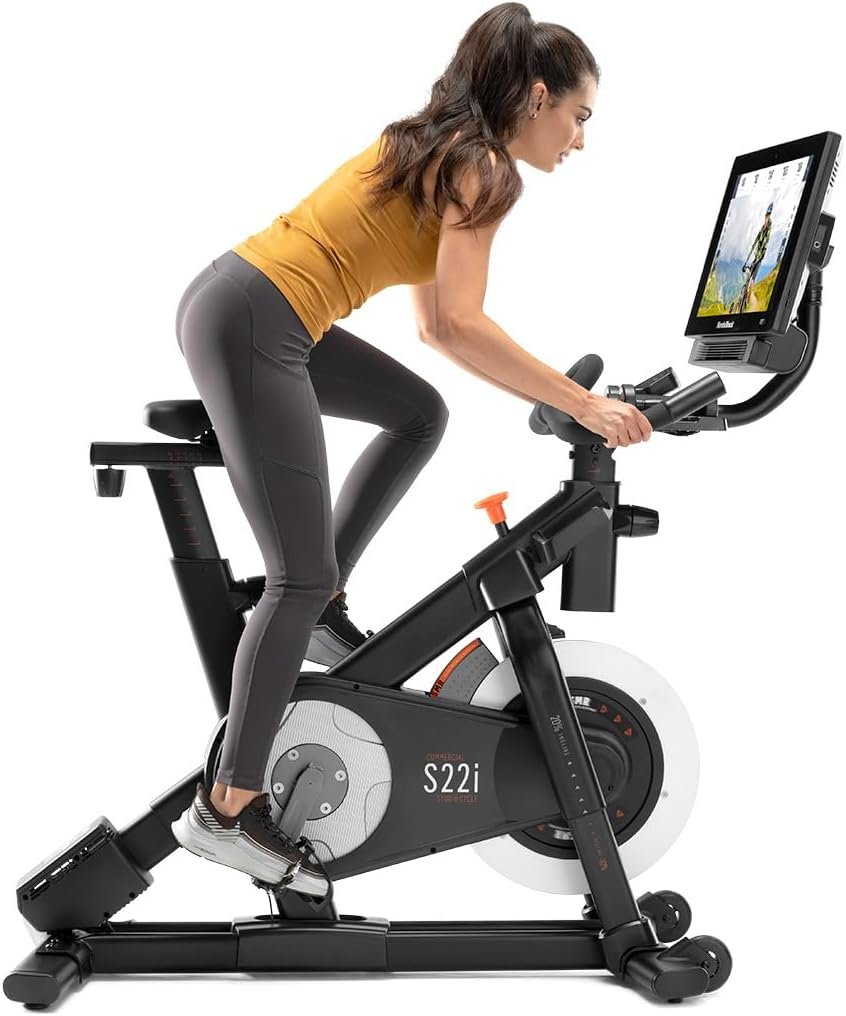
- Flywheel: Inertia-enhanced, SMR Silent Magnetic Resistance
- Incline/Decline: -10% to +20% — trainer auto-adjusts
- Weight capacity: 350 lbs
- Dimensions: 55″ L × 29.1″ W × 56.9″ H
- Display: 22″ Smart HD Touchscreen, 360° rotating
- Pedals: Dual SPD clips + toe cages
- Connectivity: iFIT proprietary — auto-adjusts incline, decline, and resistance
- Includes: Dual 3 lb dumbbells, Bluetooth audio
The NordicTrack S22i does something no other spin bike on this list does: it physically tilts the entire bike frame from -10% decline to +20% incline during your ride. When you’re following an iFIT trainer through the Swiss Alps, the bike leans you forward on the ascent and tips you back on the descent. This isn’t a screen effect — the frame actually moves. Combined with the SMR Silent Magnetic Resistance that adjusts automatically to match the terrain, the S22i creates an outdoor cycling simulation that genuinely feels different from riding a stationary bike.
What Makes It Different
The Quiet Drive Incline Technology is the defining feature. As your iFIT trainer leads you up a 15% gradient in the Dolomites, the bike’s incline mechanism adjusts silently — no grinding, no lag, no manual button pressing. Your resistance simultaneously increases to match the gradient. The result is that climbing on the S22i is genuinely more physically demanding than flat riding, recruiting your glutes and hamstrings differently in a way that flat-resistance spin bikes cannot replicate. The 360° rotating 22″ screen means you can swivel the display to face away from the bike for off-bike strength and stretching sessions — particularly useful with the included 3 lb dumbbells.
The 350 lb weight capacity is the joint-highest on this list alongside the Merach S28 — and the iFIT platform’s trainer-led workouts make it accessible for riders of all fitness levels, not just experienced cyclists. The honest tradeoff is the iFIT subscription requirement. Without it, you are paying a premium price for a 22″ touchscreen that shows limited functionality. If you will genuinely use iFIT’s destination rides and trainer-led interval sessions, the S22i is the most capable training tool on this list. If you’d rather ride with your own music and no coaching, the Schwinn IC4 or Horizon 7.0 IC serve you better for significantly less money. For structured cycling training, pair this with our guide to structured cardio workout programming.
Best for: Serious cyclists and iFIT subscribers who want terrain-matching incline and decline simulation — the only spin bike on this list where the frame physically tilts to match the route.
| Pros | Cons |
|---|---|
| -10% to +20% auto-incline — the frame physically tilts; no other bike on this list does this | iFIT subscription required — significant ongoing monthly cost to unlock full functionality |
| SMR Silent Magnetic Resistance auto-adjusts to match terrain hands-free | Proprietary Bluetooth — does not natively connect to Zwift or Kinomap the way open-platform bikes do |
| 22″ HD touchscreen rotates 360° for off-bike training | |
| 350 lb weight capacity — highest alongside Merach S28 |
4. Echelon EX-5 — Best for Live Classes Without the Peloton Price
Warranty: Frame — 1 year | Parts — 1 year | Labor — 1 year
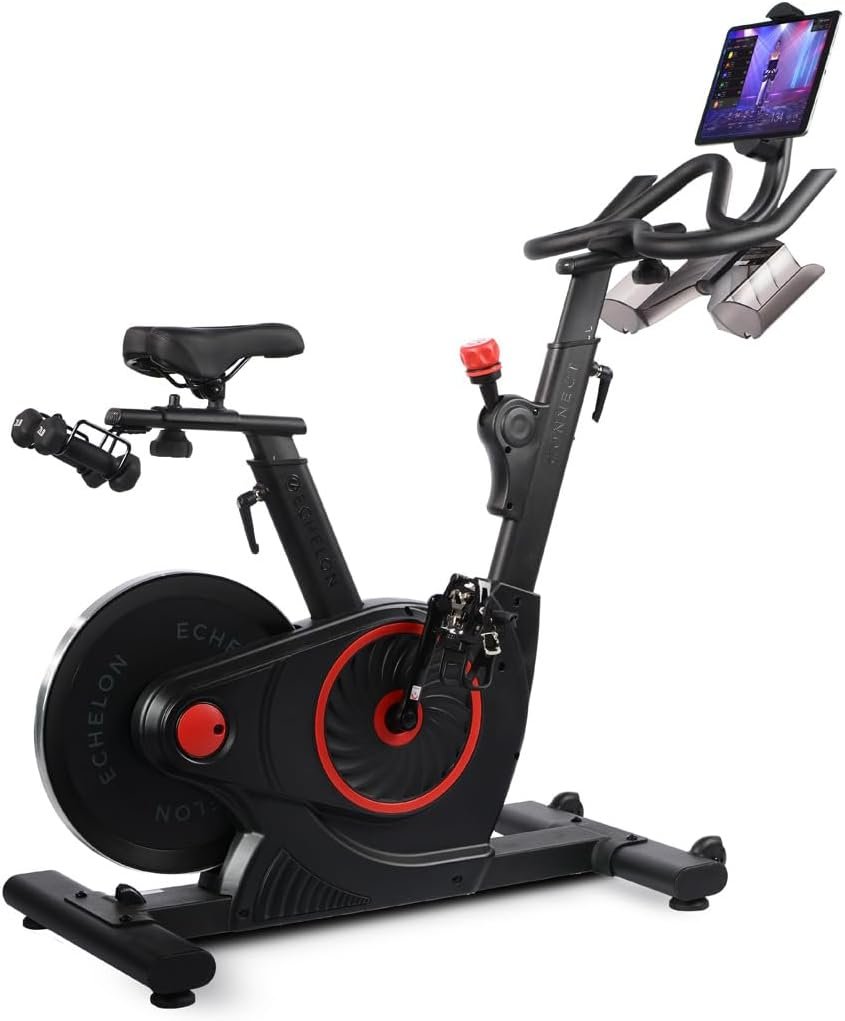
- Flywheel: 28.6 lbs, rear-mounted magnetic
- Resistance: 32 levels, magnetic knob
- Weight capacity: 300 lbs
- Dimensions: 58″ L × 20″ W × 55″ H
- Machine weight: 124 lbs
- Display: No screen — device holder rotates 180° for off-bike workouts
- Pedals: Dual SPD clips + toe cages
- Connectivity: Bluetooth — Echelon Fit app, 32-level motorised e-Drive resistance
The Echelon EX-5 is built on the same mechanical platform as the more expensive EX-5s-22 — same 28.6 lb flywheel, same 32-level magnetic resistance system, same competition aero handlebars, same dual SPD and toe cage pedals — without the built-in touchscreen. If you already own a tablet, you’re getting the same Echelon Fit class experience for significantly less than the screen-equipped version. The Echelon Fit library runs to over 15,000 on-demand workouts across cycling, strength, yoga, and HIIT, with live classes added daily and an optional leaderboard for competitive riders.
What Makes It Different
The motorised e-Drive resistance system is the defining feature. Unlike the manual knob on most spin bikes, the EX-5’s resistance can be adjusted automatically by the Echelon Fit app during class — when the instructor calls for a resistance change, it happens without you reaching for a knob. This hands-free resistance transition during HIIT intervals changes how the class feels. The rear flywheel design is also worth noting: most spin bikes mount the flywheel at the front, giving the bike a front-heavy feel. The EX-5’s rear flywheel creates a more balanced weight distribution that many experienced cyclists find more natural.
The 180° rotating device holder is genuinely useful — it flips to face away from the bike so you can follow an off-bike strength or yoga class without dismounting and repositioning a stand. The aero competition handlebars accommodate multiple grip positions, including an aero tuck that road cyclists use for sprint efforts. One thing to state clearly: the 1-year warranty across frame, parts, and labor is the weakest on this list. If you use the bike hard daily, the warranty gap compared to the Schwinn IC4 (10-year frame, 3-year parts) or Horizon 7.0 IC (lifetime frame) is meaningful. Echelon’s Premier Membership extends coverage to 5 years — but that requires a paid subscription, which adds to the ongoing cost.
Best for: Riders who want Echelon’s live class community and motorised resistance adjustment without paying for a built-in touchscreen they don’t need.
| Pros | Cons |
|---|---|
| Motorised e-Drive resistance adjusts automatically during Echelon Fit classes — hands-free transitions | 1-year warranty across all components — weakest coverage on this list by a significant margin |
| Rear flywheel design creates a more balanced, road-bike-like weight distribution | 28.6 lb flywheel — lighter than the Schwinn IC4 (40 lbs) or Sunny SF-B1805SMART (44 lbs) |
| 15,000+ on-demand classes plus daily live sessions — competitive alternative to Peloton at lower cost | |
| Device holder rotates 180° for off-bike workouts without repositioning |
5. Sunny SF-B1805SMART — Best Mid-Budget Spin Bike
Warranty: Frame — 3 years | Other parts — 180 days
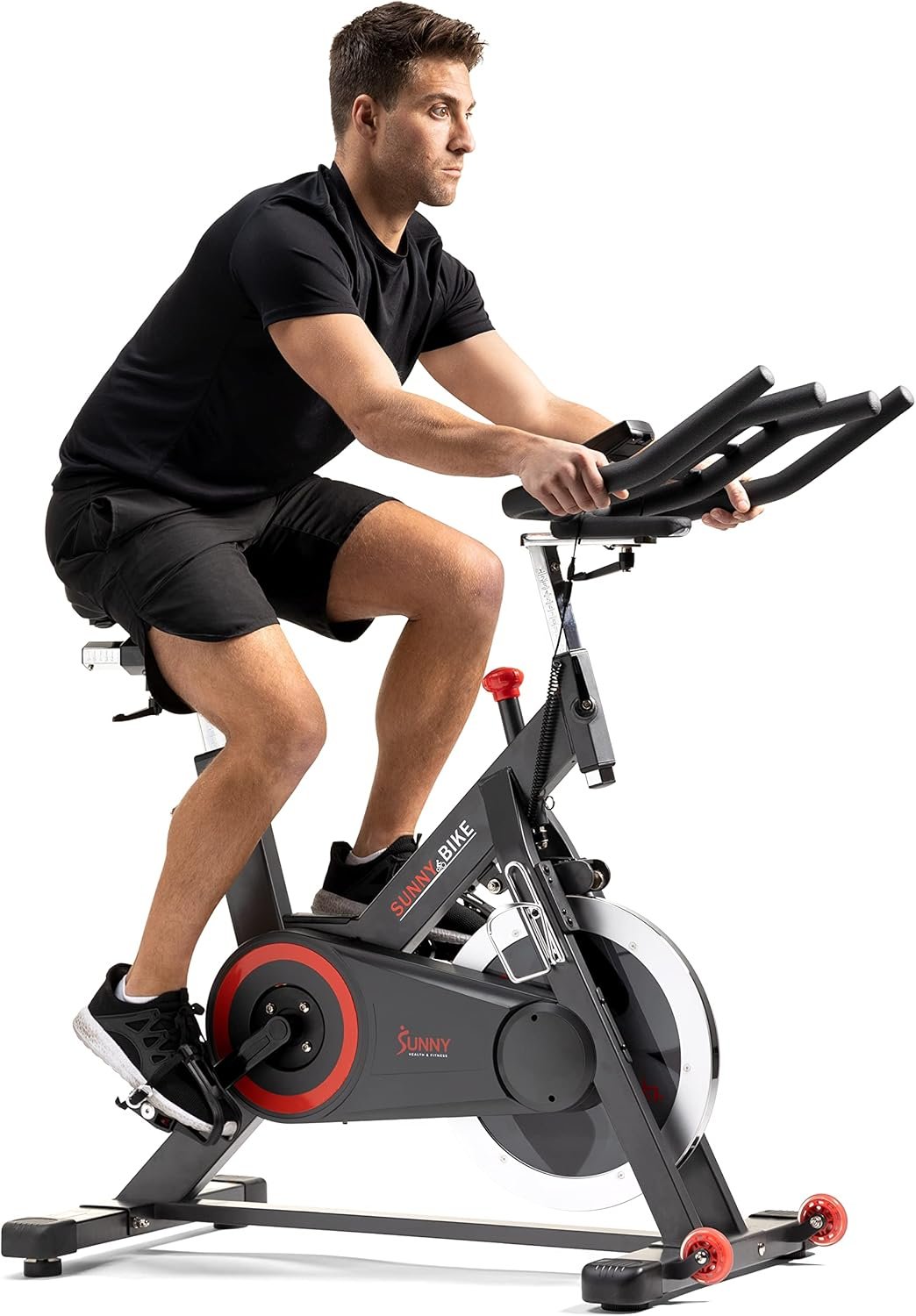
- Flywheel: 44 lbs — heaviest on this list
- Resistance: Micro-adjustable magnetic
- Weight capacity: 300 lbs
- Dimensions: 48″ L × 23″ W × 45″ H
- Machine weight: 125.7 lbs
- Inseam range: 28″–38″
- Pedals: Dual clip-in + cage
- Connectivity: Bluetooth — SunnyFit app (free, no subscription)
- Q-factor: 182mm
The Sunny SF-B1805SMART has the heaviest flywheel on this entire list at 44 lbs — heavier than the Peloton (38 lbs), heavier than the Schwinn IC4 (40 lbs), and dramatically heavier than the Echelon EX-5 (28.6 lbs). In practical terms, a heavier flywheel means more momentum once you get it spinning, smoother transitions between resistance levels, and a ride that feels closer to actual road cycling. For someone coming from gym spin classes and wanting that same heavy, fluid feel at home, the SF-B1805SMART delivers it at a fraction of the price of the premium bikes above.
What Makes It Different
The SunnyFit app is genuinely free — no subscription tier, no paywall behind the core features. You get over 1,000 trainer-guided workout videos, 10,000+ virtual scenic tours, real-time metrics during your ride, and community leaderboard features without paying a monthly fee. The app syncs your data with Apple Health and Google Fit automatically. This combination of the heaviest flywheel on the list and a fully-featured free app makes the SF-B1805SMART exceptional value for the mid-budget buyer who doesn’t want ongoing subscription costs.
The multi-grip handlebars support several riding positions — drops, hoods, flat bars, and an aero tuck — which matters for longer rides where hand fatigue becomes a factor. The dual clip-in and cage pedals match what you’d find on bikes costing twice as much. Two honest limitations: the 180-day warranty on parts other than the frame is very short — replace the frame warranty coverage with a market-leading 44 lb flywheel and the tradeoff becomes clear. If anything goes wrong with the electronics or resistance mechanism in month seven, you’re out of warranty. For this reason I’d recommend pairing this bike with a treadmill mat and keeping it well-maintained. For heavier riders, note the 300 lb capacity — the 20–30 lb headroom rule applies here as it does across all bikes in this range.
Best for: Budget-conscious riders who want the heaviest flywheel available plus a fully-featured free training app, without any ongoing subscription cost.
| Pros | Cons |
|---|---|
| 44 lb flywheel — heaviest on this list, delivers the most authentic road-cycling feel | 180-day parts warranty — very short; anything beyond the frame is uncovered after 6 months |
| SunnyFit app is genuinely free — 1,000+ workouts and 10,000+ virtual tours at no ongoing cost | 300 lb weight capacity — apply the 20–30 lb headroom rule; not suitable for riders over 270–280 lbs |
| Multi-grip handlebars support drops, hoods, flat, and aero positions | |
| Compact 48″×23″ footprint — smaller than most bikes on this list |
6. Horizon 7.0 IC — Best No-Subscription Indoor Cycle
Warranty: Frame — Lifetime | Parts — 1 year | Labor — 1 year
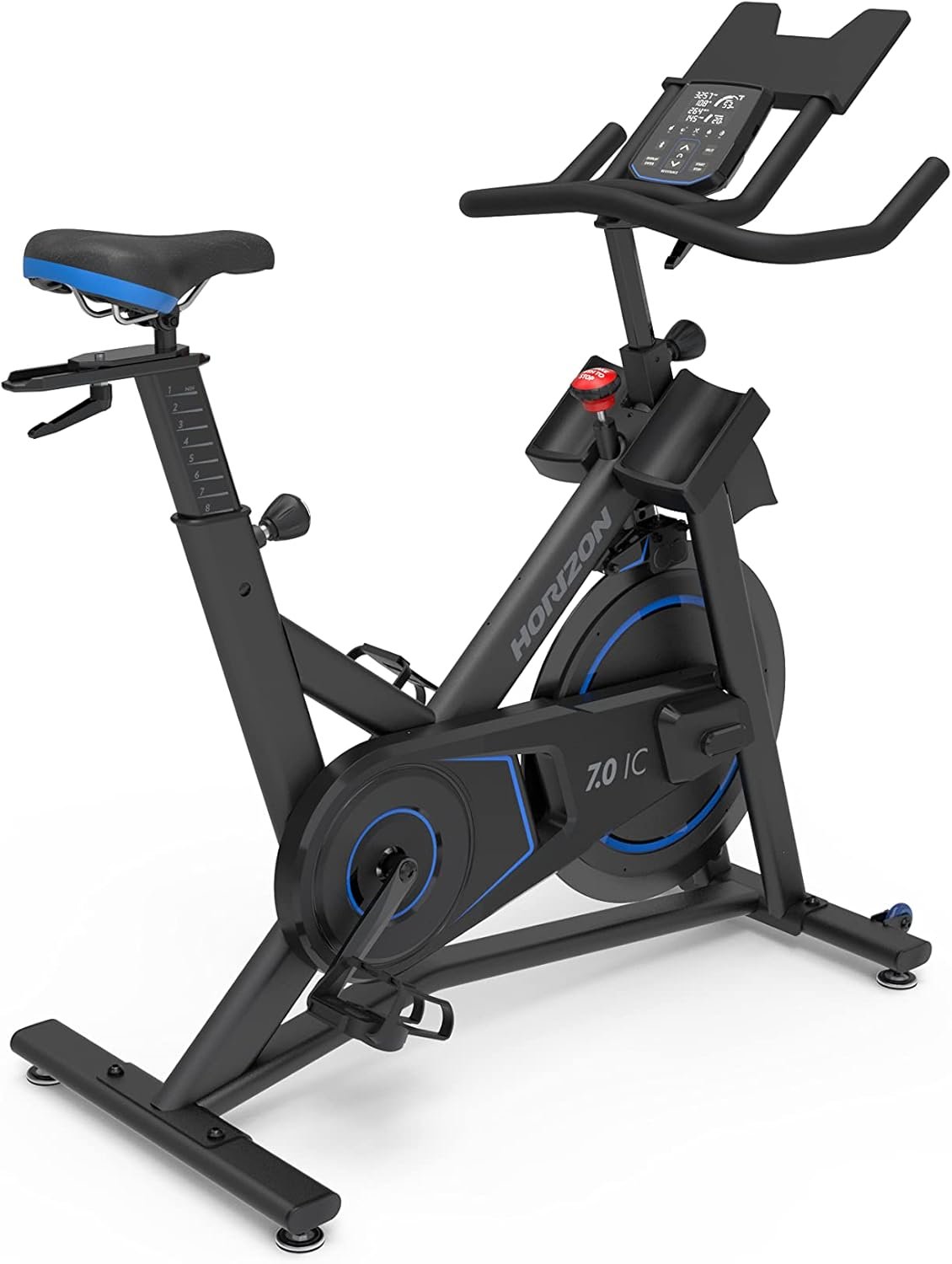
- Flywheel: 28.6 lbs, precision aluminum
- Resistance: 100 levels, electronic magnetic
- Weight capacity: 300 lbs
- Dimensions: 47.25″ L × 20.87″ W × 47.25″ H
- Machine weight: 87 lbs — lightest on this list
- Display: High-contrast LCD — tracks resistance, cadence, heart rate, watts, time, distance, calories, speed
- Pedals: Dual SPD clips + toe cages
- Connectivity: FTMS Bluetooth — Zwift, Peloton, Kinomap; includes HR armband
The Horizon 7.0 IC is the only bike on this list with a lifetime frame warranty — and as with their treadmills, Horizon backs this up with the same engineering philosophy across the range. At 87 lbs, it’s also the lightest bike here, which matters more than most buyers expect. A 135 lb bike (Peloton) that you need to move for vacuuming, for guests, or for floor rearrangement is a different daily reality than an 87 lb bike you can roll on its integrated transport wheels with one hand. The compact 47.25″ length is 13″ shorter than the Peloton and 8″ shorter than the Schwinn IC4, making it the best fit for genuinely small spaces.
What Makes It Different
The electronic resistance control — 100 levels adjusted at the touch of a button — is a step above the manual knob systems on the Echelon EX-5 and Sunny SF-B1805SMART. You can make precise, repeatable resistance changes mid-ride without losing your grip position or disrupting your cadence. The FTMS Bluetooth connects to Zwift, Peloton, Kinomap, and most third-party cycling apps with full metric sharing — your speed, cadence, power, and heart rate all transmit to the app automatically. This is the same open standard used by dedicated bike trainers that serious cyclists pay significantly more for.
The watts readout on the LCD console is notable for a bike at this price. Watts is the most accurate measure of cycling effort — more useful than speed or resistance level — and having it displayed in real time lets you set precise training targets without relying on any app. For riders following periodised training plans, this is genuinely valuable. The lifetime frame warranty combined with the open-platform FTMS Bluetooth makes the 7.0 IC the best long-term investment on this list for riders who don’t want subscription lock-in. For a comprehensive home cardio setup, this pairs well with our best home treadmill guide.
Best for: Riders who want open-platform FTMS Bluetooth, a lifetime frame warranty, and maximum portability — without paying for a subscription platform or a built-in screen.
| Pros | Cons |
|---|---|
| Lifetime frame warranty — the strongest coverage on this list | 28.6 lb flywheel — lighter than the IC4 and Sunny; noticeable at very high resistance levels |
| FTMS Bluetooth — connects to Zwift, Peloton, Kinomap natively with full metric sharing | Basic LCD display only — no streaming, no touchscreen |
| Watts readout on the LCD console — precise effort measurement without any app required | |
| 87 lbs machine weight — lightest on this list, easiest to move and store |
7. Merach S28 — Most Innovative: Auto Incline and Decline
Warranty: Frame — 2 years | Parts — 2 years | Labor — 2 years
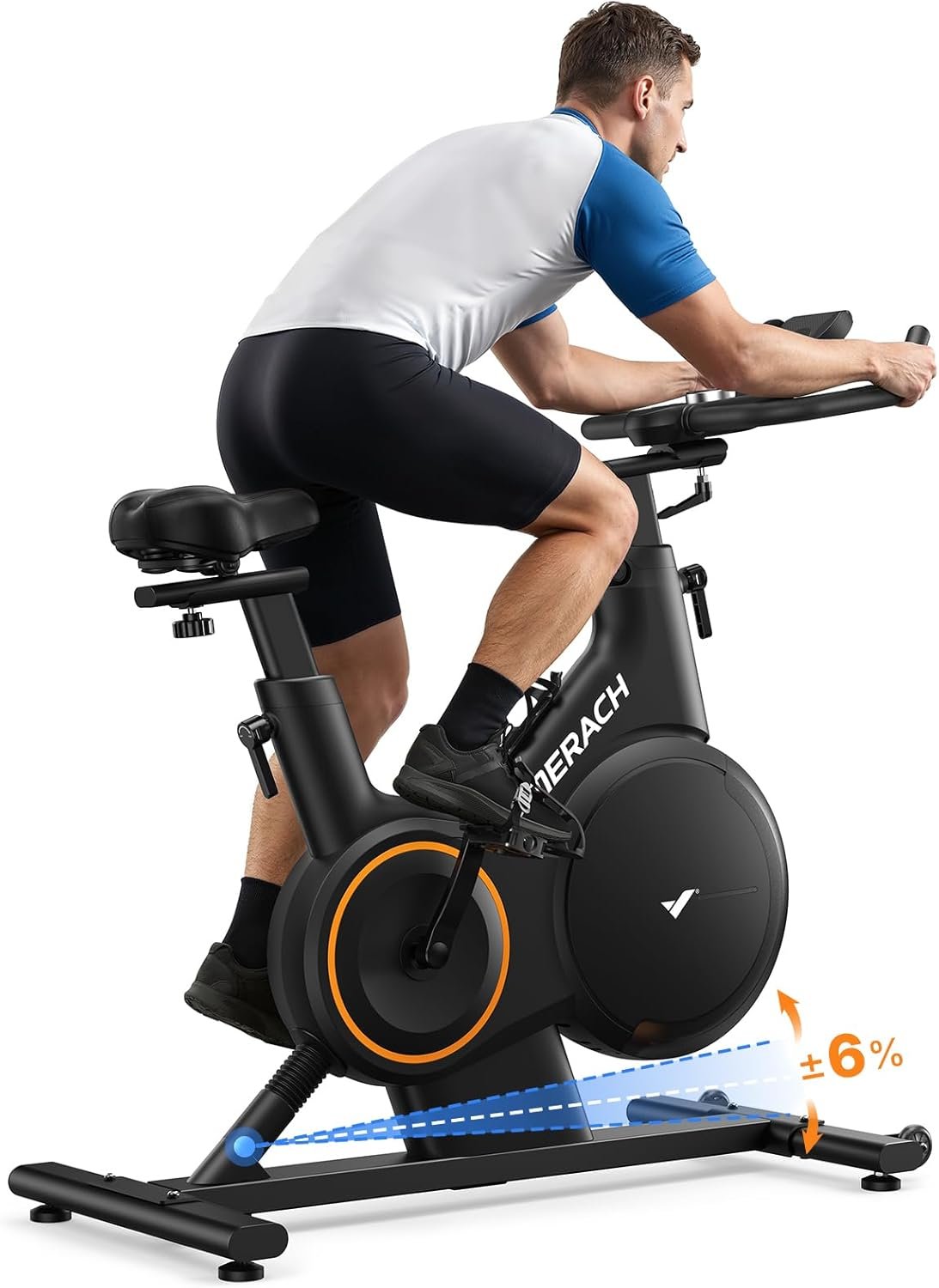
- Flywheel: 22 lbs (10 kg)
- Resistance: 16 auto-adjustable magnetic levels
- Incline/Decline: ±6° automatic
- Weight capacity: 350 lbs
- User height range: 4’8″–6’4″
- Display: No screen — tablet holder included
- Pedals: Toe cages
- Connectivity: Merach app + FantomFite gaming app — no subscription required
The Merach S28 introduces something genuinely new to the home spin bike category: automatic ±6° incline and decline simulation on a spin bike frame. Unlike the NordicTrack S22i which physically tilts the entire bike, the S28 simulates gradient by tilting the platform your feet ride on while adjusting resistance automatically to match the grade. The result is that uphill pedalling recruits your glutes and lower back differently from flat riding, and downhill pedalling changes your weight distribution and momentum in a way that flat-resistance bikes cannot replicate.
What Makes It Different
The FantomFite gaming app integration is the S28’s most distinctive feature after the incline system. Rather than following a fitness instructor, FantomFite turns your ride into a game — you complete missions, ride virtual terrain, and compete against other riders in a gamified environment. For riders who find traditional fitness classes boring or feel intimidated by competitive leaderboards, the game format provides a genuinely different motivational approach. Both the Merach app and FantomFite are completely free — no subscription tier, no paywall.
The 350 lb weight capacity matches the NordicTrack S22i as the highest on this list, which is notable for a bike from a newer brand. The H-Frame design specifically addresses stability for heavier users — the dual base rails create a wider, lower centre of gravity than the single-column frames on most spin bikes. One honest limitation to state clearly: the 22 lb flywheel is the lightest on this list. At maximum resistance, the ride feels noticeably less smooth than the 38–44 lb flywheels on the Peloton, Schwinn, and Sunny. For high-intensity sprint intervals, this is perceptible.
For steady-state cardio and moderate HIIT, most riders won’t notice it. The bike is also new to Amazon — early reviews are positive, but the review count is low, so long-term reliability data is limited compared to the established brands above. Research from the National Institutes of Health shows that variety in exercise modality improves long-term adherence, and the S28’s terrain simulation genuinely adds variety that flat bikes cannot.
Best for: Riders who want terrain simulation and incline/decline training on a spin bike, and those who prefer gamified workout motivation over traditional instructor-led classes.
| Pros | Cons |
|---|---|
| ±6° auto incline/decline — the only spin bike on this list that simulates terrain gradient | 22 lb flywheel — lightest on this list; less momentum at high resistance than heavier-flywheel competitors |
| FantomFite gaming app turns rides into missions — completely free, genuinely different motivation approach | New Amazon listing with limited reviews — long-term reliability unproven compared to established brands |
| 350 lb weight capacity — joint highest on this list | |
| No subscription required for either the Merach app or FantomFite |
How to Choose an Indoor Cycling Bike: 6 Things That Actually Matter
1. Flywheel Weight — The Most Important Spec Most Buyers Ignore
The flywheel is the engine of your ride. A heavier flywheel builds more momentum, smooths out your pedal stroke, and makes the bike feel like real road cycling. A light flywheel (under 20 lbs) will feel jerky and uneven, particularly at lower cadences. For home use, aim for a minimum of 28–30 lbs. The sweet spot is 38–44 lbs — above this, the returns diminish for most riders, but below 28 lbs you’ll notice the limitation during HIIT and sprint intervals. The Merach S28’s 22 lb flywheel is the only exception on this list, compensated for by the incline simulation feature.
2. Subscription Cost — Calculate the 3-Year Total Before Buying
Three bikes on this list require subscriptions to unlock full functionality. The cost compounds significantly over time on top of the hardware price. Before buying, decide honestly whether you will use a coaching platform consistently — and if you’re not sure, choose a subscription-free bike first. The Schwinn IC4, Sunny SF-B1805SMART, Horizon 7.0 IC, and Merach S28 all offer full functionality with no ongoing fees. The Echelon EX-5 subscription is optional — the bike works without it.
3. Pedal Compatibility — Check This Before You Order
The Peloton uses Delta cleats exclusively — it does not include a standard toe cage. If you don’t own Delta-compatible cycling shoes, you’ll need to buy them or purchase a pedal adapter. Every other bike on this list includes dual-sided pedals with both SPD clips and toe cages, meaning you can ride in regular trainers from day one and upgrade to cycling shoes later. Never assume pedal compatibility — always check the specific model before buying.
4. Resistance Type — Magnetic vs Electromagnetic vs Friction
Standard magnetic resistance uses a fixed magnet that moves closer or further from the flywheel. Electromagnetic resistance (Schwinn IC4) uses a powered electromagnet for more precise, digitally controlled tension. Friction resistance uses a brake pad against the flywheel — quieter versions use felt pads; cheaper versions use rubber. For home use, avoid friction resistance entirely — it wears out, creates noise and dust, and requires periodic pad replacement. All bikes on this list use magnetic or electromagnetic resistance.
5. Weight Capacity — Apply the 20–30 lb Headroom Rule
The rated weight capacity is the maximum — not the ideal operating load. Cycling generates impact forces greater than your body weight, particularly during standing sprint efforts. Always choose a bike rated at least 20–30 lbs above your actual weight. The Peloton Bike’s 297 lb capacity is the tightest on this list — at 270 lbs body weight, the Peloton is already operating close to its limit during hard efforts. The NordicTrack S22i and Merach S28 (both 350 lbs) give heavier riders the most headroom. For heavier riders exploring all low-impact cardio options, see our elliptical for heavy person guide.
6. Warranty — What the Frame Coverage Tells You
Frame warranty is the manufacturer’s confidence statement. Horizon (lifetime), Schwinn IC4 (10 years), and NordicTrack S22i (10 years) are engineering their bikes to last. The Peloton’s 5-year frame coverage is notably weak for a premium-priced machine. The Echelon EX-5’s 1-year across all components is the weakest on this list — if daily heavy use is your plan, the warranty gap matters. Prioritise frame warranty when comparing long-term value.
Indoor Cycling Bike vs Treadmill: Which Burns More Calories?
This is the question I get asked most by clients choosing their first home cardio machine. The honest answer is that at equivalent effort levels, the calorie burn is similar — but effort level is the key phrase. A treadmill walking at 3.5 mph is genuinely low effort. A spin bike at low resistance is also genuinely low effort. The machine that burns more calories is the one you push harder on — and that varies by person.
Where cycling has a genuine advantage is joint impact. Running at 6 mph generates impact forces of 2–3 times body weight with every stride. Cycling generates essentially zero impact — the pedalling motion is entirely circular. For clients with knee, hip, or lower back issues, cycling delivers equivalent cardiovascular training at a fraction of the joint stress. After 24 years of working with runners, I’ve seen cycling extend active training years for people whose joints couldn’t sustain running frequency.
Where the treadmill has an advantage is whole-body engagement. Running uses your arms, core, and upper body actively. Cycling isolates the lower body almost entirely — unless you’re using a bike with upper-body features or doing standing sprint efforts. For overall body composition, a combination of both modalities is more effective than either alone. For a deeper look at how to structure cardio training, see our guide to cross-training with different cardio machines.
Indoor Cycling Bike FAQs
What is the best indoor cycling bike for home use?
The Schwinn IC4 is the best indoor cycling bike for most home users. It combines a 40 lb flywheel, electromagnetic resistance, connections to Peloton, Zwift, JRNY, and Kinomap without any subscription, and a 10-year frame warranty. For riders who want a built-in screen and live classes, the Peloton Bike is the premium choice.
Do I need a subscription to use an indoor cycling bike?
No. The Schwinn IC4, Sunny SF-B1805SMART, Horizon 7.0 IC, and Merach S28 all function fully without any subscription. The Echelon EX-5 works without a subscription but unlocks more classes with one. The Peloton Bike and NordicTrack S22i require subscriptions — iFIT and Peloton All-Access respectively — to access their full screen functionality.
What flywheel weight is best for a spin bike?
For home use, aim for a minimum of 28 lbs flywheel weight. The sweet spot is 38–44 lbs — heavy enough to feel like road cycling with smooth momentum through resistance changes, without making the bike too heavy to move. The Sunny SF-B1805SMART has the heaviest flywheel on this list at 44 lbs. Under 20 lbs feels noticeably jerky during sprint intervals.
Can you lose weight with an indoor cycling bike?
Yes. Indoor cycling is an effective tool for weight loss when combined with appropriate nutrition. A 30-minute moderate-intensity cycling session burns approximately 200–400 calories depending on body weight and effort level. The consistency advantage of home equipment — no travel time, no class schedule, no weather dependency — makes it easier to achieve the frequency needed for sustainable fat loss.
What is the difference between an indoor cycling bike and an upright exercise bike?
An indoor cycling bike (spin bike) has a heavy flywheel, a fixed-gear drive, and a riding position that mimics a road bike — leaned forward, weight partially on the handlebars. An upright exercise bike has a lighter flywheel, independent pedalling, and an upright seated position more like a casual bicycle. Spin bikes are better for high-intensity interval training and cyclists. Upright bikes are better for casual cardio and longer comfortable sessions.
Is a spin bike good for bad knees?
Yes — indoor cycling is one of the best low-impact cardio options for people with knee problems. The circular pedalling motion generates almost no impact force compared to running, and the resistance is fully adjustable so you can keep intensity low while protecting the joint. Ensure your saddle height is set correctly — your knee should have a slight bend at the bottom of the pedal stroke, never fully locked out.
Can I use Zwift with an indoor cycling bike?
Yes, provided the bike supports FTMS Bluetooth. The Schwinn IC4 and Horizon 7.0 IC both support Zwift natively via FTMS. The Peloton and NordicTrack S22i use proprietary Bluetooth that does not natively integrate with Zwift. The Echelon EX-5 connects to Zwift via the Echelon app with some limitations.
How often should I ride an indoor cycling bike?
For cardiovascular fitness improvement, three sessions per week of 30–45 minutes each is an effective baseline. For weight loss, four to five sessions per week produces better results. Rest days between sessions allow muscle recovery — cycling daily without rest can lead to overuse fatigue, particularly in the hips and knees. Start with three sessions and increase frequency as your fitness improves.
Disclosure: This article contains affiliate links. If you purchase through our links we may earn a commission at no extra cost to you. All products were selected based on performance, value, and availability — not commission rates.