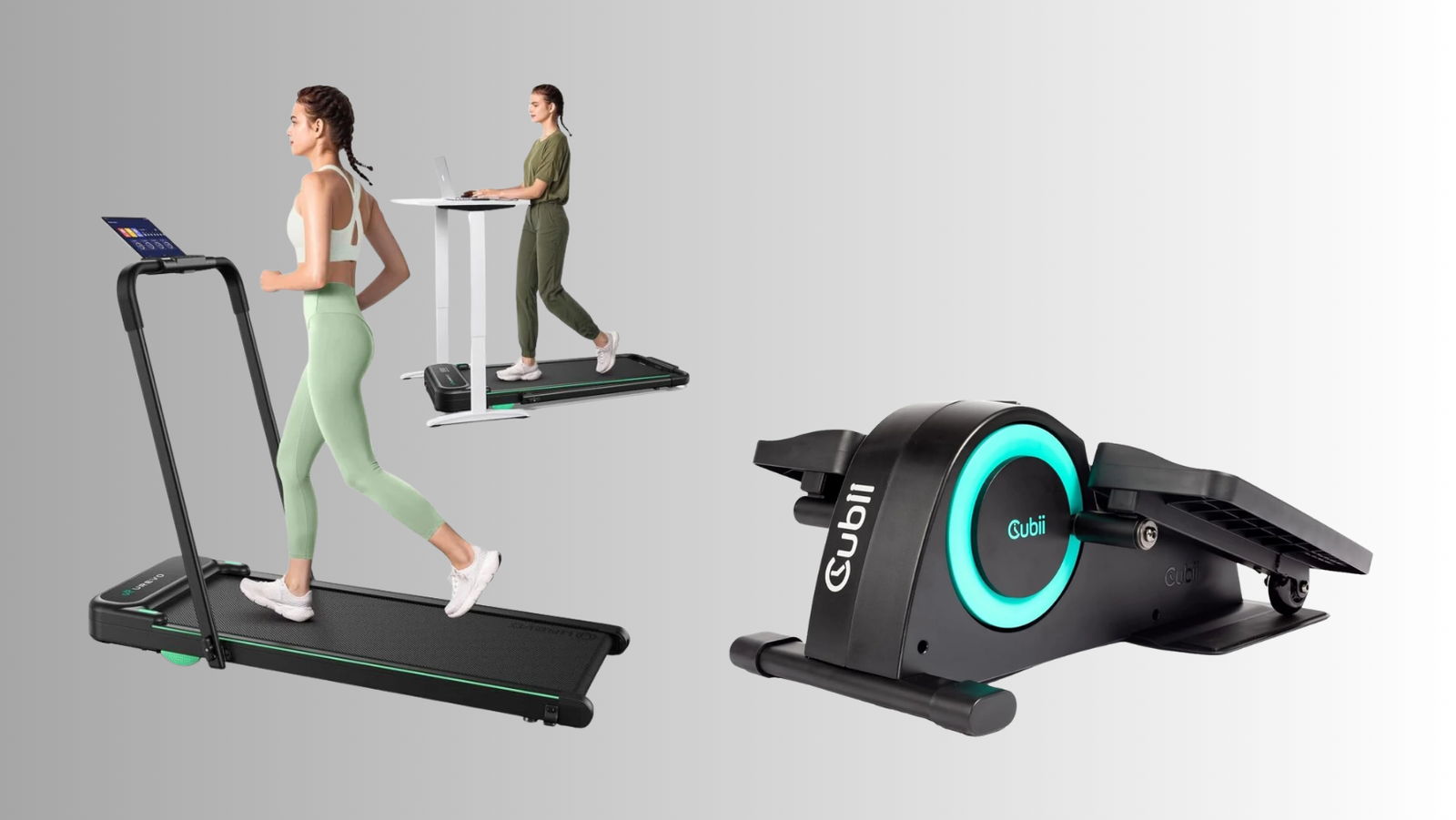
Quick Answer: Choose an under-desk elliptical if you sit while working — it fits under a standard desk and keeps your legs moving without requiring you to stand. Choose an under-desk treadmill if you use a sit-stand desk and want to walk during work sessions. Treadmills burn more calories and provide more structured exercise. Ellipticals are quieter, more compact, and require zero posture adjustment. For most desk workers, the treadmill produces better fitness results if you already own a standing desk.
The under desk elliptical vs treadmill debate comes down to one fundamental question: are you sitting or standing while you work? That single answer determines which machine belongs under your desk — and getting it wrong means buying equipment you stop using within a month. After 24 years in fitness and helping over a thousand people build sustainable movement habits, I’ve seen both machines work brilliantly for the right buyer and collect dust for the wrong one.
This guide cuts through the noise. I’ll compare both machines across every factor that actually matters for desk-based use — joint impact, calorie burn, noise, space, cost, and cognitive distraction — and give you a plain-English verdict on which one fits your specific situation.
Table of Contents
Under Desk Elliptical vs Treadmill: The Core Difference
Before comparing specs, understand the fundamental distinction between these two machines — because it changes everything else.
An under desk elliptical is used while seated. You sit in your chair, place your feet on the pedals, and move your legs in a smooth elliptical motion while your upper body stays still and productive. Your chair bears your full body weight. The machine sits flat under your desk and only needs to accommodate the pedaling motion of your lower legs.
An under desk treadmill — also called a walking pad — is used while standing. You stand on a moving belt at slow walking speeds (1–4 mph) beneath a standing desk. The machine bears your full body weight. It requires a standing desk to use while working, and needs significantly more floor space than a seated elliptical.
If you have a traditional seated desk, an under desk elliptical is your only realistic option. If you have a standing desk and want to walk while you work, an under desk treadmill is the better fit. For many buyers, this single factor resolves the decision before any other comparison is needed.
Head-to-Head Comparison Table
| Factor | Under Desk Elliptical | Under Desk Treadmill |
|---|---|---|
| Use position | Seated | Standing |
| Desk required | Any desk | Standing desk required |
| Calories burned/hr | 150–250 | 200–350 |
| Joint impact | Very low — no body weight on machine | Low — weight-bearing but slow pace |
| Noise level | Near silent | Low motor hum |
| Space required | Compact — fits under most desks | Larger footprint |
| Cognitive distraction | Minimal | Moderate |
| Cost range | $100–$400 | $300–$800 |
| Typing while using | Easy | More challenging |
| Assembly | Most arrive fully assembled | Minimal assembly required |
Joint Impact: Which Is Easier on Your Body?
The under desk elliptical wins this comparison clearly — but the reason is more nuanced than most buyers realise. Because you are seated while using an elliptical, your chair bears your entire body weight. The machine only moves your lower legs in a smooth, guided path. There is no impact, no ground reaction force, and no weight-bearing stress on your knees, hips, or ankles. For users with arthritis, joint pain, post-surgical recovery, or any lower body mobility limitation, this is a significant advantage.
Under desk treadmills are also low impact — you are walking slowly, not running — but they are weight-bearing. Your joints absorb the force of each footfall, however gentle. For most healthy adults this is not a concern and is actually beneficial for bone density. For users with specific joint conditions or rehabilitation needs, the non-weight-bearing nature of the elliptical is medically meaningful. Research published through the National Institutes of Health confirms that low-intensity seated leg movement significantly improves lower limb circulation without placing mechanical stress on joints.
Calorie Burn: Which Burns More?
Under desk treadmills burn more calories — but the gap is smaller than most buyers expect. Walking at 2 mph burns roughly 200–250 calories per hour for an average adult. An under desk elliptical at moderate resistance burns approximately 150–200 calories per hour. The gap narrows considerably at lower treadmill speeds and higher elliptical resistance settings.
The more important factor is consistency — how many hours per day you actually use the machine. An under desk elliptical used for six hours while sitting burns more total calories than a treadmill used for two hours before your feet tire or your typing accuracy drops. The machine you use most is the one that burns most calories. According to the CDC’s physical activity guidelines, any increase in daily movement — even low intensity — delivers measurable health benefits over a sedentary baseline, making consistent use the priority over marginal calorie differences.
Noise: Which Is Quieter?
Under desk ellipticals are significantly quieter than under desk treadmills. Magnetic resistance ellipticals produce virtually no mechanical noise — no motor hum, no belt slap, no vibration. The Cubii JR1 and DeskCycle Ellipse are genuinely inaudible at normal conversation distance. You can pedal continuously through a video call without the machine being detectable on the other end.
Under desk treadmills produce a low motor hum and soft belt sound that is audible in quiet rooms. Most quality models operate below 60 decibels — comparable to normal conversation — and are not disruptive in most environments. In open plan offices, during important calls, or in homes where others are nearby, the noise difference between the two is meaningful. If noise is your primary concern, the elliptical is the clear winner.
Cognitive Distraction: Can You Actually Work While Using Them?
This is the factor most comparison articles ignore — and it is one of the most practically important. The under desk elliptical wins clearly here. Because you are seated and the motion is circular and continuous, your upper body remains completely stable. Typing accuracy, reading comprehension, and cognitive focus are essentially unaffected by pedaling at low to moderate resistance. The motion becomes automatic within a few minutes and disappears from conscious attention entirely.
Walking on an under desk treadmill requires more active coordination, particularly at higher speeds. Light cognitive work — reading, attending meetings, simple emails — is manageable at 1.5–2 mph. Complex writing, detailed analysis, or tasks requiring precise mouse control become noticeably harder. If your work involves high concentration tasks for most of the day, an under desk elliptical allows more hours of simultaneous use without compromising output quality.
Space and Setup: What Does Each Machine Actually Need?
Under desk ellipticals are compact — most measure 22–25 inches long and 17–19 inches wide, sitting 10–13 inches high. They slide under virtually any standard desk with adequate knee clearance. No additional furniture is required. Most users leave them in place permanently or slide them aside when not in use.
Under desk treadmills have a non-negotiable requirement: a standing desk. Without a height-adjustable desk, you cannot use a walking pad while working. A quality standing desk adds significant additional cost to the setup — typically $400–$1,000 on top of the treadmill itself. The total investment for a treadmill-plus-standing-desk combination is substantially higher than an elliptical used with an existing seated desk. Our best under desk treadmill guide includes detailed space planning and standing desk compatibility guidance for each model.
Cost: What Does Each Setup Actually Cost?
Under desk ellipticals are less expensive at every tier. Entry-level models start around $100, quality mid-range machines sit at $150–$300, and premium options reach $300–$400. No ongoing subscription costs apply on most models, and maintenance requirements are minimal.
Under desk treadmills range from $300 for basic walking pads to $700–$800 for quality machines. But the true cost comparison must include the standing desk. The total investment for a complete walking pad setup is typically $700–$1,500 compared to $150–$400 for an under desk elliptical with your existing desk. For budget-conscious buyers, the elliptical delivers meaningful movement at a fraction of the full treadmill setup cost.
Who Should Choose an Under Desk Elliptical
Choose an under desk elliptical if:
- You work at a traditional seated desk and do not plan to buy a standing desk
- You have joint pain, arthritis, or are in rehabilitation — the non-weight-bearing motion is significantly gentler
- Noise is a concern — shared office, frequent calls, or quiet home environment
- Your work involves high-concentration tasks where physical distraction reduces productivity
- Budget is a priority — quality ellipticals cost far less than walking pad plus standing desk combinations
- You are a senior or have limited leg strength — including passive motorized options where the machine moves your legs for you
Who Should Choose an Under Desk Treadmill
Choose an under desk treadmill if:
- You already have a standing desk or are planning to buy one
- Calorie burn and daily step count are primary goals — walking burns more calories than seated pedaling at equivalent effort
- You prefer the natural walking motion over a circular pedaling stroke
- Your work involves lighter cognitive tasks — meetings, listening, reading — where walking doesn’t reduce output
- You want posture and bone health benefits that weight-bearing movement provides — benefits seated elliptical use cannot deliver
The Honest Verdict
Neither machine is universally better — they solve different problems for different buyers. The under desk elliptical vs treadmill decision ultimately comes down to your desk setup, your joint health, and how demanding your work is during the hours you plan to use it. The under desk elliptical is the right choice for the majority of desk workers because it works with any existing setup, costs less, makes no noise, and can be used continuously through even demanding work sessions without disrupting focus. It is also the medically safer option for anyone with joint concerns.
The under desk treadmill is the right choice if you are already committed to a standing desk lifestyle and want more active, calorie-burning movement during your working day. The higher cost and space requirements are justified if walking while working is already part of how you operate — but they are hard to justify if they require a complete desk setup overhaul just to accommodate the machine.
My honest coaching advice: if you are currently sitting all day at a traditional desk, start with an under desk elliptical. It requires no additional equipment, costs less, and will add more consistent daily movement to your routine than a treadmill setup that demands a bigger commitment to get started. Once you have built the habit of daily desk movement, you will know whether a standing desk and walking pad make sense as the next step.
Our Top Picks: Where to Go Next
If you have decided which machine suits your situation, here are the best options in each category. If your under desk elliptical vs treadmill decision is made and you know which machine suits your situation, here are the best options in each category — all verified for current Amazon availability and reviewed in full detail.
Best under desk ellipticals: Our complete guide to the best under desk elliptical covers 7 models including the Cubii JR1, LifePro FlexStride Plus, DeskCycle Ellipse, and ANCHEER motorized option — with full specs, honest pros and cons, and a plain-English decision guide for every buyer profile.
Best under desk treadmills: Our complete guide to the best under desk treadmill covers the full range of walking pads — from quiet apartment-friendly options to powerful machines for serious daily use — with detailed space planning guidance and standing desk compatibility for each model.
Frequently Asked Questions
Can I use an under desk elliptical with a regular desk?
Yes — under desk ellipticals are designed specifically for use with standard seated desks. The machine sits flat on the floor under your desk and you pedal while sitting in your chair. The only requirement is adequate knee clearance — typically 24 to 26 inches from the floor to the underside of your desk surface. If clearance is tight, the DeskCycle Ellipse with its ultra-low pedal height is designed specifically for standard desk heights where other machines cause knee contact.
Do I need a standing desk for an under desk treadmill?
Yes — a standing desk is essential for using an under desk treadmill while working. The treadmill sits on the floor and you walk on it while standing, so your desk needs to be at standing height for your arms to reach the keyboard and screen comfortably. Some users purchase a separate desk riser that sits on top of a regular desk as a more affordable alternative to a full height-adjustable standing desk.
Which is better for weight loss — under desk elliptical or treadmill?
The under desk treadmill burns slightly more calories per hour. But the under desk elliptical vs treadmill calorie comparison is less important than most buyers think — consistency over weeks and months matters far more than hourly burn rate. The under desk elliptical typically allows more hours of consistent daily use because it doesn’t disrupt cognitive work. For weight loss purposes, total daily calorie burn over weeks and months matters more than the hourly rate. Choose the machine you will use most consistently — for most desk workers, that is the elliptical used throughout the full working day rather than the treadmill used for shorter periods. Neither machine replaces structured exercise for significant weight loss — they work best as supplements to an existing activity routine. For a broader look at home fitness options, our best treadmill for home use guide covers full-size options for more intensive training.
Is an under desk elliptical good for seniors?
Yes — under desk ellipticals are particularly well suited to older adults. The seated, non-weight-bearing motion places no stress on joints, and the passive motorized options (like the ANCHEER) move your legs for you without requiring any physical effort. For seniors who can pedal actively, starting at the lowest resistance level provides a gentle, safe daily movement routine. Always consult a physician before starting any new exercise programme if pre-existing health conditions are a factor.
Can you use an under desk treadmill without a standing desk?
You can walk on an under desk treadmill without a desk at all — as a standalone walking machine in front of your sofa or anywhere with space. But to use it while working simultaneously, you need a surface at standing height. Without a standing desk, the treadmill becomes a standalone exercise device rather than a desk productivity tool, which largely removes the purpose of buying an under desk model rather than a standard treadmill.
Which is quieter for apartment use?
Under desk ellipticals are significantly quieter and the better choice for apartment use. Magnetic resistance models like the Cubii JR1 are virtually silent — no motor, no belt noise, no vibration transferred to the floor. Under desk treadmills produce a motor hum and some floor vibration that can transmit to downstairs neighbours. If noise and vibration are concerns in your living situation, an under desk elliptical is the more considerate and practical choice.
Disclosure: This article contains affiliate links. If you purchase through these links, we may earn a commission at no additional cost to you. All recommendations are based on AnilKK’s 24 years of fitness experience and independent product assessment.