
Flexibility exercises for seniors don’t need a gym, equipment, or even getting down on the floor — most of what matters can be done from a sturdy chair in under 15 minutes a day. Stiffness isn’t just an annoying part of getting older; it’s a leading reason people stop reaching for the top shelf, stop bending to tie their shoes without help, and eventually stop moving as much as they used to. I’m AnilKK, an INFS-certified fitness coach with 24 years of experience, and the nine stretches below are the ones I actually teach to older clients — not a generic list copied from a fitness magazine.
Quick Answer: The most useful flexibility exercises for seniors target the neck, shoulders, hips, hamstrings, calves and lower back — the areas that tighten fastest and cause the most daily trouble. Ten to fifteen minutes, four to five days a week, done gently and without bouncing, is enough to notice a real difference within a few weeks. Hold each stretch 15–30 seconds, breathe normally, and never stretch into sharp pain.
Table of Contents
Why Stiffness Creeps In as You Age
Muscles and the connective tissue around joints naturally lose water content and elasticity with age, and years of sitting more and moving less compounds it. The result isn’t damage — it’s disuse. The good news is that this kind of stiffness responds quickly to the right kind of movement, often faster than people expect.
The National Institute on Aging includes flexibility as one of the four core types of exercise older adults need, alongside endurance, strength and balance. It’s the one people skip most often, usually because the payoff feels less obvious than a stronger grip or a longer walk. But it’s often flexibility work that makes the other three possible — you can’t build strength in a hip that won’t fold enough to sit in a chair properly.
1. Neck and Shoulder Roll
Sit or stand tall. Slowly drop your right ear toward your right shoulder, hold for a breath, then roll your chin gently down and across to the left shoulder. Continue in a slow, controlled half-circle for 5 rolls, then reverse direction. Keep shoulders relaxed and down the whole time — this isn’t a full head-back circle, which can strain the neck in older joints.
This is the one I start almost every client with, because neck and upper-shoulder tension builds up from hours of looking down at a phone, a book, or a plate, and it’s usually the stiffness people notice least until it’s already limiting how far they can turn to check a blind spot or look over their shoulder.
2. Overhead Reach and Side Bend
Stand or sit with feet hip-width apart. Raise both arms overhead, interlace your fingers if comfortable, and reach up and slightly to the right, feeling a stretch along your left side. Hold 15–20 seconds, return to center, then reach left. Keep breathing — don’t hold your breath through the stretch.
This one directly targets the muscles that let you reach a top shelf, pull a jacket over your head, or hang laundry without it turning into a whole-body ordeal. If overhead reaching is painful rather than just tight, stop and see the note on shoulder conditions further down.
3. Seated Spinal Twist
Sit sideways on a sturdy chair, feet flat, spine tall. Gently rotate your torso toward the chair back, using your hands on the backrest to deepen the twist slightly. Hold 15–20 seconds, then switch sides. Move into the twist slowly — this is a stretch, not a stretch-and-crack.
Rotational stiffness in the spine is one of the most common things I see, and it’s exactly what makes checking a mirror, reversing a car, or twisting to grab something from the back seat feel increasingly awkward. A few seated twists most days keeps that rotation available.
4. Seated Figure-4 Hip Stretch
Sit toward the front edge of a sturdy chair. Cross your right ankle over your left knee, forming a figure-4 shape. Keeping your spine tall, gently lean your torso forward from the hips until you feel a stretch in the right hip and outer glute. Hold 20–30 seconds, then switch sides.
Tight hips are behind a lot of the “getting up from a chair is harder than it used to be” feeling, and this is one of the most effective seated stretches for that specific muscle group. If crossing the ankle over the knee isn’t comfortable, skip this one rather than forcing it.
5. Standing Quad Stretch (Chair-Assisted)
Stand behind a sturdy chair, holding the backrest with one hand for balance. Bend your right knee, bringing your heel toward your glutes, and hold your ankle with your right hand if you can reach it comfortably (or loop a towel around your ankle if not). Hold 15–20 seconds, then switch legs.
Tight quads pull on the kneecap and can make stairs and getting up from low chairs harder than the knee joint itself warrants. Always keep one hand on the chair for this one — balance, not flexibility, is the real risk here.
6. Calf and Achilles Stretch Against a Wall
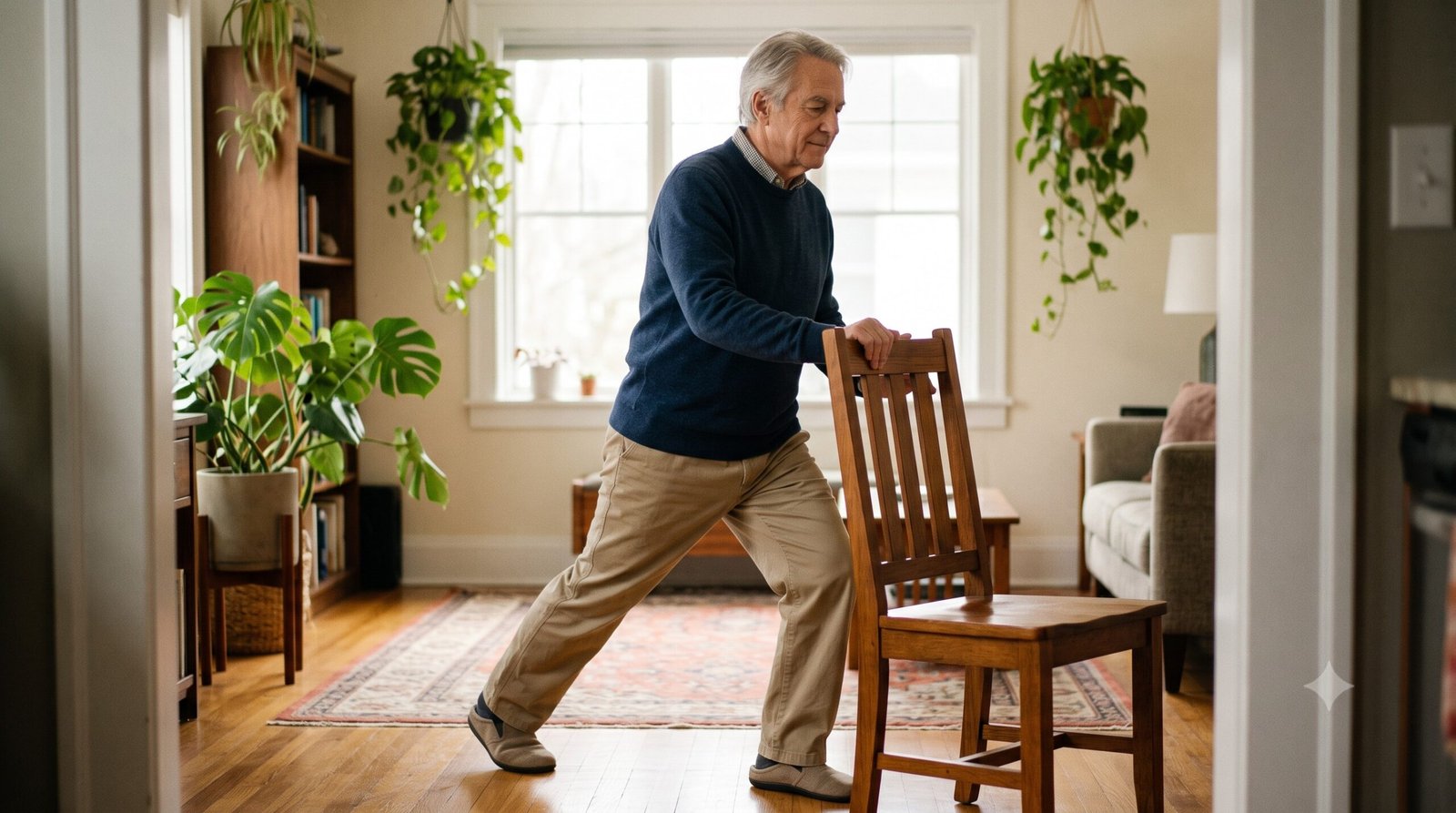
Stand facing a wall, hands flat against it at shoulder height. Step your right foot back, keeping it straight with the heel flat on the floor, and bend your front left knee until you feel a stretch through the right calf. Hold 20–30 seconds, then switch legs.
Tight calves shorten your stride and are one of the most common, most overlooked reasons walking starts to feel more effortful with age. It’s the same muscle group I flag for beginners building up to incline treadmill walking, where a warmed-up, flexible calf makes the uphill push noticeably easier and reduces next-day soreness.
7. Seated Hamstring Stretch
Sit on the edge of a sturdy chair. Extend your right leg straight out in front of you, heel on the floor, toes pointing up. Keeping your back straight, hinge forward gently from the hips until you feel a stretch along the back of the thigh. Hold 20–30 seconds, then switch legs.
Tight hamstrings pull on the lower back and are a common, fixable contributor to that “can’t quite touch my toes anymore” feeling. This stretch is gentler than the standing version and removes the balance demand entirely, which is why I default to it for most older clients.
8. Ankle Circles and Pumps
Sit with one leg extended, heel on the floor. Slowly circle your ankle 5 times clockwise, then 5 times counterclockwise. Follow with 10 ankle pumps — pointing your toes away, then flexing them back toward your shin. Repeat on the other side.
Ankle mobility gets almost no attention compared to hips and knees, but it’s directly tied to balance and to how confidently you walk on uneven ground — a curb, a gravel path, an unfamiliar floor. It’s also one of the easiest exercises to do daily since it needs no standing and no equipment at all.
9. Cat-Cow for the Lower Back
If getting onto hands and knees is comfortable for you, this is the single best lower-back mobility move there is: on all fours, alternately arch your back toward the ceiling (cat) and dip it toward the floor while lifting your chest (cow), moving slowly with your breath for 8–10 rounds.
If getting down to the floor isn’t realistic, you can do a seated version: sitting tall, alternate between rounding your back (chin to chest, hands pushing knees away) and arching it (chest lifted, gentle backward lean). Either version loosens the same segments of the spine that stiffen from long hours sitting.
How Often and How Long to Stretch
Consistency beats intensity here. Ten to fifteen minutes, four to five days a week, produces better results than one long session on the weekend. You can do all nine stretches as one short routine, or spread a few through the day — a couple in the morning, a couple after sitting for a while, a couple before bed.
A controlled study of flexibility training in healthy older adults found that eight weeks of regular stretching improved spinal range of motion by roughly a third in the group studied. That’s a meaningful, measurable change from a routine that takes less time than a coffee break, and it’s consistent with what I see in clients who stick with it for even a month.
Flexibility work also pairs naturally with the other side of healthy aging: what you eat. Muscle and connective tissue need adequate protein to stay resilient, which is worth knowing if you’re only thinking about stretching and not about protein intake for seniors as part of the same picture.
Safety Rules: What to Avoid
A few rules keep this list safe rather than risky:
- Never bounce. A stretch should be a slow ease into tension, held still. Bouncing increases injury risk without adding flexibility benefit.
- Stop at mild tension, not pain. You should feel a pull, never a sharp or burning sensation. Pain means back off, not push through.
- Keep breathing. Holding your breath raises blood pressure unnecessarily during a stretch. Breathe slowly and normally throughout.
- Use support for standing stretches. A chair back or wall under one hand removes the balance risk from stretches like the quad and calf stretch.
- Warm up first if you can. A few minutes of easy walking before stretching, rather than stretching cold, reduces strain on stiff tissue.
If a warm-up walk isn’t practical, a few gentle minutes on a low-impact machine works just as well. A recumbent bike built for seniors keeps the effort easy on the joints while still warming the muscles enough to stretch effectively afterward.
Who Should Check With a Doctor First
This routine is gentle by design, but a few situations call for a doctor’s or physiotherapist’s clearance before starting: a recent joint replacement or surgery, diagnosed osteoporosis (some spinal flexion movements like a full cat-cow may need modification), a recent fall, or any stretch that reproduces sharp pain rather than a gentle pull.
If standing balance is a genuine concern, every stretch on this list can be done seated. Pairing this routine with the right equipment matters too — I’ve covered what to look for in treadmills built for older users.
Handrail quality specifically is worth checking before you buy, since a rail that’s too far forward or too low doesn’t give the support it promises — I break down which models get this right in my guide to treadmills with proper handrail support.
Flexibility Exercises for Seniors: FAQ
What is the best flexibility exercise for seniors?
There isn’t one single best stretch, since stiffness usually shows up in several areas at once. The seated hamstring stretch and the seated figure-4 hip stretch tend to produce the most noticeable everyday improvement, since tight hips and hamstrings affect walking, sitting and standing more than almost any other muscle group.
How long should a senior hold a stretch?
15 to 30 seconds per stretch is enough to gain a benefit without overloading the tissue. Holding much longer doesn’t add meaningful extra flexibility for most people and increases the chance of losing good form partway through.
Can flexibility exercises be done every day?
Yes. Unlike strength training, gentle flexibility work doesn’t require rest days and can be done daily. Four to five days a week is a realistic, effective minimum if daily doesn’t fit your routine.
Do these stretches need to be done on the floor?
No. Every stretch in this list has a seated or standing option using a sturdy chair. Only the full cat-cow move is traditionally done on hands and knees, and it has a seated alternative described above.
Is it normal for stretching to feel harder on one side of the body?
Yes, mild asymmetry is common, often from handedness, old injuries, or habitual posture. Stretch the tighter side a little longer if needed, but if the difference is sudden or paired with pain, mention it to a doctor rather than assuming it’s normal.
Will stretching help with balance and fall prevention?
Indirectly, yes. Flexibility is one of the four exercise types recommended for healthy aging alongside strength, endurance and balance, and better ankle and hip mobility supports the kind of steady, adaptable movement that reduces fall risk. Stretching alone isn’t a substitute for dedicated balance training, but it supports it.
Should seniors stretch before or after walking?
Light stretching is generally better after a short warm-up walk than cold, since warmed-up tissue moves more freely and comfortably. If you stretch before walking, keep it gentle; save deeper holds for after your walk when muscles are already warm.
How soon will flexibility improve with regular stretching?
Many people notice reduced morning stiffness within one to two weeks. Measurable range-of-motion gains typically build over four to eight weeks of consistent practice, and the improvement tends to hold as long as the routine continues.
Affiliate disclosure: myactivetribe.com is supported by its readers. When you purchase through links on our site, we may earn an affiliate commission at no extra cost to you. This article contains no product recommendations; guidance is based on AnilKK’s coaching experience and cited research.