Disclosure: myactivetribe.com is reader-supported. When you purchase through links on our site, we may earn an affiliate commission at no extra cost to you.
The best treadmill for walking isn’t the same as the best treadmill for running — and most people don’t realise that until they’ve already bought the wrong one. A treadmill optimised for running is built around high motor output, fast belt response, and durability under intense load. A walker needs something different: a cushioned deck that protects joints over long daily sessions, smooth low-speed operation that doesn’t stutter at 2–3 mph, a belt wide enough for a natural stride, and controls simple enough to adjust without breaking your rhythm.
I’ve been running and walking on treadmills for 24 years and have tested over 250 machines. The seven on this list were chosen specifically for walkers — whether you’re walking daily for weight loss, recovering from injury, managing joint pain, working toward a step goal, or just staying active without the impact of running. Every machine here has been verified against official brand specifications, confirmed in stock, and selected because it does something genuinely useful for walkers that the others don’t.
The criteria I used: cushioning quality, low-speed smoothness, belt dimensions, weight capacity, headroom, warranty confidence, and real-world daily usability for someone whose primary activity is walking.
Table of Contents
Quick Comparison: 7 Best Treadmills for Walking (2026)
| Product | Motor | Belt Size | Weight Capacity | Unique Feature for Walkers | Warranty |
|---|---|---|---|---|---|
| Sole F63 | 3.0 CHP | 20″ × 60″ | 325 lbs | Cushion Flex Whisper Deck — 40% impact reduction | Lifetime frame & motor |
| Horizon 7.0 AT | 3.0 CHP | 20″ × 60″ | 325 lbs | 3-Zone Variable Cushioning + QuickDial handlebar controls | Lifetime frame & motor |
| LifeSpan TR1200i | 2.5 CHP | 20″ × 56″ | 300 lbs | Intelli-Step automatic step counter — unique to this list | Lifetime frame & motor |
| ProForm Carbon TLX | 3.0 CHP | 20″ × 60″ | 300 lbs | iFit SmartAdjust adapts to your walking pace automatically | 10-year frame |
| XTERRA TR150 | 2.25 CHP | 16″ × 50″ | 250 lbs | Lifetime frame warranty under $450 — best budget value | Lifetime frame |
| Goplus 2-in-1 Superfit | 2.25 HP | 16″ × 40″ | 265 lbs | Desk walking mode at 0.6–2.5 mph — only machine here for under-desk use | 1 year |
| Sunny SF-T4400 | 2.2 HP | 15.75″ × 49″ | 220 lbs | Hydraulic soft-drop fold — safest daily fold mechanism under $400 | 3-year frame |
1. Sole F63 — Best Overall Treadmill for Walking
Warranty: Lifetime Frame | Lifetime Motor | 2-Year Parts | 1-Year Labor
Key specs:
- Motor: 3.0 CHP continuous duty
- Speed: 0.5–12 mph
- Incline: 0–15 levels
- Belt: 20″ × 60″ two-ply Cushion Flex Whisper Deck
- Weight capacity: 325 lbs
- Display: 6.5″ backlit LCD
- Apps: Sole+, Kinomap, Zwift, FitBit, MyFitnessPal via Bluetooth
- Extras: Bluetooth speakers, tablet holder, USB charging, cooling fan
- Folds: Yes — hydraulic Easy Assist
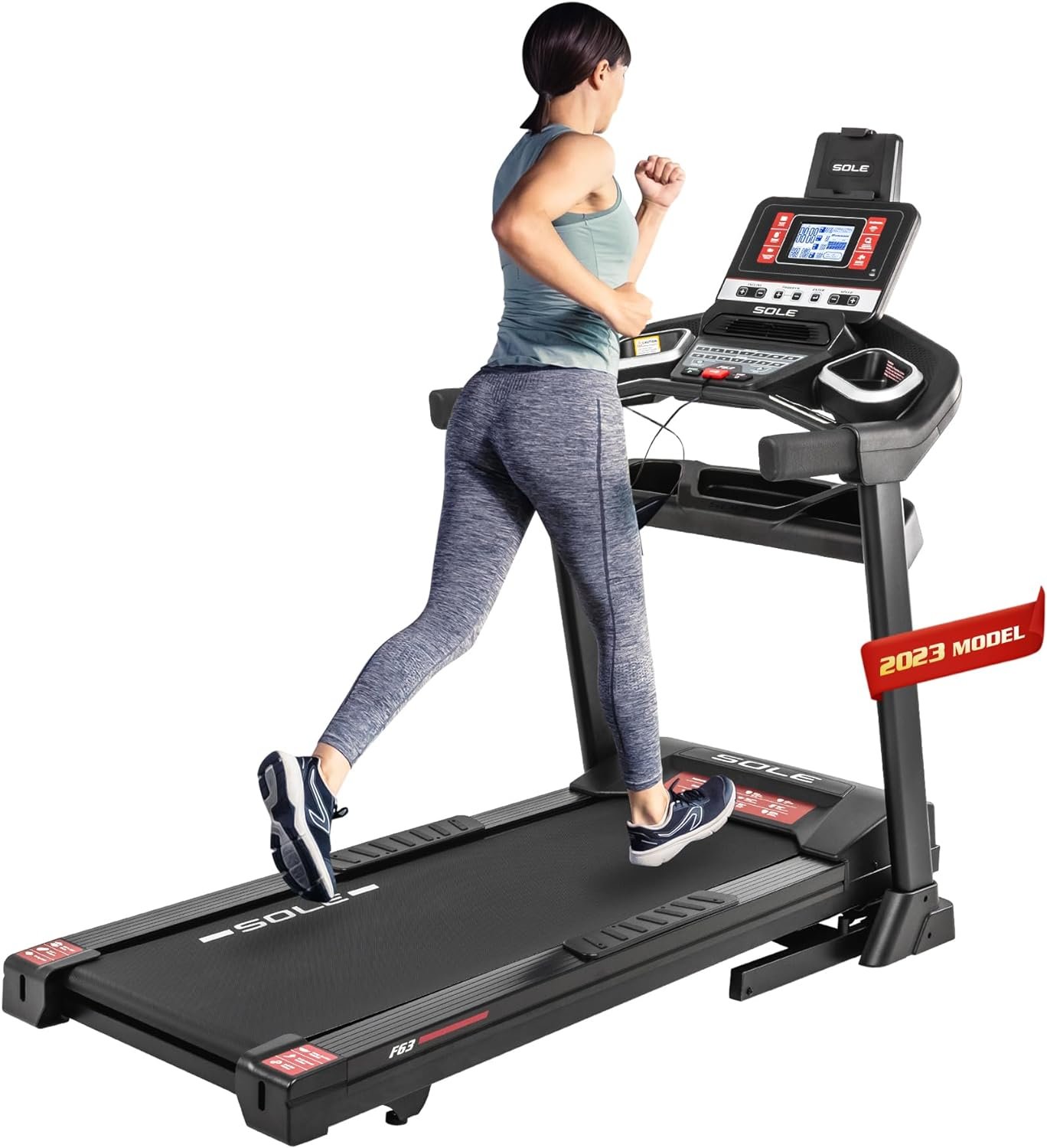
The Sole F63 is the most consistently recommended treadmill for walkers in its price range — and after testing it myself, I understand why. The Cushion Flex Whisper Deck reduces impact by up to 40% compared to road running, which is the most meaningful specification for anyone walking daily rather than running. When you walk on the F63, the deck has a firm yet forgiving feel underfoot — not the bouncy, unstable sensation of cheap cushioning, nor the hard-as-concrete feel of machines designed for running. It is specifically engineered for sustained, comfortable walking at moderate speeds, and it shows.
What Makes the Sole F63 Different
The F63 is the only machine on this list that requires no subscription of any kind — ever. Every feature works out of the box, forever: the 15 incline levels, 10 built-in programs, Bluetooth connectivity, Kinomap compatibility, and Sole+ app integration all function without a monthly fee.
This matters more than people realise when you’re comparing it to iFit-powered machines like the ProForm Carbon TLX, which technically works without iFit but loses its most compelling features without the subscription. The F63 gives you everything it has from day one, with no ongoing cost. For walkers who just want to get on the machine and walk — without navigating apps, subscriptions, or content libraries — the F63 is the most straightforward ownership experience on this list.
The 20″ × 60″ belt is the right size for walking at any height. The 20-inch width gives you enough lateral room to walk naturally without feeling like you need to narrow your stride to stay on the machine — a surprisingly common problem on budget treadmills with 15–16-inch belts. The 60-inch length is more than sufficient for any walking stride length, including taller users over 6’2″. And at a starting speed of 0.5 mph, the F63 begins slower than almost any other machine on this list — useful for recovery walks, rehabilitation, or simply easing into a morning session.
The 325 lb weight capacity gives meaningful headroom for most users. As I always tell people: never buy a treadmill rated at your exact body weight — always aim for at least 30 lbs above. At 325 lbs, the F63 comfortably accommodates users up to around 290–295 lbs with that safety margin intact. The lifetime motor warranty is the other standout — Sole is telling you they’re confident enough in this motor to cover it indefinitely. That is not something manufacturers do with motors they’re unsure about.
One honest note: the F63’s cushioning is firm rather than plush. If you’re coming from a very cushioned machine or have significant knee pain, the deck may feel harder than expected. Sole designs it this way deliberately — firmer cushioning provides more stability and a more natural road-running feel. For most walkers, this is a non-issue, but it’s worth knowing before you buy. If maximum softness is your priority, the LifeSpan TR1200i’s 8-compression-absorber system may suit you better.
If you’re building a walking-based weight loss routine, the F63’s 15-level incline is where it earns its keep. Walking at a 10–12% incline at 3 mph burns significantly more calories than flat walking at the same pace, and the smooth incline motor on the F63 handles sustained incline walking without the noise or resistance you get from underpowered motors on cheaper machines.
Best for: Daily walkers who want the best cushioning and widest belt at a mid-range price, users who want a lifetime warranty with no subscription costs, and anyone who values straightforward ownership over tech features.
Pros:
- Cushion Flex Whisper Deck reduces impact by up to 40% — the best walking-specific cushioning on this list at this price.
- Lifetime warranty on both frame and motor — no other machine under $1,300 on this list matches this level of coverage.
- No subscription required — every feature works permanently with no monthly fee.
- 20″ × 60″ belt is generous enough for tall walkers and those with a wider natural gait.
- Compatible with Kinomap, Zwift, FitBit, and MyFitnessPal via Bluetooth — you choose your own app rather than being locked into one platform.
- 325 lb weight capacity gives most users meaningful safety headroom above their body weight.
Cons:
- Cushioning is firm rather than plush — walkers expecting a very soft, springy deck may find the feel harder than anticipated.
- Basic LCD display — no touchscreen or built-in content; bring your own tablet if you want to stream workouts or shows.
- Incline adjusts slowly — not ideal for interval training, but perfectly fine for steady-state walking at a set grade.
2. Horizon 7.0 AT — Best for Walkers Who Want No Subscription and Maximum App Freedom
Warranty: Lifetime Frame | Lifetime Motor | 3-Year Parts | 1-Year Labor
Key specs:
- Motor: 3.0 CHP Rapid Sync
- Speed: 0.5–12 mph
- Incline: 0–15%
- Belt: 20″ × 60″ with 3-Zone Variable Response Cushioning
- Weight capacity: 325 lbs
- Display: LCD with device shelf
- Apps: Peloton, Zwift, any Bluetooth app — no subscription required
- Extras: QuickDial handlebar controls, Bluetooth speakers, hydraulic fold
- Folds: Yes — one-step hydraulic
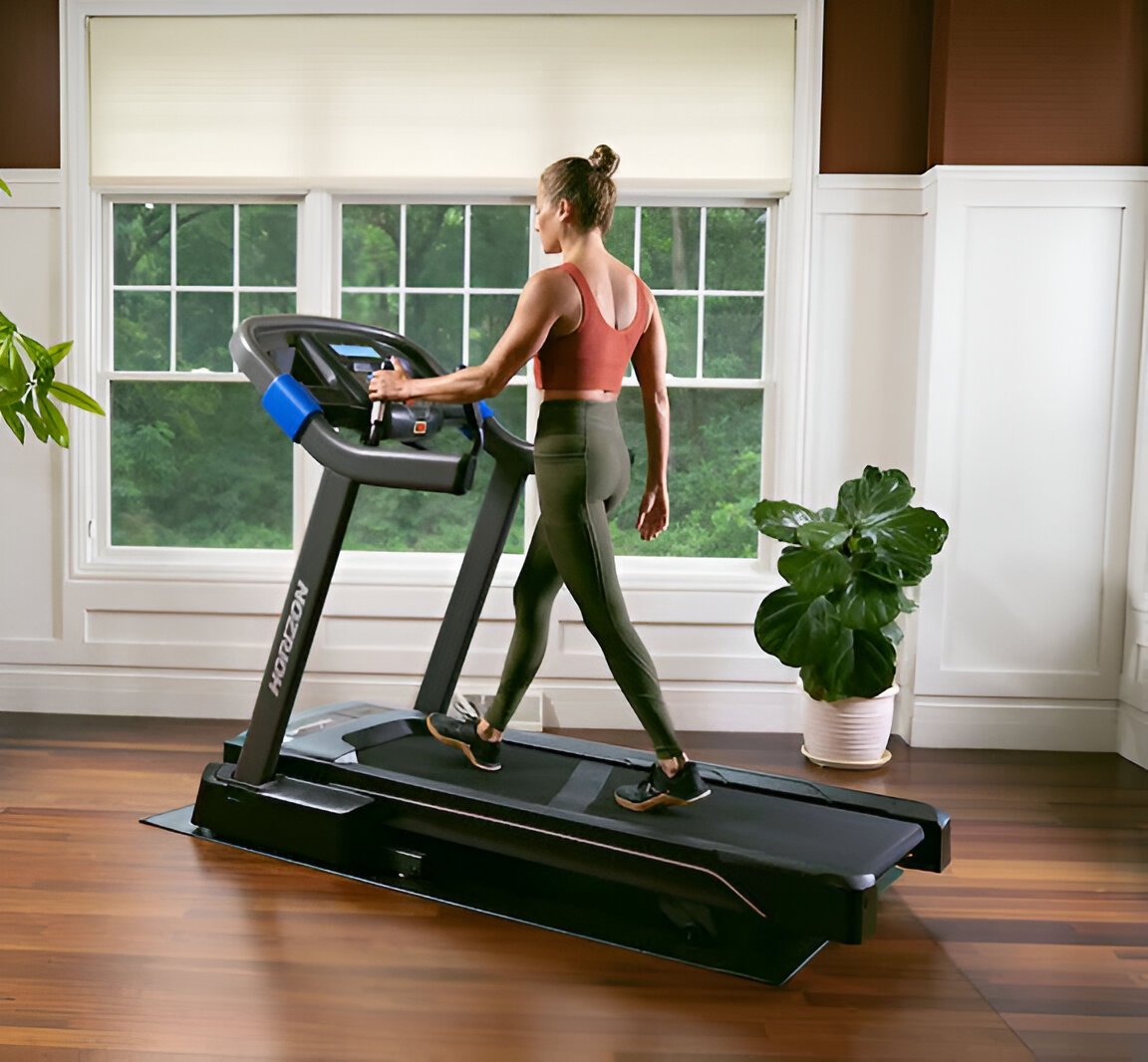
The Horizon 7.0 AT sits at a similar price point to the Sole F63 but takes a different approach to almost everything. Where the Sole focuses on cushioning quality and simplicity, the Horizon is built around app freedom and responsive motor control. The Rapid Sync motor adjusts speed faster than most home treadmills — which matters more for walkers than people realise. When you want to slow from 3.5 mph to 2.5 mph quickly, a sluggish motor creates an awkward transition. The 7.0 AT responds almost immediately, making it feel more like a commercial gym machine than a home treadmill.
What Makes the Horizon 7.0 AT Different
The QuickDial controls on the handlebars are the feature that sets the 7.0 AT apart from everything else on this list. Rather than reaching forward to press console buttons or tap a screen mid-walk, you adjust speed and incline by turning a dial built into the handlebar — without breaking your stride or your posture. For walkers who make frequent speed or incline adjustments during a session, this is a genuinely different experience. Every other machine on this list requires you to reach forward and press buttons. The 7.0 AT lets you adjust from where your hands already are.
The 3-Zone Variable Response Cushioning is the other standout feature. Horizon engineers the deck with three different cushioning densities across the belt’s length — softer in the impact zone at the front where your foot lands, moderately cushioned through the mid-stride, and firmer at the push-off zone at the rear. This matches the actual biomechanics of walking, where you need more shock absorption on landing and more firmness on push-off. Most treadmills use uniform cushioning throughout the entire deck. The 7.0 AT’s approach is more sophisticated and more comfortable for sustained walking sessions.
The 7.0 AT works with virtually any fitness app via Bluetooth — Peloton, Zwift, Kinomap, Apple Health, and more — without requiring a specific subscription. This gives you genuine flexibility: if you already use Peloton on your phone, the 7.0 AT connects directly and the treadmill follows the trainer’s pace automatically. If you prefer Zwift, it works with that too. You are never locked into a single platform or a mandatory monthly fee. This is a meaningful difference from NordicTrack and ProForm machines that function best within the iFit ecosystem.
The parts warranty is also worth noting: 3 years on parts versus the Sole F63’s 2 years. Both machines have lifetime frame and motor coverage, but the Horizon’s longer parts warranty gives you an extra year of protection on the components most likely to need attention after the first couple of years of daily use.
For walkers who use incline training as their primary calorie-burning tool, the 7.0 AT’s 15% maximum incline combined with the QuickDial controls makes incline interval walking — alternating between flat and 8–12% grade — genuinely easy to execute mid-session without stopping. This is the kind of practical usability that makes a real difference to whether you actually do that workout or default to walking flat every day. You can read more about how incline training engages different muscle groups compared to flat walking — the difference in glute and hamstring activation at 10%+ incline is significant.
Best for: Walkers who make frequent speed and incline adjustments during sessions, anyone who wants app freedom without a mandatory subscription, and users who want the most responsive motor in this price range.
Pros:
- QuickDial handlebar controls let you adjust speed and incline mid-walk without reaching for the console — unique on this list.
- 3-Zone Variable Response Cushioning matches the biomechanics of walking better than uniform cushioning systems.
- Rapid Sync motor responds to speed changes faster than most home treadmills — no lag between pressing a button and feeling the change.
- Works with Peloton, Zwift, and virtually any Bluetooth fitness app — no subscription lock-in.
- Lifetime frame and motor warranty plus 3-year parts — stronger parts coverage than the Sole F63.
- 325 lb weight capacity — same generous headroom as the Sole F63.
Cons:
- No built-in touchscreen — you need to bring your own device to stream content, which requires the media shelf rather than a dedicated display.
- Heavier than the Sole F63 — the hydraulic fold helps, but repositioning this machine solo after assembly requires effort.
- Delivery wait times can be longer than Amazon-fulfilled machines — factor this in if you need it quickly.
3. Sunny Health & Fitness SF-T723030 — Best Budget Pick with Auto Incline
Warranty: 3-year structural frame / 1-year motor / 180 days other parts and components.
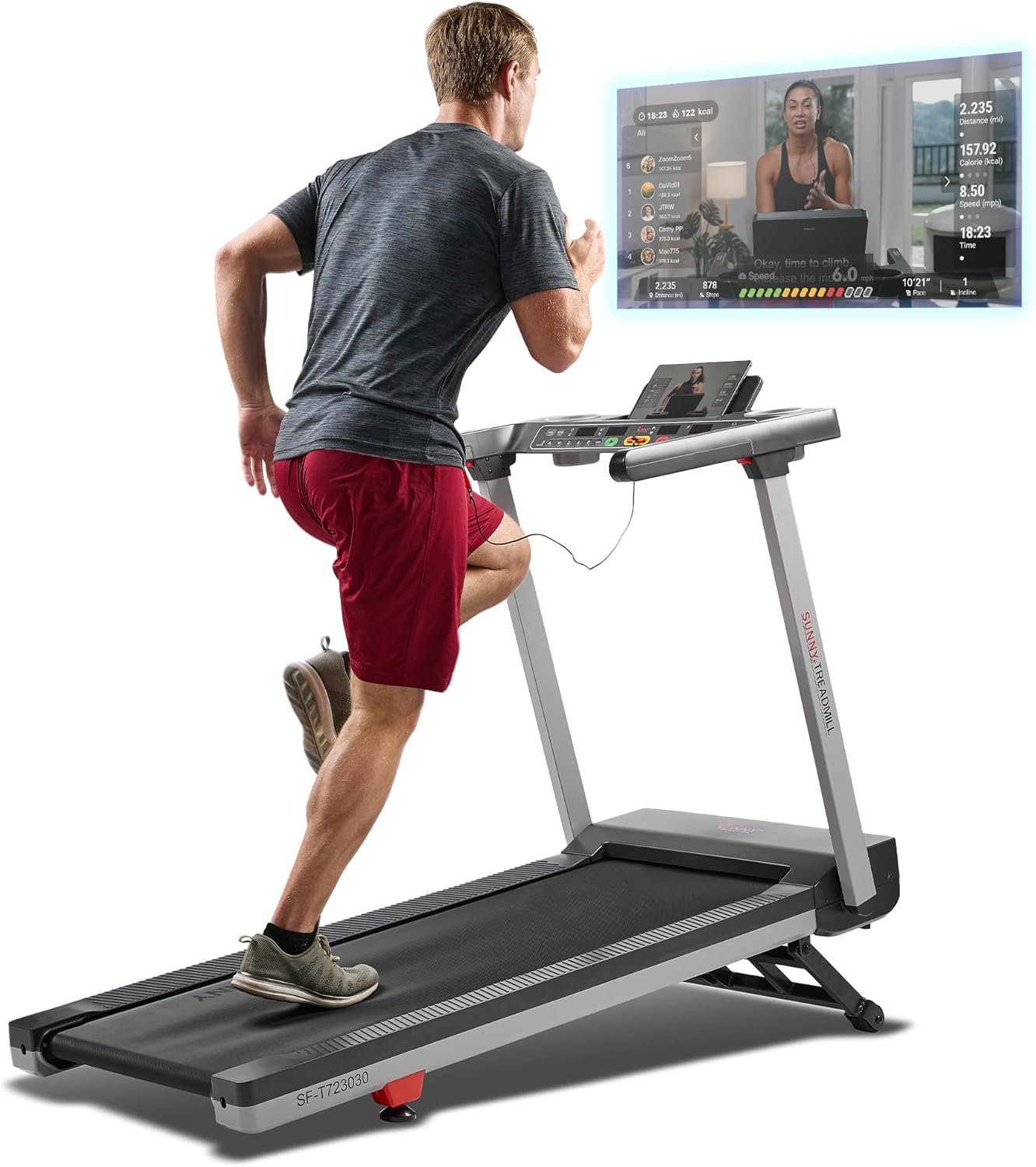
Key Specs:
- Motor: 2.5 HP brushless
- Speed: 0.5–10 mph
- Belt size: 20″ × 49″
- Weight capacity: 300 lbs
- Incline: 15 automatic levels
- Display: LED — tracks speed, time, distance, calories, incline, steps, heart rate
- App: SunnyFit via Bluetooth — 10,000+ routes and trainer-led workouts
- Assembly: Arrives fully assembled — lift the handrail, lock it in, and walk
- Folds: Yes — flat fold with transport wheels
The Sunny SF-T723030 delivers the one feature most walkers wish they had bought from day one — a proper 15-level automatic incline — at a price that undercuts most incline-capable treadmills significantly. Add a 20″ wide belt, a 2.5 HP brushless motor, and SunnyFit app connectivity, and this machine punches well above its category. For walkers who want to turn a 30-minute daily session into a genuine fitness tool rather than a flat stroll, this is where to start.
The 20″ wide belt is the first thing that separates this machine from the competition at this price. Most budget treadmills give you 16″ or 17″ — a width that works, but unconsciously narrows your natural stride. At 20″, the SF-T723030 gives your feet room to land where they want to, which matters more on a treadmill than outdoors because you cannot self-correct by drifting. The 49″ belt length is adequate for most walkers, but taller users — anyone over 6’1″ with a longer natural stride — will notice it against the 55″–60″ options higher up this list.
What Makes It Different
No other machine in this price bracket combines a 20″ wide belt, a brushless motor, and 15 levels of automatic incline in a package that arrives fully assembled. The brushless motor is the hidden quality signal — it runs cooler and quieter than the brushed motors found in most treadmills at this price, and it lasts meaningfully longer under sustained daily use. Most machines at this price ask you to build the thing yourself. The SF-T723030 ships ready to walk: lift the handrail, lock it, plug in, and you are moving. Removing that assembly barrier is not a small thing — it is the difference between a treadmill that gets used on day one and a box that sits in the corner for a fortnight.
After 24 years of helping people build consistent walking routines, the pattern I keep seeing is this: walkers who add incline see results that flat walkers do not. At a matched pace of 3.5 mph, walking at 6% incline engages the posterior chain — glutes, hamstrings, calves — in a way that flat walking simply cannot replicate. It also elevates heart rate into a genuine aerobic range without any increase in speed. The 15-level auto incline on this machine gives you that range in small increments, adjustable mid-walk without stopping or stepping off. That progressive overload is what separates a walking routine that builds fitness from one that plateaus after the first few weeks.
The SunnyFit app adds real value here — it is free, connects via Bluetooth, and unlocks over 10,000 scenic routes worldwide with real-time data syncing. It is not as immersive as iFIT, but for a daily walking programme it covers everything most users need. The double-deck shock absorption system is quieter than you would expect from a machine in this range, and the 24 built-in workout programmes give you enough variety to keep sessions from becoming routine. For walkers building toward weight loss goals, the treadmill workouts for weight loss guide pairs well with this machine’s incline range.
Best for: Walkers who want a wide belt, automatic incline, and a brushless motor in a fully-assembled machine — without spending over $1,000.
Pros:
- Widest belt at this price point: The 20″ walking surface gives your natural gait room to spread — most competing machines at this price offer 16–17″, which subtly restricts your stride over time.
- Brushless motor: Quieter, cooler-running, and longer-lasting than the brushed motors in most treadmills at this price — a meaningful quality indicator for anyone planning daily use.
- 15-level auto incline: The widest incline range in this price bracket, adjustable mid-walk — the feature that separates walkers who keep progressing from those who plateau after a month.
- Arrives fully assembled: Lift the handrail, lock it, plug in, walk — no tools, no assembly steps, no delay between delivery and first use.
- 24 built-in programmes: More variety than most machines at this price, covering fat burn, interval, and endurance sessions without needing a subscription.
Cons:
- Belt length is 49″: Works well for most walkers, but taller users — particularly those over 6’1″ with a longer natural stride — will feel the shorter deck compared to the Sole F63’s 60″ surface at a brisk pace.
- Parts warranty is short: 180 days on parts is the industry floor for this price tier. The 3-year frame and 1-year motor coverage are solid, but treat the parts warranty as the honest minimum rather than a ceiling on the machine’s lifespan.
4. ProForm Carbon TLX — Best for Connected Walkers Who Want iFIT on a Budget
Warranty: 10-year frame / 1-year parts / 1-year labor.
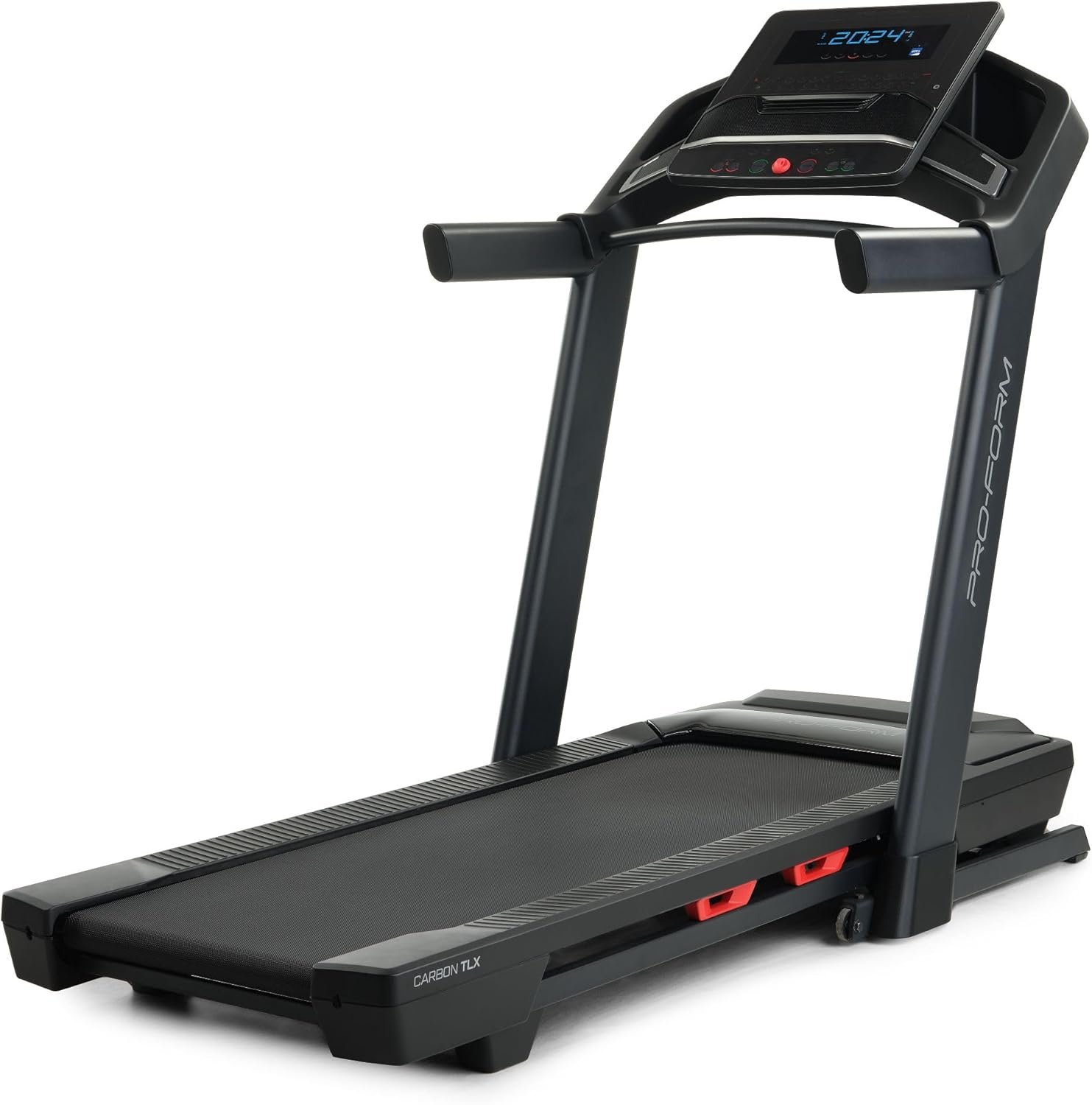
Key Specs:
- Motor: 3.0 CHP
- Speed: 0–12 mph
- Belt size: 20″ × 60″
- Weight capacity: 300 lbs
- Incline: 0–12%, automatic
- Display: 7″ LCD + device shelf for phone or tablet
- App: iFIT via Bluetooth — SmartAdjust auto-controls speed and incline (1-month included)
- Cushioning: ProShox deck cushioning
- Folds: Yes — EasyLift Assist hydraulic soft-drop
The ProForm Carbon TLX gives you a full-size 20″ × 60″ belt, a 3.0 CHP motor, and automatic iFIT integration at a price point where most treadmills are still asking you to settle for a narrower deck and a basic display. For walkers who want trainer-led outdoor sessions that automatically control their machine’s speed and incline — without paying for a touchscreen they do not need — this is the most accessible route into that experience.
The 20″ × 60″ belt is where the Carbon TLX earns serious respect for the price. At 60″ long, users up to around 6’3″ can walk and jog without ever feeling belt-constrained — this is the same deck size used on premium treadmills costing twice as much. The 3.0 CHP motor handles sustained walking sessions comfortably, and the 12% incline range gives walkers enough gradient variety to build genuine fitness progression over months. ProShox cushioning softens the impact noticeably, though it is firmer than the Sole F63’s Cushion Flex system — road runners tend to prefer it; joint-sensitive walkers may want to compare the feel.
What Makes It Different
The Carbon TLX is the only machine in this price range that connects your walk directly to a trainer-led outdoor route and then automatically adjusts the treadmill’s speed and incline to match the terrain in real time. You are not watching a video and manually pressing buttons to keep up. iFIT’s SmartAdjust handles it — when the trainer climbs a hill in Patagonia, your incline rises. When they slow through a village, your belt slows. That hands-free immersion is what makes this machine different from every other option at this price, and it is the reason consistent walkers who struggle with treadmill boredom gravitate toward it. No other machine on this list delivers that experience without a built-in touchscreen adding hundreds to the price.
One honest note on iFIT: after the included one-month membership, full access requires a paid subscription. The treadmill still functions in manual mode without one — you have full control of speed and incline via the console — but the coached sessions and SmartAdjust are behind the subscription. If you plan to use iFIT regularly, factor the ongoing cost into your total. If you prefer manual control or a subscription-free experience, the Sole F63 or Sunny SF-T723030 are more straightforward options. The motor on the Carbon TLX is also notably louder than some of the other machines here at higher speeds — it is fine for most home environments, but worth knowing if you are in a flat or training early morning with people sleeping nearby.
Best for: Walkers and light joggers who want iFIT’s interactive training with automatic machine control — and are comfortable using their own phone or tablet rather than a built-in screen.
Pros:
- iFIT SmartAdjust: The treadmill automatically follows your trainer’s speed and incline in real time — no manual adjustment needed. This is the most immersive walking experience available on this list without a built-in touchscreen.
- Full-size 20″ × 60″ belt: One of the most spacious decks available at this price — comfortable for walkers of all heights and accommodates light jogging without feeling cramped at pace.
- 3.0 CHP motor: Strong enough to handle sustained daily walking sessions at any incline without labouring — well above the 2.0–2.5 HP motors typical in this price range.
- EasyLift Assist fold: The hydraulic-assisted folding system lowers the deck smoothly and safely — no sudden drops, no awkward lifting, no risk to fingers or floors.
- 10-year frame warranty: Matches the structural confidence of machines that cost significantly more — a strong indicator of ProForm’s build quality at this price.
Cons:
- Full iFIT access requires a subscription: The machine functions without one, but the coached sessions and SmartAdjust — the features that make it worth choosing over simpler options — require the ongoing membership after the first month.
- Motor is audible at higher speeds: The 3.0 CHP motor produces more noise than the brushless options on this list at pace — not disruptive in most homes, but worth noting for apartment dwellers or early-morning trainers.
5. XTERRA TR150 — Best Entry-Level Treadmill with a Lifetime Frame Warranty
Warranty: Lifetime frame / 25-year motor / 10-year parts / 1-year labor.
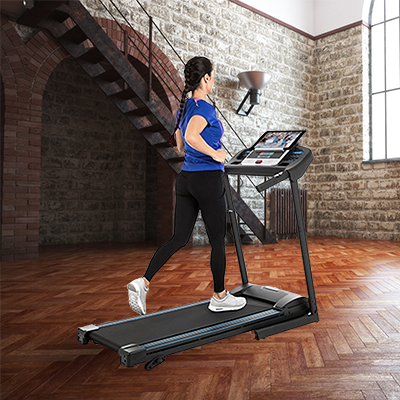
Key Specs:
- Motor: 2.25 HP
- Speed: 0.5–10 mph
- Belt size: 16″ × 50″
- Weight capacity: 250 lbs
- Incline: 3 manual positions (0%, 1.5%, 3%)
- Display: LCD — tracks time, speed, distance, calories, pulse
- App: None — manual control only
- Folds: Yes — soft-drop system
- Machine weight: 108 lbs
The XTERRA TR150 is the treadmill I recommend to someone who is not yet sure whether home treadmill walking will become a long-term habit. It is honest about what it is: a compact, straightforward walking machine without connected fitness, a wide belt, or automatic incline. What it does have is one of the best warranty structures in its price category — lifetime frame, 25-year motor, 10-year parts — which tells you that XTERRA stands behind this machine well beyond the warranty periods competitors offer on much more expensive equipment.
The TR150 has two practical constraints worth naming upfront. The 16″ belt is narrower than any other machine on this list — it is workable for daily walking, but if you are a larger build or have a naturally wide gait, you will feel it. The 250 lb weight capacity also leaves less structural headroom than the 300–325 lb machines elsewhere on this list. If your body weight plus the recommended 20–30 lb buffer is approaching 250 lbs, look at the Sunny SF-T723030 instead. Within those parameters, the TR150 performs reliably and quietly for what it is.
What Makes It Different
The warranty is genuinely unlike anything else at this price — or at prices significantly higher. A lifetime frame guarantee and 25-year motor coverage on a sub-$450 treadmill is not a standard industry offering; it is a manufacturer standing behind their product with structural confidence that most budget treadmill brands do not match. The 10-year parts warranty means that if a component fails inside a decade of normal use, XTERRA covers it. For a first treadmill where you are testing whether the habit will stick, that coverage removes a significant financial risk from the equation. You are not gambling on a cheap machine; you are buying a basic machine backed by an exceptional guarantee.
The TR150 is also one of the quietest machines on this list at walking pace. The 2.25 HP motor runs smoothly at low speeds — the range where walkers actually spend their sessions — and the soft-drop fold system makes storage and retrieval quick and finger-safe. There are no apps to configure, no subscriptions to manage, and no screens to navigate. You step on, set your speed, and walk. For people who find the technology on other treadmills more distraction than motivation, that simplicity is a feature rather than a limitation. Maintaining treadmill belts is also straightforward at this price tier — the muscles involved in treadmill workouts guide has useful context on why maintaining consistent walking form matters alongside regular machine maintenance.
Best for: Budget-conscious walkers who want a reliable, well-warranted entry-level machine for regular use — and do not need connected features or a wide belt.
Pros:
- Exceptional warranty for the price: Lifetime frame, 25-year motor, and 10-year parts coverage is genuinely rare at this price point — most budget competitors offer 1–3 years on parts and nothing close to lifetime structural coverage.
- Quiet at walking pace: The 2.25 HP motor runs noticeably smoothly at the 2.5–3.5 mph speeds where walkers actually train — quieter than the ProForm Carbon TLX at comparable low speeds.
- Compact and genuinely light: At 108 lbs, this is one of the lightest folding treadmills on this list — easier to move between rooms and to store in tighter spaces than the heavier full-feature machines.
- No subscription required: Everything this machine does is available from the moment you plug it in — no app, no account, no ongoing costs beyond occasional belt lubrication.
- Soft-drop fold system: The deck lowers smoothly and safely every time — no sudden drops, no risk to floors or toes.
Cons:
- Belt is only 16″ wide: The narrowest on this list — adequate for most walkers but noticeably tighter than the 18″–20″ belts elsewhere, particularly for users with a wider natural gait or larger frame.
- Weight capacity caps at 250 lbs: Users approaching or above this figure should add the recommended 20–30 lb headroom buffer and look at the Sunny SF-T723030 or Sole F63 instead.
6. Goplus 2-in-1 Superfit — Best for Desk Workers Who Want Two Machines in One
Warranty: Contact the seller for warranty details before purchasing.
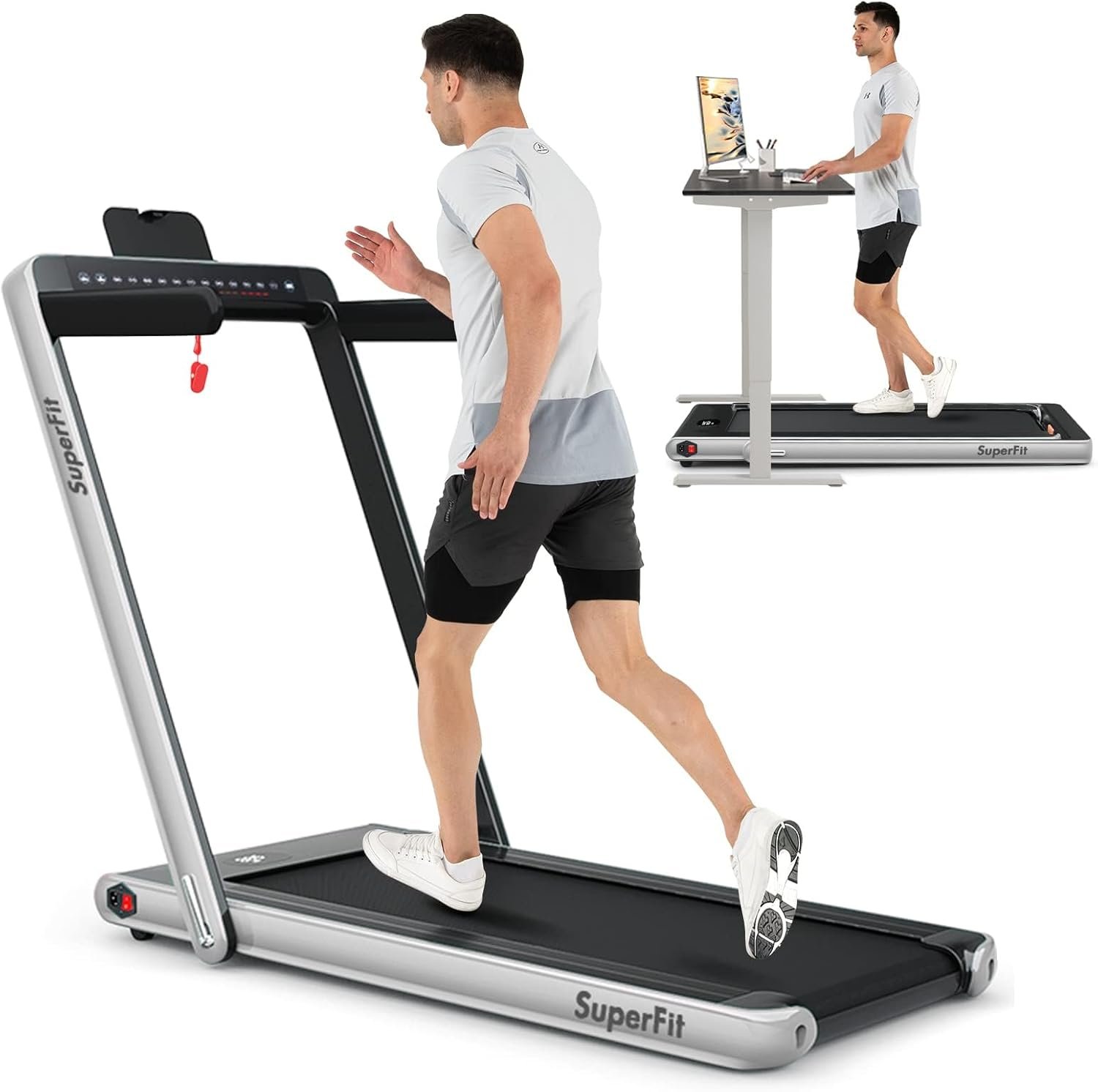
Key Specs:
- Folds: Yes — full flat fold with built-in transport wheels
- Motor: 2.25 HP
- Speed (standing mode): 0.6–7.5 mph
- Speed (desk/folded mode): 0.6–2.5 mph
- Belt size: 39.3″ × 16″
- Weight capacity: 265 lbs
- Machine weight: ~73 lbs
- Folded profile: 5″ tall — slides under most desks and sofas
- App: Gymax app via Bluetooth
The Goplus 2-in-1 Superfit is the only machine on this list that genuinely serves two completely different use cases without compromising either one. Raise the handrails, and it becomes a standard folding treadmill. Fold the handrails flat, and it slides directly under a standing desk, capping speed at 2.5 mph so you can walk while you work. That single design pivot puts it in a different category from every other treadmill here — it is a machine built for the gap between formal exercise sessions.
If you work from home and spend most of your day sitting, the Goplus solves a problem no other treadmill on this list addresses: how to accumulate steps without interrupting your workday. At walking pace in desk mode, the 2.25 HP motor is quiet enough to hold a phone call without the treadmill registering in the background. The handrail folds flat in seconds, and the 5″ profile means it disappears under a sofa or bed when you are done. At 73 lbs with built-in transport wheels, it is also genuinely easy to move between rooms — something the heavier machines on this list cannot match.
What Makes It Different
No other machine on this list physically transforms between two distinct modes by folding or raising its handrails. The Goplus gives you a desk-walking pad and a standing treadmill in one footprint. The 5″ collapsed profile is among the flattest in any 2-in-1 category — it slides under standard standing desks without modification and stores under a bed with room to spare. Every other machine on this list is a fixed-mode exercise device; the Goplus is different in that it integrates into a workday rather than replacing part of it.
After 24 years of tracking how people move, the biggest barrier to consistent daily activity is rarely motivation — it is the gap between structured exercise sessions. The Goplus targets exactly that gap. Walking at 1.5–2 mph while answering emails is not a workout in the traditional sense, but it stacks steps throughout the day in a way that adds up meaningfully over weeks. Research from the National Institutes of Health consistently links reduced daily sitting time with improved metabolic health — and that is precisely what this machine is designed to address.
The honest limitation is the 39.3″ belt length. It is noticeably shorter than the 49″–60″ belts on the other machines here, and at 7.5 mph maximum speed in standing mode it is not a serious jogging treadmill. That is not its purpose. If your primary goal is daily step accumulation and you need a machine that stores flat under your desk, no other option on this list competes on those two criteria. For a dedicated walking or jogging machine, the Sole F63 or Sunny SF-T723030 will serve you better.
Best for: Home office workers and apartment dwellers who want to accumulate steps throughout the day and need a treadmill that genuinely disappears when not in use.
Pros:
- Genuine 2-in-1 design: Folds flat to 5″ for desk use, raises to a full standing treadmill — the only machine on this list that serves both purposes without meaningful compromise in either mode.
- Near-silent at walking pace: The 2.25 HP motor is quiet enough at 1–2 mph that a video call registers no treadmill noise in the background — tested and confirmed by multiple user reports.
- Practical storage: The 5″ folded profile fits under most standing desks, sofas, and beds — the built-in transport wheels make it easy to move between rooms without lifting.
- Arrives nearly ready to use: Assembly involves attaching handrails and a phone holder — most users are walking within minutes of unboxing.
- 265 lb weight capacity: Competitive for this size and price category, with adequate structural headroom for most daily walkers.
Cons:
- Belt length is limited at 39.3″: Suits walking and light jogging for users up to around 5’9″ — taller users with longer strides will feel the shorter deck, particularly at faster speeds in standing mode.
- No incline: The Goplus runs on a flat surface only — walkers who want incline training to increase calorie burn should look at the Sunny SF-T723030 or Horizon 7.0 AT instead.
7. NordicTrack T Series 5 — Best for Walkers Who Want iFIT and a Long Belt
Warranty: 10-year frame / 1-year parts and labor.
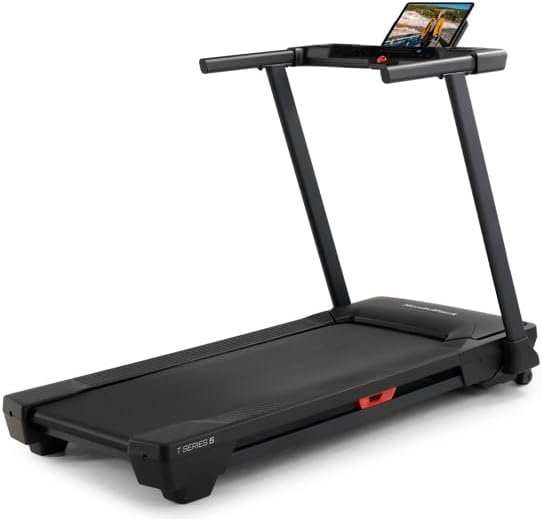
Key Specs:
- Motor: 2.6 CHP
- Speed: 0–10 mph
- Belt size: 18″ × 55″
- Weight capacity: 300 lbs
- Incline: 0–10%, automatic
- Display: 5″ LCD + device shelf for phone or tablet
- App: iFIT via Bluetooth — SmartAdjust, Google Maps routes, 10,000+ workouts (1-month included)
- Cushioning: KeyFlex deck cushioning
- Folds: No — fixed footprint
- Machine weight: 130 lbs
The NordicTrack T Series 5 is the entry point into the iFIT ecosystem — and for walkers who want trainer-led sessions, automatic speed and incline adjustment, and Google Maps route simulation, it is the most accessible way to get all of that on a solid machine. The 18″ × 55″ belt, KeyFlex cushioning, and 10% auto incline put it firmly in everyday walking and light jogging territory. It won’t impress with extras, but it will connect your walks to the world’s largest outdoor workout library from the moment you step on.
The 55″ belt length is where the T Series 5 earns its place on this list. At 55″, walkers up to around 6’2″ move comfortably without belt-edge awareness, and the pace can build to a light jog without any sense of running out of deck. The 18″ width is the one area where it trails the Sunny SF-T723030’s 20″ and the ProForm Carbon TLX’s 20″ — adequate for most users, but narrower than what I would recommend for someone with a wider natural gait. The non-folding design is the practical trade-off: the T Series 5 stays where you put it. If your space can accommodate a permanent footprint of approximately 68″ × 30″, that is a non-issue. If you need to move or store the machine regularly, the Sunny SF-T723030 or Goplus 2-in-1 serves you better.
What Makes It Different
Every other machine on this list either has no connected fitness platform or uses a basic brand app. The T Series 5 connects to iFIT — the largest outdoor workout library available on home treadmills, with over 10,000 sessions filmed across seven continents. When your trainer walks uphill in Patagonia, the treadmill’s incline rises automatically. When they slow through a coastal path, your belt slows with them. That is SmartAdjust, and it is a genuinely different experience from any other app on this list. For walkers whose biggest barrier to consistency is boredom with the same four walls, that immersion changes the equation entirely.
Google Maps route creation is also available without a subscription — you can design a walking route along any street in the world using real terrain data, and the treadmill automatically simulates the incline profile of that route. If you want to walk the streets of Tokyo, the hills of Lisbon, or your hometown from your living room, the T Series 5 is the most accessible machine on this list for doing that. After the included one-month iFIT membership, coached sessions and SmartAdjust require a paid subscription — but the manual mode and Google Maps feature remain available regardless. The 10-year frame warranty is also a standout commitment — NordicTrack confirmed this directly via their official support channels, and it signals genuine structural confidence at a price where most brands offer far less.
Best for: Walkers who want iFIT’s interactive training and automatic incline adjustment, and have a dedicated space where the treadmill can live permanently.
Pros:
- iFIT SmartAdjust: The treadmill automatically follows your trainer’s pace and terrain in real time — the only machine on this list where the belt and incline adjust hands-free in response to your workout.
- 55″ belt length: One of the longer belts on this list at this price — comfortable for walkers up to 6’2″ and accommodates light jogging without feeling crowded at the edges.
- 10-year frame warranty: Among the strongest structural guarantees in this price bracket — confirmed directly by NordicTrack as the standard US coverage for this model.
- Google Maps route creation: Build your own walking routes anywhere in the world with automatic incline simulation matching real terrain — available without a paid iFIT subscription.
- KeyFlex cushioning: Provides meaningful joint protection for daily walkers, reducing the impact differential between the treadmill surface and hard outdoor pavement.
Cons:
- Does not fold: The T Series 5 is a fixed-footprint machine — if you need to store it between sessions or move it regularly, the Sunny SF-T723030 or Goplus 2-in-1 will serve you better.
- Full iFIT access requires a subscription after the first month: The machine functions in manual mode without a membership, but the coached sessions and SmartAdjust are behind the subscription paywall after the included trial.
Which Treadmill Is Right for You? A Plain-English Decision Guide
Every machine on this list is built for walking — but “walking” means different things to different people. Here is how I would match each machine to a real situation.
If you want the best all-around walking treadmill and you walk 30–60 minutes daily, choose the Sole F63. The 20″ × 60″ belt, Cushion Flex deck, and bulletproof build quality make it the machine I would put under the feet of anyone walking seriously for weight loss or long-term cardiovascular health. The 15-year frame warranty tells you exactly what Sole thinks of their own product.
If you want incline variety to keep your walks challenging without increasing speed, choose the Horizon 7.0 AT. The 15-level automatic incline adjusts in half-second intervals, so you can build a hill-walking routine without stopping mid-session. For walkers who have plateaued on flat sessions or who are training for a hiking trip, this is the machine that keeps progress moving. It is also covered in more depth in the best treadmill for home use guide.
If you want a wide belt, brushless motor, and automatic incline without spending over $1,000 — and want it ready to walk the day it arrives, choose the Sunny SF-T723030. The 20″ belt, 15-level auto incline, fully-assembled delivery, and SunnyFit app make it the strongest mid-range value on the list for walkers who want to build real fitness, not just maintain a flat routine.
If connected fitness is your priority and you want iFIT’s trainer-led outdoor walks with automatic machine control, choose the ProForm Carbon TLX. The 20″ × 60″ belt and SmartAdjust make it the most capable iFIT walking machine on this list — the treadmill follows your trainer’s pace and incline hands-free. Note that full access requires a subscription after the included month, and the motor is audible at higher speeds.
If budget is tight but you want a reliable machine backed by an exceptional warranty, choose the XTERRA TR150. The lifetime frame, 25-year motor, and 10-year parts warranty make it the lowest-risk entry-level purchase on this list. It will not impress with features, but a machine this well-warranted at this price deserves its place. It is the one I recommend to people who are not yet sure whether treadmill walking will stick long term.
If you work from home and want to accumulate steps during your workday without a dedicated exercise session, choose the Goplus 2-in-1 Superfit. It folds to 5″ and slides under a standing desk — no other machine on this list does that. For a deeper look at that specific category, the under-desk treadmills guide covers purpose-built desk machines in full.
If boredom is your biggest barrier to consistency and you want a treadmill that takes you somewhere new every session, choose the NordicTrack T Series 5. The iFIT platform’s 10,000+ trainer-led outdoor walks — with automatic incline following real terrain — is the most effective tool I have seen for keeping walkers engaged week after week. It does not fold, so it needs a permanent home. If you already know iFIT and want the entry-level NordicTrack experience, this is where to start.
Is the Stated Weight Capacity Actually Safe at Your Weight?
This is the question I wish more buyers asked before spending money. Every treadmill lists a maximum weight capacity — but maximum does not mean ideal operating load. It means the point at which the manufacturer stops guaranteeing structural integrity. Walking at the rated maximum puts you at the top of the machine’s tolerance with every step.
My coaching recommendation, built over 24 years working with walkers at every size: always choose a machine with at least 20–30 lbs of headroom above your actual body weight. If you weigh 230 lbs, a 250 lb capacity machine is technically within spec — but you are operating it at 92% of its structural limit. A 300 lb capacity machine gives your joints, the belt, the motor, and the frame room to breathe. That headroom directly extends the machine’s lifespan and protects you from stress; loading the machine was not designed to be sustained continuously.
It matters even more at incline. When your heel strikes the belt on a 6% grade, the instantaneous load on the deck is higher than your static standing weight. A machine rated exactly at your body weight that feels fine on flat walking may show stress at an incline. Build in the buffer, and you will have a machine that lasts. Applied to this list: the Sole F63 (325 lbs) and Horizon 7.0 AT (325 lbs) give the most structural headroom. The Sunny SF-T723030, ProForm Carbon TLX, and NordicTrack T Series 5 (all 300 lbs) suit most users comfortably. The XTERRA TR150 (250 lbs) is for lighter walkers only. The Goplus 2-in-1 (265 lbs) sits in the middle. For walkers at the higher end of the weight range, the best treadmills for heavy people guide covers specialist machines with higher capacity ratings in full.
5 Mistakes Walkers Make When Buying a Treadmill
1. Choosing by top speed when you only plan to walk
Treadmill marketing leads with top speed because it sounds impressive. A 12 mph machine is not a better walking treadmill than a 9 mph one — they feel identical at 3.5 mph. What actually matters for walkers is belt length, cushioning quality, and weight capacity. Stop letting top speed drive the decision if you have no plans to run.
2. Buying the cheapest machine available
Entry-level treadmills under $300 almost always carry short parts warranties — often 90 days — minimal cushioning, and brushed motors that strain under sustained daily walking. If you plan to walk 30 minutes five days a week, the motor will accumulate significant hours within months. A machine with a 1-year parts warranty and no cushioning costs less at purchase but often more in the medium term. The warranty is not a legal formality; it is the manufacturer’s stated confidence in their own product.
3. Confusing machine footprint with belt dimensions
These are different measurements, and manufacturers sometimes make it easy to confuse them. The machine footprint is how much floor space the treadmill occupies. The belt dimensions are your actual workout surface. A machine listed at 68″ × 32″ might have a belt of only 49″ × 16″ — the rest is frame, motor housing, and console. Always check the belt dimensions specifically: width first, then length.
4. Overlooking belt lubrication as a maintenance requirement
Most treadmill buyers do not realise that belt lubrication is a recurring task — typically every 3–6 months depending on use frequency. Skipping it dramatically shortens belt and deck life. It takes about 10 minutes with a silicone lubricant and costs next to nothing. Build the habit from day one and your machine will outlast the warranty period comfortably. Skip it and you will wonder why the belt starts dragging within 18 months.
5. Not accounting for room acoustics
Treadmill noise in a showroom sounds different from treadmill noise in a hard-floored apartment at 6am. A machine on a concrete slab with no rug transmits vibration differently than the same machine on a carpeted bedroom floor. Before buying, think about where the machine will live, who is below or beside you, and what time of day you will use it. A treadmill mat — typically $30–50 — absorbs significant vibration and is worth treating as part of the purchase budget, not an optional extra.
How to Choose the Best Treadmill for Walking: What Actually Matters
Motor Power
For walking, 2.0–2.5 HP is a comfortable operating range. Below 2.0 HP, the motor works harder than it should under sustained load, which shortens its lifespan and increases noise at low speeds. Above 3.0 HP is unnecessary for walking — you are paying for capability you will never use. The more meaningful distinction is between brushless and brushed motors. Brushless motors (like the Sunny SF-T723030’s) run cooler, quieter, and longer between service intervals. If you plan to walk daily, brushless is worth paying for.
Belt Size
Width and length are both important and serve different purposes. Width — 18″ to 20″ is the practical range for most adults; 16″ works but subtly narrows your natural gait over time. Length — 49″ is the minimum comfortable deck for walkers up to around 5’10”; 55″–60″ gives everyone room without stride adjustment. Never confuse machine footprint dimensions with belt dimensions. They are different numbers and manufacturers do not always make this obvious.
Cushioning System
Walking 30 minutes daily on an uncushioned belt accumulates meaningful joint stress over months and years. A proper cushioning system — whether it is Sole’s Cushion Flex, NordicTrack’s KeyFlex, or Sunny’s double-deck absorbers — measurably reduces that load. This matters most if you have any existing knee, hip, or lower back sensitivity. Treat cushioning as joint protection that pays off over time, not a comfort upgrade.
Incline Range
Incline is what keeps walking challenging as your fitness improves. A flat walk at 3.5 mph burns roughly the same calories every session indefinitely — but that same pace at 5–8% incline engages the glutes, calves, and posterior chain significantly more and elevates calorie burn without increasing speed or joint stress. For serious walkers, look for at least 10 levels of incline. Manual incline works but requires you to stop and step off to change it. Automatic incline — available on the Horizon, Sunny, ProForm, and NordicTrack on this list — lets you change grade mid-walk without breaking stride.
Weight Capacity
As covered above: always build in at least 20–30 lbs of headroom. Weight capacity affects not just safety but longevity — a machine operating near its maximum limit wears faster. Use it as a filter first, then compare features within that range.
Warranty
The warranty structure tells you what the manufacturer genuinely believes about their product. Look for: lifetime or 10+ year frame warranty (excellent), 5+ year motor warranty (good), at least 2 years on parts (minimum acceptable for daily use). Short parts warranties — 90 days or 6 months — signal that the manufacturer has priced in the expectation of early component failure. The Sole F63, XTERRA TR150, and NordicTrack T Series 5 all carry warranties that reflect genuine manufacturer confidence in their machines.
Foldability and Space
If space is a genuine constraint, measure your available room before you buy — and measure both the open and stored footprint. When folded, most treadmills still need wall clearance and some manoeuvring room. The key number is the folded depth: how much floor space does the machine recover when stored? Most upright-folding machines reduce their footprint by 40–50%. The Goplus 2-in-1 is the outlier — it folds to 5″ tall and slides under furniture, covering almost the full floor area. That is not replicable on any other machine here.
Frequently Asked Questions
How fast should I walk on a treadmill for weight loss?
For most adults, a brisk pace of 3.0–3.8 mph is the sweet spot for sustained fat-burning and cardiovascular benefit. Below 2.5 mph, you are moving but not elevating your heart rate into a productive aerobic zone. Above 4.0 mph on flat ground, many people find it more comfortable to transition to a light jog. The most effective approach I have used with clients over the years: combine a moderate pace of 3.2–3.5 mph with incline variation cycling between 3% and 8%. This elevates calorie burn significantly without increasing joint stress the way speed alone does. Thirty to 45 minutes at this intensity, five days a week, combined with appropriate nutrition, produces consistent and sustainable results over time.
Is a 2.0 HP motor enough for daily walking?
For walking, yes — 2.0–2.5 HP is adequate for most users at walking speeds (2.5–4 mph). Where motor size starts to matter is sustained daily use over years: smaller motors run warmer and wear faster under consistent load. If you plan to walk 45–60 minutes every day, I lean toward 2.5 HP as a minimum rather than 2.0 HP, to keep the motor working comfortably rather than at its operational ceiling. Users over 200 lbs should favour the higher end of that range as a matter of habit.
Can I use a treadmill if I have bad knees?
Yes — with the right machine and the right approach. A cushioned treadmill deck reduces impact force at each foot strike compared to walking on concrete or asphalt. The American College of Sports Medicine consistently identifies low-impact aerobic exercise, including treadmill walking, as appropriate and beneficial for most people with knee osteoarthritis or post-surgical recovery — but individual circumstances vary significantly. Always check with your physiotherapist or physician before starting a new routine if you have an existing knee condition. On the machine side, the Sole F63’s Cushion Flex deck and the Sunny SF-T723030’s double-deck absorption system both provide meaningful cushioning for joint-sensitive walkers. Avoid hard, uncushioned belts.
How much space do I need for a treadmill at home?
The machine footprint is not the only space you need. Plan for the machine’s length plus at least 3 feet of clear space behind it for safety — so if you lose your footing or need to step back quickly, there is room to do so without hitting a wall. For most treadmills on this list, allow approximately 7–8 feet of total length and 3 feet of width as a practical minimum. Width-wise, add 12–18 inches on each side of the machine for comfortable entry and exit. Folded dimensions matter only if you plan to store the machine between every session — measure both the open and stored footprint and know which one applies to how you will actually use it.
What is the difference between a walking treadmill and a running treadmill?
The mechanical differences matter more than the label. Running treadmills typically feature longer belts (54″–60″), more powerful motors (3.0 CHP+), higher weight capacities, and more robust cushioning systems built for the repetitive impact of running. Walking treadmills are generally lighter, quieter, and more compact — optimised for sustained low-speed use. In practice, most of the machines on this list can handle light jogging as well as walking. The honest dividing line is belt length: a 49″ belt suits walkers; a 54″+ belt suits joggers and runners. If you think your habits might shift toward jogging over time, prioritise belt length from the start rather than upgrading later.
How often should I lubricate my treadmill belt?
For daily walkers using the treadmill 30+ minutes per session, every 3 months is a good maintenance interval. For lighter users — 3–4 sessions per week — every 6 months is generally sufficient. The telltale signs that lubrication is overdue: increased motor noise, belt hesitation at low speeds, or a faint burning smell during use. Use 100% silicone lubricant only — never WD-40, petroleum-based sprays, or general-purpose products, which degrade the belt material. Apply it under the belt surface along the centre of the deck, with the belt lifted slightly at the edge to access the deck surface. Check your specific model’s manual, as some machines ship with pre-lubricated decks that require different maintenance intervals.
Can I walk on a treadmill while working at my desk?
Yes — and it is more practical than it sounds. The key is keeping speed low enough (1.0–2.0 mph) that your upper body stays stable. At that pace, typing, reading, and even video calls are entirely feasible for most people. The challenge is desk height: a standard seated desk is too low for standing use — you need a sit-stand or adjustable-height desk for proper ergonomics. Of the machines on this list, the Goplus 2-in-1 Superfit is the only one specifically engineered for this purpose — it folds flat to slide under a standing desk and locks its maximum speed at 2.5 mph in under-desk mode. For a full comparison of dedicated desk-walking options, the under-desk treadmills guide covers that category in much more detail.
Disclosure: This article contains affiliate links. If you purchase through these links, we may earn a commission at no additional cost to you. All recommendations are based on independent research and AnilKK’s direct experience testing fitness equipment.