Quick Answer
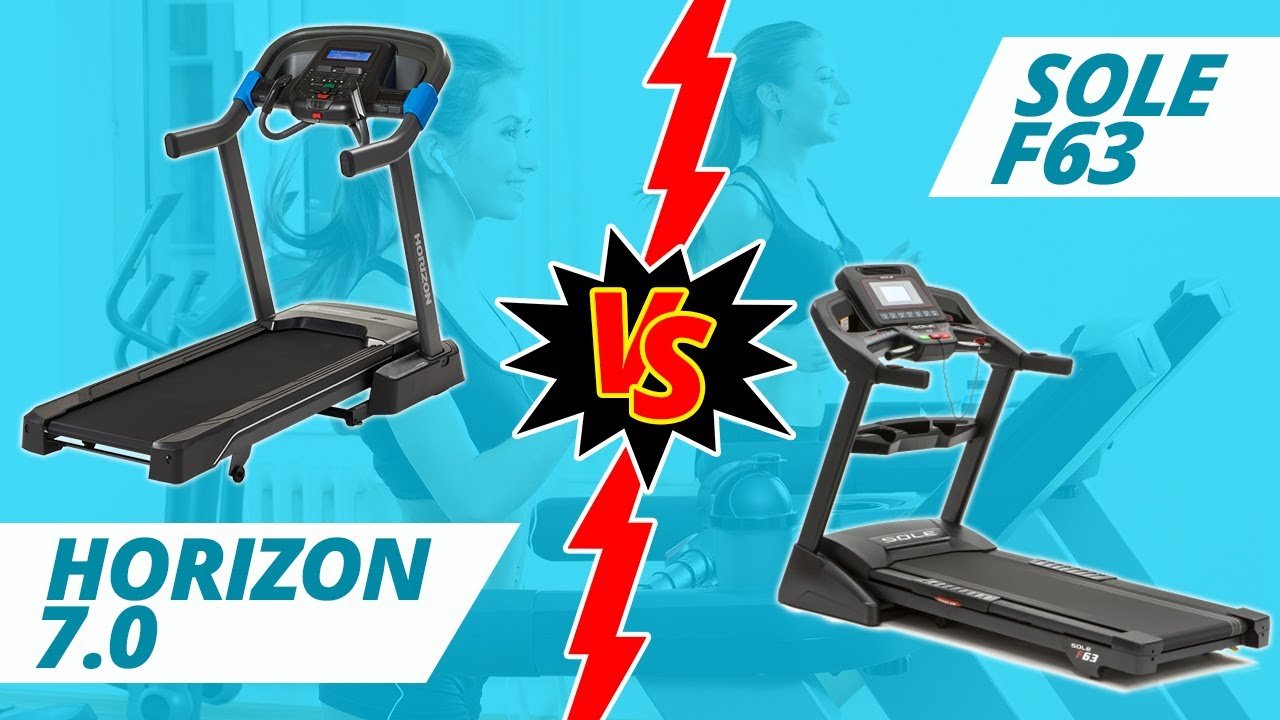
The Sole F63 and Horizon 7.0 AT are closely matched, with about $100 between them — Sole relaunched the F63 for 2026 with a 3.0 HP brushless motor, dial controls and a lighter 187 lb frame. Both have a 20″ × 60″ deck, 15% incline, a 325 lb limit and lifetime frame and motor cover. Choose the Sole F63 if you want a lighter treadmill that is easier to move. Choose the Horizon 7.0 AT for softer cushioning and Apple Watch sync.
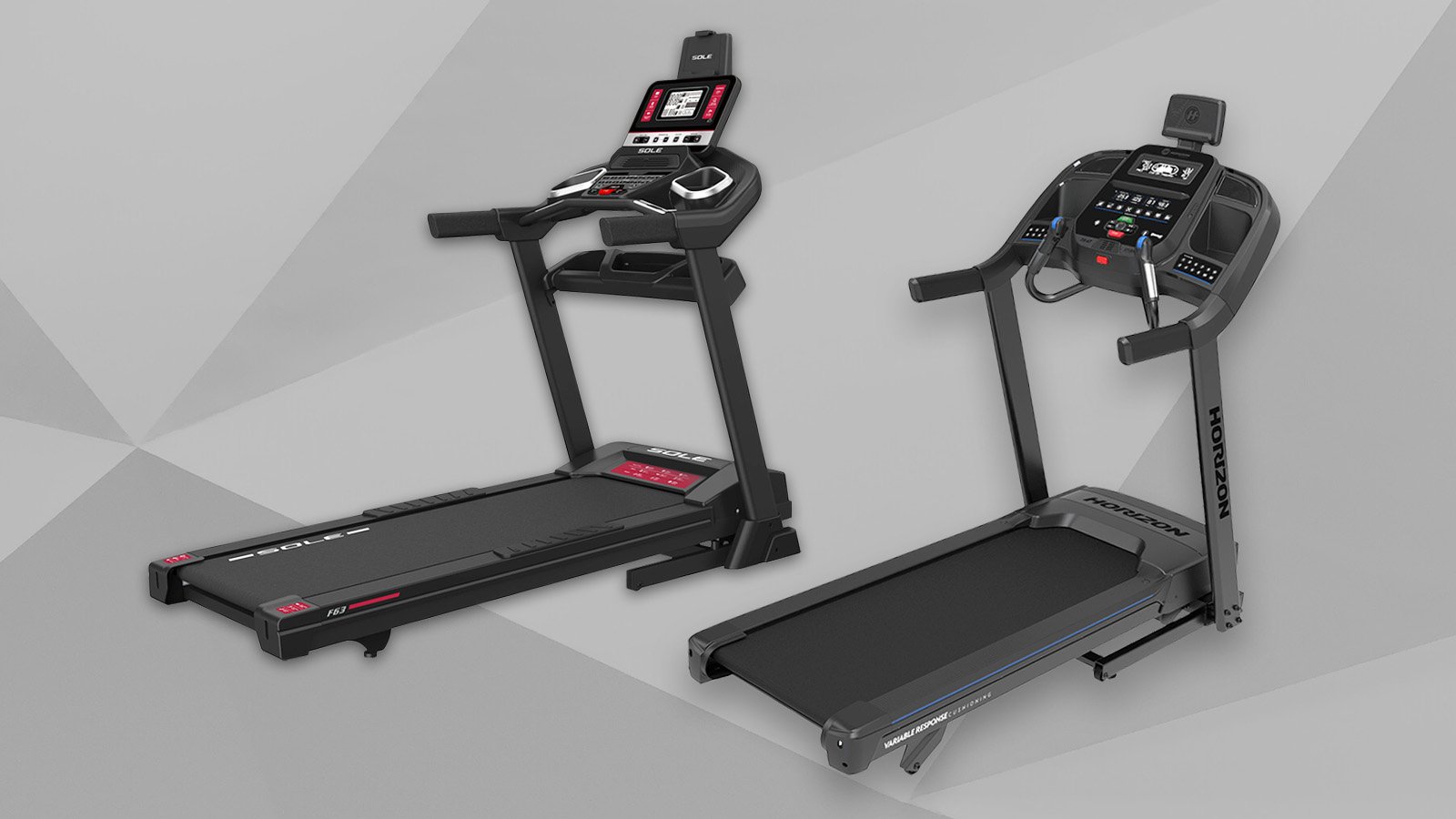
The Sole F63 vs Horizon 7 0 AT is one of the most searched treadmill comparisons right now — and honestly, I understand why. The F63 is $1,199.99 and the 7.0 AT is $1,099. The 2026 F63 has a 3.0 HP brushless motor, the 7.0 AT has a 3.0 CHP motor, and both have a 20″ x 60″ deck and a 15% max incline. On paper, they look almost identical.
But spending over $1,000 on the wrong machine is a frustrating mistake. So which one is actually worth your money?
I’ve been running for 24 years and have personally tested over 250 treadmills. Here’s everything you need to know to make the right call.
The Short Answer
Both are excellent treadmills in the $1,000 range — but they suit different types of runners. The Sole F63 is a steady, durable machine built for consistent mileage. The Horizon 7.0 AT is a more connected, interval-friendly machine with a superior cushioning system and better app integration. If you are still deciding whether either fits your budget, our best treadmills under $1,500 guide covers the full range at this price point.
Neither is universally “better.” The right choice depends on how you actually train.
Official Specs: Sole F63 vs Horizon 7.0 AT (2026)
All specs verified directly from soletreadmills.com and horizonfitness.com
| Specification | Sole F63 | Horizon 7.0 AT |
|---|---|---|
| Price | $1,199.99 | $1,099 |
| Motor | 3.0 HP brushless | 3.0 CHP (RapidSync) |
| Speed Range | 0.5 – 12 mph | 0.5 – 12 mph |
| Incline Range | 0 – 15% (15 levels) | 0 – 15% |
| Running Surface | 20″ x 60″ | 20″ x 60″ |
| Weight Capacity | 325 lbs | 325 lbs |
| Machine Weight | 187 lbs | 277 lbs |
| Step-Up Height | — | 8 5/8″ |
| Belt | 2-ply, 1.6mm | 1.6mm Silicone |
| Front Roller | 2.36″ | 60mm (2.36″) |
| Rear Roller | 1.8″ | 46mm (1.81″) Tapered |
| Cushioning | CushionFlex 2.0, 18 mm deck (firm) | 3-Zone Variable Response (softer) |
| Display | White LED | 7.25″ High Contrast LCD + 4 LED Windows |
| Built-In Programs | 10 (6 modes, 2 custom, 2 heart rate) | 8 |
| Speed/Incline Controls | Handgrip dials + console quick keys | Console + QuickDial handlebar controls |
| Heart Rate | Bluetooth receiver (chest strap or armband) | Hand grip sensors + Bluetooth wireless receiver |
| Apple Watch | No | Yes (Apple GymKit) |
| Samsung Galaxy Watch | No | Yes |
| App Compatibility | SOLE+, Kinomap | Peloton, Zwift, Strava, Kinomap, Bluetooth FTMS |
| Speakers | Bluetooth audio speakers | Bluetooth speakers + Audio In/Out jack |
| USB Port | Type-C, 5V 1.5A | Type A, 5V 1A |
| Fan | Yes | Yes |
| Energy Saver Mode | No | Yes |
| Transport Wheels | Yes | 2 wheels |
| Folding Mechanism | Kick-release, hydraulic assist | One-step hydraulic folding |
| Assembled Dimensions | 75″L x 34″W x 52″H | 76″L x 35″W x 67″H |
| Folded Dimensions | 42″L x 34″W x 71″H | 44″L x 35″W x 68″H |
| Frame Warranty | Lifetime | Lifetime |
| Motor Warranty | Lifetime | Lifetime |
| Deck Warranty | 2 years | Covered under lifetime frame warranty |
| Parts Warranty | 2 years | 3 years |
| Labor Warranty | 1 year | 1 year |
| Cosmetic Warranty | 90 days | — |
What’s the Same — And Why That Matters
Before diving into the differences, it’s worth being honest about just how similar these machines are at their core. Close on price. The same 3.0 motor number, though Sole lists HP and Horizon lists CHP, so the two are not a direct match. Same deck size. Same max speed. Same max incline. Same weight capacity. Same roller sizes (both front rollers measure 2.36″).
Anyone telling you one of these is dramatically superior to the other is stretching the truth. What separates them is genuinely about use case — not quality hierarchy.
Key Differences That Actually Matter
1. Cushioning: The Biggest Real-World Difference
This is where these two machines feel most different when you’re actually running on them, and it’s the single most important factor to consider.
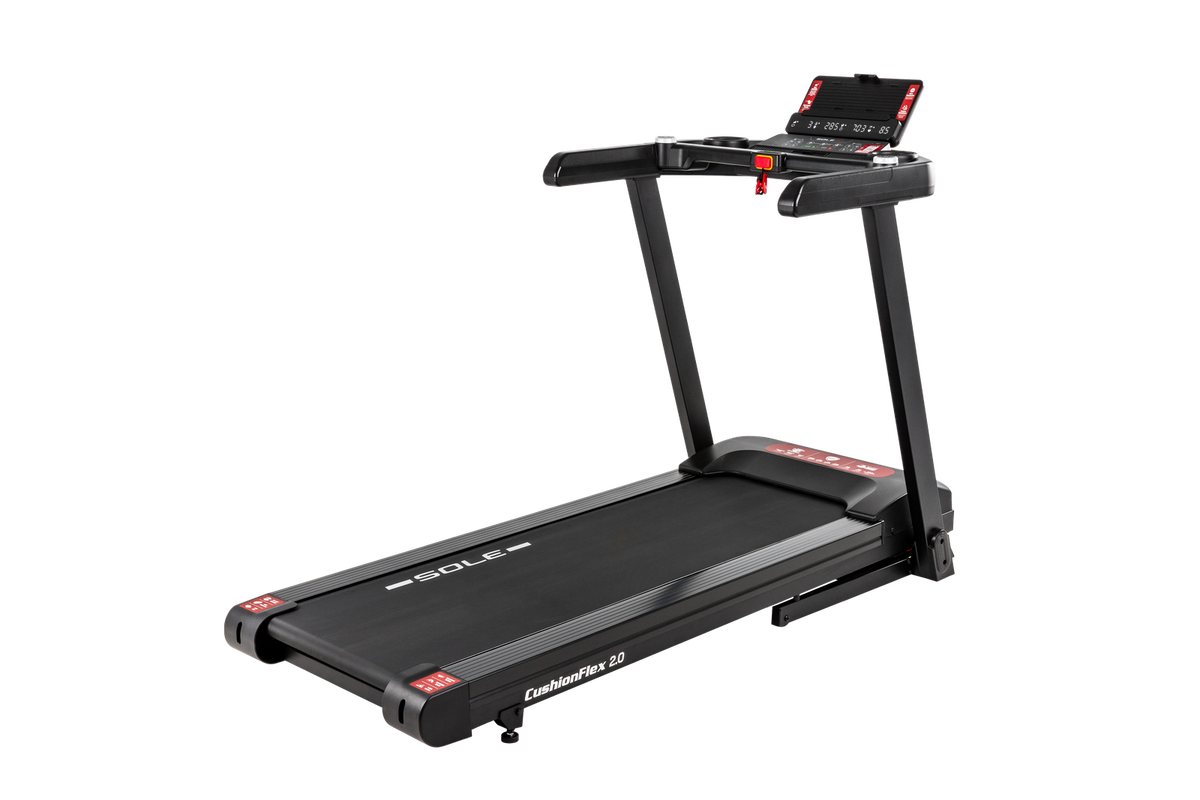
The 2026 Sole F63 uses an 18 mm CushionFlex 2.0 deck. The cushioning is firm and responsive — it absorbs shock but keeps the deck stiff underfoot. The feel is closer to road running than a padded gym floor. That’s actually intentional, and for road race training, it’s a genuine advantage. If you’re training specifically for road races and want to simulate firm surfaces, the F63 keeps that road-running feel.
The Horizon 7.0 AT uses a Three-Zone Variable Response Cushioning system. The front of the deck (impact zone) is softer to absorb landing forces. The middle zone transitions. The rear (push-off zone) is firmer to give you drive. Running on it feels noticeably more comfortable and forgiving, especially on longer sessions.
If you have knee, hip, or ankle issues, the 7.0 AT’s cushioning system will be kinder to your joints. We cover this in more depth in our guide to the best treadmills for bad knees. If you’re training specifically for road races and want to simulate firm surfaces, the F63 keeps that road-running feel. You may also find our article on whether treadmill running is bad for your knees useful.
2. QuickDial Controls: A Game-Changer for Interval Training
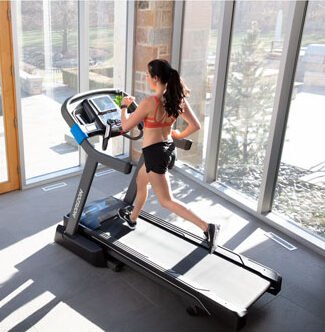
The Horizon 7.0 AT has QuickDial controls on both handlebars. Right dial controls speed. Left dial controls incline. You roll them forward or back to adjust — without looking down at the console, without breaking stride, without missing a beat.
The 2026 Sole F63 now has dial controls for speed and incline in its handgrips too, plus quick keys on the console, so this gap has closed.
If you do any form of interval training — alternating between effort levels, doing hill repeats, following a structured workout — dial controls change everything. Speed changes from 1 mph to 12 mph in about 18 seconds. You can trigger them mid-stride without losing rhythm. It’s one of the best interval features available at this price point.
3. App and Watch Connectivity
The Horizon 7.0 AT connects to Apple Watch through Apple GymKit and also pairs with Samsung Galaxy Watch — tap your Apple Watch to the console and it syncs calories, speed, distance, pace, and time automatically. It also connects with Peloton, Zwift, Strava, and Kinomap via Bluetooth FTMS. That watch pairing is exclusive to the 7.0 within Horizon’s Studio Series, as I explain in my Horizon 7.0 vs 7.4 vs 7.8 comparison.
The Sole F63 connects with the free SOLE+ app and Kinomap. It does not have Apple Watch or Samsung Watch native connectivity.
If your fitness life revolves around Apple Watch metrics or Peloton classes, the 7.0 AT integrates more seamlessly into your existing setup.
4. Warranty: Horizon Has the Parts Edge
Both machines carry lifetime warranties on the frame and motor — that’s equal and excellent. Horizon’s parts warranty is 3 years, while Sole gives 2 years on the deck, electronics and parts. Both give 1 year on labor. That extra year matters, because electronics and smaller components are what tend to fail after the motor and frame are settled in.
Sole offers a 90-day cosmetic warranty (covering scratches and finish issues from delivery) that Horizon doesn’t explicitly offer.
5. Portability: F63 Is Easier to Move
The 2026 Sole F63 weighs 187 lbs and has transport wheels, so you can roll it into place.
The Horizon 7.0 AT weighs 277 lbs — 90 lbs heavier — and has two transport wheels. Moving it requires tilting it onto those two wheels, which at that weight is a genuine workout in itself.
The F63 also folds to a slightly smaller footprint (42″ x 34″) than the 7.0 AT (44″ x 35″), so it takes up a little less floor space when stored upright.
6. Display and Console

The Horizon 7.0 AT has a 7.25″ high-contrast LCD screen plus 4 additional LED windows showing workout metrics clearly. The 2026 Sole F63 has a simpler white LED display showing speed, incline, time, distance, calories and heart rate. Neither has a touchscreen, which is consistent with both brands’ philosophy: keep the cost in the machine, not the screen.
The Horizon console also includes an audio in/out jack alongside Bluetooth, giving you more options for connecting headphones or speakers.
Are These Treadmills the Best in Their Category?
Both the Sole F63 and Horizon 7.0 AT are consistently ranked among the top treadmills under $1,200, and the F63 name has years of owner trust behind it. The 2026 version is new, though, so reviews of this exact model are still building.
The Sole F63 is widely considered the benchmark for build quality at this price point. Its lifetime motor and frame warranty, combined with quality components, make it one of the most recommended treadmills by fitness professionals for home use. For someone who wants a no-subscription, durable running machine that will last, it’s as close to a best-in-class as you’ll find under $1,300.
The Horizon 7.0 AT is the benchmark for connected, interval-focused training at this price. No other treadmill under $1,100 offers native Apple Watch and Samsung Watch connectivity combined with QuickDial handlebar controls and direct Peloton and Zwift integration. For the modern connected runner, it punches well above its price.
Limitations of Both Machines
Sole F63 Limitations
- Very few owner reviews so far. The 2026 version is new, so long-term feedback is still building.
- Simple display. The white LED shows your numbers clearly, but there is no LCD screen.
- No Apple Watch or Samsung Watch native connectivity. If you rely on your watch for workout tracking, there’s no direct sync.
- No energy saver mode. Minor, but the Horizon has one, and the F63 doesn’t.
- No decline. Neither treadmill has a decline, but worth noting if that’s on your wishlist.
- Console programs are basic. The 10 programs are functional but not exciting. No Sprint 8 or advanced HIIT programming.
Horizon 7.0 AT Limitations
- Heavy and hard to move. At 277 lbs with only 2 transport wheels, repositioning this machine solo is genuinely difficult.
- Belt slippage reported at high incline with heavier users. Independent testing found the belt can slip under users over 250 lbs at inclines of 6% or higher. If you’re on the heavier end of the 325 lb capacity, be aware of this.
- No decline. Same as the F63.
- No chest strap included. Despite having a Bluetooth heart rate receiver, the chest strap itself is sold separately.
- Plastic console feel. Several users note the console feels less premium than the machine itself.
- Basic programming. The 7.0 AT doesn’t include Sprint 8 HIIT programming — that’s reserved for the 7.4 AT and above.
Marathon Training or Less? What These Treadmills Are Really For
This is the question I get most often, so let me be direct.
Neither the Sole F63 nor the Horizon 7.0 AT is a marathon training treadmill.
Here’s why. The F63 suits moderate daily mileage. For higher mileage — marathon-level training of 8, 10, 12+ miles per day — step up to the Sole F80 or higher. The Horizon 7.0 AT is similarly rated for moderate use. Its 3.0 CHP motor and standard components are built for a recreational runner, not someone logging 60+ miles a week.
For marathon training, you want at minimum a 3.5 CHP motor, commercial-grade rollers, and ideally a belt that can handle sustained high-speed, high-mileage sessions without wearing prematurely. That puts you in the $1,500–$2,500 range with machines like the Sole F80, Horizon 7.4 AT or 7.8 AT, or NordicTrack Commercial 1750.
What both the F63 and 7.0 AT are excellent for:
- 10 km training (up to 6 – 8 kms per session, occasionally)
- 5K and 10K training
- General fitness running (3–5 miles per day)
- Walking and incline walking
- HIIT and interval sessions
- Weight loss cardio
- Post-injury rehabilitation running
Who Should Buy the Sole F63?
The F63 is the right machine for you if:
- You run steady, consistent mileage (3–6 miles per day) and don’t do much interval training
- You’re training for road races up to a half marathon and want a firm, road-like feel underfoot
- Long-term build quality and durability matter more to you than connectivity features
- You move your treadmill around the room regularly and want a lighter machine at 187 lbs
- You don’t use Peloton, Apple Watch, or other fitness apps and just want a machine that runs reliably
- You’re a single-runner household putting in moderate but consistent mileage
Who Should Buy the Horizon 7.0 AT?
The 7.0 AT is the right machine for you if:
- You do interval training regularly and want softer cushioning under fast pace changes
- You use Apple Watch, Samsung Galaxy Watch, Peloton, Zwift, or Strava and want everything to sync automatically
- You have knee, hip, or ankle issues and need a more cushioned, joint-friendly deck
- You’re a beginner to moderate runner building up your mileage gradually
- You want a treadmill with years of owner feedback behind it
- You want the best parts warranty in this price range (3 years vs 2 years)
My Honest Take After 24 Years of Running
With only about $100 between them, this is genuinely a close call — and anyone who tells you it isn’t is oversimplifying.
If I were buying one of these for myself, I’d pick the Sole F63. I run long, steady miles and I care more about a machine that holds up for a decade than one that syncs with apps. The firm cushioning suits my road-running background, and the lighter 187 lb frame is practical.
But if I were advising most people — recreational runners, fitness walkers, people who do Peloton classes, Apple Watch users — I’d point them to the Horizon 7.0 AT without hesitation. The QuickDial controls genuinely change how interval training feels. The cushioning system is superior for people whose joints don’t want to be pounded. The app connectivity is better. And the 3-year parts warranty gives you more protection.
The bottom line: don’t overthink this. Either machine will serve you well for years. Pick based on how you actually train, not based on specs you’ll never notice.
Related reading: Best Horizon Treadmill
FAQs
Is the Sole F63 or Horizon 7.0 AT better for beginners?
The Horizon 7.0 AT has a slight edge for beginners. The softer cushioning is more forgiving while your body adapts to regular running, and the app connectivity gives you more guided training options from day one.
Which is quieter?
Both are quiet machines. Sole says the 2026 F63’s brushless motor is quieter than before. You can hold a phone conversation on either at moderate speeds.
Can either treadmill handle marathon training?
Not comfortably. Both suit moderate daily mileage. For full marathon training volumes (60+ miles per week), step up to the Sole F80, Horizon 7.4 AT, or a commercial-grade machine.
Does the Horizon 7.0 AT really work with Peloton?
Yes. The 7.0 AT supports Bluetooth FTMS, which Peloton uses to receive live speed and incline data from your treadmill. Your Peloton app will display your actual treadmill metrics during class — no manual input needed.
Are the rollers the same size on both?
Yes. Both treadmills have 2.36″ (60mm) front rollers and approximately 1.8″ rear rollers. This was a correction from earlier comparisons that incorrectly stated the F63 had larger rollers — the official specs show them as equal.
Which treadmill has the better warranty?
Both carry lifetime warranties on frame and motor. Horizon has a better parts warranty (3 years vs Sole’s 2 years). Both give 1 year on labor, and Sole adds a 90-day cosmetic warranty. Overall, Horizon’s parts coverage makes it slightly stronger in this category.
Is the Horizon 7.0 AT safe for users over 250 lbs?
The official weight capacity is 325 lbs, but independent testing has reported belt slippage with users over 250 lbs at higher inclines. If you’re in the 250–325 lb range and plan to use incline regularly, the Sole F63 may be the more reliable choice. See our best treadmills for heavy people guide for more options.
Can I fold both treadmills easily?
Both fold with hydraulic assistance. The 2026 F63 folds to a slightly smaller footprint (42″ vs 44″ long) and weighs 90 lbs less, so it is easier to move.