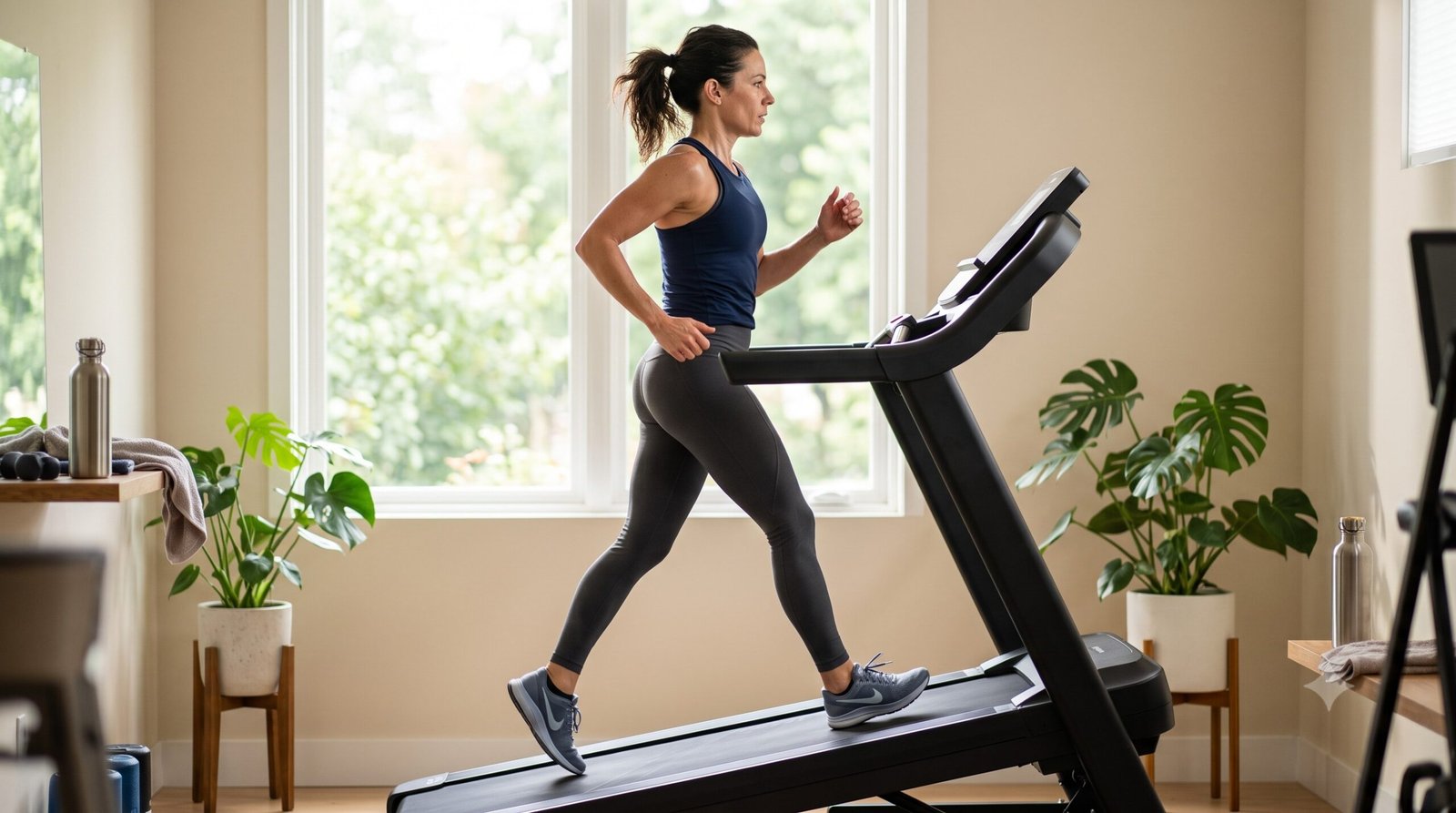
Treadmill incline benefits come down to one thing: you get more out of every minute without adding speed. Raising the deck to 8–10% roughly doubles the calories you burn at a walking pace, shifts the work onto your glutes and hamstrings, and gives you running-level heart rates without the pounding. I’m AnilKK, an INFS-certified nutrition and fitness coach with 24 years of running behind me, and incline walking is the one setting I recommend to almost every client who owns a treadmill.
Quick Answer: The biggest treadmill incline benefits are higher calorie burn at the same speed (10% incline at 3 mph burns about 2.2× more than flat), stronger glutes, hamstrings and calves, and less knee stress than walking fast or jogging on a flat belt. Start at 3–5% for a few weeks, build to 8–12% for fat loss and fitness, and let go of the handrails — holding on cancels most of the gain.
Table of Contents
Treadmill Incline Benefits: What Actually Changes (2026 Explainer)
Walking on a flat belt is mostly a balancing act. Your body swings forward like a pendulum, and the muscles do surprisingly little lifting. Tilt the deck and that changes: with every step you now have to raise your body weight against gravity, and the muscles on the back of your legs take over that job.
That is why a modest incline feels so much harder than the number suggests. A 10% grade on a treadmill means the belt rises 10 feet for every 100 feet you walk. Outdoors, that’s a hill most people would call steep. Most home treadmills offer 0–12% incline; some models go to 15% or more, and a few incline trainers reach 40%.
One clarification before the benefits, because it confuses a lot of readers: treadmills show incline in percent grade, while research papers often use degrees. A 6° slope is about a 10.5% grade. I’ve converted everything below to percent so it matches what you’ll see on your console.
1. You Burn Far More Calories at the Same Speed
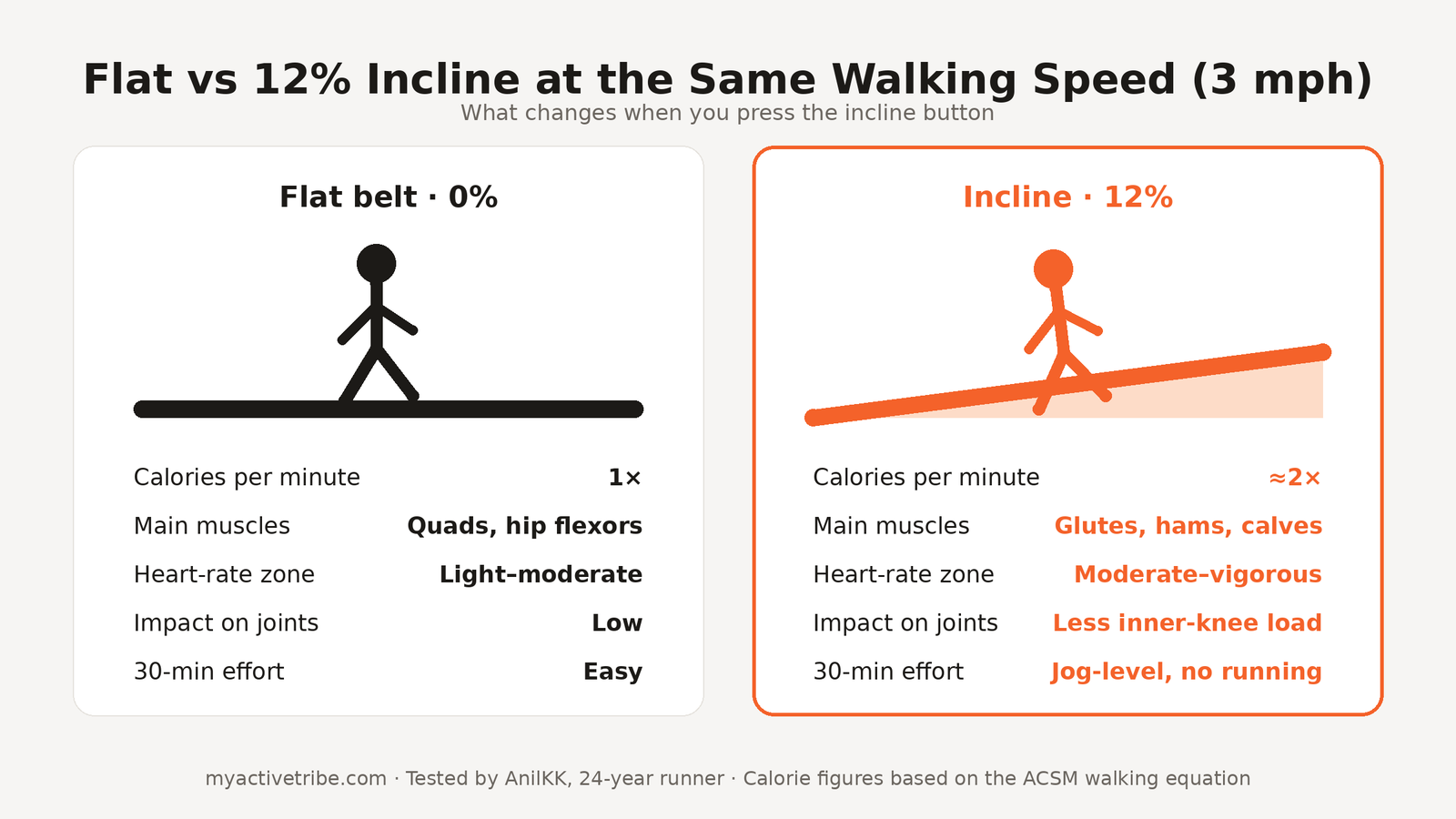
This is the benefit everyone comes for, and the numbers hold up. Using the ACSM metabolic equations for walking, a 180-lb person walking at 3 mph on a flat belt burns roughly 140 calories in 30 minutes. At 5% incline that rises to about 230. At 10% it’s around 320 — more than double the flat figure, at exactly the same speed.
The reason is simple mechanics: lifting your body weight up a slope costs energy that flat walking doesn’t demand. Speed adds calories too, but for most people speed has a ceiling — you can only walk so fast before it becomes an awkward shuffle. Incline has no such ceiling, which is why it’s the better lever for anyone who wants to burn more without running.
Two honest caveats. Console calorie counters are estimates and often generous. And the moment you grab the handrails, you unload a big share of your body weight onto your arms and the calorie advantage shrinks dramatically. Hands off the rails is not optional if you want these numbers.
2. It Builds Your Glutes, Hamstrings and Calves
Flat walking barely wakes up your glutes. Incline walking recruits them with every stride, because extending the hip against a slope is exactly what the gluteus maximus is built for. Hamstrings and calves work harder for the same reason: they are the muscles pushing you uphill.
Research using muscle sensors has shown that hip, knee and ankle extensor activity rises step by step as the grade increases from 0% through 3%, 6% and 9%. In practice, clients who add three incline sessions a week notice firmer glutes and stronger calves within about six weeks — not the size you’d get from squats, but a noticeable change in shape and stair-climbing strength. If you want the full picture of which muscles a treadmill works at each setting, I’ve broken it down separately.
One thing incline does not do, despite what you’ll read on social media: it doesn’t isolate the glutes or “sculpt” them the way a targeted strength program does. It makes them work more than flat walking. That’s the honest claim, and it’s still a good one.
3. It Puts Less Load on Your Knees Than Walking Fast on the Flat
This is the benefit I wish more people knew, especially heavier walkers and anyone with cranky knees. Most people assume “harder workout” means “more joint stress.” With incline, the opposite is true when you compare it to getting the same workout by walking faster.
A Colorado State University study published on PubMed (NIH) measured obese adults walking at combinations of speed and grade. Walking slowly at around 10% grade produced the same moderate-intensity effort as walking fast on the flat, but peak knee extension moments were about 19% lower and knee adduction moments about 26% lower. Loading rates dropped too. Same calories, less force through the joint.
What that means for you: if your goal is a solid 30-minute session and your knees complain when you push the speed, slow down and raise the incline instead. You’ll get the same cardiovascular benefit with a gentler ride for the joint. This is exactly why I steer clients over 200 lb toward incline before speed.
4. You Get Running-Level Fitness With a Fraction of the Impact
Steep incline walking and easy jogging can burn the same calories per minute. The difference is what happens at the moment your foot lands. Jogging has a flight phase — both feet leave the ground — so every landing is an impact. Walking never leaves the ground, no matter how steep the slope.
A 2025 study available through PubMed Central (NIH) compared walking at 20% incline with level jogging at matched calorie burn. Accelerations measured at the foot and the lower back were significantly higher during jogging, and jogging produced greater peak activation in the shin and thigh muscles that absorb landing shock. The authors describe high-incline walking as a lower-impact yet equally demanding alternative.
As a runner of 24 years, I still run — but on the days my legs need a break, a 12–15% incline walk gives me the heart-rate work without the recovery cost. For anyone who wants to be fit but has no interest in running, this is the strongest reason to use incline.
5. It Raises Your Heart Rate Without Needing to Run
Beginners, heavier walkers and older adults often hit the same wall: flat walking doesn’t raise the heart rate enough to count as moderate exercise, but running is out of the question. Incline is the bridge.
At 3 mph and 0% incline, most people sit in the light-intensity zone. Add 6–8% and the same person moves into moderate intensity — the zone health guidelines recommend for 150 minutes a week. Push to 12% and many people reach vigorous intensity while still walking. You control the intensity with one button, without changing your stride.
6. It Trains Your Posture and Core — If You Don’t Cheat
Walking uphill forces a slight forward lean from the ankles and asks your core to keep your torso stable against the slope. Done well, that’s free posture training. Done badly, it’s a rounded back and a death grip on the handrails.
The fix is a cue I give every client: lean from the ankles, not the waist. Your ears, shoulders and hips should stay in a line that’s tilted slightly forward. Arms swing naturally. If you can’t keep that form at a given incline, the incline is too steep for now — drop it 2% and build back up.
7. It Prepares You for Hills, Hiking and Real Race Courses
Outdoors, hills are what break people — on a hike, on a hilly 10K, or just on the walk home. Treadmill incline lets you rehearse that exact stress in a controlled way, at a grade you choose, for as long as you choose.
For hiking prep, I use 10–15% for 30–45 minutes with a loaded backpack, twice a week, for six weeks before a trip. For runners training for a hilly race, alternating 4-minute blocks at 6–8% with 2 minutes flat builds the specific strength that flat miles never will. Your legs learn the hill before they meet it.
8. It Breaks Weight-Loss Plateaus Without Longer Workouts
The most common plateau I see: someone walks 30 minutes a day at the same speed for months, loses weight for a while, then stalls. Their body has adapted. The usual advice — walk longer — doesn’t fit into most people’s lives.
Incline is the adjustment that fits. Keep the 30 minutes, keep the speed, add 2% incline every two weeks. The calorie cost climbs, the muscles get a new stimulus, and the plateau usually breaks within a month. The progression is also gentler on your joints than adding speed, which matters when you’re carrying extra weight.
9. It’s a Gentler Way Back for Older Adults and After Injury
Because incline lets you get a meaningful workout at a slow, controlled speed, it suits people who can’t move quickly: older walkers, anyone returning from a layoff, and people rebuilding after lower-body injury under a physio’s guidance. The lower loading rates from the knee research above are the reason it shows up in rehabilitation settings.
Two rules for this group. First, start at 2–3% and stay there for two full weeks before adding more — the calves and Achilles need time to adapt to uphill work. Second, if you have any hip, knee or ankle condition, clear incline walking with your doctor or physiotherapist first. This is general guidance, not a treatment plan.
How Much Incline Should You Use?
Here’s the guide I use with clients. Match the incline to the goal, not to what looks impressive on the console.
| Your goal | Incline range | Suggested speed | Session length | Why this setting works |
|---|---|---|---|---|
| Just starting out | 2–4% | 2.5–3.0 mph | 20–30 min | Enough to feel the glutes without straining calves and Achilles |
| General fitness | 5–8% | 3.0–3.5 mph | 30 min | Moves most people into moderate-intensity heart-rate zone |
| Fat loss | 8–12% | 3.0 mph | 30–40 min | Roughly doubles flat-walking calorie burn with low joint load |
| Hiking or hill-race prep | 10–15% | 2.5–3.0 mph | 30–45 min | Rehearses the exact demand of real hills |
| Runner’s cross-training day | 12–15% | 3.0–3.5 mph | 30 min | Running-level heart rate with no landing impact |
| Older adults / return from injury | 2–3% for 2 weeks, then +1% every 2 weeks | 2.0–2.5 mph | 15–25 min | Lets calves and joints adapt gradually |
The popular “12-3-30” routine — 12% incline, 3 mph, 30 minutes — sits squarely in the fat-loss row, and it works for the reasons above. My only change for beginners: earn your way to 12% over four to six weeks rather than starting there. If you’d like structured sessions built around incline, the treadmill workouts for weight loss guide has seven progressions for different fitness levels.
Incline Walking vs Running: Which Burns More?
It depends entirely on the incline. The table below uses the ACSM metabolic equations for a 180-lb person over 30 minutes. Your numbers will differ with body weight, but the ratios hold.
| Activity | Approximate intensity (METs) | Calories in 30 min (180 lb) | Impact on landing |
|---|---|---|---|
| Walk 3 mph, 0% incline | 3.3 | About 140 | Low |
| Walk 3 mph, 5% incline | 5.4 | About 230 | Low |
| Walk 3 mph, 10% incline | 7.4 | About 320 | Low |
| Walk 3 mph, 15% incline | 9.5 | About 410 | Low |
| Jog 5 mph, 0% incline | 8.7 | About 375 | High — flight phase on every stride |
The takeaway: walking at 15% incline out-burns an easy jog, and walking at 10% gets close, with none of the landing forces. Running still wins on time efficiency at faster paces, and it builds bone density and running-specific fitness that walking can’t replace. But if the question is “how do I burn what a jog burns without jogging,” a 10–15% incline is the answer.
6 Incline Mistakes That Cancel the Benefits
Holding the handrails. This is the big one. Gripping the rails shifts body weight onto your arms, cuts calorie burn sharply, and pulls your posture forward at the waist. If you can’t walk hands-free at a given incline, lower it.
Going too steep too soon. Calves and the Achilles tendon adapt more slowly than your lungs do. Jumping straight to 12% is the most common cause of the calf tightness and heel pain people blame on the treadmill.
Leaning from the waist. A rounded, bent-over posture loads the lower back and takes the glutes out of the movement. Lean from the ankles and keep the chest open.
Only ever going up. If your machine has a decline setting, use it occasionally. Downhill walking loads the quads eccentrically, which is exactly what tired legs face on the back half of a hike or race. I cover the trade-offs in the decline treadmill guide.
Trusting the “1% rule” as fact. You’ll read everywhere that 1% incline makes treadmill running ‘equal’ to outdoor running. It comes from a single 1996 study on a handful of runners, so a small incline is a sensible default for runners — just don’t treat the exact number as sacred.
Using incline every single day. Uphill walking is a strength stimulus. Like any strength work, it needs recovery. Three to four incline sessions a week with flat or easy days between them gets better results than seven in a row.
Who Should Be Careful With Incline
Incline is gentle on knees but not on everything. People with Achilles tendinopathy or plantar fasciitis often find steep grades aggravate the problem, because the calf and the tissue under the foot are stretched under load on every step. Keep grades low and progress slowly, or stick to flat until the tissue settles.
Anyone with low-back pain should watch their posture closely — the forward lean is where the trouble starts. And if you have a heart condition or are new to exercise after a long break, the fact that incline raises heart rate quickly is a reason to start conservatively and get medical clearance. None of this rules incline out; it just means the progression should be slower than the table above.
A 4-Week Incline Plan for Beginners
Three sessions a week, 30 minutes each, at a speed where you can talk in short sentences. Warm up 5 minutes flat and cool down 5 minutes flat inside each session.
- Week 1: 20 minutes at 3%. Focus on hands-free walking and ankle lean.
- Week 2: 20 minutes at 5%. If calves are tight, repeat week 1 instead.
- Week 3: Alternate 4 minutes at 8% with 2 minutes at 2%, for 20 minutes.
- Week 4: 20 minutes steady at 8%, or 12-3-30 if that feels comfortable.
After week 4, add 1–2% every two weeks toward your goal range. Most people are comfortable at 10–12% within two to three months. Progress the incline before the speed, and the duration before either.
What to Look for in a Treadmill With Incline
If you’re buying with incline in mind, three things matter more than the maximum percentage on the box. Motorised incline beats manual — you’ll actually change it mid-workout. A 12% ceiling covers every goal in this article; 15% is a bonus for hikers. And a longer, wider belt matters more than usual, because uphill walking shifts your stride. My best treadmills for walking guide compares machines on exactly these points.
Working from a desk? Incline is harder to find in compact machines, but it exists. I’ve tested the options in a separate guide to under-desk treadmills with incline — most cap at 3–5%, which is enough for the general-fitness row in the table above, but not for fat-loss-level grades.
Frequently Asked Questions
Is walking on an incline better than walking on a flat treadmill?
For most goals, yes. Incline walking burns more calories at the same speed, works the glutes and hamstrings harder, and raises heart rate into the moderate zone without running. Flat walking is still useful for warm-ups, recovery days and people with Achilles or calf problems.
How many more calories does a 10% incline burn?
Roughly 2.2 times more than flat walking at the same speed, based on the ACSM metabolic equations. For a 180-lb person at 3 mph, that’s about 320 calories in 30 minutes versus about 140 on the flat. Holding the handrails reduces these numbers substantially.
Does incline walking really help with belly fat?
Incline walking increases total calorie burn, which supports fat loss across the whole body, including the belly. No exercise targets belly fat specifically. Combine three to four incline sessions a week with a modest calorie deficit and the results follow over weeks, not days.
Is incline walking bad for your knees?
Research on obese adults found that slow walking at roughly 10% grade produced lower peak knee moments and loading rates than walking fast on a flat belt, at the same effort level. Incline is generally kinder to knees than adding speed. Steep grades can, however, aggravate Achilles or plantar fascia problems.
What incline should a beginner start with?
Start at 2–4% for the first two weeks at a comfortable walking speed, then add 1–2% every two weeks. Calves and the Achilles tendon adapt more slowly than your cardiovascular system, and rushing the incline is the most common cause of calf tightness on a treadmill.
Is 12-3-30 a good workout?
Yes — 12% incline at 3 mph for 30 minutes lands in the fat-loss zone for most people and is low impact. The only adjustment I recommend is building up to 12% over four to six weeks rather than starting there, and keeping your hands off the rails throughout.
Can incline walking replace running?
For calorie burn and heart-rate training, largely yes: walking at 15% incline burns more than an easy jog with far less impact. It can’t fully replace running for bone density, running-specific fitness or race preparation. Many runners use it as a cross-training day rather than a full replacement.
How often should I do incline walking?
Three to four sessions a week, with flat or easy days between them. Uphill walking is a strength stimulus for the glutes, hamstrings and calves, and those muscles need recovery time to adapt. Daily steep incline usually leads to tight calves rather than faster results.
Affiliate disclosure: myactivetribe.com is supported by its readers. When you purchase through links on our site, we may earn an affiliate commission at no extra cost to you. This does not affect which products I recommend — every recommendation is based on hands-on testing and verified manufacturer specifications.