Is creatine good for skin and hair? The honest answer is mixed but has gotten clearer recently: there’s genuine early evidence that topical creatine can help with skin aging, and the hair-loss concern that’s circulated for years just got directly tested in a proper randomized trial — with reassuring results. I’m AnilKK, an INFS-certified nutrition and fitness coach with 24 years of experience, and this is one of those topics where the research is real but frequently overstated online — so let’s separate what’s actually been studied from what’s just repeated as fact.
Quick Answer: Topical creatine has some genuine early research support for reducing skin sagging and wrinkles. The hair-loss concern — that oral creatine raises DHT, a hormone linked to hair loss in genetically predisposed men — was based for years on a single small 2009 study. A proper 2025 randomized controlled trial directly testing DHT levels and actual hair follicle health found no significant effect from creatine. Separately, “dry scooping” creatine powder (eating it without water) carries real choking and lung-aspiration risk and isn’t recommended.
Table of Contents
Is Creatine Good for Skin and Hair?
Does Creatine Help Skin?
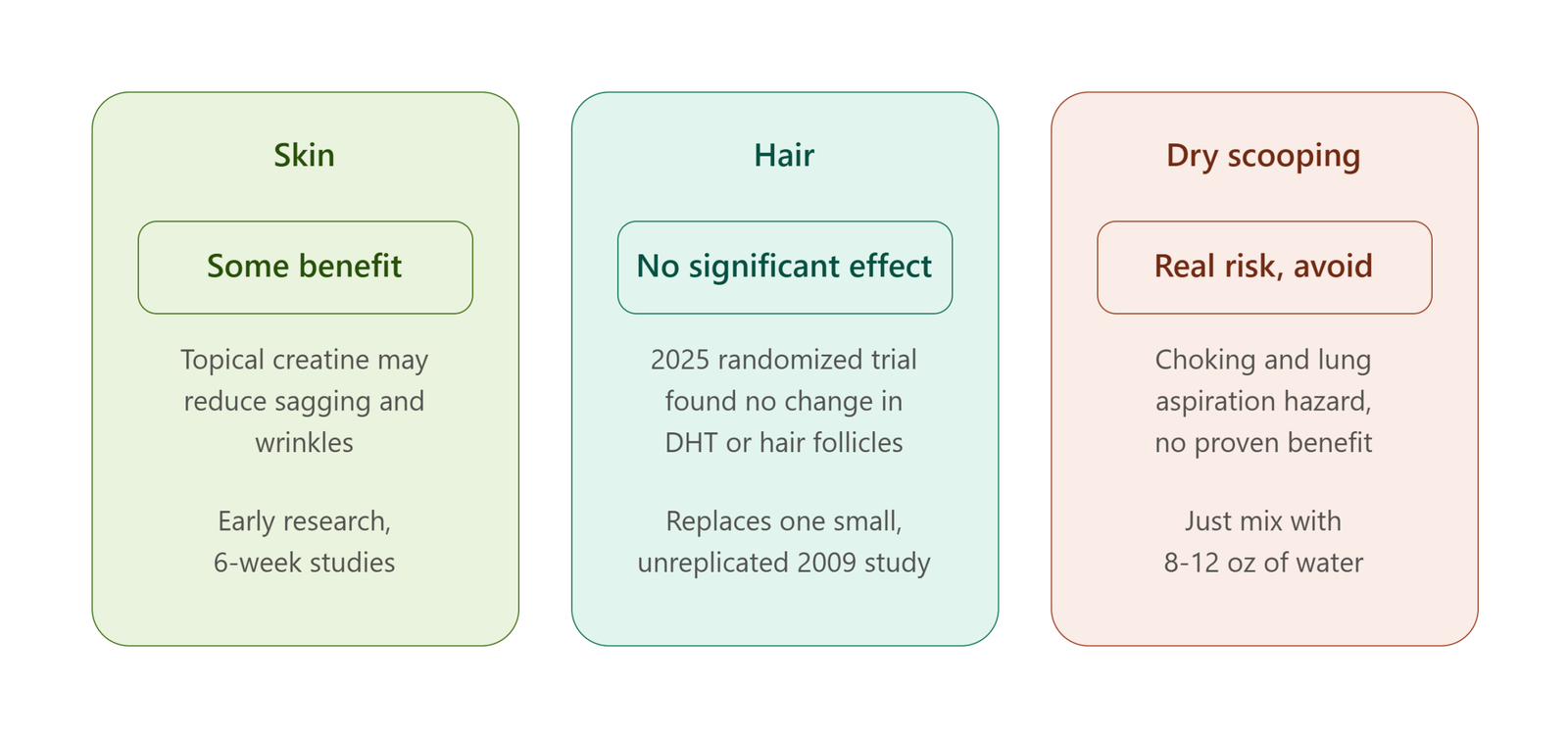
This is the more genuinely supported side of the question. A systematic review of creatine research, hosted on the National Institutes of Health’s PMC database, describes a study finding that topical creatine rapidly penetrates the dermis, stimulates collagen synthesis, and significantly reduced sagging in the jowl area along with crow’s feet and under-eye wrinkles after 6 weeks of daily use. The researchers concluded creatine represents a genuinely beneficial active ingredient for topical use in skin aging.
Worth being precise about what this does and doesn’t tell us: this is early-stage research on a specific topical formulation, not a blanket claim that oral creatine supplements will improve your skin. If skin aging specifically is your goal, a dedicated topical product with researched creatine concentrations is a different thing entirely from the creatine powder you’re taking for the gym. If you’re new to creatine generally, our broader guide to creatine covers the fundamentals beyond just this skin and hair question.
Does Creatine Affect Hair?
For years, the claim that creatine increases hair loss traced back to a single small study from 2009, which found that college rugby players taking creatine had elevated DHT (dihydrotestosterone) levels after a loading phase and maintenance dose. DHT is a hormone that can shrink hair follicles in men genetically predisposed to pattern baldness. That study measured hormone levels only — not actual hair loss — and was never replicated for over 15 years, yet it became the entire basis for a claim repeated constantly online.
That changed in 2025. A 12-week randomized controlled trial in 45 resistance-trained men directly measured both DHT levels and actual hair follicle health — the first study to test real hair outcomes rather than just hormones — and found no significant difference in DHT, DHT-to-testosterone ratio, or hair growth parameters between the creatine and placebo groups. This is meaningfully stronger evidence than the original 2009 study, since it’s the first research to actually look at hair itself rather than inferring risk from a hormone reading.
One honest caveat worth knowing: this newer study was conducted by researchers affiliated with the International Society of Sports Nutrition and published in that organization’s own journal — a real conflict of interest worth factoring in, similar to how any industry-funded research deserves a bit more scrutiny. It doesn’t invalidate the findings, but it’s fair to know who funded and published the study clearing creatine’s name.
If you’re genetically prone to male pattern baldness and still concerned, it’s a reasonable thing to discuss with a doctor — but the current evidence leans toward creatine not being the hair-loss risk it’s often made out to be. For most people, the much better-established reason to take creatine remains its role in building and maintaining muscle mass, which has decades of consistent research behind it.
Is Dry Scooping Creatine Dangerous?
“Dry scooping” — eating creatine or pre-workout powder directly without mixing it into water — has become a social media trend, with claims that it works faster than mixing it into a drink. There’s no research supporting the idea that it improves absorption or effectiveness. What it does carry is genuine, physical risk.
Fine, dry powder in your mouth is a real choking hazard, and if you inhale sharply while it’s there, it can enter your airway. Inhaling fine particulate matter into the lungs can trigger acute irritation and, in more severe cases, contribute to pneumonia — the same basic mechanism at play whether the inhaled material is food, liquid, or fine powder. There’s also a genuine digestive cost: creatine is osmotic, meaning it pulls water toward it to dissolve, and taking it dry can pull that water from your gut tissue instead, leading to cramping and bloating.
The fix costs nothing and takes seconds: mix your creatine into 8-12 oz of water, juice, or a protein shake before drinking it. There’s no legitimate performance reason to skip this step. Our creatine powder FAQ guide covers other common mixing and usage questions in more depth.
How to Take Creatine Safely
Beyond avoiding dry scooping, the basics are straightforward: 3-5g of creatine monohydrate daily, mixed into any liquid, taken consistently. Loading phases (around 20g daily for 5-7 days) aren’t required but can get you to full muscle saturation faster if you want it. If you’re deciding between powder and capsules specifically, our creatine pills or powder comparison breaks down the real tradeoffs between the two formats.
Water retention in muscle tissue is a normal, expected part of how creatine works, and it’s not the same as bloating or fat gain — if that’s a specific concern for you, our guide on whether creatine causes bloating covers the actual mechanism and what to do about it.
Frequently Asked Questions
Does creatine do anything for your skin?
Early research on topically applied creatine (not the oral supplement you drink) found it can reduce skin sagging and wrinkles after consistent use over several weeks. This is a different product and application method from standard creatine powder.
Does creatine affect hair growth or cause hair loss?
For years this was based on one small, unreplicated 2009 study measuring hormone levels only. A 2025 randomized controlled trial directly tested actual hair follicle health and found no significant effect from creatine, though it’s worth knowing that study had a funding conflict of interest. If you’re genetically predisposed to male pattern baldness and still concerned, discuss it with a doctor.
Does creatine tighten skin?
Early research on topical creatine formulations found reduced sagging and wrinkles after 6 weeks of daily use, largely attributed to stimulated collagen synthesis. This is specific to topical application, not oral supplementation.
Is it safe to dry scoop creatine?
No. Dry scooping carries real choking and lung-aspiration risk, along with digestive discomfort since creatine needs liquid to dissolve properly. There’s no research showing it improves absorption or effectiveness, so the risk isn’t offset by any real benefit.
Does creatine help facial hair growth?
There’s no direct research establishing this. A 2025 randomized trial found creatine doesn’t meaningfully raise DHT or affect hair follicle health, which was the proposed mechanism behind any facial hair claim in the first place — so there’s little basis for this claim either way.
Can creatine cause acne or oily skin?
There’s no established evidence linking oral creatine supplementation to increased sebum production or acne. If you notice skin changes after starting creatine, it’s more likely related to other factors in your routine than the creatine itself.
Should women worry about creatine and hair loss?
The original DHT research was conducted on men, and DHT-related hair loss is primarily a male-pattern baldness mechanism. There’s no direct research on creatine and hair loss risk specifically in women.
What should I do instead of dry scooping?
Mix 3-5g of creatine into 8-12 oz of water, juice, or a protein shake before drinking. This takes only a few extra seconds, delivers the same effectiveness, and eliminates the choking and digestive risks entirely.
Affiliate Disclosure: myactivetribe.com is supported by its readers. When you purchase through links on our site, we may earn an affiliate commission at no additional cost to you.