The best elliptical for heavy person buyers in 2026 are the Sole E95 (400 lb capacity, 27 lb flywheel, best overall build quality), the Niceday Elliptical (400 lb, best budget pick), and the HCI PhysioStep MDX (500 lb, best for users over 400 lb and rehab needs) — all confirmed in stock on Amazon. After 24 years of running and working with 1,000+ people on weight management as an INFS-certified coach, the single biggest mistake I see heavy buyers make is choosing an elliptical at their exact body weight.
A machine rated for your weight is operating at its maximum load, which accelerates wear on bearings, resistance mechanisms, and frame joints. Always choose a machine with at least 30 lb of headroom above your current weight. Every product on this list was verified against its official brand specification and confirmed in stock on Amazon before inclusion.
Quick Answer: For heavy people, the Sole E95 (400 lb capacity, 27 lb flywheel, lifetime frame warranty) is the strongest all-round pick under $2,000. The Niceday Elliptical (400 lb, 16 lb flywheel, Kinomap app) is the best budget option under $600. The HCI PhysioStep MDX (500 lb capacity, recumbent design) is the only option here for users over 400 lb or those with mobility and joint limitations. The NordicTrack AirGlide 16 (300 lb capacity, 32 lb flywheel, 16″ HD touchscreen) is the best tech pick for users under 270 lb who want iFIT training. All seven products below are verified in stock on Amazon as of May 2026.
Table of Contents
Best Elliptical for Heavy Person 2026 — Quick Comparison
| Product | Weight Capacity | Flywheel Weight | Stride Length | Resistance Levels | Frame Warranty | Ideal Buyer Profile |
|---|---|---|---|---|---|---|
| Sole E95 | 400 lb | 27 lb | 20″ adjustable | 20 levels | Lifetime | Best overall — serious daily users up to 370 lb |
| Niceday Elliptical | 400 lb | 16 lb | 15.5–18″ adjustable | 16 levels | Lifetime (brand promise) | Best budget — casual to moderate users up to 370 lb |
| Sole E35 | 350 lb | 25 lb | 20″ fixed | 20 levels | Lifetime | Mid-range — users up to 320 lb wanting Sole quality |
| Merach Self-Powered Elliptical | 400 lb | 17.6 lb | 18.5″ | 16 levels electromagnetic | Manufacturer warranty | No power cord needed — users up to 370 lb needing placement flexibility |
| NordicTrack AirGlide 16 | 300 lb | 32 lb | 19″ adjustable | 26 levels | 10 years frame | Best tech — users under 270 lb wanting iFIT training |
| Sunny SF-E3912 | 330 lb | 13.2 lb | 15.5″ fixed | 16 levels | 3 years frame | Entry level — light to moderate users up to 300 lb |
| HCI PhysioStep MDX | 500 lb | Commercial grade | 12″ recumbent | 16 levels | Lifetime | 500 lb capacity — users over 400 lb or with mobility limitations |
Is an Elliptical Actually Safe for a Heavy Person?
Yes — and for most heavy users, an elliptical is safer than a treadmill. Research published through the NIH confirms that elliptical training produces significantly lower peak impact forces on the knee and hip joints compared to walking or running on a treadmill, making it one of the most joint-friendly cardiovascular options available. For someone carrying excess weight, that reduced impact matters — every step on a treadmill transfers a force of 1.5 to 3 times your body weight through your joints. The elliptical eliminates that impact entirely by keeping your feet in continuous contact with the pedals throughout the stroke.
The critical caveat is machine selection. A standard consumer elliptical with a 250 lb weight limit is not designed for a 280 lb user — the frame, bearings, and resistance mechanism are all engineered for lighter loads, and running any machine near its maximum rated capacity accelerates wear and increases the risk of mechanical failure during use. The products on this list are specifically selected for structural capacity, flywheel weight as a quality indicator, and frame construction — not just because the number on the box is high enough.
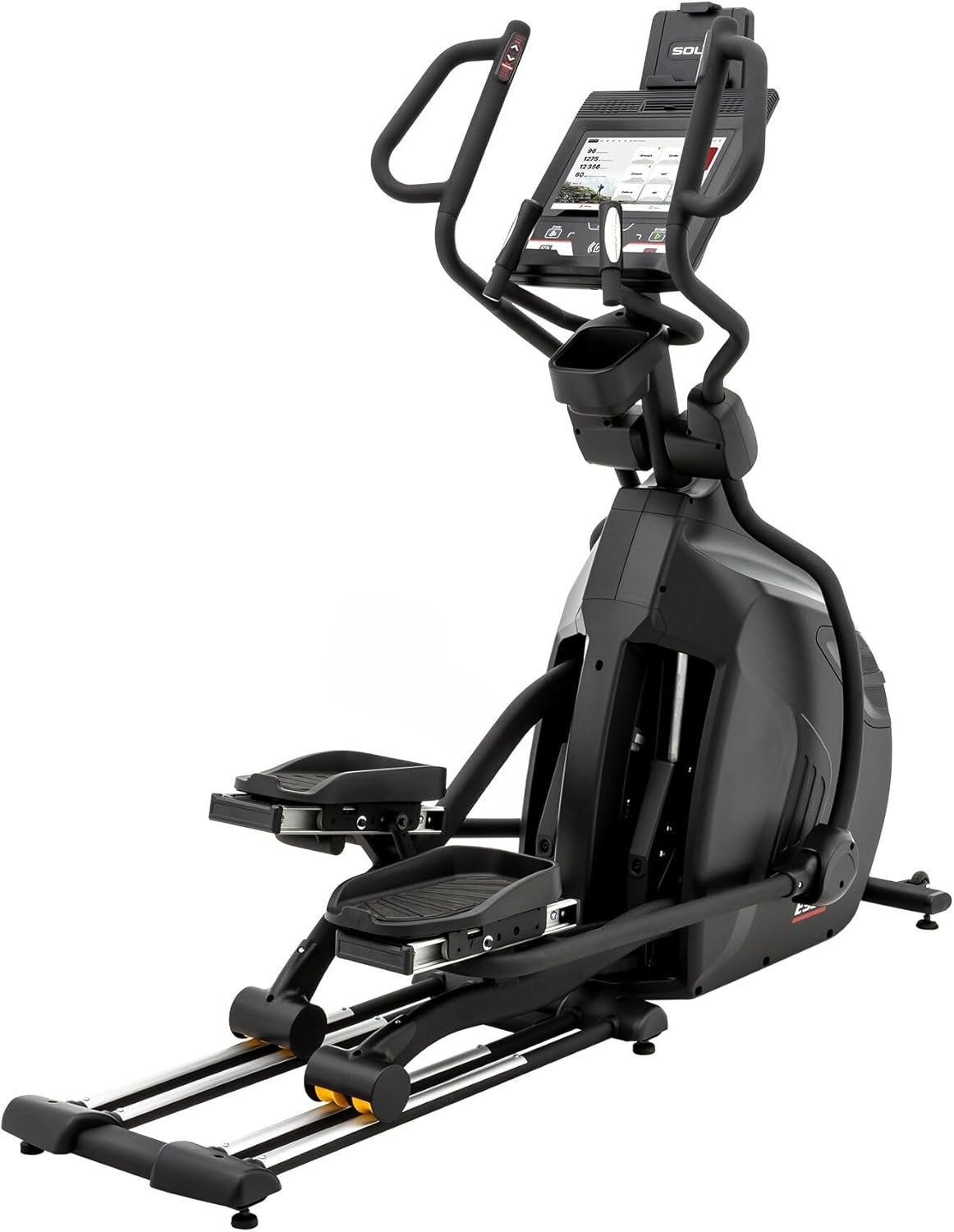
1. Sole E95 — Best Overall Heavy Duty Elliptical Machine for Home Use
Warranty: Lifetime frame and flywheel | 3 years parts and electronics | 1 year labor
- Weight capacity: 400 lb
- Flywheel: 27 lb
- Stride length: 20″ adjustable
- Resistance levels: 20
- Incline levels: 20
- Console: 13.3″ touchscreen with WiFi, screen mirroring, built-in apps
- Pedals: Adjustable 10 positions, 2-degree inward slope, cushioned
- Machine weight: 236 lb
- Dimensions: 71″ L × 29″ W × 67″ H
- App: SOLE+ (free), Bluetooth compatible
The Sole E95 is the standard against which every other elliptical for heavy people should be measured. At 236 lb of machine weight with a 27 lb flywheel and a lifetime frame warranty, it is the closest thing to commercial-grade performance you will find in a residential elliptical under $2,000. The 400 lb user capacity — upgraded from 375 lb in earlier models — combined with six adjustable floor levelers and three stabilisers, gives it the structural integrity to handle consistent daily use from heavier users without the wobble or frame flex that cheaper machines develop within months.
What Makes It Different
The Sole E95 is the only elliptical on this list with adjustable pedals — ten positions controlled by a worm drive mechanism — combined with a built-in 2-degree inward slope. That combination was developed in collaboration with a physical therapist specifically to reduce the ankle and knee stress that is most problematic for heavier users whose joints are already under greater load. No other product at this price point offers that level of biomechanical customisation. The dual-rail pedal system with four rear wheels also eliminates the side-to-side wobble that cheaper front-drive ellipticals develop at heavier loads — a genuine difference you feel from the first stride.
The 27 lb flywheel is the real quality signal here. Most consumer ellipticals use a 13–16 lb flywheel — the E95’s flywheel is nearly twice that weight, which means more rotational momentum, a smoother pedal stroke at every resistance level, and better mechanical stability under heavier loads. When you are 300+ lb on a machine, a light flywheel creates a choppy, uneven stroke that is both uncomfortable and harder on joints. The E95 eliminates that entirely.
The lifetime frame and flywheel warranty is the manufacturer’s confidence statement about this machine’s longevity. Sole does not offer lifetime coverage on machines they expect to fail — and at 236 lb of steel construction, the E95 is built to last a decade of regular use. The 13.3″ touchscreen with screen mirroring, built-in Netflix, and the free SOLE+ workout platform means you are not locked into a subscription to use the machine’s tech features — a meaningful advantage over NordicTrack’s iFIT-dependent ecosystem.
Best for: Heavy users up to 370 lb (applying the 30 lb headroom rule) who want the most durable, biomechanically well-designed elliptical under $2,000 for daily use — the closest to commercial quality available for home gyms.
Pros:
- 27 lb flywheel — nearly double the industry standard — delivers a genuinely smooth, stable stroke at all weight levels and resistance settings.
- Adjustable pedals with worm drive and 2-degree inward slope reduce ankle and knee stress — the most biomechanically considered design on this list for heavy users with joint concerns.
- Lifetime frame and flywheel warranty is the strongest on any non-commercial elliptical — a genuine long-term value signal.
- 400 lb capacity with three stabilisers and six levelling feet provides structural stability that lighter machines cannot match under sustained heavy use.
- Free SOLE+ app access — no mandatory subscription to use the interactive features, unlike iFIT-dependent competitors.
Cons:
- 236 lb machine weight means two people are needed for assembly and positioning — not a solo setup job.
- Higher price point than most options on this list — the premium is justified by the build quality, but budget-conscious buyers should consider the E35 or Niceday instead.
2. Niceday Elliptical — Best Budget Elliptical for Heavy Person with 400 lb Capacity
Warranty: Lifetime service promise (brand replacement policy)
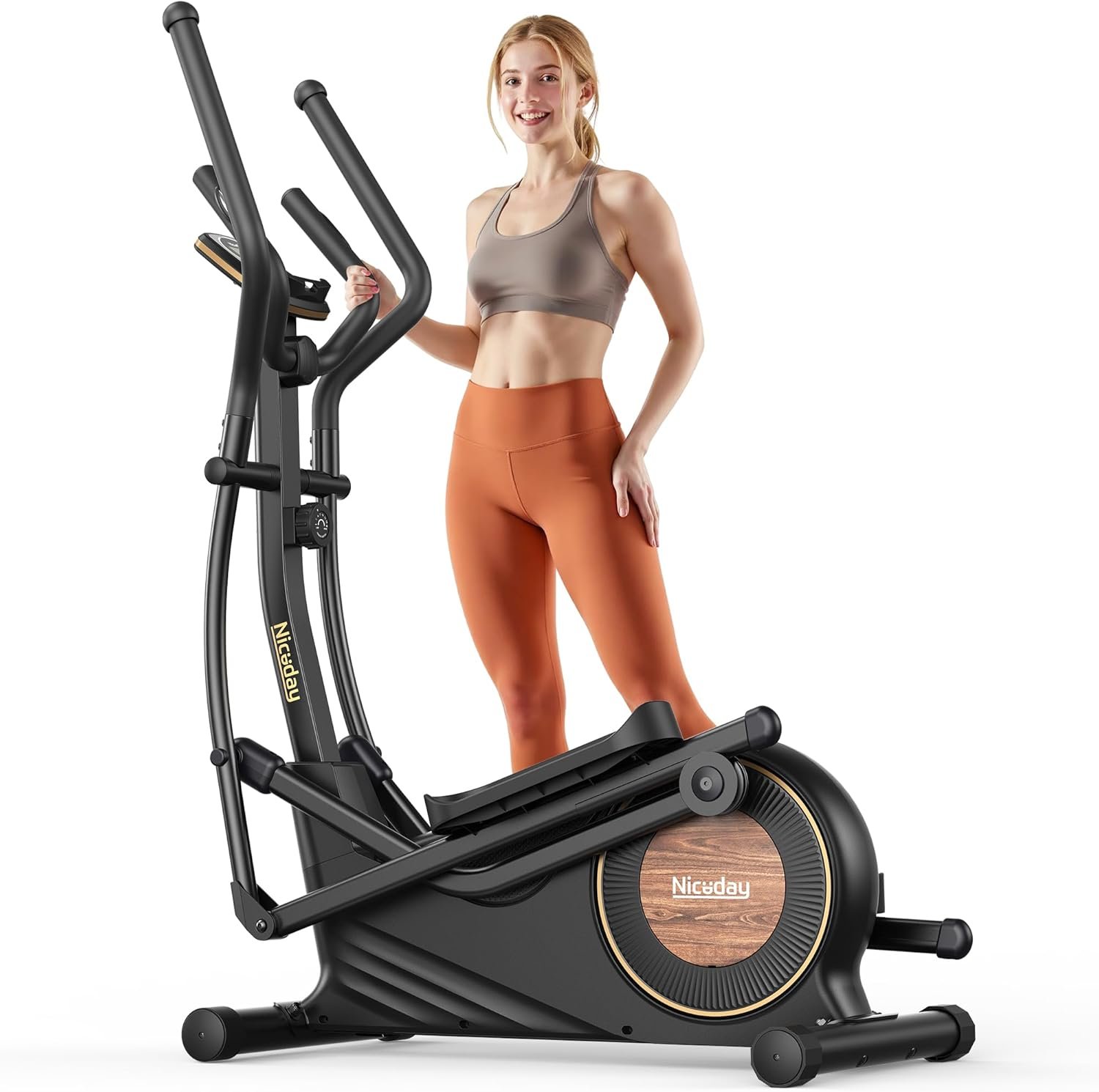
- Weight capacity: 400 lb
- Flywheel: 16 lb
- Stride length: 15.5–18″ adjustable
- Resistance levels: 16
- Incline: No
- Noise level: Under 20 dB
- Frame: 8×5 cm commercial steel pipe
- Machine weight: 106 lb
- Dimensions: 48″ L × 25″ W × 62″ H
- App: Kinomap compatible
- Assembly: 90% pre-assembled
The Niceday delivers a 400 lb weight capacity at under $600 — a combination that no other elliptical on this list matches at that price point. The commercial steel pipe frame construction (8×5 cm tubing) is the reason it can make that claim: the structural integrity comes from the frame material, not from complexity or electronics. For a heavy person who needs a reliable, quiet, low-impact cardio machine for home use without spending $1,500+, this is the most practical starting point on the market right now.
What Makes It Different
The Niceday is the only budget elliptical on this list with an adjustable stride length — ranging from 15.5″ to 18″ — which means it can accommodate users from 4’9″ to 6’2″ on the same machine. Most ellipticals in this price bracket have a fixed stride. That adjustability matters for heavier users who are also taller, where a stride that is too short forces an unnatural gait and increases knee stress. The under-20 dB noise level — quieter than a normal conversation — is a genuine operational advantage for apartment living or shared spaces where a treadmill would be impractical.
The honest limitation is the 16 lb flywheel. Compared to the Sole E95’s 27 lb flywheel, the Niceday’s stroke will feel noticeably lighter and less smooth at higher resistance levels. For walking and moderate-intensity cardio, this is not a problem. For users who want high-resistance interval training, the flywheel weight will be a ceiling on the quality of the experience. The Niceday’s lifetime service promise — where the brand covers replacement costs — is reassuring, but it operates differently from Sole’s formal lifetime warranty with documented terms. Check the current Amazon listing for warranty details before purchasing.
Best for: Budget-conscious heavy users up to 370 lb who want a quiet, space-efficient 400 lb capacity elliptical for walking and moderate cardio without the cost of a premium machine.
Pros:
- 400 lb capacity under $600 — the best structural value on this list for budget buyers needing high capacity.
- Adjustable 15.5–18″ stride accommodates a wide range of user heights on the same machine.
- Under 20 dB noise level — genuinely quiet, suitable for apartments and shared living spaces.
- 90% pre-assembled — one of the fastest setup times on this list, typically under 30 minutes.
- Kinomap app compatibility adds guided video workouts without requiring a proprietary subscription.
Cons:
- 16 lb flywheel is lighter than mid-range and premium options — stroke smoothness at high resistance levels does not match the Sole E35 or E95.
- No incline feature — workouts are limited to flat elliptical motion without the ability to vary lower body muscle engagement through ramp adjustment.
3. Sole E35 — Best Mid-Range Heavy Duty Elliptical for 350 lb Users
Warranty: Lifetime frame and flywheel | 2 years parts | 1 year labor
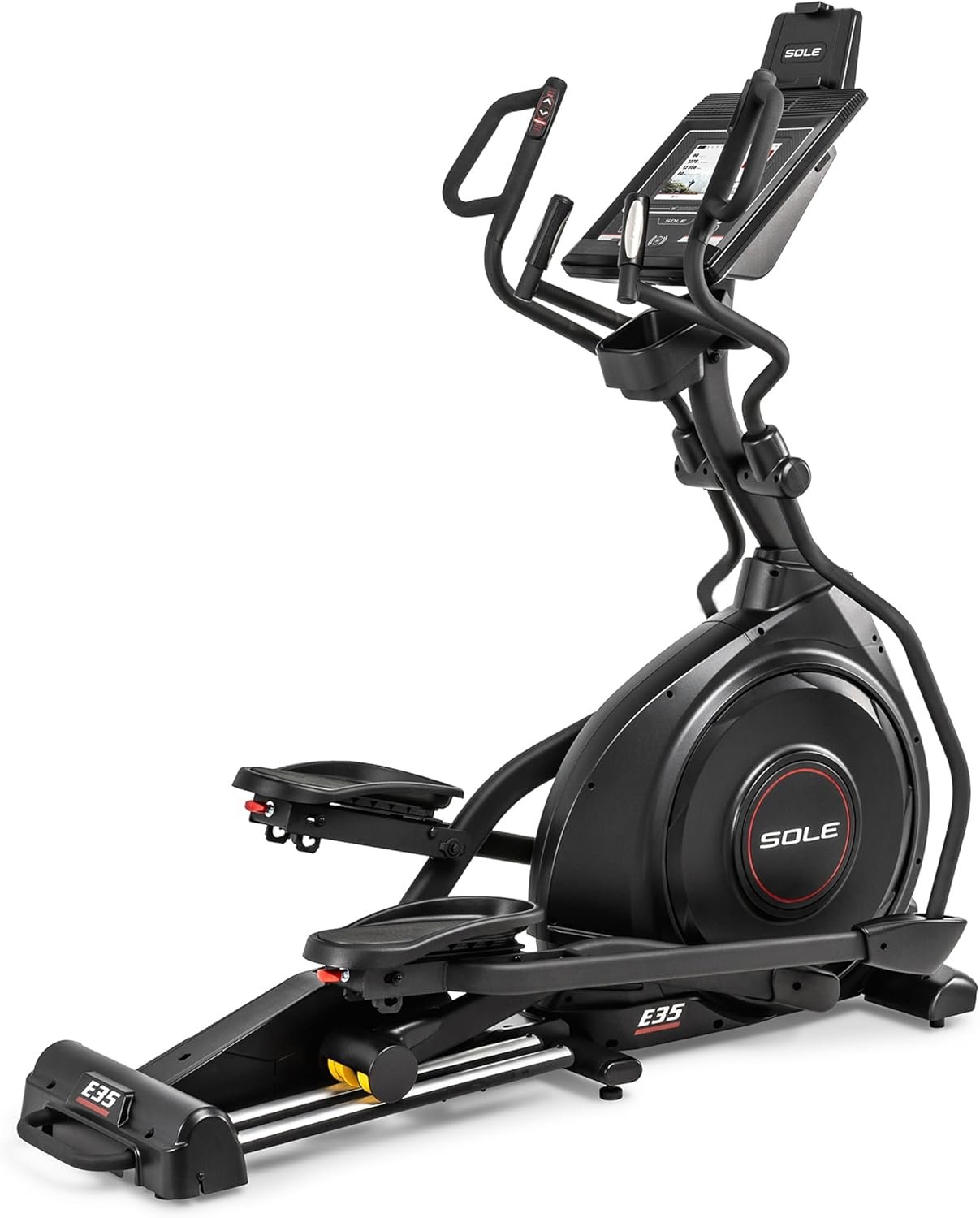
- Weight capacity: 350 lb
- Flywheel: 25 lb
- Stride length: 20″ fixed
- Resistance levels: 20
- Incline levels: 20
- Console: 10.1″ touchscreen with Netflix, Hulu, Spotify, Amazon Prime built in
- Machine weight: 211 lb
- Pedals: 2-degree inward slope, cushioned, four rear wheels on rails
- App: SOLE+, Bluetooth audio
The Sole E35 sits between the Niceday and the E95 in both price and specification — and for users who weigh up to 320 lb (applying the 30 lb headroom rule to its 350 lb rated capacity), it delivers the Sole quality standard at a meaningfully lower price than the E95. The 25 lb flywheel and lifetime frame warranty match the quality signal of the E95, while the lower capacity and fixed stride keep the price accessible for mid-range buyers.
What Makes It Different
The E35 is the only mid-range elliptical on this list that includes 20 levels of power incline alongside 20 resistance levels — giving it a training variety that neither the Niceday nor the Merach can match at a comparable price. The incline repositions your body on the pedals to target glutes, hamstrings, and calves at a different angle — meaningful for heavy users who want progressive overload from a single machine without buying additional equipment. The 10.1″ touchscreen with preloaded streaming apps including Netflix, Amazon Prime, and Hulu requires no additional subscription — you use your existing accounts.
The honest boundary here is the 350 lb capacity. If you weigh between 320 lb and 370 lb, the E95 is the correct choice — not this one. The 30 lb headroom rule applies, and the E35 is not the right machine for users in that weight range. For users at 320 lb and below who want Sole’s quality, build, and warranty at a lower price point, the E35 is the smarter buy over the E95.
Best for: Users up to 320 lb who want the Sole quality standard — 25 lb flywheel, lifetime warranty, 20 incline levels, and streaming apps — at a lower price than the E95.
Pros:
- 25 lb flywheel delivers near-E95 smoothness at a lower price — the best stroke quality per dollar on this list.
- 20 levels of power incline plus 20 resistance levels — more training variety than any other mid-range option here.
- Lifetime frame and flywheel warranty — the same coverage as the E95, at a lower price point.
- Built-in streaming apps with no subscription required — Netflix, Amazon Prime, Hulu available from day one.
Cons:
- 350 lb capacity is the lowest of the high-capacity options on this list — not appropriate for users over 320 lb when applying the headroom rule.
- Fixed 20″ stride does not adjust — users under 5’4″ may find it slightly long for natural, comfortable motion.
4. Merach Self-Powered Elliptical — Best Mid-Range Budget Elliptical for Heavy Person with No Power Cord Needed
Warranty: Manufacturer warranty — check current Amazon listing for terms
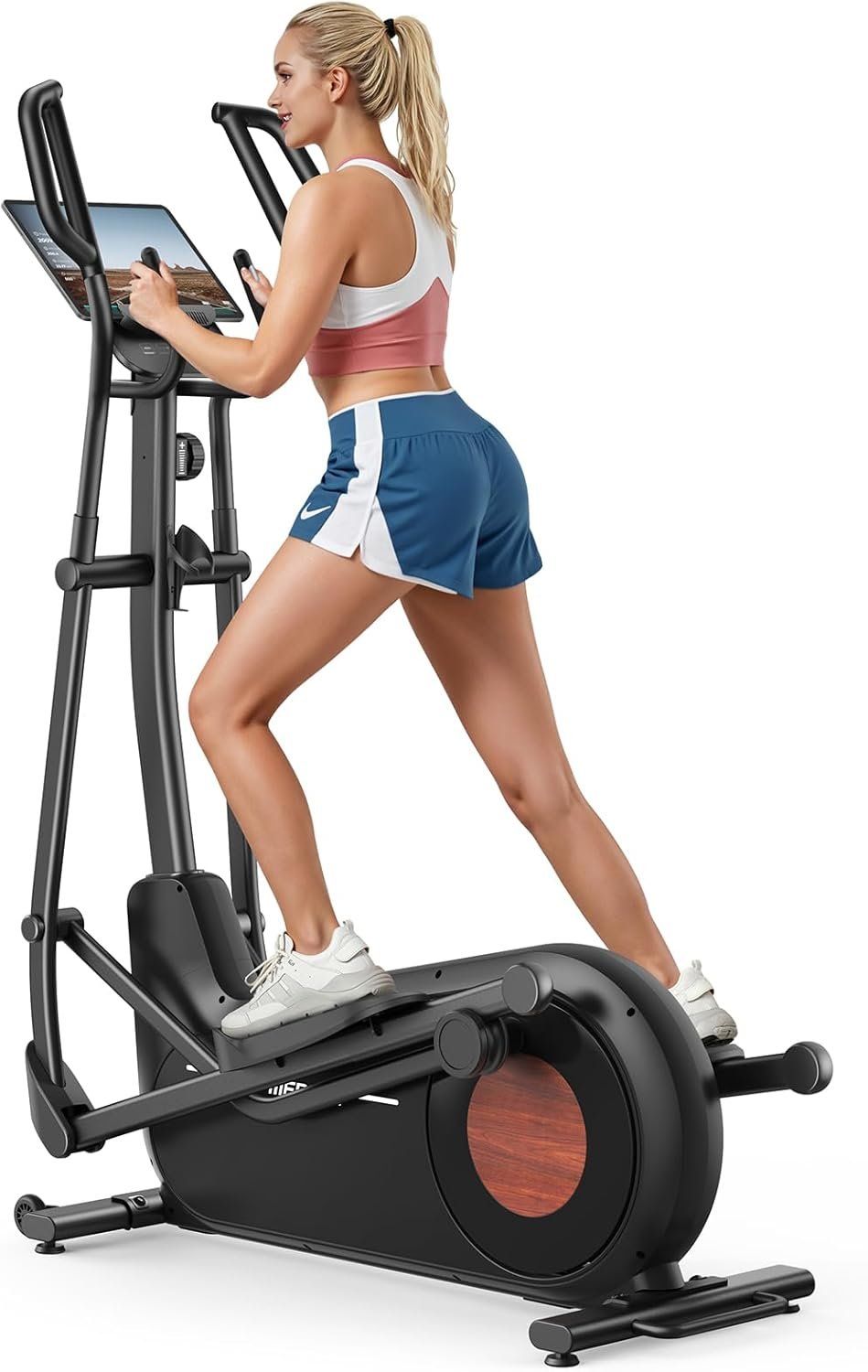
- Weight capacity: 400 lb
- Flywheel: 17.6 lb
- Stride length: 18.5″
- Resistance levels: 16 electromagnetic
- Incline: No
- Noise level: Under 15 dB
- Power: Self-powered — no power cord or outlet required
- Machine weight: Not stated
- Dimensions: 58.5″ L × 22.2″ W × 65″ H
- Assembly: 90% pre-assembled — under 20 minutes
- App: MERACH app + Kinomap compatible
The self-powered Merach delivers 400 lb capacity with an 18.5″ stride at a mid-range price — and unlike every other product on this list, it requires no power outlet. The electromagnetic resistance system generates its own power through the flywheel motion, which means it can be placed anywhere in a home: a garage without a nearby socket, a garden room, a balcony, or a spare bedroom without accessible wiring. For heavy users whose home gym space is not near a power outlet, this practical advantage is the deciding factor.
What Makes It Different
The self-powered system is the single feature that no other product on this list offers. Every other elliptical here requires a mains power connection for the resistance and console systems. The Merach’s electromagnetic resistance is powered entirely by the user’s pedalling motion — the harder you pedal, the more power is generated, which the machine uses to drive the resistance system and LCD display. This means zero running costs beyond the machine itself, placement flexibility that no corded elliptical can match, and no risk of the machine going dark during a power cut. The under-15 dB noise level — quieter than a whisper — combined with cord-free operation makes this the most installation-flexible option on the list.
The honest limitation is the 17.6 lb flywheel — lighter than the Sole E35 and E95, which means the stroke is smoother than the Niceday and Sunny but not as refined as the Sole machines at higher resistance levels. For moderate-intensity training, the difference is minor. For users who want high-resistance interval sessions, the Sole E95 remains the better choice. The warranty transparency gap noted for Merach generally applies here — always confirm current terms on the Amazon listing before purchasing.
Best for: Heavy users up to 370 lb who need placement flexibility — no power outlet near the intended location — or who want 400 lb capacity with app-connected training at a mid-range price without the installation constraints of a corded machine.
Pros:
- Self-powered system — no power cord or outlet required — the only elliptical on this list with complete placement flexibility including garages, balconies, and garden rooms.
- Under 15 dB operation — the quietest machine on this list by a meaningful margin, suitable for any shared living environment.
- 400 lb capacity at a mid-range price with an 18.5″ stride accommodating users up to 6’7″.
- 90% pre-assembled — setup under 20 minutes, no specialist tools required.
- MERACH app and Kinomap compatibility — trainer-led classes and virtual routes without a proprietary subscription.
Cons:
- 17.6 lb flywheel is lighter than the Sole E35 and E95 — stroke quality at high resistance levels does not match premium options.
- Warranty terms not formally documented — verify current coverage on the Amazon listing before purchasing.
5. NordicTrack AirGlide 16 — Best Tech Elliptical for Heavy Person Under 270 lb
Warranty: 10 years frame | 2 years parts | 1 year labor
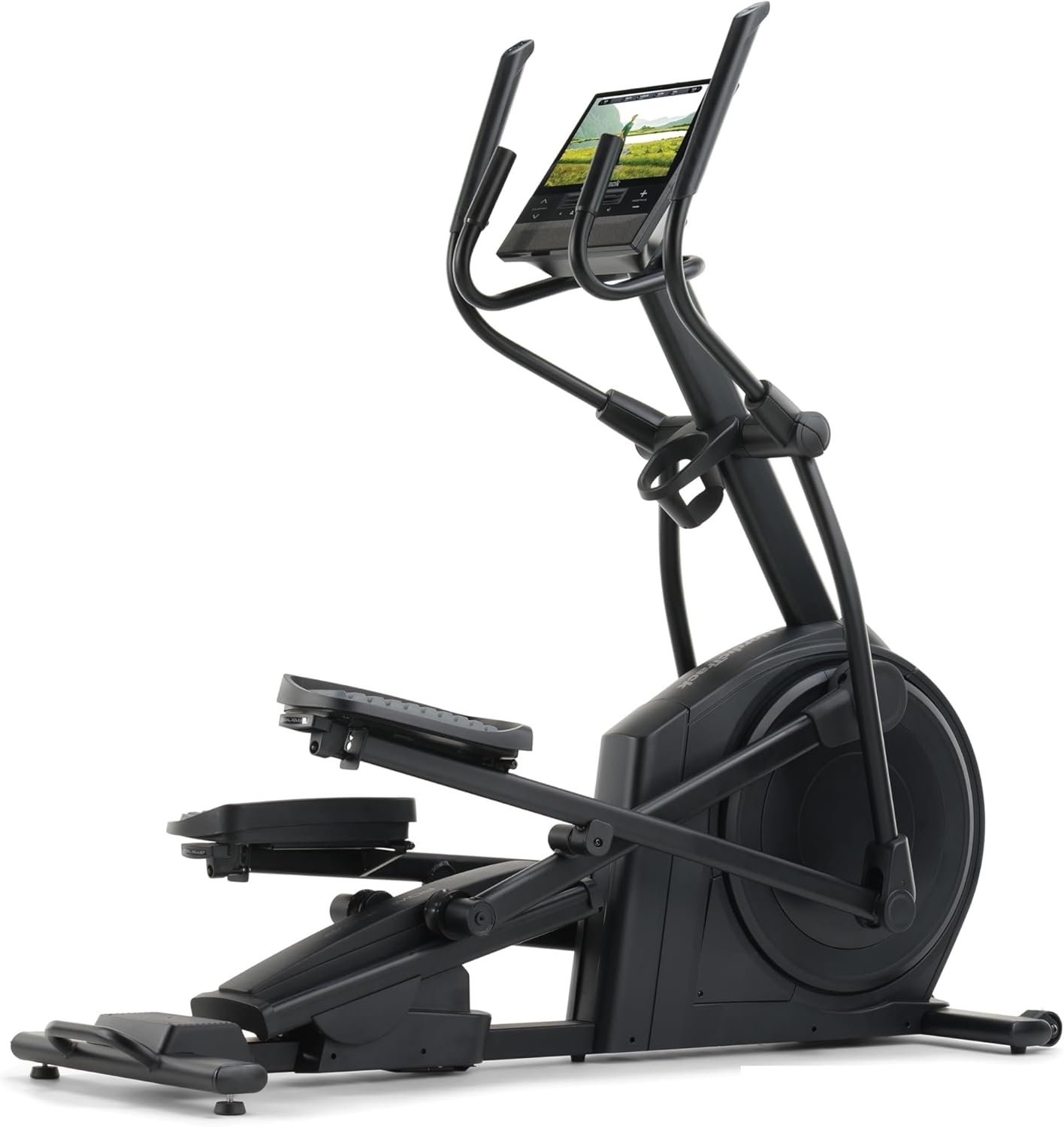
- Weight capacity: 300 lb
- Flywheel: 32 lb
- Stride length: 19″ adjustable
- Resistance levels: 26
- Incline range: -5% decline to 15% incline
- Console: 16″ tilting HD touchscreen
- App: iFIT (subscription required for full access — $39/month)
- Special features: SmartAdjust, AutoBreeze fan, USB-C charging port
The NordicTrack AirGlide 16 has the heaviest flywheel on this list at 32 lb — heavier than the Sole E95 — which produces the smoothest pedal stroke of any elliptical here. Combined with a 16″ tilting HD touchscreen, 26 resistance levels, and -5% decline to 15% incline range, it is the most feature-rich machine on this list. But its 300 lb weight capacity is the lowest here, which means it belongs in a specific position: for heavy users who weigh under 270 lb and want premium training technology alongside their cardio.
What Makes It Different
The AirGlide 16 is the only elliptical on this list with decline capability — dropping to -5% — which targets the anterior chain muscles (quads, tibialis anterior) that standard flat or incline ellipticals do not engage effectively. Combined with iFIT’s SmartAdjust technology, which automatically changes incline and resistance to match the trainer’s workout in real time, this is the most genuinely interactive training experience available in any home elliptical. The 32 lb flywheel creates a stroke quality that is noticeably different from anything else on this list — for users in the eligible weight range, it delivers a gym-quality feel that the Sole machines, good as they are, do not quite match.
The important caveat here is the iFIT subscription. The full feature set — SmartAdjust, live classes, global workouts, streaming — requires an active iFIT Pro membership at $39 per month. Without it, the machine functions manually but the touchscreen’s primary value is locked. If you are not prepared to commit to the subscription, the Sole E95 with its free SOLE+ app delivers more accessible value. For users who will use iFIT actively, the subscription cost is justified by the quality and breadth of the workout library.
Best for: Heavy users under 270 lb who want the best training technology on any home elliptical — decline capability, SmartAdjust, and a 32 lb flywheel — and are committed to using iFIT actively.
Pros:
- 32 lb flywheel — the heaviest on this list — delivers the smoothest, most gym-quality pedal stroke available in a residential elliptical.
- -5% decline to 15% incline is the only decline capability on this list — targets anterior chain muscles that flat ellipticals miss entirely.
- SmartAdjust automatically changes resistance and incline in real time during iFIT workouts — the most genuinely interactive training experience here.
- 26 resistance levels — the widest range on this list — provides the most progressive overload options for long-term fitness development.
Cons:
- 300 lb weight capacity is the lowest on this list — only suitable for users under 270 lb when the 30 lb headroom rule is applied.
- iFIT subscription at $39/month is required for full feature access — adds a recurring cost that Sole’s free SOLE+ app avoids entirely.
6. Sunny Health & Fitness SF-E3912 — Best Entry Level Elliptical for Overweight People
Warranty: 3 years frame | 180 days parts
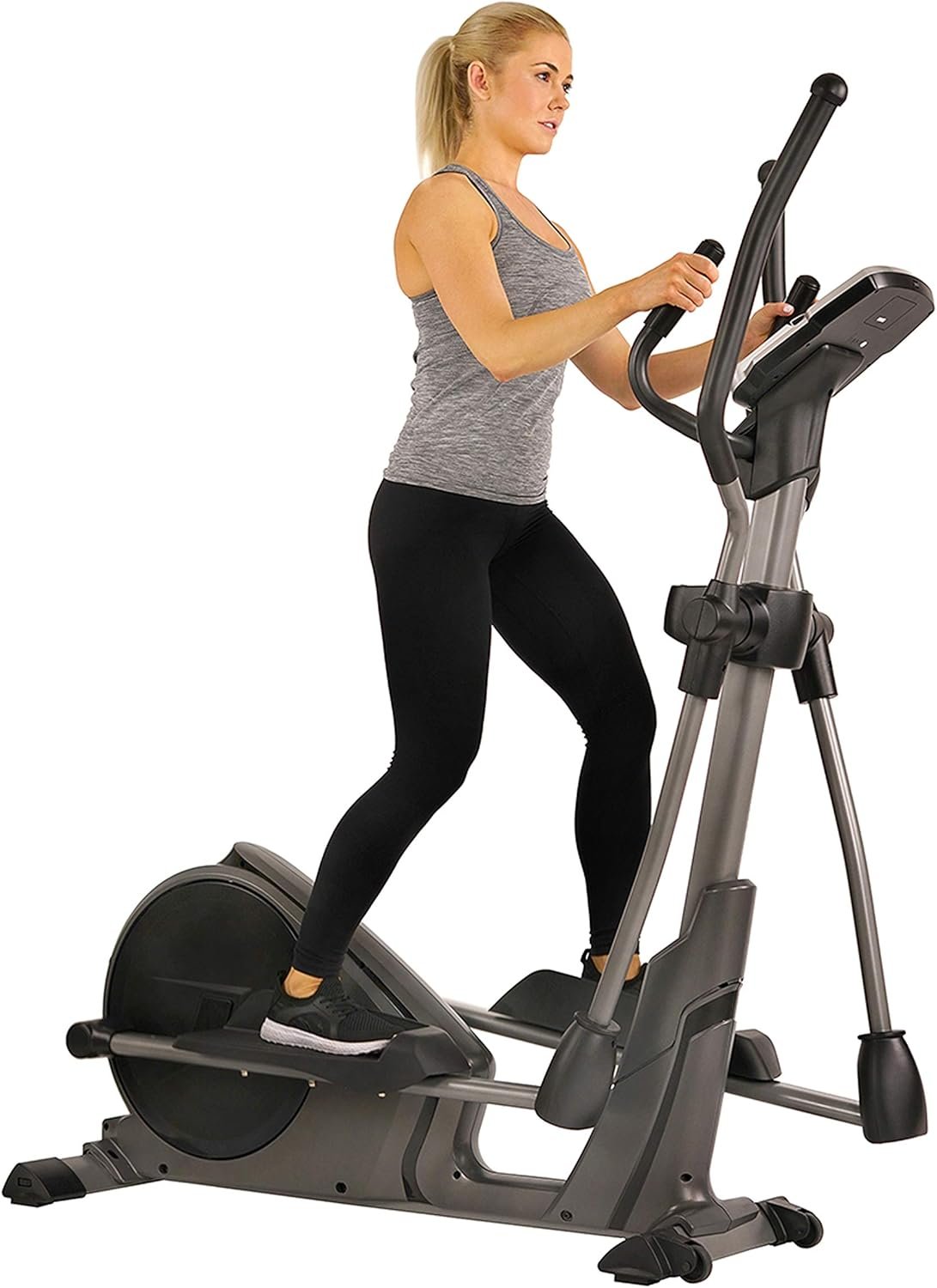
- Weight capacity: 330 lb
- Flywheel: 13.2 lb
- Stride length: 15.5″ fixed
- Resistance levels: 16 programmable
- Incline: No
- Console: Backlit LCD — tracks speed, time, distance, calories, RPM, watts, resistance
- Workout programmes: 24 pre-built modes
- App: SunnyFit compatible
- Dimensions: 23″ W × 64.5″ L × 55″ H
The Sunny SF-E3912 is the entry point on this list — the right choice for someone who is overweight, new to exercise, and needs a stable, reliable machine to start a cardio habit without spending $800 or more. Its 330 lb capacity covers users up to 300 lb when the headroom rule is applied. It is not the machine for daily high-intensity training from a 300 lb user. It is the machine for a 250 lb person who wants to start exercising consistently and needs something that works, fits a smaller budget, and will not break in the first three months.
What Makes It Different
The SF-E3912 has 24 pre-built workout programmes — more than any other product on this list. For a beginner who does not know how to structure cardio sessions, those built-in programmes provide structure and progression without requiring a separate app subscription. The SunnyFit app compatibility adds a connected training layer for users who want guided workouts as they progress. Sunny Health & Fitness is a US-based brand with domestic customer support — a meaningful practical advantage over newer Chinese brands for after-sales service and parts availability.
The 13.2 lb flywheel is the honest limitation — it is lighter than every other option on this list. At lower resistance levels, the stroke is smooth enough. At resistance levels 12–16, the lighter flywheel creates a choppier, less fluid stroke that more experienced or heavier users will notice immediately. This is an entry-level machine in every sense — adequate for starting out, but with a clear ceiling on training intensity that the Niceday, Merach, and Sole options do not have.
Best for: Beginners and casual exercisers up to 300 lb who want a budget-friendly, programme-rich entry-level elliptical for walking and light to moderate cardio — not for heavy daily training use.
Pros:
- 24 pre-built workout programmes — the most structured guidance out of the box of any product on this list, ideal for beginners who need workout direction.
- Most affordable price point on this list — best entry point for budget-constrained buyers starting a fitness habit.
- US-based brand with domestic customer support — more reliable after-sales service than newer imported brands.
- Amazon’s Choice designation with 3,600+ reviews — one of the most proven value options in this category on Amazon.
Cons:
- 13.2 lb flywheel is the lightest on this list — stroke quality at higher resistance levels is noticeably less smooth than mid-range and premium options.
- 330 lb capacity limits practical use to users under 300 lb — not the right machine for users in the 300–400 lb range.
7. HCI PhysioStep MDX — Best Elliptical for Heavy Person Over 400 lb
Warranty: Lifetime frame | 3 years parts | 1 year labor
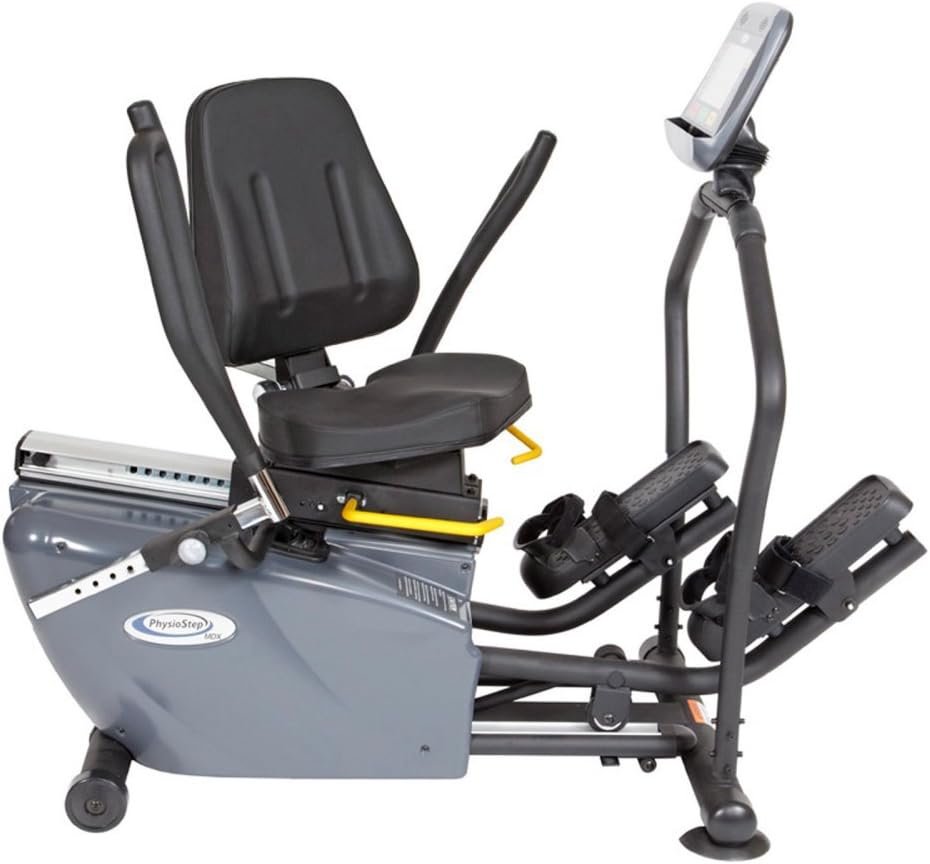
- Weight capacity: 500 lb
- Stride type: Recumbent elliptical (seated)
- Stride length: 12″ recumbent
- Resistance levels: 16
- Seat: Large cushioned seat, three recline angle positions
- Pedals: Oversized with heel cups and foot straps
- Machine weight: 209 lb
- Dimensions: 48″ L × 44″ W × 32″ H
- Height range: 4’8″ to 6’4″
- Special features: Transition handle for entry/exit, dual water bottle holders, transport wheels
The HCI PhysioStep MDX is in a completely different category from every other product on this list. It is a recumbent elliptical — meaning you exercise in a seated position rather than standing — with a 500 lb weight capacity that is used in clinical weight loss programmes, physical therapy practices, and cardiac rehabilitation centres. For users who weigh over 400 lb, or who have mobility, balance, or joint limitations that make a standing elliptical unsafe, this is the only appropriate option on this list.
What Makes It Different
No other residential elliptical on the market combines a 500 lb rated capacity with a seated recumbent design, oversized foot pedals with heel cups and foot straps, three adjustable seat recline angles, and a transition handle for safe entry and exit. Each of those features exists to solve a specific problem that very heavy users and mobility-limited users face with standard upright ellipticals: balance during entry and exit, foot security during pedalling, and core fatigue from maintaining an upright position during extended cardio sessions. The recumbent position removes the balance requirement entirely — you are supported by the seat throughout, which means the cardiovascular work is the focus rather than the stability effort.
For a 450 lb person who has never exercised consistently, the PhysioStep MDX removes every physical barrier to starting — there is no standing balance requirement, no minimum fitness level for safe use, and the recumbent position reduces hip flexion stress compared to upright ellipticals. The lifetime frame warranty on a machine used in clinical settings is the manufacturer’s statement that this is built for sustained heavy use. It is expensive, and it is large — but for the specific user it is designed for, there is nothing else comparable.
Best for: Users over 400 lb, users with balance or mobility limitations that make upright ellipticals unsafe, and post-surgical or rehab users who need a seated low-impact cardio option with clinical-grade stability.
Pros:
- 500 lb capacity — the highest on this list by 100 lb — with clinical-grade construction used in rehabilitation and medical weight loss programmes.
- Seated recumbent design removes the standing balance requirement entirely — safe for users with mobility limitations, joint replacement recovery, or balance issues.
- Three seat recline angle positions adjust the hip flexion angle and muscle engagement — more rehabilitation versatility than any upright elliptical.
- Lifetime frame warranty on a machine engineered for clinical use — the strongest durability statement on this list.
Cons:
- Most expensive option on this list by a significant margin — the clinical-grade construction and capacity come at a premium price.
- Recumbent design burns fewer calories per session than upright ellipticals at equivalent effort levels — the trade-off for accessibility and joint protection.
Which Elliptical Is Right for You? — Decision Guide
- You weigh between 270–370 lb and want the best overall machine → Sole E95. The 27 lb flywheel, adjustable pedals with worm drive, and lifetime warranty justify the price for daily serious use.
- You weigh between 270–370 lb and have a tight budget → Niceday Elliptical. 400 lb capacity under $600 — no other machine on this list matches that combination.
- You weigh between 250–320 lb and want Sole quality at a lower price → Sole E35. Same lifetime warranty and near-E95 flywheel quality, 350 lb capacity, streaming apps included.
- You weigh between 270–370 lb and want app-connected training with no power outlet needed → Merach Self-Powered Elliptical. 400 lb capacity, 17.6 lb flywheel, free MERACH app, cord-free placement anywhere.
- You weigh under 270 lb and want the best training tech and interactivity → NordicTrack AirGlide 16. 32 lb flywheel, decline capability, SmartAdjust iFIT training — best tech experience on this list.
- You are a beginner under 300 lb and want an affordable starting point → Sunny SF-E3912. 24 pre-built programmes, US brand support, Amazon’s Choice, most affordable entry point here.
- You weigh over 400 lb or have mobility/balance limitations → HCI PhysioStep MDX. The only 500 lb capacity recumbent elliptical with clinical-grade construction on this list — nothing else is appropriate for this profile.
What Weight Capacity Do You Actually Need? — The 30 lb Headroom Rule
Every elliptical manufacturer publishes a maximum weight capacity — but that number is the structural limit of the machine, not the recommended operating weight. Running any piece of fitness equipment at its exact rated capacity accelerates wear on every component: bearings, resistance mechanisms, frame welds, and pedal rails all degrade faster when the machine operates at maximum load continuously.
The practical rule I use with everyone I coach: choose a machine rated for at least 30 lb more than your current weight. If you weigh 350 lb, you need a machine rated for at least 380 lb — which means the Sole E95 (400 lb) or the Niceday (400 lb), not the Sole E35 (350 lb). This is not an arbitrary safety margin — it is the difference between a machine that lasts five years of daily use and one that develops wobble, resistance inconsistency, and mechanical failure within eighteen months. The ACSM recommends 150–300 minutes of moderate-intensity cardio per week for health maintenance — for that training volume to be sustainable, the equipment needs to be rated appropriately for the user.
Flywheel Weight — Why It Matters More Than Any Other Spec for Heavy Users
The flywheel is the single most important quality indicator on any elliptical — more than resistance levels, more than the screen size, and more than the number of workout programmes. Here is why it matters specifically for heavy users.
A heavier flywheel stores more rotational energy during the pedal stroke, which means the momentum carries through the full range of motion with less drop-off between strides. On a light flywheel (13–16 lb), the resistance feels consistent at low settings but becomes choppy and uneven at higher settings — particularly noticeable at heavier bodyweights where more force is applied to the pedals with each stride. On a heavy flywheel (25–32 lb), the stroke remains smooth and fluid across all resistance levels because the momentum is sufficient to carry through the natural force variation in each stride cycle.
For a heavy user, that difference has a direct practical consequence: a smooth stroke reduces joint stress at each stride, while a choppy stroke creates micro-impact forces that accumulate over a 30-minute session. If you are 300 lb and exercising on a 13 lb flywheel at resistance level 12, you are subjecting your knees and hips to significantly more cumulative stress than the same session on a 27 lb flywheel. The flywheel weight is the single spec I tell every heavy buyer to prioritise above everything else on the label.
Elliptical vs Treadmill for Heavy Person — Which Is Better?
For most heavy users, an elliptical is the better starting point — not because treadmills are bad, but because the impact equation is different. Every footfall on a treadmill transfers a ground reaction force of 1.5–3 times your bodyweight through your ankle, knee, and hip joints. At 300 lb, that means 450–900 lb of force per step. The elliptical eliminates that impact by keeping your feet in continuous contact with the pedals — the force is continuous rather than repetitive impact, which is substantially easier on joints that are already under higher load from excess bodyweight.
That said, treadmills have advantages the elliptical cannot replicate — specifically for people whose goal is weight loss through walking and building towards running. If your weight loss plan includes progressive walking and eventual running training, our guide to the best treadmills for heavy people covers the structural requirements in the same detail as this article. For pure low-impact cardio habit-building — especially in the early stages of a weight loss journey — the elliptical wins on joint protection, safety, and consistency. For a full picture of how elliptical and treadmill training compare in terms of muscle engagement, the muscles involved in treadmill workouts guide explains the key differences in lower body activation between the two machines.
Buying Guide — 5 Things to Check Before You Buy an Elliptical as a Heavy Person
1. Weight Capacity with the 30 lb Headroom Rule
As covered above — never buy at your exact bodyweight. Add at least 30 lb to your current weight and use that number as your minimum rated capacity. If you are actively losing weight, consider where you are starting from rather than where you plan to be. A 380 lb person who plans to lose 80 lb still needs a machine rated for at least 380 lb today, not 300 lb.
2. Flywheel Weight — The Quality Indicator No Advertisement Mentions
Check the flywheel weight in the specifications, not the marketing copy. Under 16 lb is entry-level. 20–25 lb is mid-range. 27–32 lb is premium. A brand that does not publish flywheel weight is a yellow flag worth noting — always check the spec sheet, not just the marketing copy. Flywheel weight directly determines stroke smoothness, and smooth stroke directly determines joint stress at higher bodyweights.
3. Stride Length Relative to Your Height
A stride that is too short forces your legs into an unnaturally restricted range of motion — increasing knee stress and reducing calorie burn per stroke. A rough guide: under 5’3″ → 14–16″ stride. 5’3″–5’8″ → 16–18″ stride. 5’8″–6’0″ → 18–20″ stride. Over 6’0″ → 20″+ stride. For taller heavy users, stride length becomes especially important because the combination of height and weight amplifies the joint stress of a mismatched stride.
4. Frame Construction and Machine Weight
Heavier machines are almost always better-built machines. This is not coincidence — the weight comes from thicker steel, more substantial welds, and heavier components. The Sole E95 weighs 236 lb assembled. The Niceday weighs 106 lb. That difference reflects directly in construction quality, stability under load, and long-term durability. A machine that wobbles or flexes visibly at your bodyweight is not safe for sustained use — check assembly reviews on Amazon for any mention of frame flex or instability before purchasing.
5. Warranty Length as a Manufacturer Confidence Signal
A manufacturer that offers a lifetime frame warranty is telling you they are confident the frame will not fail under normal use. A manufacturer that offers a 90-day parts warranty is telling you something different. For heavy users who will subject the machine to more sustained load than a lighter user, the warranty signal matters more — not just because of the coverage, but because it reflects how the machine was engineered. Sole’s lifetime frame and flywheel warranty, backed by decades of commercial fitness manufacturing, is a meaningfully different statement than a one-year manufacturer warranty from a brand that launched in 2022.
Frequently Asked Questions
Is an elliptical good for a heavy person?
Yes — ellipticals are one of the best cardio options for heavy people specifically because they eliminate the high-impact ground reaction forces that make treadmill running and walking problematic at higher bodyweights. The continuous contact motion of an elliptical distributes load evenly across the full stride cycle rather than creating repetitive impact peaks at each footfall. For someone who is overweight and new to exercise, an elliptical allows consistent cardio training without the joint stress that often causes pain and early dropout on treadmills. The key is selecting a machine with sufficient weight capacity — at least 30 lb above your current weight — and an appropriately heavy flywheel for smooth, joint-friendly motion.
What weight capacity do I need in an elliptical?
Always choose an elliptical rated for at least 30 lb more than your current bodyweight. This is not a safety margin in the conventional sense — it is an engineering operating point. A machine used at its exact rated capacity operates every component at maximum load continuously, which accelerates wear and shortens the machine’s practical lifespan significantly. If you weigh 300 lb, the minimum capacity you should consider is 330 lb — which means the Niceday, Merach, or Sole E95, not the Sunny SF-E3912 or the Sole E35. If you weigh 370 lb, you need a 400 lb rated machine. If you weigh over 420 lb, the HCI PhysioStep MDX at 500 lb is the only appropriate option on this list.
Can a 400 lb person use an elliptical?
Yes — but the product selection must match that weight. Most consumer ellipticals are rated for 250–300 lb and are completely unsuitable for a 400 lb user. From this list, the Sole E95 (400 lb rated) and the Niceday Elliptical (400 lb rated) are appropriate for users up to 370 lb when the 30 lb headroom rule is applied. For users at or above 400 lb, the HCI PhysioStep MDX with its 500 lb rated capacity and recumbent seated design is the only appropriate option — it removes the standing balance requirement and is built to clinical rehabilitation standards for sustained heavy use.
Is an elliptical better than a treadmill for weight loss when you are overweight?
For most overweight people starting a fitness routine, an elliptical is the better choice for the first phase of weight loss. The low-impact motion allows longer and more consistent sessions without the joint pain that often forces early treadmill sessions to stop prematurely. Consistency is the primary driver of weight loss results, and a machine you can use for 30 minutes without pain beats a machine that forces you to stop at 12 minutes every time. Once joint capacity and cardiovascular fitness improve — typically after 4–8 weeks of consistent elliptical use — introducing treadmill walking becomes more practical and expands the training options available.
How long should a heavy person use an elliptical each day?
Start with 10–15 minutes at low resistance if you are new to exercise or returning after a long break. The goal in the first two weeks is to establish the habit and let your joints adapt to the motion — not to maximise calorie burn. Progress to 20–30 minutes after two weeks if the sessions feel manageable, and aim for 30–45 minutes at moderate intensity once you have four to six weeks of consistent use behind you. The most common mistake I see with heavy beginners on ellipticals is starting at too high an intensity and causing enough muscle soreness to interrupt the routine for several days. Starting conservatively and building progressively is what produces consistent long-term results.
What is the difference between an upright and recumbent elliptical for a heavy person?
An upright elliptical requires you to stand and balance throughout the workout — your core and stabilising muscles are engaged to maintain posture. A recumbent elliptical like the HCI PhysioStep MDX provides a seat, so you exercise in a supported seated position. For most heavy users, an upright elliptical is appropriate and provides a more complete cardio and muscle engagement profile. The recumbent design is specifically beneficial for users who have balance limitations, mobility restrictions, hip or knee replacements, or who find the standing balance requirement of an upright machine creates a safety concern. If you can stand and balance comfortably on an upright machine, start there — the calorie burn and muscle engagement per session is higher than the recumbent alternative.
Does elliptical training help lose belly fat for overweight people?
Elliptical training supports fat loss — including abdominal fat — as part of a calorie deficit, but no cardio machine targets belly fat specifically. The mechanism is total energy expenditure: consistent elliptical sessions burn calories, and when combined with dietary changes that create a calorie deficit, the body reduces fat stores across the whole body over time. The elliptical’s advantage for this goal is that it allows heavier users to sustain longer cardio sessions without joint pain, which increases total weekly calorie burn more than shorter, pain-limited sessions on higher-impact equipment. Thirty minutes on an elliptical at moderate intensity burns approximately 270–400 calories depending on bodyweight and effort level — a meaningful contribution to a weekly calorie deficit when done consistently.
Final Thoughts
The right elliptical for a heavy person comes down to three numbers: your bodyweight plus 30 lb sets the minimum capacity, the flywheel weight determines the stroke quality your joints will experience, and the warranty length tells you what the manufacturer thinks of their own machine. For most heavy users up to 370 lb, the Sole E95 is the correct long-term investment — the flywheel, warranty, and adjustable pedals represent genuine engineering for sustained heavy use. If budget is the constraint, the Niceday delivers 400 lb capacity at a fraction of the price and will serve a casual to moderate user well. For anyone over 400 lb, the HCI PhysioStep MDX is the only appropriate starting point on this list.
Disclosure: myactivetribe.com participates in affiliate programmes. When you purchase through links on this page, we may earn a commission at no additional cost to you. All product selections are based on verified specifications and AnilKK’s direct assessment — not on commission rates or brand relationships.