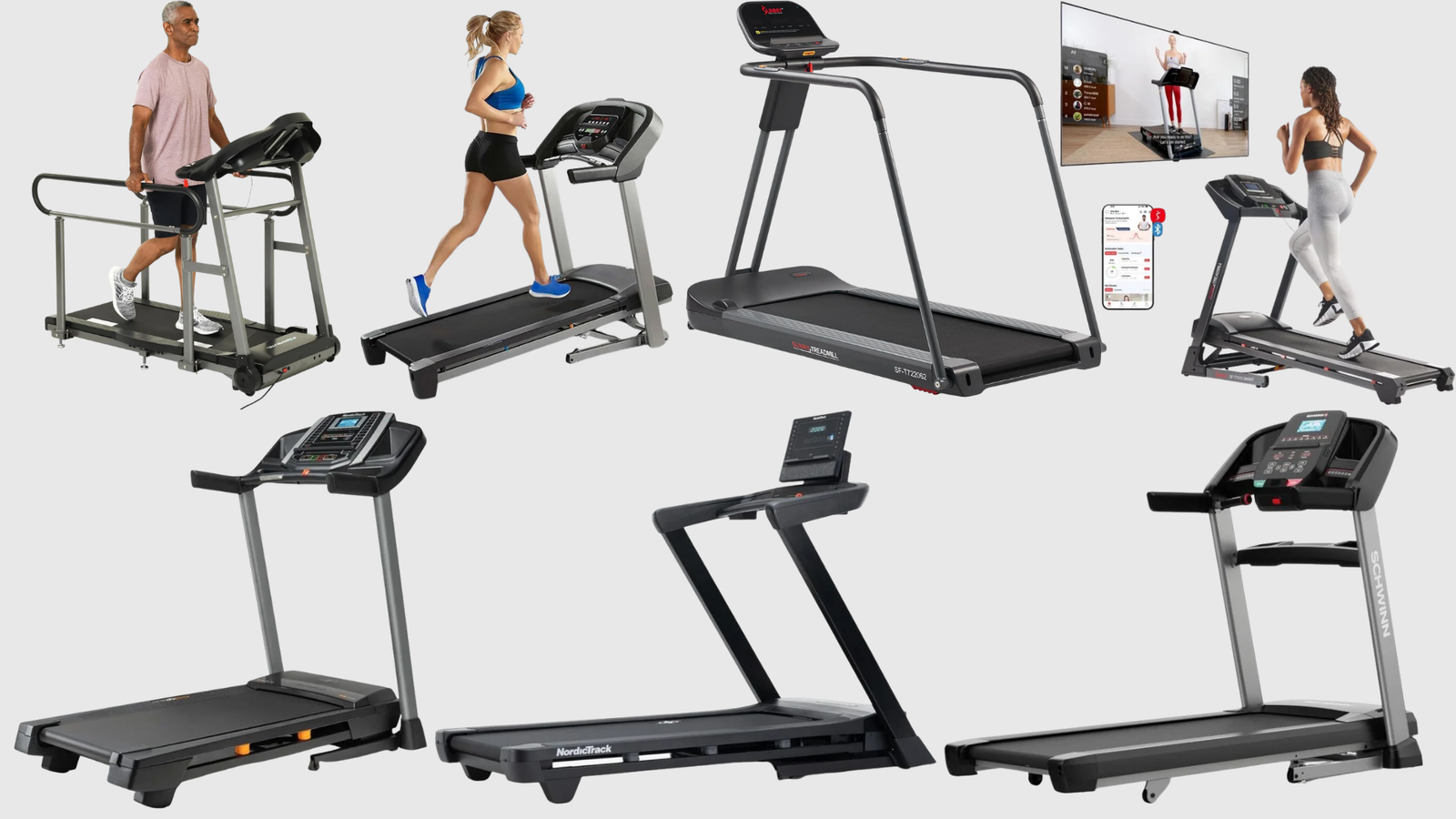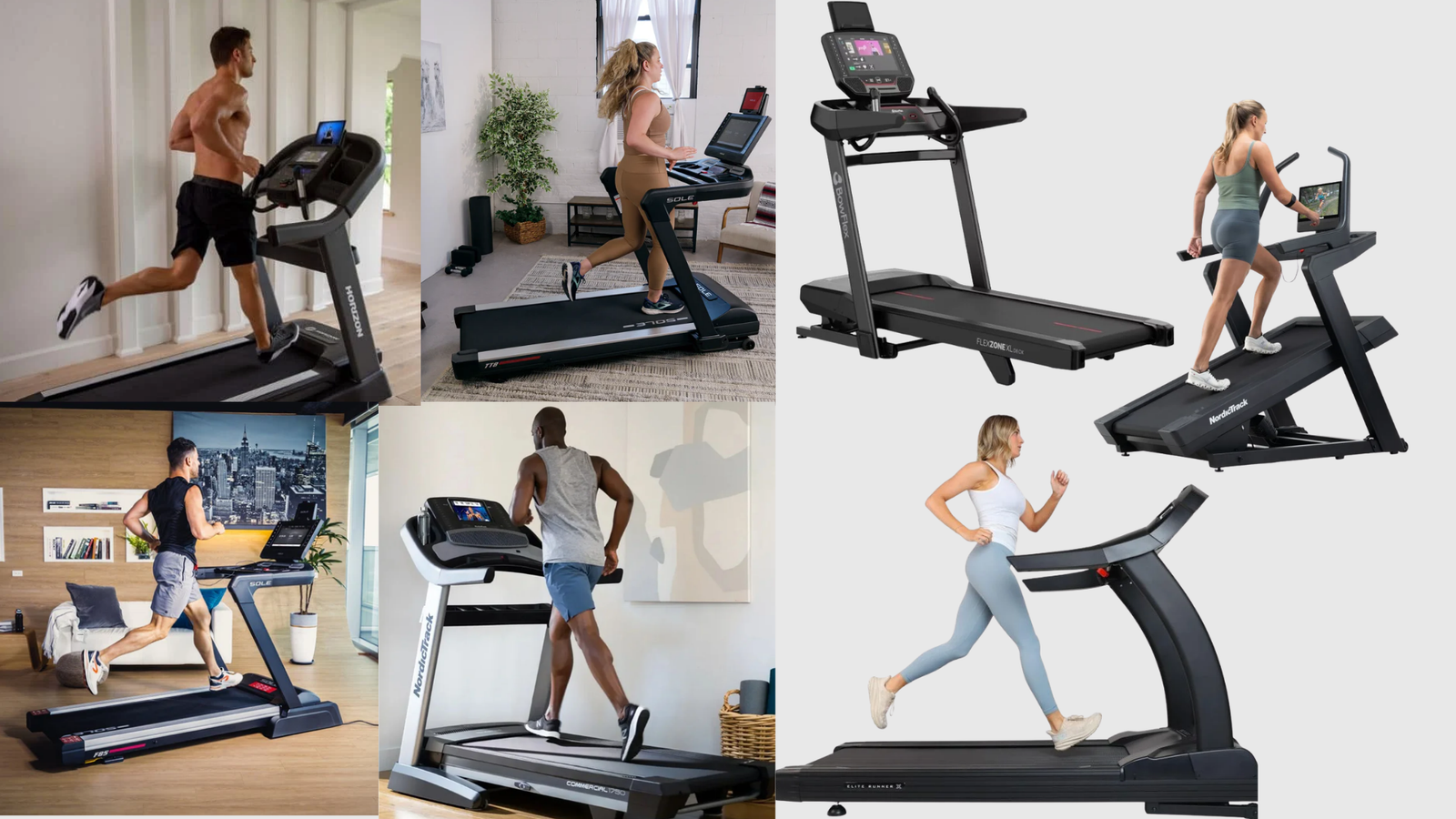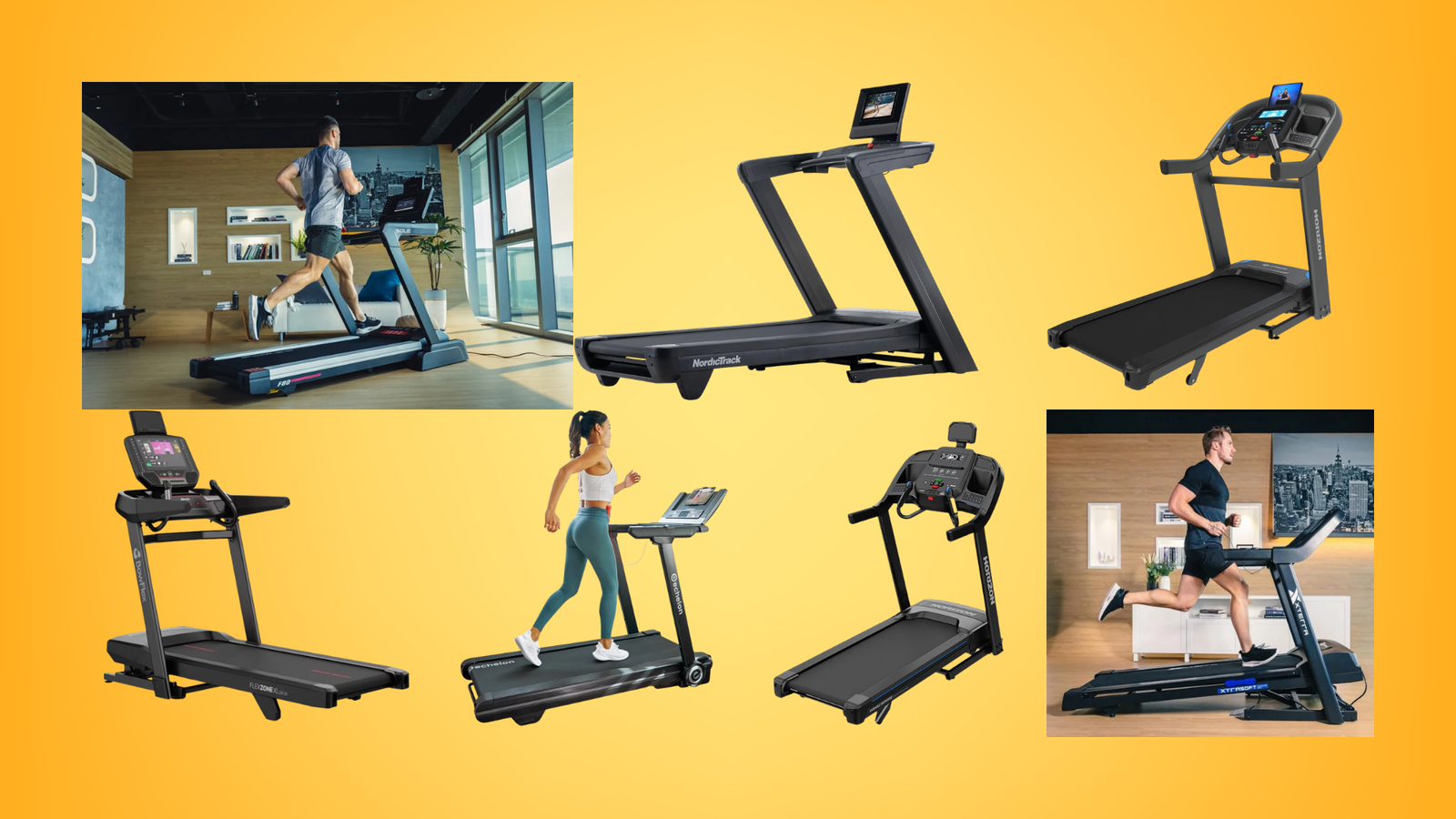
The best folding treadmills give you a full-performance running machine that disappears when you’re done with it — without forcing you to choose between quality and space. After personally testing treadmills for over 24 years and helping more than 1,000 clients set up home gyms, I can tell you the folding mechanism is only one piece of the puzzle. Motor durability, deck size, and warranty terms matter just as much.
Quick Answer: The Sole F80 is the best folding treadmill overall — lifetime frame and motor warranty, 22″×60″ deck, no subscription required. For the best value with a touchscreen, the Bowflex T16 delivers a 16″ HD display with no mandatory subscription at a competitive price. Budget buyers who still want FTMS Bluetooth for Zwift should look at the XTERRA TR75.
Table of Contents
Best Folding Treadmills: Quick Comparison
| Treadmill | Motor (CHP) | Belt Size (L×W) | Weight Capacity | Folding System | Subscription | Warranty (Frame/Motor) |
|---|---|---|---|---|---|---|
| Sole F80 | 3.5 | 60″×22″ | 350 lbs | Easy Assist | None required | Lifetime / Lifetime |
| NordicTrack C1250 | 3.0 | 60″×22″ | 400 lbs | EasyLift Assist | iFIT required | 10-year / Lifetime |
| Horizon 7.4 AT | 3.5 | 60″×22″ | 350 lbs | Hydraulic 1-step | None required | Lifetime / Lifetime |
| Bowflex T16 | 3.5 | 60″×22″ | 375 lbs | SoftDrop | JRNY optional | Lifetime / Lifetime |
| Echelon Stride-6S | 3.0 | 60″×20.5″ | 300 lbs | Auto-Fold (folds flat) | Echelon optional | 10-year / 5-year |
| Horizon 7.0 AT | 3.0 | 60″×20″ | 325 lbs | Hydraulic 1-step | None required | Lifetime / Lifetime |
| XTERRA TR75 | 3.25 | 60″×20″ | 350 lbs | Lift Assist | None required | Lifetime / 1-year |
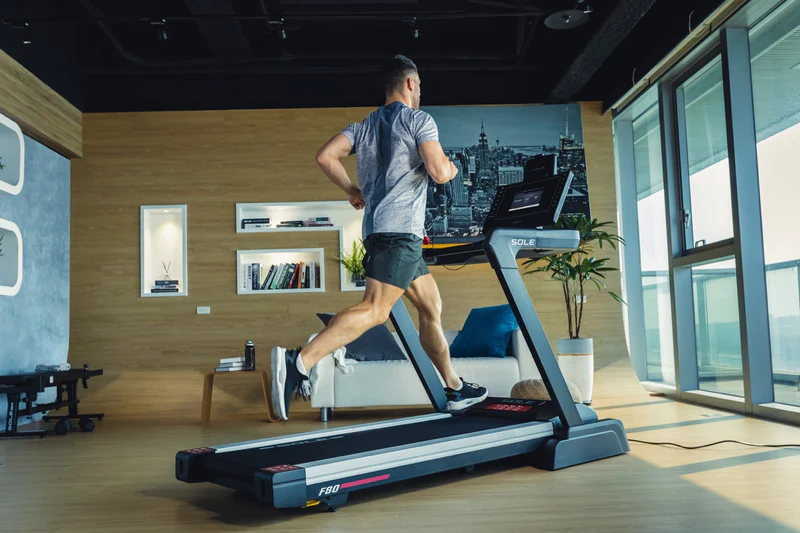
1. Sole F80 — Best Overall Folding Treadmill
Warranty: Frame — Lifetime | Motor — Lifetime | Parts — 3 years | Labor — 1 year
- Motor: 3.5 CHP DC
- Speed range: 0.5–12 mph
- Incline: 0–15%
- Running surface: 22″ × 60″
- Weight capacity: 350 lbs
- Display: 10.1″ Android touchscreen
- Cushioning: CushionFlex Whisper Deck
- Folding: Easy Assist hydraulic, folds to 44″×38″×71.5″
- Connectivity: FTMS Bluetooth — works with Zwift, Kinomap, Peloton app
- Rollers: 2.5″ high-speed balanced
The Sole F80 earns the top spot because it does everything well without charging you monthly for the privilege. No iFIT subscription, no JRNY fee — every feature works from the moment you plug it in. After 24 years of running on treadmills ranging from $300 budget machines to $15,000 commercial units, I can tell you that the F80’s build quality punches well above its price. The CushionFlex deck reduces joint impact by up to 40% compared to running on asphalt, and you can feel it the moment your foot hits the belt.
What Makes It Different
The F80 uses FTMS Bluetooth — the open standard that lets you pair with Zwift, Kinomap, Peloton app, Apple Fitness+, and virtually any third-party training platform without paying for a proprietary subscription. Most competitors at this price lock you into their own ecosystem. The F80 doesn’t. The 10.1″ Android touchscreen streams Netflix, YouTube, and Hulu directly — no phone mirroring needed. That combination of open connectivity and subscription-free streaming is genuinely rare under $2,000.
The Easy Assist folding mechanism is worth highlighting specifically. A gas shock absorbs the weight of the deck so you can fold and unfold it with one hand. The deck locks upright automatically — no manual pin or latch. When it unfolds, it lowers itself slowly rather than dropping. These details matter after the thousandth fold, and they’re why hotels have trusted Sole equipment for over 20 years in environments where treadmills get used hard every single day.
The 22″×60″ running surface gives runners with long strides the room they need. I always recommend this deck size as the minimum for anyone running above 8 mph regularly — shorter belts restrict your natural gait and increase injury risk over time. At 350 lbs weight capacity, the F80 handles most users comfortably, though if you’re closer to that limit, I’d recommend the heavy-duty treadmill options that offer more headroom.
One honest limitation: the F80 has no decline capability. If downhill training is part of your race prep, you’ll need to look at the NordicTrack C1250 or Bowflex T16 instead. For the majority of home runners who want incline training and reliable daily mileage, it won’t matter.
Best for: Home runners who want a no-subscription, subscription-free machine with a lifetime warranty and the freedom to use any fitness app they choose.
- Pro: Lifetime frame and motor warranty — Sole backs it up, not just on paper
- Pro: FTMS Bluetooth works with Zwift, Kinomap, Peloton app, Apple Fitness+ without any extra fees
- Pro: 10.1″ Android touchscreen streams Netflix, YouTube, Hulu directly — no phone needed
- Pro: Easy Assist gas shock fold — one hand, no pinched fingers, auto-locks upright
- Con: No decline training — incline only (0–15%)
- Con: At 274 lbs machine weight, it’s not easy to move alone — transport wheels help but it’s still heavy
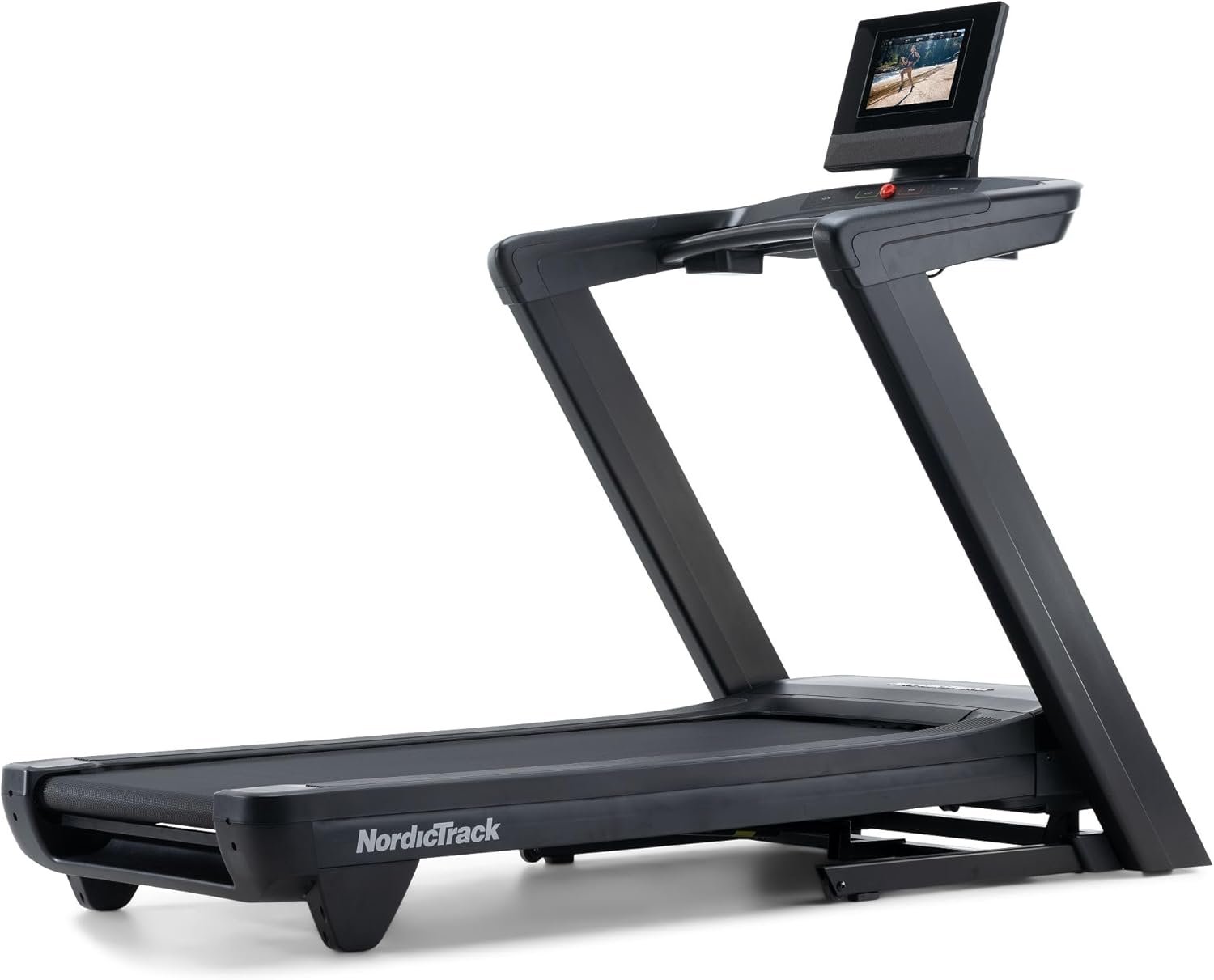
2. NordicTrack C1250 — Best for iFIT Training
Warranty: Frame — 10 years | Motor — Lifetime | Parts — 2 years | Labor — 1 year
- Motor: 3.0 CHP
- Speed range: 0–12 mph
- Incline/Decline: -3% to 12%
- Running surface: 22″ × 60″
- Weight capacity: 400 lbs
- Display: 10″ tilt-and-pivot HD touchscreen
- Cushioning: RunFlex cushioning system
- Folding: EasyLift Assist, SpaceSaver design
- Connectivity: iFIT SmartAdjust — auto speed and incline control
The NordicTrack C1250 is the smartest entry point into NordicTrack’s Commercial series — and at around $400–$700 less than the 1750, it’s genuinely the better buy for most home runners. The deck is identical: 22″×60″, same rollers, same incline and decline range (-3% to 12%). The only meaningful differences are the motor (3.0 vs 4.25 CHP on the 1750) and the screen (10″ vs 16″). For walkers, joggers, and runners up to about 7–8 mph, the 3.0 CHP motor is more than adequate.
What Makes It Different
The C1250 is the only treadmill on this list with both incline and decline capability at this price point. That -3% decline matters for downhill running simulation — it recruits your quads differently and is genuinely useful for race-specific training. The iFIT SmartAdjust technology takes this further: when you’re following a trainer-led workout, the treadmill automatically adjusts speed and incline to match what’s on screen. No touching buttons mid-run. This hands-free training experience is what iFIT does better than any other platform.
The 400 lb weight capacity is the highest on this list and worth noting for heavier users who are often told their options are limited. The EasyLift Assist mechanism makes it manageable to fold despite the machine weighing over 300 lbs — the mechanism reduces the effective lifting weight to roughly 20–25 lbs. One honest thing to tell you upfront: iFIT costs $39/month or $396/year, and without it the touchscreen’s value drops significantly. If you’re not going to use trainer-led workouts, the Sole F80 or Horizon 7.4 AT will serve you better.
For runners who are serious about structured training and want a platform that controls the machine for them, the C1250 paired with iFIT is one of the most effective home training setups available. According to the American College of Sports Medicine, structured interval training consistently outperforms unstructured cardio for both cardiovascular fitness and body composition — and SmartAdjust makes interval training genuinely effortless.
Best for: Runners who want iFIT’s trainer-led workouts and automatic speed/incline control, particularly those who benefit from decline training or need 400 lb capacity.
- Pro: Decline to -3% — the only treadmill on this list with that capability at this price
- Pro: 400 lb weight capacity — highest on this list
- Pro: SmartAdjust auto-controls speed and incline during iFIT workouts — truly hands-free training
- Pro: $400–$700 cheaper than the 1750 with the same deck and rollers
- Con: iFIT subscription required to unlock full functionality — $39/month is a real ongoing cost
- Con: 10″ screen is smaller than the 1750 — noticeable if you follow video workouts closely
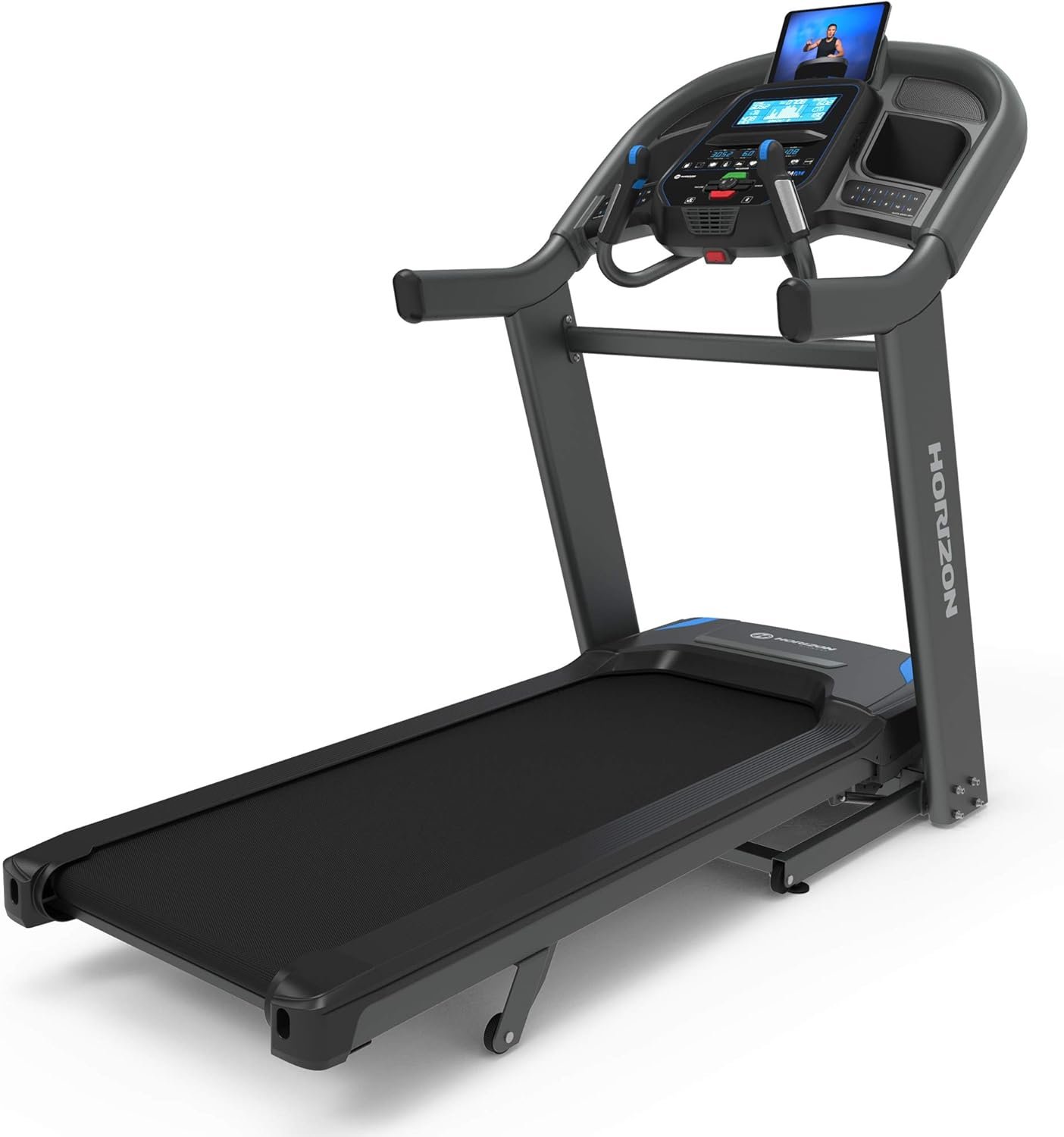
3. Horizon 7.4 AT — Best for Serious Runners
Warranty: Frame — Lifetime | Motor — Lifetime | Parts — 5 year | Labor — 1 year
- Motor: 3.5 CHP RapidSync
- Speed range: 0.5–12 mph
- Incline: 0–15%
- Running surface: 22″ × 60″
- Weight capacity: 350 lbs
- Display: 8.25″ LCD + tablet holder
- Cushioning: 3-Zone Variable Response
- Folding: Hydraulic 1-step
- Connectivity: FTMS Bluetooth — Zwift, Peloton, Studio, Kinomap, Apple Watch
The Horizon 7.4 AT is the choice for runners who care more about how the treadmill performs than how it looks. No built-in subscription platform, no proprietary ecosystem — just a 3.5 CHP RapidSync motor, a 22″×60″ deck, and complete freedom to run with whatever app or platform you prefer. After 24 years of running, I’ve come to value this philosophy deeply. The best training tool is the one that gets out of your way and lets you run.
What Makes It Different
The RapidSync motor is the defining feature of the entire Horizon Studio Series lineup. Most treadmill motors take 1–2 seconds to respond to a speed or incline change — perceptible during HIIT intervals and genuinely frustrating when you’re trying to hit a specific pace. The RapidSync motor responds near-instantly using a 500 lb thrust incline system. If you do interval training — and as a running coach I’d argue you should — this responsiveness changes how the machine feels to run on.
The 3-Zone Variable Response Cushioning is engineered differently from most folding treadmills. The front zone is softer for landing, the mid-zone provides support for transition, and the rear zone is firmer for push-off. This mimics the natural mechanics of road running more accurately than a uniformly cushioned deck. For runners logging serious weekly mileage, this reduces fatigue over time.
The open-platform Bluetooth (FTMS standard) means you can connect Zwift, Peloton, Studio, Kinomap, Apple Fitness+, or any other compatible app directly — with full metric control, not just heart rate. No adapter, no workaround. This is what the Horizon Studio Series was specifically designed for and it executes it better than any other treadmill at this price. For those building a structured running program, this pairs perfectly with structured treadmill workout plans.
The 8.25″ LCD screen is genuinely basic compared to the 10–16″ touchscreens on other options here — it exists purely to display your metrics while you run with your own device. If you want an all-in-one streaming solution, look at the F80 or T16. But if you’re a runner who already has a preferred training app and wants a machine that responds to it perfectly, the 7.4 AT is the most capable option on this list.
Best for: Dedicated runners who do interval or HIIT training and want the fastest motor response available, with freedom to use any fitness app without subscription lock-in.
- Pro: RapidSync motor responds faster than any competitor at this price — essential for HIIT and interval training
- Pro: True FTMS open platform — Zwift, Peloton, Studio, Kinomap all connect with full metric control
- Pro: Lifetime frame and motor warranty — same as more expensive models
- Pro: 3-Zone cushioning mimics road running mechanics better than uniform decks
- Con: Basic 8.25″ LCD screen — not suitable as a standalone entertainment system
- Con: No decline — incline only (0–15%)
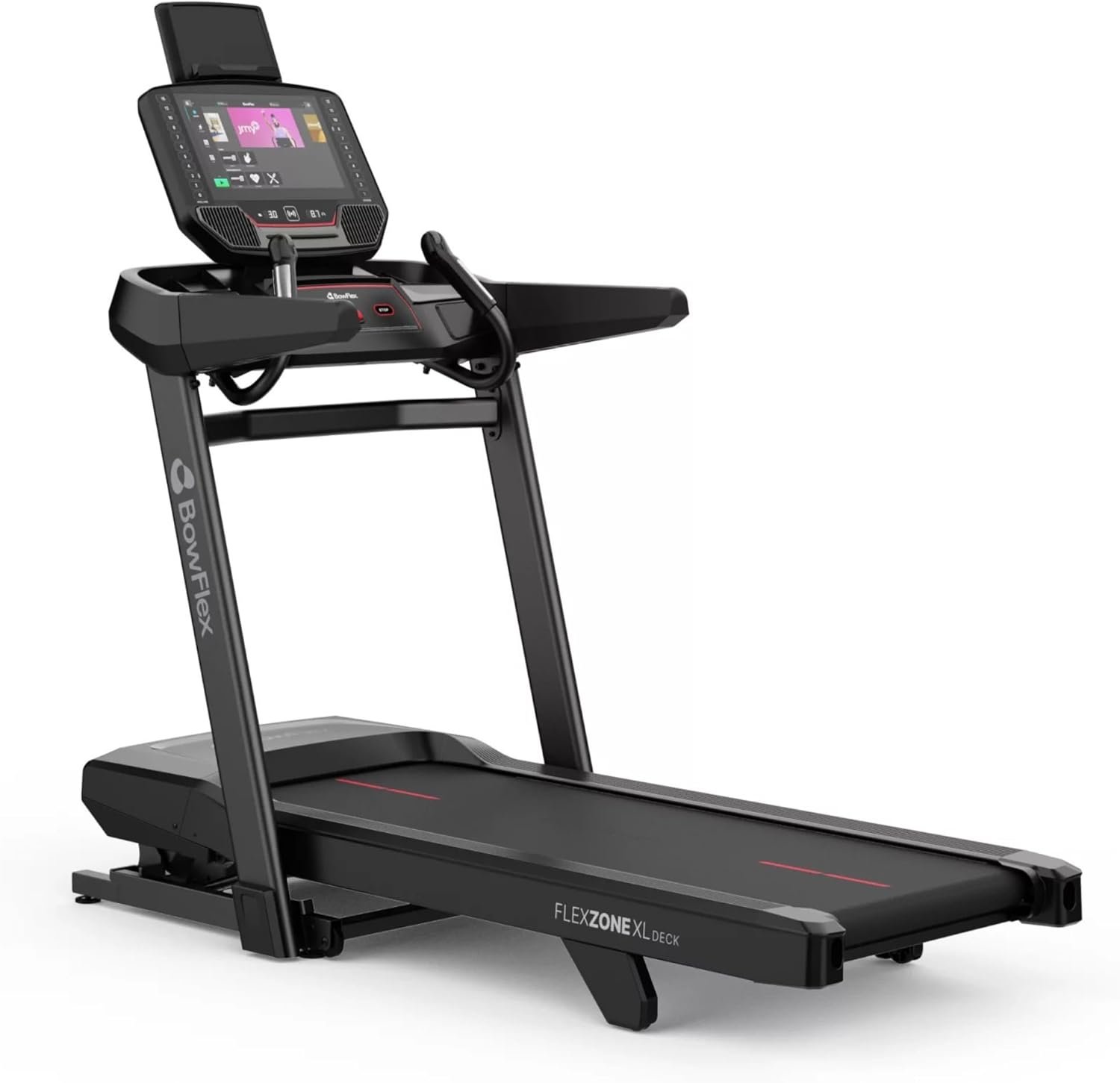
4. Bowflex T16 — Best Touchscreen Folding Treadmill
Warranty: Frame — Lifetime | Motor — Lifetime | Parts — 3 years | Labor — 1 year
- Motor: 3.5 CHP MaxReact Drive System
- Speed range: 0.5–12 mph
- Incline: 0–15%
- Running surface: 22″ × 60″
- Weight capacity: 375 lbs
- Display: 16″ HD touchscreen
- Cushioning: FlexZone XL 3-zone
- Folding: SoftDrop, stowed: 48.6″×37″×67.6″
- Connectivity: Bluetooth — JRNY, Peloton, Zwift, Netflix, Spotify, Apple Watch, Galaxy Watch
The Bowflex T16 is the replacement for the discontinued T10, and it improves on it meaningfully — smaller overall footprint, larger screen, and a better warranty. What sets it apart from every other folding treadmill on this list is the 16″ HD touchscreen that streams Netflix, YouTube, Spotify, Hulu, and Prime Video natively, without needing to mirror your phone or pay for a fitness subscription. JRNY is available if you want trainer-led workouts, but you’re never forced into it.
What Makes It Different
A 16″ touchscreen on a folding treadmill at this price is genuinely unusual. Most manufacturers either put a smaller screen and charge less, or put a large screen and lock you into a subscription to use it properly. The T16 does neither — the screen works fully out of the box without JRNY. You can browse the web, open any streaming app, or follow along with Peloton or Zwift from your phone or tablet while the treadmill tracks your metrics. The QuickDial controls on the handlebars let you adjust speed and incline without reaching for the console — important during hard intervals.
The FlexZone XL cushioning is a genuinely engineered three-zone system — softer at the front for landing, supported in the middle, firmer at the rear for push-off. At 293 lbs machine weight, the T16 is notably lighter than the T10 was (323 lbs) while maintaining the same 22″×60″ running surface. The SoftDrop folding system lowers the deck slowly and safely — it won’t crash down if you accidentally release it.
The 375 lb weight capacity is solid, and the lifetime frame and motor warranty matches what Sole and Horizon offer. The 3-year parts warranty is stronger than most competitors at this price. If you’re the kind of person who wants to watch your shows while running without setting up a tablet holder or paying for a fitness platform, the T16 is the cleanest solution on this list.
Best for: People who want a large built-in entertainment screen with full streaming freedom and no mandatory subscription, in a folding treadmill with a solid warranty.
- Pro: 16″ HD touchscreen — largest on this list — streams everything natively without subscription
- Pro: Lighter than its predecessor at 293 lbs with same 22″×60″ deck
- Pro: QuickDial handlebar controls for speed and incline without breaking stride
- Pro: Lifetime frame and motor warranty with 3-year parts coverage
- Con: No decline capability — incline only (0–15%)
- Con: JRNY app required to unlock full coaching features — optional but adds cost if you want it
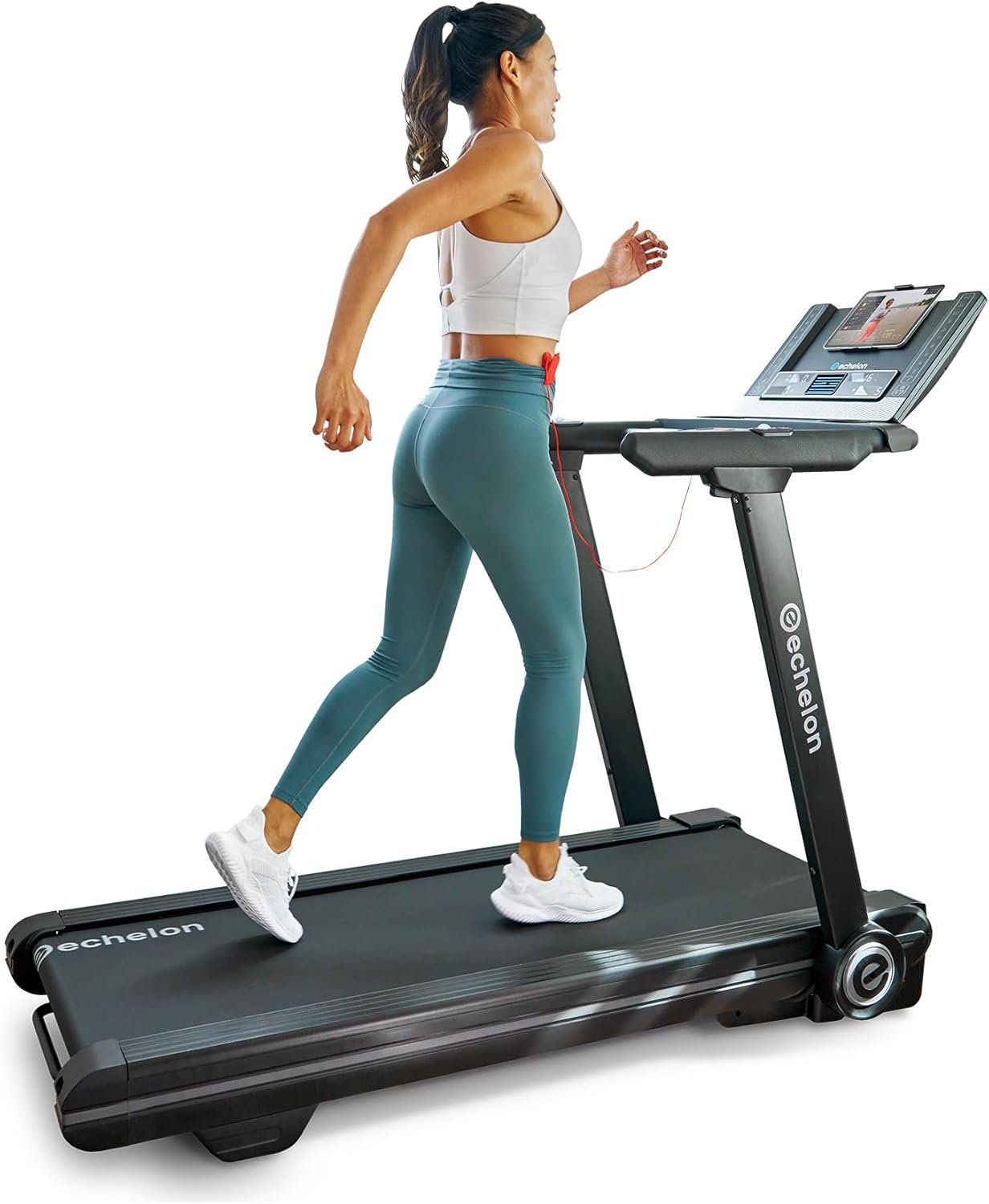
5. Echelon Stride-6 S — Best Folds Flat Treadmill
Warranty: Frame — 10 years | Motor — 5 years | Parts — 1 year | Labor — 1 year
- Motor: 3.0 HP brushless
- Speed range: 0–12.5 mph
- Incline: 0–12%
- Running surface: 20.5″ × 60″
- Weight capacity: 300 lbs
- Display: 10″ HD touchscreen
- Cushioning: Open-front waterfall deck, softer running surface
- Folding: Auto-Fold — folds to 10″ height flat, slides under bed or sofa
- Connectivity: Bluetooth — Echelon Fit App, FitOS entertainment streaming
Every other treadmill on this list folds upright — the deck tilts vertical and the machine takes up a narrow floor footprint but gains height. The Echelon Stride-6 S does the opposite. Its Auto-Fold system collapses the entire machine to just 10 inches tall, so it slides completely flat under a bed frame, sofa, or storage shelf. If ceiling height is a constraint, or if you live in a studio apartment where a 70″ tall folded treadmill is still in your way, this is the only serious running treadmill that solves that problem.
What Makes It Different
The 2026 Stride-6 S is a significant upgrade over the original Stride. The new open-front waterfall deck design moves the motor housing under the running surface, eliminating the plastic hood at the front that runners on cheaper machines frequently kick accidentally. The running surface itself uses a softer, more forgiving material that reduces joint impact — noticeably different underfoot from the firm decks on most folding machines.
The Auto-Fold mechanism is electric — at the touch of a button, the treadmill folds itself. No lifting, no manual effort. This matters more than it sounds when you’re using a treadmill daily and need to reclaim your living space quickly. The built-in 10″ HD touchscreen is a meaningful upgrade over the original Stride-6 (which required you to bring your own device) — it connects directly to the Echelon Fit App for live and on-demand classes, plus FitOS for entertainment streaming.
Where the Stride-6 S makes compromises is capacity. At 300 lbs weight capacity and a 20.5″ belt width, it’s the most space-constrained option on this list. The 12% maximum incline is lower than most competitors. These are real tradeoffs for the fold-flat advantage — worth it for apartment dwellers, less so for larger users or serious incline trainers. Anyone over 270 lbs should apply the standard 20–30 lb headroom rule and look at the heavier-duty options above. For information on under-desk and compact treadmill options, our dedicated guide covers the full range.
Best for: Apartment dwellers and small-space users who need a treadmill that disappears completely when not in use, and want a built-in screen without setting up a separate device.
- Pro: Folds to 10″ height — the only treadmill here that stores completely flat under furniture
- Pro: Electric Auto-Fold at the touch of a button — no lifting required
- Pro: Open-front waterfall deck design eliminates the front motor hood runners kick
- Pro: 2026 brushless motor — quieter and more durable than brushed alternatives
- Con: 300 lb weight capacity — lowest on this list, limits suitability for larger users
- Con: 12% max incline — lower than the 15% available on most competitors
6. Horizon 7.0 AT — Best Value with Lifetime Warranty
Warranty: Frame — Lifetime | Motor — Lifetime | Parts — 3 years | Labor — 1 year
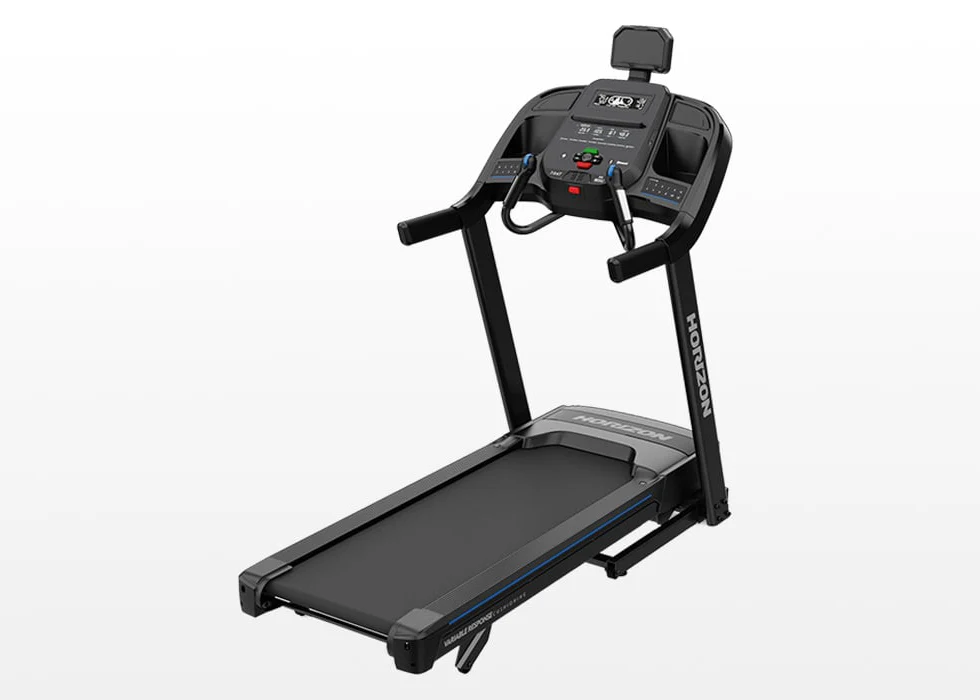
- Motor: 3.0 CHP
- Speed range: 0.5–12 mph
- Incline: 0–15%
- Running surface: 20″ × 60″
- Weight capacity: 325 lbs
- Display: 7.25″ high-contrast LCD + tablet holder
- Cushioning: 3-Zone Variable Response
- Folding: Hydraulic 1-step
- Connectivity: FTMS Bluetooth — Zwift, Peloton, Studio, Kinomap, Apple Watch
The Horizon 7.0 AT regularly sells for under $1,100 — sometimes significantly under — making it one of the best-value lifetime warranty treadmills available anywhere. You get the same FTMS open-platform Bluetooth as the 7.4 AT, the same 3-Zone Variable Response Cushioning, and the same hydraulic one-step folding. The differences are a 3.0 CHP motor instead of 3.5, a 20″×60″ belt instead of 22″×60″, and a 325 lb capacity instead of 350. For walkers, joggers, and runners up to about 6’2″, these differences are unlikely to matter.
What Makes It Different
The lifetime frame and motor warranty at this price point is, frankly, unusual. Most treadmills under $1,200 offer 5–10 years on the frame and 1–2 years on the motor. Horizon offers lifetime on both — and backs it up with the same engineering philosophy as their more expensive models. The QuickDial turnstile controls on the handlebars are an underrated feature: rather than pressing small buttons at speed, you roll a dial with your thumb. It’s fast, intuitive, and reduces the risk of accidentally hitting the wrong button during an interval.
The open-platform FTMS Bluetooth connects to Zwift, Peloton, Studio, Apple Fitness+, and Kinomap with full speed and incline metric sharing — not just heart rate. This is rare at this price. Most budget treadmills offer basic Bluetooth for audio only. The 7.0 AT treats app connectivity as a core feature, not an afterthought. For anyone building toward a comprehensive home cardio setup, this level of connectivity at this price is hard to beat.
The 20″×60″ belt is narrower than the 22″ options above — worth noting for wider runners or those who’ve been told they have a wide gait. It’s still within the standard range and fine for the majority of users. The 7.25″ LCD screen is purely functional — metrics only, no streaming.
Best for: Walkers, joggers, and recreational runners who want a lifetime-warranty treadmill with open-platform Bluetooth at the lowest possible price.
- Pro: Lifetime frame and motor warranty — exceptional for this price tier
- Pro: True FTMS Bluetooth — Zwift, Peloton, Studio, Kinomap all work natively
- Pro: QuickDial turnstile controls — fastest speed and incline adjustment of any treadmill here
- Pro: Regularly discounted well below MSRP — frequently the best value on this list by price
- Con: 20″ belt width — narrower than the 22″ options above
- Con: No built-in entertainment screen — requires your own device for video workouts
7. XTERRA TR75 — Best Budget Folding Treadmill
Warranty: Frame — Lifetime | Motor — 1 year | Parts — 1 year | Labor — 1 year
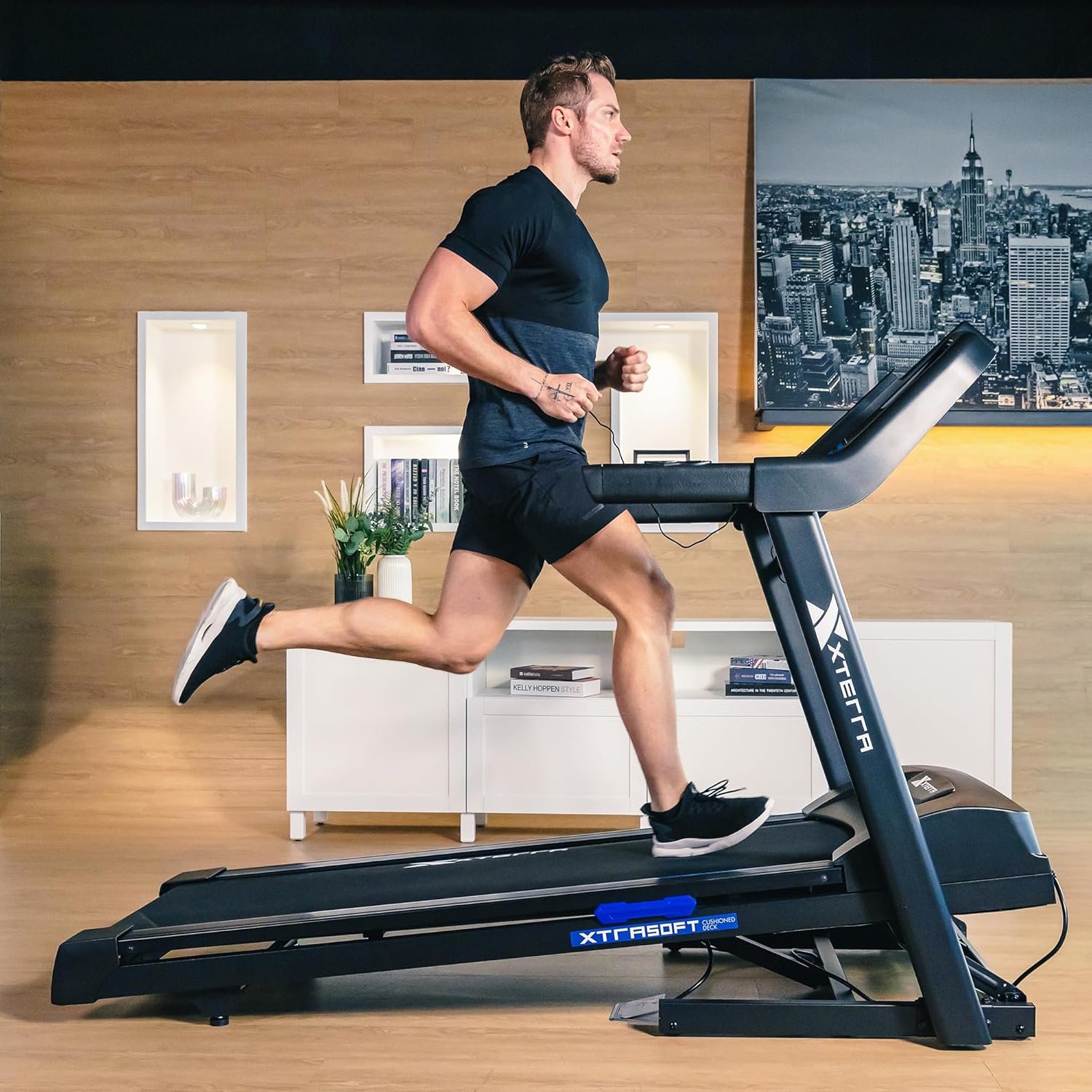
- Motor: 3.25 HP
- Speed range: 0.5–12 mph
- Incline: 12 power levels
- Running surface: 20″ × 60″
- Weight capacity: 350 lbs
- Display: 6.5″ blue backlit LCD
- Cushioning: XTRASoft deck
- Folding: Lift Assist with Safe Drop
- Connectivity: FTMS Bluetooth — Zwift, Kinomap, Tacx
At under $700, the XTERRA TR75 does something few budget treadmills manage: it includes genuine FTMS Bluetooth connectivity. That means you can connect it to Zwift, Kinomap, or Tacx and have the app control your speed and incline automatically during a structured session. Most treadmills at this price offer Bluetooth for audio only. The TR75 offers actual training app integration — a feature that typically costs two to three times more.
What Makes It Different
The 3.25 HP motor paired with a 20″×60″ belt and 350 lb weight capacity is a genuinely capable specification for this price. Most budget treadmills compromise on either motor size or belt length — the TR75 doesn’t shortchange either. The Lift Assist folding mechanism includes a Safe Drop system that controls the rate at which the deck lowers — a safety feature often absent on cheaper machines where the deck can crash down onto fingers or feet.
The 18 preset programs plus 5K, 10K, target time, distance, and calorie programs provide more structured workout variety than most budget alternatives. Handlebar-mounted speed and incline controls mean you can adjust pace without reaching for the console mid-run. The XTRASoft deck cushioning is noticeably softer underfoot than comparable budget options — important for protecting joints over time.
The honest limitation is the warranty: lifetime on the frame but only 1 year on the motor. This reflects where budget is saved. If you’re planning to run high mileage daily, the motor warranty gap matters — the Horizon 7.0 AT’s lifetime motor warranty is worth the extra investment. But for moderate use — 3–4 sessions per week at varied speeds — the TR75 is reliable, well-built for its price, and uniquely capable thanks to the FTMS Bluetooth. Research from the National Institutes of Health consistently shows that regular moderate-intensity exercise significantly reduces cardiovascular disease risk — and the TR75 makes that accessible without a large financial commitment.
Best for: Budget-conscious buyers who want genuine Zwift or Kinomap connectivity in a folding treadmill without paying a premium price.
- Pro: FTMS Bluetooth at budget price — Zwift, Kinomap, Tacx all connect with full metric control
- Pro: 350 lb weight capacity at this price — unusually generous
- Pro: Safe Drop deck lowering system — prevents the crash-down risk on cheaper machines
- Pro: 18 preset programs plus 5K, 10K, and goal-based programs built in
- Con: Only 1-year motor warranty — weakest on this list for motor coverage
- Con: Basic 6.5″ LCD — no streaming, no touchscreen
How to Choose a Folding Treadmill: 6 Things That Actually Matter
1. Folding Mechanism — Not All Folds Are Equal
There are three distinct folding types. Upright fold (Sole, NordicTrack, Horizon, Bowflex) — the deck tilts vertical, reducing floor footprint but adding height. Flat fold (Echelon Stride-6 S) — the entire machine collapses to under 12″ tall and slides under furniture. Under-bed walking pads — ultra-low-speed only, not suitable for running. If ceiling height is a constraint in your storage space, measure before buying an upright-fold model — they typically reach 67–72″ when stored.
2. Motor Size vs. How You’ll Actually Use It
A 2.5 CHP motor is adequate for walking. A 3.0 CHP motor handles jogging and light running well. A 3.5 CHP motor is the right choice for regular running above 7 mph or heavier users. The motor rating also affects longevity — an underpowered motor working at 80–90% of its capacity daily will wear out significantly faster than one running at 50–60%. Buy at least one motor tier above what your primary use requires.
3. Belt Size — The Spec Most Buyers Overlook
The belt size listed on a treadmill is the running surface, not the machine footprint — these are different numbers. A 20″×55″ belt is fine for walking. A 20″×60″ belt suits most runners up to 6’2″ with a normal stride. A 22″×60″ belt is recommended for tall runners, runners with a wide gait, or anyone running above 8 mph regularly. Never confuse the machine’s overall dimensions with the actual running surface.
4. Weight Capacity — Apply the 20–30 lb Headroom Rule
The rated weight capacity on a treadmill is the maximum — not the ideal operating load. Running generates impact forces of two to three times your body weight with every stride. If you’re 300 lbs and buy a 300 lb capacity treadmill, the machine is operating at its absolute limit on every step. I always recommend choosing a treadmill rated at least 20–30 lbs above your actual weight. At 280 lbs, the 300 lb Echelon is too close — look at the 350 lb models instead.
5. Subscription Costs — The Hidden Long-Term Expense
The NordicTrack C1250 requires iFIT at $39/month to unlock full touchscreen features — that’s $468/year or nearly $1,400 over three years on top of the treadmill price. The Bowflex T16’s JRNY is optional — the screen streams entertainment without it. Sole, Horizon, and XTERRA have no subscription requirement. This isn’t a reason to avoid subscription platforms if you’ll genuinely use the coaching content — but factor the ongoing cost into your total budget before buying.
6. Warranty — What It Tells You About the Manufacturer’s Confidence
A lifetime warranty isn’t just consumer protection — it’s the manufacturer’s public statement about how long they expect the machine to last. Brands offering lifetime frame and motor warranties (Sole, Horizon, Bowflex T16) are engineering their products to still be running in 10–15 years. Brands offering 1-year motor warranties are being more conservative. The motor is the most expensive component to replace — weight the motor warranty heavily when comparing value.
Does a Folding Treadmill Affect Your Running Performance?
This is the question I get asked most by runners considering their first home treadmill. The honest answer: on a quality folding treadmill with a solid frame and a decent motor, no — you won’t notice any performance difference compared to a non-folding machine. The folding mechanism adds a hinge point in the frame, but on well-engineered models this hinge is reinforced and contributes no flex or wobble during running.
Where cheaper folding treadmills do affect performance is in frame rigidity at speed. At 10–12 mph on a poorly built folding machine, the frame can flex noticeably — disrupting your gait and increasing injury risk. Every product on this list has been specifically selected to avoid this problem. The Horizon 7.4 AT, Sole F80, and Bowflex T16 in particular have been praised by reviewers who run serious mileage for their stability at top speed.
The one genuine tradeoff with folding treadmills is deck cushioning depth. Some non-folding commercial treadmills use thicker decks that provide marginally better long-run cushioning. For most home users running 30–60 minutes per session, this won’t matter. If you’re training for marathons and logging 15+ miles per week on a home treadmill, the heavy-duty non-folding options are worth considering.
Folding Treadmill FAQs
What is the best folding treadmill for home use?
The Sole F80 is the best folding treadmill for most home users. It combines a 3.5 CHP motor, 22″×60″ running deck, lifetime frame and motor warranty, and FTMS Bluetooth connectivity — all without requiring a subscription. The Easy Assist folding mechanism makes daily storage effortless. For runners who specifically want iFIT coaching, the NordicTrack C1250 is the better choice.
Which folding treadmill folds completely flat?
The Echelon Stride-6 S folds to just 10 inches in height using its electric Auto-Fold system. This allows it to slide under most bed frames and sofas, making it the only full-performance running treadmill (12.5 mph capable) that can be stored completely flat. Traditional folding treadmills fold upright to roughly 67–72″ tall — still space-saving but not under-furniture storage.
Is a folding treadmill as good as a non-folding treadmill?
On quality models, yes. The folding mechanism adds a reinforced hinge that does not flex or affect performance during running. Every treadmill on this list has been selected specifically for frame rigidity at speed. The main difference is that commercial-grade non-folding treadmills sometimes use thicker decks for additional cushioning — relevant for marathon-level mileage but not for typical home use of 3–5 sessions per week.
What folding treadmill has the best warranty?
The Sole F80, Horizon 7.4 AT, Horizon 7.0 AT, and Bowflex T16 all offer lifetime warranties on both the frame and motor — the strongest coverage available in a home treadmill. The Sole F80 and Bowflex T16 additionally cover parts for 3 years. The NordicTrack C1250 offers lifetime motor coverage but only 10 years on the frame.
What is the best folding treadmill for small apartments?
The Echelon Stride-6 S is the best choice for small apartments — it folds completely flat to 10″ tall and slides under furniture, so it takes up zero floor or wall space when stored. For apartments where a standard upright-folding treadmill fits storage-wise, the Horizon 7.0 AT offers the smallest active footprint (76″×35″) among the more capable options.
Can I use Zwift with a folding treadmill?
Yes, provided the treadmill has FTMS Bluetooth. The Horizon 7.4 AT, Horizon 7.0 AT, Sole F80, and XTERRA TR75 all use the open FTMS standard that Zwift, Kinomap, and other major platforms connect to natively — with full speed and incline metric sharing. The NordicTrack C1250 uses a proprietary Bluetooth system optimised for iFIT, which limits direct integration with third-party apps.
How much should I spend on a folding treadmill?
For a reliable folding treadmill suitable for running, budget a minimum of $700–$800 (XTERRA TR75 range). Under this price, you’ll typically find motors under 2.5 CHP, belts shorter than 55″, and warranties measured in months. The $1,100–$1,800 range (Horizon 7.0 AT through Sole F80) offers the best combination of performance, warranty, and longevity. Above $2,000 you’re paying primarily for larger screens and subscription-based training ecosystems.
Do folding treadmills require more maintenance?
No more than non-folding treadmills. All treadmills require regular belt lubrication (typically every 3–6 months), belt tension checks, and deck cleaning. The folding hinge should be checked periodically for tightness but adds no significant maintenance burden. Using a treadmill mat under the machine reduces debris entering the motor and extends belt life regardless of whether the machine folds.
Disclosure: This article contains affiliate links. If you purchase through our links we may earn a commission at no extra cost to you. All products were selected based on performance, value, and availability — not commission rates.