Is treadmill running bad for your knees? No — and the research on this is genuinely strong. Regular running, indoors or out, is consistently associated with lower rates of knee osteoarthritis than being sedentary, not higher. But the more interesting, less-covered question is how the indoor version actually differs from running outdoors biomechanically — and that’s where most articles either oversimplify or repeat myths that don’t hold up under closer research. I’m AnilKK, an INFS-certified nutrition and fitness coach with 24 years of running experience and 250+ treadmills personally tested, and I want to give you the real mechanics, not just the reassurance.
Quick Answer: No, it’s not bad for your knees — research consistently links regular running to lower, not higher, rates of knee osteoarthritis, and treadmills specifically offer better shock absorption than pavement or concrete. The real differences worth knowing: the belt reduces activation in some muscles (notably your glutes and hamstrings) since it assists your stride, and the popular “1% incline rule” to mimic outdoor conditions has weaker evidence behind it than commonly claimed.
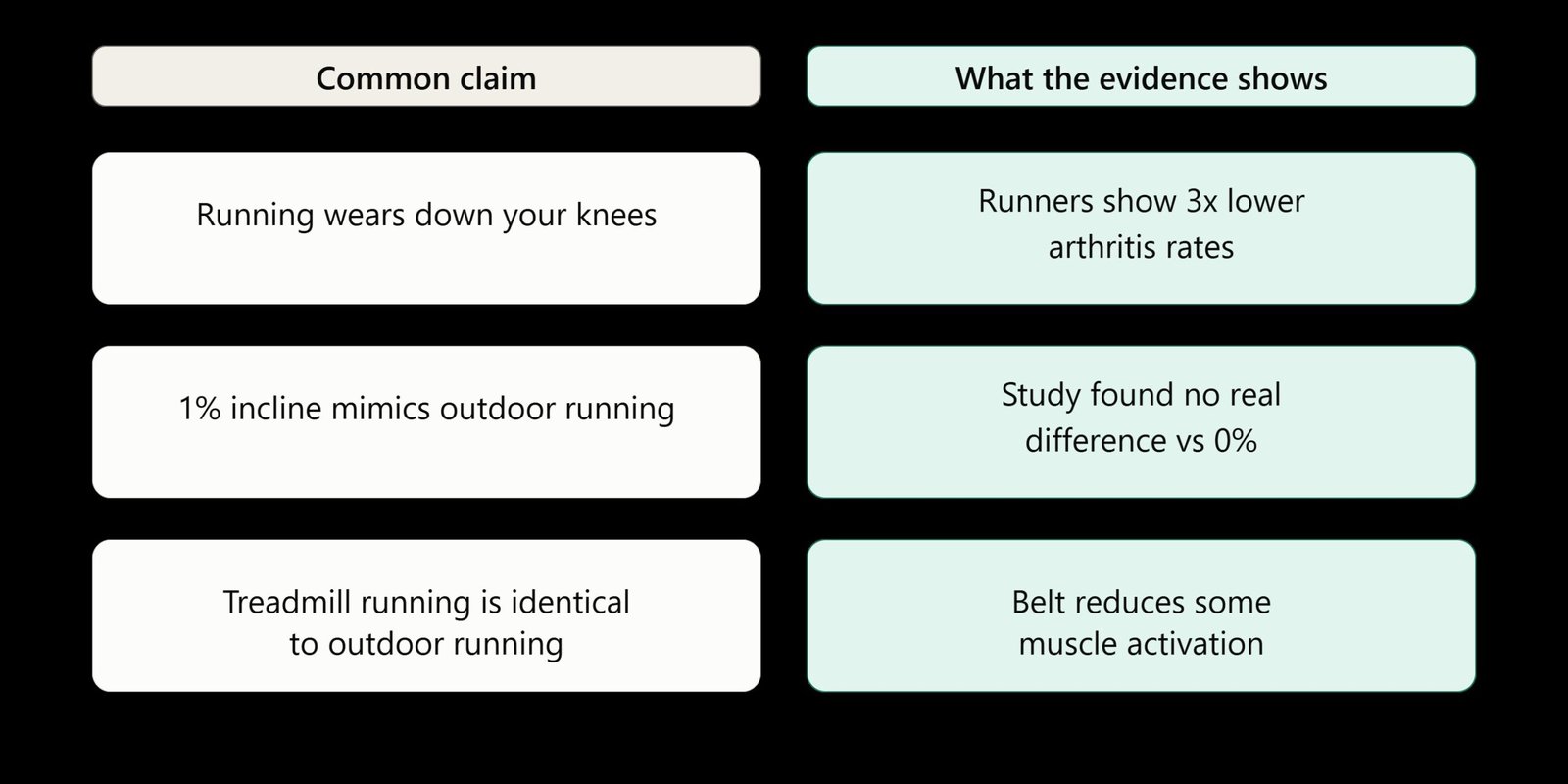
Table of Contents
Is Treadmill Running Bad for Your Knees? What the Research Shows
This is one of the most persistent fitness myths, and the evidence runs firmly the other way. Research from Stanford’s Prevention Research Center found that recreational runners have knee and hip osteoarthritis rates three times lower than sedentary non-runners, with competitive runners showing an even greater four-fold reduction — the opposite of what most people assume. Regular running appears to strengthen the muscles supporting the knee and support cartilage health over time, rather than wearing it down.
Treadmills specifically add a genuine advantage on top of this: their decks are engineered with shock absorption that outdoor surfaces like concrete or asphalt simply don’t have, meaningfully reducing impact forces compared to running on the hardest common outdoor surfaces. If you’re choosing equipment specifically with knee comfort in mind, our best treadmill for walking guide covers cushioning systems built around exactly this priority.
Treadmill vs. Outdoor Running: What Actually Differs
Knee safety isn’t really the interesting question — the real differences are biomechanical, and most articles either ignore this or oversimplify it. Some research using surface electromyography has found lower muscle activation on treadmills compared to overground running in the calf and quadriceps muscles specifically, across multiple running speeds — the moving belt does part of the propulsive work your muscles would otherwise handle outdoors.
Worth being honest about the bigger picture, though: a comprehensive meta-analysis pooling 33 studies and nearly 500 participants found that most biomechanical outcomes between indoor and outdoor running were actually comparable, with muscle activation specifically showing conflicting results across the full body of research — not a single, settled finding. The practical takeaway: don’t assume the two are biomechanically identical, but also don’t assume they’re dramatically different either. If you’re specifically comparing engagement across muscle groups, our muscles involved in treadmill workouts guide covers this in more depth.
The 1% Incline “Rule”: Weaker Evidence Than You’d Think
You’ll see this recommendation everywhere: set your treadmill to a 1% incline to simulate outdoor wind resistance and better mimic overground running. It’s repeated so consistently that most articles present it as settled fact. It isn’t.
A study specifically designed to test this found no significant difference in spatiotemporal running factors between 0% and 1% incline, directly challenging the widely-repeated claim that a 1% incline meaningfully mimics overground running better than a flat treadmill. That doesn’t mean incline is pointless — a genuinely steep incline does measurably change muscle activation — but the specific “1%” figure appears to be a myth that’s been repeated so often it’s treated as fact without much evidence behind it.
The Proprioception Gap: What Treadmills Don’t Train
This is genuinely underdiscussed. Outdoor running on varied, uneven terrain forces constant small stabilization adjustments — proprioception, or your body’s sense of balance and position — that a flat, consistent treadmill belt simply doesn’t demand. If you run exclusively on a treadmill, you may be missing out on this specific training stimulus entirely.
This isn’t a reason to avoid indoor running — it’s a reason to occasionally supplement it. Simple balance work (single-leg stands, unstable surface training) or periodic outdoor runs can fill this specific gap without requiring you to give up the treadmill’s real advantages in weather-proof consistency and joint-friendly cushioning. Our exercise bike vs. treadmill comparison covers similar tradeoffs if you’re weighing equipment variety more broadly.
Who Benefits Most From Running Indoors
For older adults: the controlled, predictable environment is a genuine advantage — no uneven sidewalks, potholes, or unpredictable obstacles to navigate, and speed stays entirely within your control. For anyone returning from injury: the ability to precisely control pace and gradually reintroduce load makes a treadmill a genuinely useful rehabilitation tool, though always follow guidance from your physical therapist or doctor on your specific return-to-running timeline.
If joint concerns specifically are what’s holding you back regardless of surface, our treadmill for bad knees guide covers incline settings and form adjustments that reduce impact further.
How to Run on a Treadmill Without Aggravating Your Knees
Avoid running at 0% incline for extended periods — a completely flat belt slightly simulates a gentle downhill, which can increase strain on your knees and patellar tendon over a long session. A small incline (even without chasing the specific “1%” figure) generally feels more natural than dead flat.
Keep your stride natural rather than overstriding to match the belt, and avoid gripping the handrails unless you genuinely need them for balance — leaning on them changes your posture and reduces the actual training effect. If you’re building up mileage from scratch, progress gradually rather than jumping straight into long sessions; our treadmill workouts guide covers structured progression plans for exactly this.
Frequently Asked Questions
Is treadmill running better than outdoor running for your knees?
Treadmills generally offer better shock absorption than hard outdoor surfaces like concrete or asphalt, which can mean less impact stress per stride. That said, running itself — indoor or outdoor — is associated with lower knee osteoarthritis rates than being sedentary, so both options support long-term knee health when done reasonably.
Does it build the same muscle as running outdoors?
Mostly, but not entirely identical. Some research shows reduced activation in certain muscles like the calves and quadriceps on a treadmill since the belt assists part of your propulsion, though findings across the full body of research are mixed rather than fully settled.
Should I always run at a 1% incline on the treadmill?
Not necessarily. Despite being widely repeated as a rule to mimic outdoor running, a study specifically testing this found no significant difference between 0% and 1% incline. A slight incline can still feel more natural than dead flat, but there’s no strong evidence the specific 1% figure matters.
Can it cause shin splints?
Shin splints are generally caused by increasing running volume or intensity too quickly, not by the treadmill itself as a surface. Progressing gradually and ensuring proper footwear matters more than whether you’re running indoors or outdoors.
Why does it feel different from running outdoors?
Part of it is genuine biomechanics — the moving belt assists some of your propulsion, and there’s no wind resistance or varied terrain. Part of it is also psychological, since the lack of changing scenery can make the same effort feel more monotonous than covering real ground outdoors.
Is it safe for seniors to run on a treadmill?
Generally yes, and the controlled, predictable surface is often an advantage over uneven outdoor terrain for older runners. As always, check with a doctor before starting a new running program, particularly if you have existing joint or cardiovascular concerns.
How do I transition from indoor running to the road?
Introduce outdoor runs gradually rather than switching entirely at once, since your body will need to adapt to the reduced muscle assistance from the belt and the demands of uneven terrain and varied stabilization. Starting with shorter outdoor sessions alongside your regular indoor routine is a reasonable approach.
Does it cause lower back pain?
Running indoors isn’t a direct cause of lower back pain, but poor posture — such as leaning on the handrails, hunching forward, or overstriding — can contribute to it. Maintaining natural, upright form matters more than the surface itself.
Affiliate Disclosure: myactivetribe.com is supported by its readers. When you purchase through links on our site, we may earn an affiliate commission at no additional cost to you.