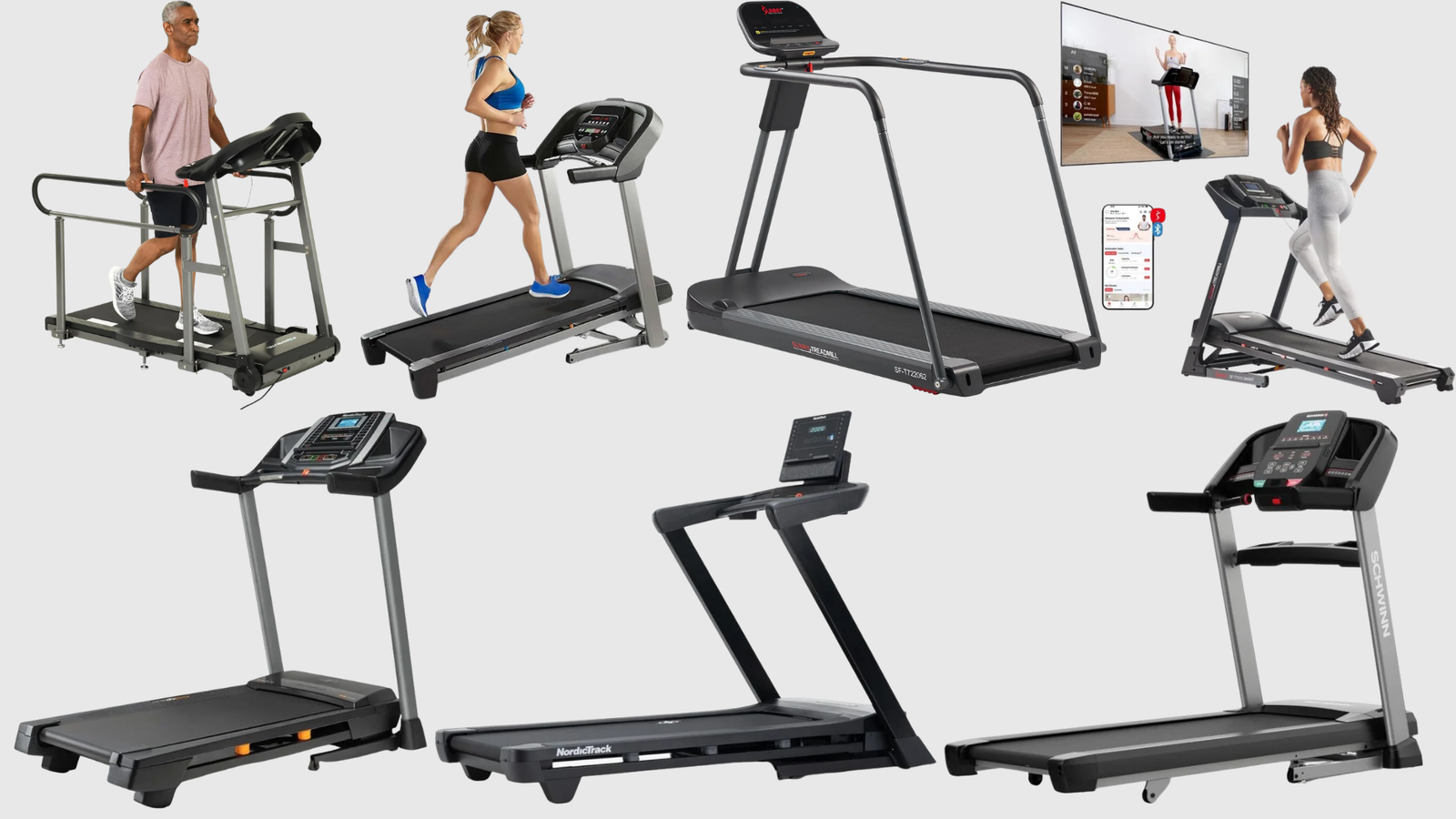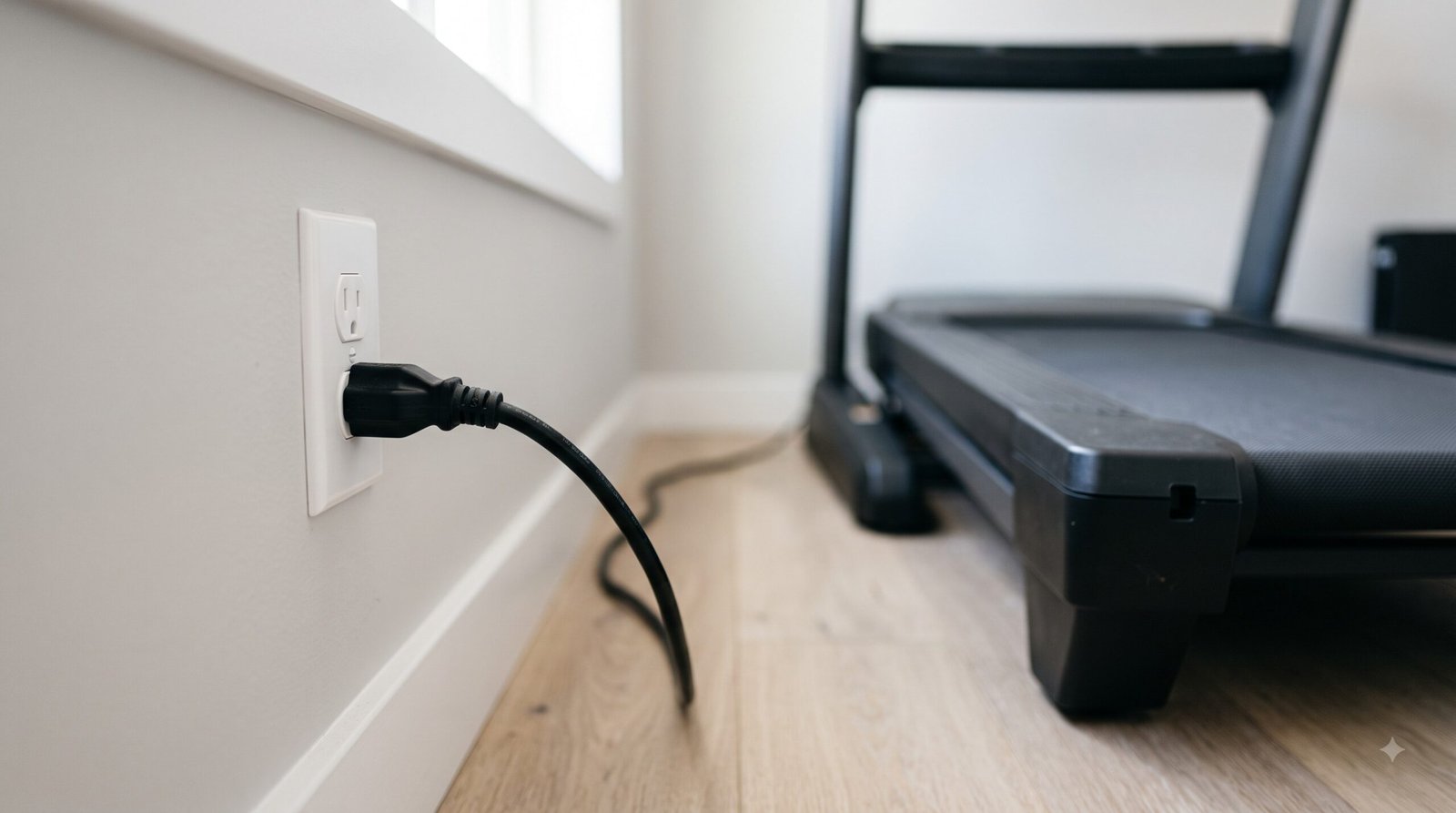
Your treadmill power requirements come down to two separate questions people often mix up: how much electricity it actually consumes during use, and what kind of electrical circuit and outlet it needs to run safely. The two aren’t the same thing, and getting either one wrong — either overestimating your electric bill or plugging into the wrong kind of outlet — is a common source of confusion. I’m AnilKK, an INFS-certified nutrition and fitness coach who has personally tested 250+ treadmills, and this is one of those topics where a simple textbook formula gets repeated online without matching how these machines actually draw power in real use.
Quick Answer: Most home treadmills realistically draw somewhere between 600 and 1,800 watts during actual use, depending on user weight, speed, and incline — not a fixed number based purely on motor horsepower. Separately, most treadmills need a dedicated 15-20 amp, 120-volt grounded circuit, and are specifically incompatible with GFCI and AFCI outlets, which can cause tripping or motor issues.
Table of Contents
What Are The Actual Treadmill Power Requirements?
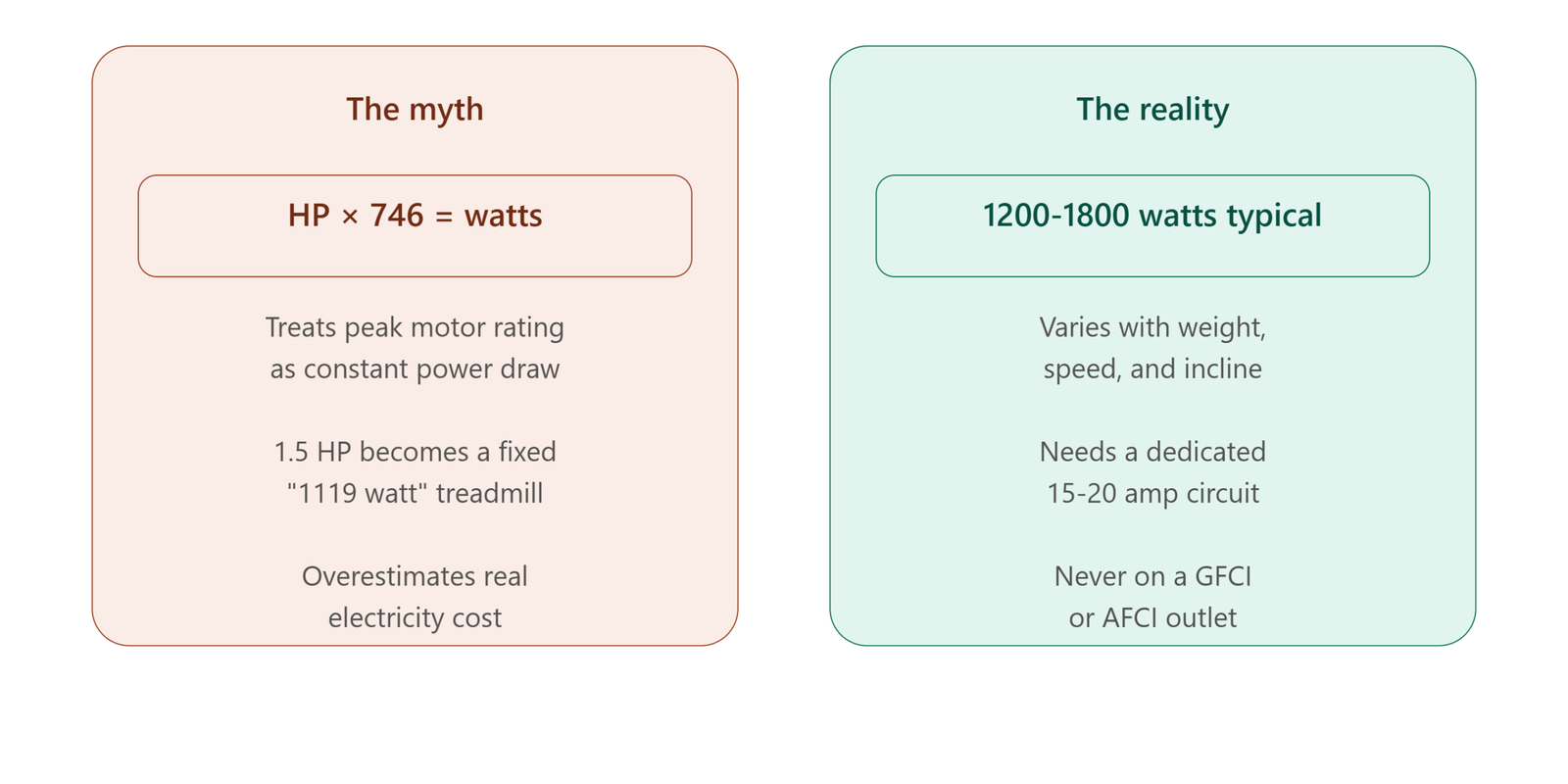
A common but misleading shortcut converts a treadmill’s horsepower rating directly into watts using the standard physics conversion (1 HP ≈ 746 watts), then treats that number as the treadmill’s running power draw. That’s not accurate. A motor’s horsepower rating describes its maximum rated output, not what it continuously draws during a normal walk or run — most of the time, the motor isn’t working anywhere near its peak capacity.
Horizon Fitness’s own official guidance is more realistic: a safe estimate for many scenarios is around 1,200 watts, though some situations may require up to 1,800 watts, with actual consumption varying based on user weight, belt speed, incline, belt and deck condition, and even temperature. That’s a meaningfully different picture than a fixed HP-to-watts conversion suggests, and it’s why two people using the same treadmill model can see genuinely different power draw.
Someone doing steady walking, for instance, will typically draw less than someone doing higher-speed intervals, similar to what you’d see in our best treadmill for walking guide.
Calculating Your Estimated Electricity Cost
Once you have a realistic wattage estimate (rather than a theoretical HP conversion), the cost math is straightforward. Multiply your treadmill’s estimated wattage by hours of use per month, divide by 1,000 to get kilowatt-hours, then multiply by your local electricity rate (roughly 12-16 cents per kWh in much of the US, though this varies significantly by region and provider).
For example: at a realistic 1,200 watts, used for 1 hour a day, 6 days a week (about 26 hours a month), that’s 31.2 kWh — roughly $4-5 a month at typical US electricity rates. That’s a meaningfully lower estimate than what you’d get plugging a naive HP-to-watts conversion into the same formula, which is why starting from a realistic power draw matters. If you’re specifically shopping with a tighter budget in mind, our treadmills under $1,000 guide covers options that also tend to have more modest power requirements.
Amps, Circuits, and Outlets: What Your Treadmill Actually Needs
This is a separate question from power consumption, and it’s the one that causes the most real-world confusion — including a fair number of people who buy a used or commercial-grade treadmill and discover their home wiring can’t support it.
Most North American treadmills require 120 volts of electricity at 60Hz, on a dedicated 15-20 amp circuit, and are specifically not compatible with GFCI or surge-protected outlets — using one can cause the treadmill to trip a breaker, run at reduced voltage, or in some cases overheat the motor. A dedicated circuit means no other devices are drawing power from the same breaker while your treadmill runs.
For higher-end and commercial-grade treadmills specifically, a 20-amp circuit with a NEMA 5-20R outlet and 12-gauge wiring (rather than the more common 14-gauge) is often required rather than optional. If you’re buying a used commercial treadmill or a heavy-duty home model, don’t assume your existing outlet will work — check the specific electrical requirements listed in the owner’s manual before you commit to a spot for it. If you’re deciding between models with different power demands, our best treadmill for home use guide covers options across different power and space requirements.
Why Is My Treadmill Tripping the Circuit Breaker?
The most common cause is exactly what’s described above: the treadmill is plugged into a GFCI or AFCI-protected outlet, which is fundamentally incompatible with how treadmill motors draw and manage power. These outlets are designed to cut power quickly in response to certain electrical patterns that a treadmill motor can trigger under normal operation, even when nothing is actually wrong.
The fix is usually to move the treadmill to a standard, non-GFCI/AFCI outlet on its own dedicated circuit. If that’s not straightforward in your space, a licensed electrician can confirm what your specific wiring supports and whether a new dedicated circuit is a reasonable option.
Extension Cords, Grounding, and Other Setup Questions
Plug your treadmill directly into a grounded, dedicated outlet whenever possible — this is the safest and most reliable setup. If you absolutely must use an extension cord, it should be grounded (three-pronged), no longer than 6 feet, and at minimum the same wire gauge as your treadmill’s own power cord (commonly 14-gauge). Longer or thinner cords can’t reliably carry the current a treadmill motor needs, particularly under load.
When your treadmill isn’t in use, unplugging it (rather than just switching it off) is a reasonable safety habit — it protects against both power surges and reduces wear from constant standby power draw. If you’re weighing treadmill options with different power profiles as part of a broader equipment decision, our treadmills for heavy people guide covers higher-capacity models, which often have correspondingly higher power requirements worth planning for in advance.
Manual Treadmills: The No-Electricity Option
If power requirements and outlet compatibility are a genuine obstacle in your space, manual (non-motorized) treadmills are worth considering. These use your own walking or running motion to move the belt rather than a motor, which means no outlet, no circuit requirements, and no electricity cost at all — though most still use battery-powered consoles for basic stats like time and distance. They also tend to have fewer moving parts to maintain, though the feel and incline options are generally more limited than motorized models. This tradeoff is worth weighing carefully if you’re in a smaller space to begin with — our best treadmill for apartment guide covers additional space-conscious options beyond just the power question.
Frequently Asked Questions
How much electricity does a treadmill use per hour?
Realistically, most home treadmills draw somewhere between 600 and 1,800 watts per hour of use, depending on user weight, speed, and incline — not a fixed number based purely on the motor’s horsepower rating. At a typical US electricity rate, this generally costs somewhere in the range of 15-25 cents per hour of use.
How many amps does a treadmill use?
Most home treadmills are designed to run on a 15-20 amp circuit. Higher-end and commercial-grade models often specifically require a full 20-amp dedicated circuit rather than a shared 15-amp household circuit, so it’s worth checking your specific model’s manual before assuming a standard outlet will work.
Can I plug my treadmill into a GFCI outlet?
It’s not recommended. Treadmills are generally incompatible with GFCI and AFCI outlets, which can cause the treadmill to trip the breaker, run at reduced power, or in some cases contribute to motor overheating. Use a standard grounded outlet on a dedicated circuit instead.
Do treadmills use a lot of electricity?
Not as much as people often assume. At a realistic power draw and typical usage patterns (an hour a day, several days a week), most home treadmills add somewhere around $4-8 a month to an electricity bill, depending on local rates and how the machine is used.
What is a 5 HP treadmill’s actual power consumption?
A 5 HP rating theoretically converts to roughly 3,700 watts, but that’s the motor’s peak rated output, not its real-world running draw. In practice, even a high-horsepower treadmill typically draws closer to 1,200-1,800 watts during normal use, since the motor rarely operates at its full rated capacity continuously.
Should I unplug my treadmill when not in use?
It’s a reasonable safety habit. Unplugging protects against power surges and reduces unnecessary standby power draw, though it’s not strictly required for safety if your treadmill is otherwise properly installed on a grounded, dedicated circuit.
Can I use an extension cord with my treadmill?
It’s best avoided if possible. If you must use one, it should be grounded (three-pronged), no more than 6 feet long, and at least as thick as your treadmill’s own power cord, typically 14-gauge. A direct connection to a dedicated grounded outlet is always the safer, more reliable option.
Do manual treadmills need electricity at all?
No, manual treadmills are powered entirely by your own walking or running motion and don’t require an outlet or circuit. Most still use a small battery-powered console for basic stats like time and distance, but this doesn’t require a wall connection.
Affiliate Disclosure: myactivetribe.com is supported by its readers. When you purchase through links on our site, we may earn an affiliate commission at no additional cost to you.