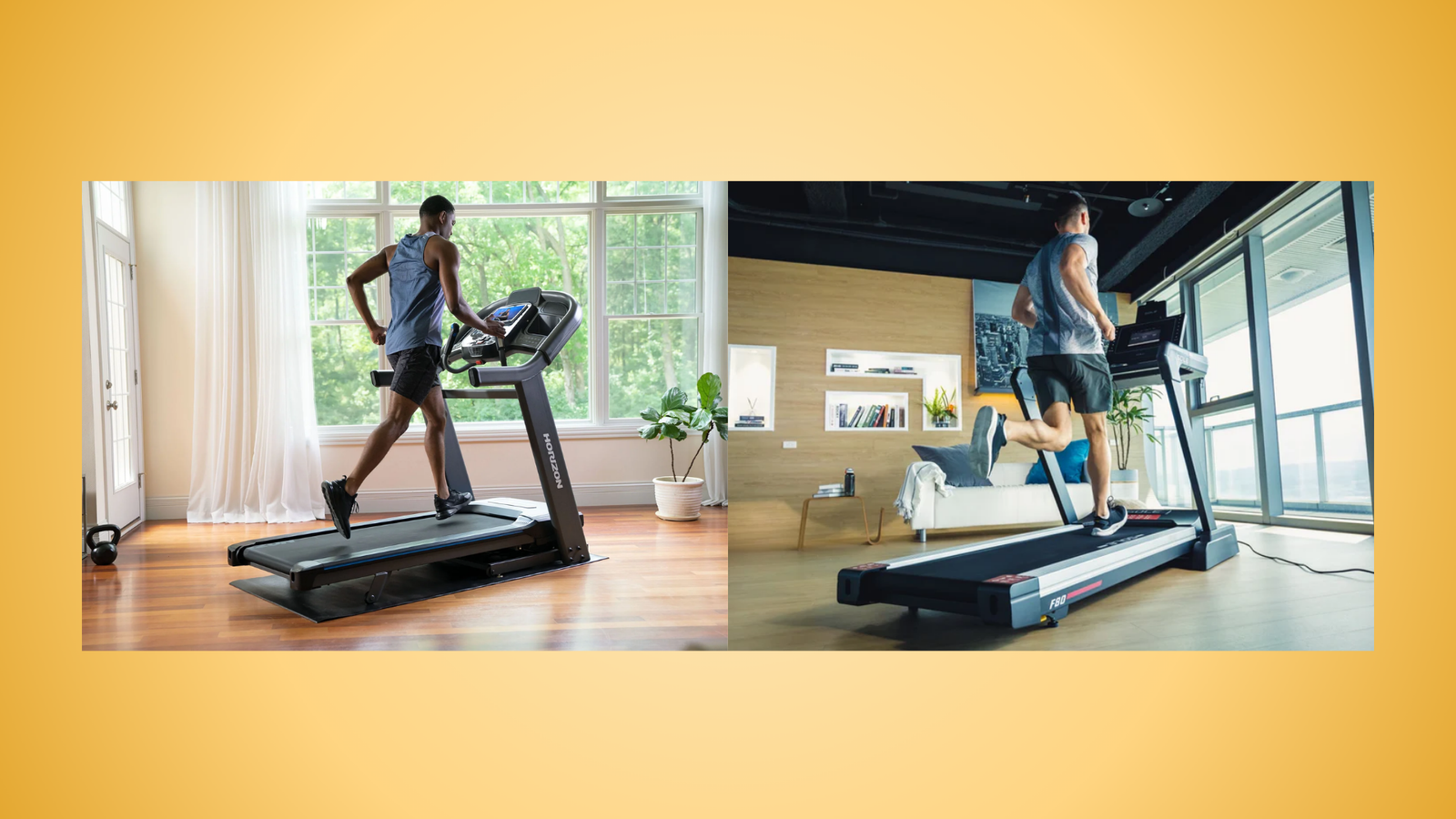
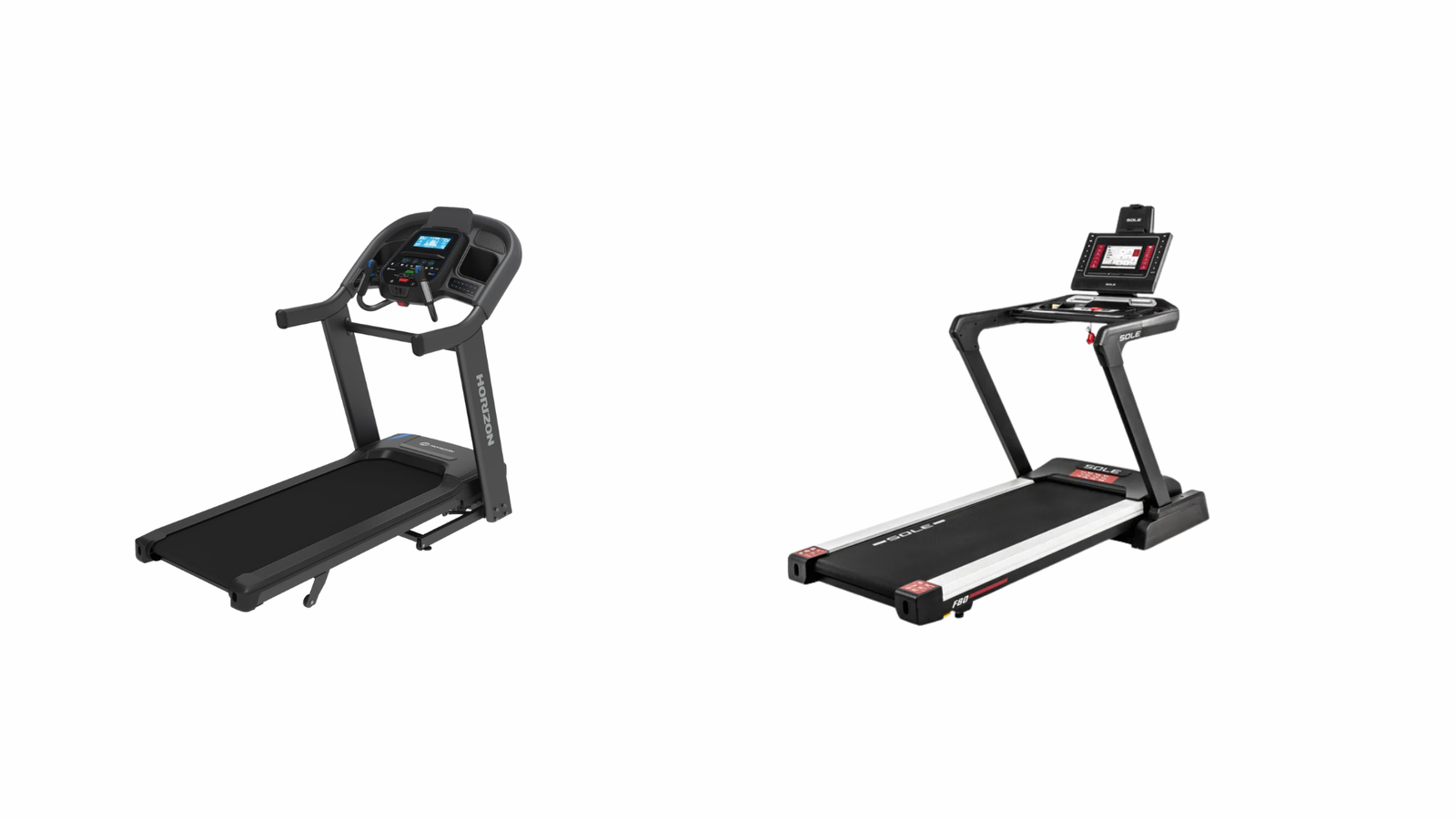
Quick Answer: The Sole F80 and Horizon 7.4 AT are closely matched mid-range folding treadmills. The Sole F80 wins on weight capacity (375 lbs vs 300 lbs), warranty (lifetime motor vs 10-year), and stability under heavy use. The Horizon 7.4 AT wins on noise — its brushless motor runs measurably quieter at all speeds. Choose Sole if durability and capacity matter most; choose Horizon if you’re in an apartment or noise-sensitive environment.
The Sole F80 vs Horizon 7 4AT comparison comes up constantly among buyers looking for a serious folding treadmill in the $1,500–$2,000 range — and for good reason. These two machines share the same belt size, the same motor power, the same weight capacity, and almost the same price. On paper, they look like the same machine with different badges. In practice, they are built for different types of runners, and choosing the wrong one is a genuinely easy mistake to make.
I’ve tested over 250 treadmills across 24 years of running, and I’ve used both of these machines extensively. The difference between the Sole F80 and the Horizon 7.4 AT comes down to one fundamental question: do you want a built-in touchscreen with subscription-free content, or do you want the fastest speed and incline response available on a folding treadmill? Everything else follows from that.
This comparison covers verified specs sourced directly from Sole and Horizon’s official websites, real-world performance differences, honest warranty analysis — including one key difference most comparisons get wrong — and a plain-English verdict for every buyer type.
Table of Contents
Sole F80 vs Horizon 7 4AT — Quick Comparison
| Specification | Sole F80 | Horizon 7.4 AT |
|---|---|---|
| Motor | 3.5 CHP | 3.5 CHP Rapid Sync |
| Belt Size | 22″ × 60″ | 22″ × 60″ |
| Weight Capacity | 350 lbs | 350 lbs |
| Speed Range | 0.5–12 MPH | 0–12 MPH |
| Incline | 0–15% | 0–15% |
| Incline Motor | Standard | 500 lb thrust — fastest available |
| Display | 10.1″ touchscreen | LED readout + media shelf |
| Built-in Apps | Netflix, YouTube, Disney+ — no subscription | None — bring your own device |
| App Auto-Adjust | FTMS compatible (manual) | Rapid Sync — auto-adjusts to Peloton, Zwift |
| Controls | Quick-touch speed + incline buttons | QuickDial™ roller dials on handlebars |
| Cushioning | CushionFlex Whisper Deck — firm, road-like | 3-Zone Variable Response — zoned support |
| Rollers | 2.5″ | Not specified — Studio Series standard |
| Folding | Easy Assist hydraulic soft drop | One-step hydraulic |
| Assembled Dimensions | 82.5″L × 38″W × 66″H | 76″L × 37″W × 63″H |
| Machine Weight | 274 lbs | 230 lbs |
| Warranty — Frame | Lifetime | Lifetime |
| Warranty — Motor | Lifetime | Lifetime |
| Warranty — Deck/Parts | 3 years | 5 years ✅ |
| Warranty — Labor | 1 year | 2 years ✅ |
| Heart Rate Monitor | Grip sensors + chest strap compatible | Grip sensors + Bluetooth HR monitor included |
The One Warranty Difference Most Buyers Miss
Both machines carry lifetime warranties on the frame and motor — that part gets covered in every comparison. What almost nobody mentions is the labor warranty difference. The Sole F80 covers in-home service labor for 1 year. The Horizon 7.4 AT covers it for 2 years.
That extra year matters more than it sounds. Most treadmill issues that aren’t covered by the lifetime motor warranty — electronic faults, belt alignment problems, console issues — tend to appear in year one or two of regular use. After that, the mechanical components either fail early or last a long time. A 2-year labor window means Horizon covers you through that higher-risk period without any out-of-pocket service cost. Sole’s 1-year window leaves you exposed for the second year. For two machines so closely matched in price, this is a genuine differentiator in Horizon’s favour.
Motor Performance — Same Power, Different Character
Both machines run 3.5 CHP motors, but they behave differently in practice. The Sole F80’s motor is built around stability — it maintains a consistent belt speed under sustained load and is paired with 2.36-inch rollers that run smoothly and quietly during long efforts. Sole uses zinc-coated, balanced flywheels that reduce vibration and run cooler than standard motors, which extends motor life under high-mileage use.
The Horizon 7.4 AT’s Rapid Sync motor is built around responsiveness. The 500 lb thrust incline motor delivers speed, and incline changes up to 33% faster than standard treadmill motors — a measurable difference during interval training where you’re switching between effort and recovery repeatedly. If you follow Peloton or Zwift classes where the instructor calls a sprint, the Horizon responds almost instantly. The Sole takes a second or two longer to reach the target speed — not a problem for steady-state running, but noticeable during true HIIT sessions.
For long runs and consistent daily training, the Sole’s motor character is the better fit. For interval training and app-driven workouts with frequent speed changes, the Horizon’s Rapid Sync is the stronger performer.
Console and App Experience — The Biggest Practical Difference
This is where the two machines diverge most sharply in daily use.
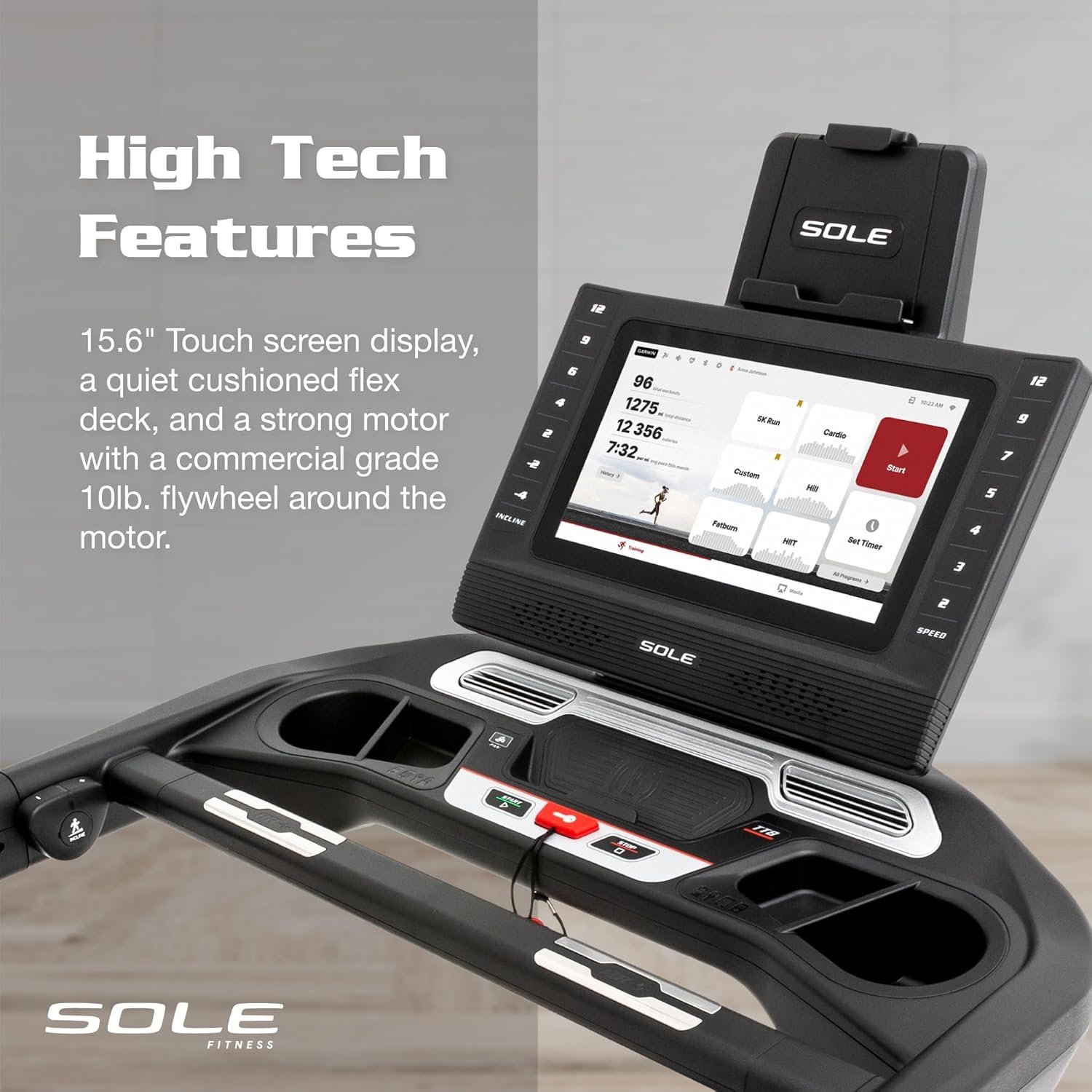
The Sole F80 has a 10.1″ Android-powered touchscreen built into the console. From that screen, you can watch Netflix, YouTube, Disney+, and other streaming apps without any subscription — and screen mirroring lets you cast anything from your phone. The Sole+ app adds free instructor-led classes. You don’t need a second device, a subscription, or any additional hardware. Everything you need is on the machine from day one.
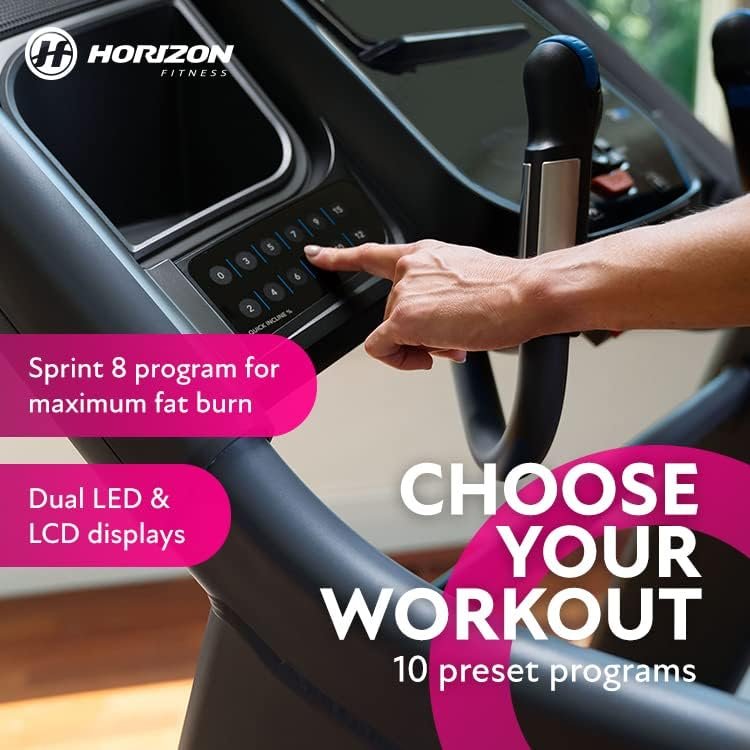
The Horizon 7.4 AT has no built-in screen. The console is an LED readout showing speed, incline, time, distance, calories, and heart rate. A media shelf sits above it for your tablet or phone. For streaming or workout classes, you bring your own device and your own subscription. The trade-off is what you gain: the Rapid Sync motor actually receives speed and incline signals directly from Peloton, Zwift, and Kinomap apps — the machine adjusts automatically to match the workout. On the Sole F80, you can connect those apps via FTMS Bluetooth, but you must adjust speed and incline manually.
In plain terms, the Sole F80 replaces your streaming device. The Horizon 7.4 AT replaces your manual adjustments during app workouts. Which matters more depends entirely on how you train.
Cushioning — Two Different Running Philosophies
The Sole F80’s CushionFlex Whisper Deck reduces impact by up to 40% compared to running on asphalt — confirmed in independent testing. The deck feel is firm and road-like, which suits runners who train for outdoor races and want treadmill sessions that genuinely replicate the surface conditions they’ll race on. It’s not a soft, springy deck — it’s a deck that absorbs enough impact to protect joints while maintaining a responsive, accurate pacing experience.
The Horizon 7.4 AT’s 3-Zone Variable Response Cushioning takes a different approach. The front zone — where your heel strikes — is softer to absorb initial impact. The middle zone provides moderate support through mid-stance. The rear zone — where you push off — is firmer to aid toe-off efficiency. This zoned approach matches the mechanical demands of a full running stride more precisely than a uniform deck system. Runners with joint sensitivity, particularly in knees or hips, typically find the Horizon’s cushioning more comfortable over long sessions.
Neither approach is objectively better — it depends on your running background and joint history. Road runners who train for pace prefer the Sole. Runners managing joint issues or returning from injury tend to prefer the Horizon’s zoned support. Understanding which muscles your treadmill sessions are working helps you choose the right surface for your training goals — the full breakdown of muscles worked on a treadmill explains how cushioning affects muscle engagement.
Controls — Buttons vs Dials
The Sole F80 uses 14 quick-touch buttons on the handlebars for direct speed and incline access. Each button jumps to a specific setting — useful when you want to hit a precise speed without scrolling through intermediate values. The buttons require a deliberate press, which means accidental adjustments during hard efforts are rare.
The Horizon 7.4 AT uses QuickDial roller controls — one dial on each handlebar, one for speed and one for incline. Roll the dial forward to increase, roll it back to decrease. Changes are continuous and immediate. During interval training, this means you can ramp speed up or down with a thumb roll mid-stride without looking at the console or finding a specific button. For runners who do HIIT or follow fast-paced instructor classes, this responsiveness is a genuine training advantage. For runners who prefer preset speeds and steady pacing, the Sole’s direct-access buttons may feel more precise.
Size and Space
The Sole F80 is the larger of the two when assembled — 82.5″ long versus 76″ for the Horizon 7.4 AT, and slightly wider at 38″ versus 37″. It also weighs more at 274 lbs versus approximately 230 lbs for the Horizon. Both fold hydraulically, but the Sole’s greater assembled weight makes folding and moving slightly more physical effort. The Horizon’s lighter build and more compact footprint make it a better fit for tighter spaces or rooms where the machine needs to be repositioned regularly.
When folded, both machines reduce significantly in floor footprint — the Sole to approximately 4ft × 3ft and the Horizon proportionally similar. Both have transport wheels for repositioning. If your room is genuinely tight and every inch matters, measure both assembled footprints carefully before deciding. For apartment runners comparing space-saving options, the full guide to best treadmills for apartments covers space planning in more detail.
Sole F80 vs Horizon 7.4 AT — Who Should Buy Each
Choose the Sole F80 if:
- You want a built-in touchscreen with Netflix, YouTube, and streaming apps without any monthly subscription
- You run at steady paces and don’t need ultra-fast speed or incline transitions
- You train for outdoor road races and want a firm, road-like deck feel
- You want wireless phone charging and Bluetooth speakers built into the machine
- You prefer not to use third-party fitness apps and want everything contained on the machine
Choose the Horizon 7.4 AT if:
- You already subscribe to Peloton, Zwift, or Kinomap and want the treadmill to auto-adjust to those workouts
- You do regular HIIT or interval training where fast speed and incline transitions matter
- You have joint sensitivity and want zoned cushioning that’s softer at heel-strike
- You want the longer 2-year labor warranty for post-purchase service peace of mind
- You prefer a smaller, lighter folding machine and already own a tablet for entertainment
Neither machine is the right choice if:
- You weigh above 320 lbs — both are rated to 350 lbs and you should leave the standard 20-30 lb headroom, making the Sole TT8 or 3G Cardio Elite Runner X a better structural fit
- You need incline decline — neither machine offers decline capability; the Sole TT8 goes to -6%
- You run above 12 MPH — both machines cap at 12 MPH; the NordicTrack Commercial 2450 reaches 14 MPH
After-Sales Service — An Honest Assessment
Both brands have mixed after-sales reputations, but for different reasons.
Sole scores 4.57 stars across over 10,000 verified reviews on ResellerRatings — strong at scale. Their parts team is consistently praised for responsiveness and accuracy. The friction points are third-party technician scheduling for in-home repairs, which can be slow in some areas, and occasional reports of units shipping with minor pre-existing issues. Sole resolves 100% of logged BBB complaints — the process isn’t always fast, but resolution happens.
Horizon’s after-sales service is more problematic. They carry a BBB B- rating with a higher complaint volume than Sole, and verified reviews frequently cite long technician wait times and frustrating warranty communication. Horizon’s initial response to service tickets is generally quick — the follow-through is where the process breaks down. The 2-year labor warranty is genuinely better than Sole’s 1-year coverage, but you’re more likely to need it given the documented service experience.
If after-sales service is a deciding factor, Sole has the stronger real-world track record despite Horizon’s better warranty labor terms.
Long-Term Durability Signals
The Sole F80 weighs 274 lbs assembled — 40+ lbs more than the Horizon 7.4 AT. That weight difference reflects more steel in the frame, heavier rollers, and a denser overall build. Heavier machines flex less at higher speeds and under heavy user loads, which translates directly to longer frame life and a more stable running platform over years of use. The 2.36-inch rollers on the Sole are a meaningful quality signal — larger rollers spread belt load over a wider contact surface, generating less heat and extending belt life under high-mileage use. For runners logging 30+ miles per week, the Sole’s heavier construction gives it the durability edge.
The Horizon 7.4 AT’s lighter build makes it more manageable for everyday folding and repositioning, but the lighter frame is more susceptible to flex at higher speeds with heavier users. For moderate runners logging 15–20 miles per week, this difference is unlikely to manifest as a practical problem within the machine’s lifespan. For serious runners running hard and often, the Sole’s build quality advantage becomes relevant over a 5–10 year ownership period.
Research on running mechanics consistently shows that treadmill incline training increases calorie burn significantly — both machines offer a full 15% incline range, making either a genuine conditioning tool for weight management training.
Sole F80 vs Horizon 7.4 AT — Verdict
The Sole F80 wins for: steady-state runners, road race training, built-in entertainment without subscriptions, long-term heavy use durability, and buyers who want everything on the machine without a second device.
The Horizon 7.4 AT wins for: interval trainers, existing Peloton and Zwift subscribers, runners with joint sensitivity, buyers who value the 2-year labor warranty, and anyone who needs a lighter, slightly more compact folding machine.
If you’re genuinely undecided, here’s the simplest test: do you already pay for a fitness app like Peloton or Zwift? If yes, the Horizon 7.4 AT turns that existing investment into a fully automated treadmill experience — no screen needed because your phone or tablet is already in your hand. If no, the Sole F80 gives you everything you need built in, with no ongoing cost beyond the machine itself.
Frequently Asked Questions
Is the Sole F80 or Horizon 7.4 AT better for beginners?
The Sole F80 is the more beginner-friendly option. The 10.1″ touchscreen with built-in programs, Netflix, and YouTube removes any setup friction — you step on and start. The Horizon 7.4 AT requires a separate device for entertainment and relies on third-party apps for guided workouts, which adds setup complexity that first-time treadmill owners may find less intuitive. Both machines are structurally appropriate for beginners, but the Sole’s all-in-one experience is easier to get started with from day one.
Which is better for interval training — Sole F80 or Horizon 7.4 AT?
The Horizon 7.4 AT is significantly better for interval training. The QuickDial roller controls and 500 lb thrust Rapid Sync motor deliver speed and incline changes up to 33% faster than the Sole F80’s standard motor and button controls. During true HIIT sessions where you’re switching between effort and recovery every 30–60 seconds, that responsiveness is the difference between hitting your target intensities and constantly playing catch-up with the machine. The Rapid Sync motor also auto-adjusts to Peloton and Zwift interval workouts automatically — no manual input needed during the session.
Does the Horizon 7.4 AT work with Peloton?
Yes — and more effectively than most treadmills. The Horizon 7.4 AT’s Rapid Sync motor connects to the Peloton App via Bluetooth and automatically adjusts the treadmill’s speed and incline to match the instructor’s cues in real time. You still need an active Peloton App membership and a separate device to run the app, but the machine itself responds to the workout automatically. This is a meaningfully different experience from simply using a tablet on a media shelf — the treadmill becomes part of the class rather than just a backdrop to it.
Does the Sole F80 require a subscription?
No — and this is one of its strongest selling points. The Sole F80’s built-in Netflix, YouTube, Disney+, and other streaming apps work without any subscription beyond your existing streaming accounts. The free Sole+ app adds instructor-led classes at no additional cost. Screen mirroring lets you cast anything from your phone. Bluetooth FTMS connects to third-party apps like Zwift and Kinomap if you choose to use them — but no subscription is required to access the machine’s full functionality. Over three years, that subscription-free model saves up to $1,800 compared to machines that lock features behind monthly fees.
Which treadmill has the better warranty — Sole F80 or Horizon 7.4 AT?
Both carry lifetime frame and motor warranties, and Sole offers 3 years on parts and Horizon 5 years. The meaningful difference is parts and labor coverage: the Sole F80 covers in-home service labor for 1 year, while the Horizon 7.4 AT covers it for 2 years. That extra year of covered labor is significant because most non-motor issues — electronic faults, console problems, belt alignment — tend to surface in the first two years of use. On that specific dimension, the Horizon 7.4 AT has the better warranty. Overall, after-sales service track record and real-world resolution quality, Sole has a stronger reputation despite the shorter labor term.
Is the Sole F80 good for heavy users?
The Sole F80 is rated to 350 lbs — the same as the Horizon 7.4 AT. For users under 320 lbs, both machines provide adequate structural headroom with the standard 20-30 lb safety buffer applied. The Sole F80 has a durability edge for heavier users, specifically because of its heavier frame construction (274 lbs assembled vs ~230 lbs for the Horizon) and 2.36-inch rollers, both of which handle higher per-stride loading better over long-term use. For users above 320 lbs who want more structural margin, the Sole TT8 at 400 lbs capacity or the 3G Cardio Elite Runner X at 400 lbs are better options than either machine in this comparison.
Can a tall person use the Sole F80 or Horizon 7.4 AT comfortably?
Both machines have a 22″ × 60″ belt — the standard minimum for comfortable running at 6 feet tall and above. A verified Sole user who is 6’4″ and 300 lbs confirmed the F80 handled walking at full capacity without instability. For running at paces above 7 MPH at 6’2″ or taller, both belts provide adequate stride room at standard training speeds. Runners over 6’4″ who train at faster paces may find the 60-inch belt length becomes a constraint during full-effort runs — in that case, the 3G Cardio Elite Runner X at 62 inches or the Landice L8 at 63 inches provide additional stride room.
Disclosure: This article contains affiliate links. If you purchase through these links we may earn a commission at no additional cost to you. We only recommend products we have thoroughly researched and believe are genuinely suitable for the buyers described.