Learning how to choose the right treadmill for your home gym comes down to matching real specs — motor power, deck size, weight capacity, and incline range — to how you’ll actually use the machine, not just picking whatever has the most impressive-looking console. I’m AnilKK, an INFS-certified nutrition and fitness coach who has personally tested 250+ treadmills, and the single biggest mistake I see people make is buying based on price tier or screen size instead of working backward from their actual training goals. This guide walks through the real decision framework, with concrete numbers, not vague advice.
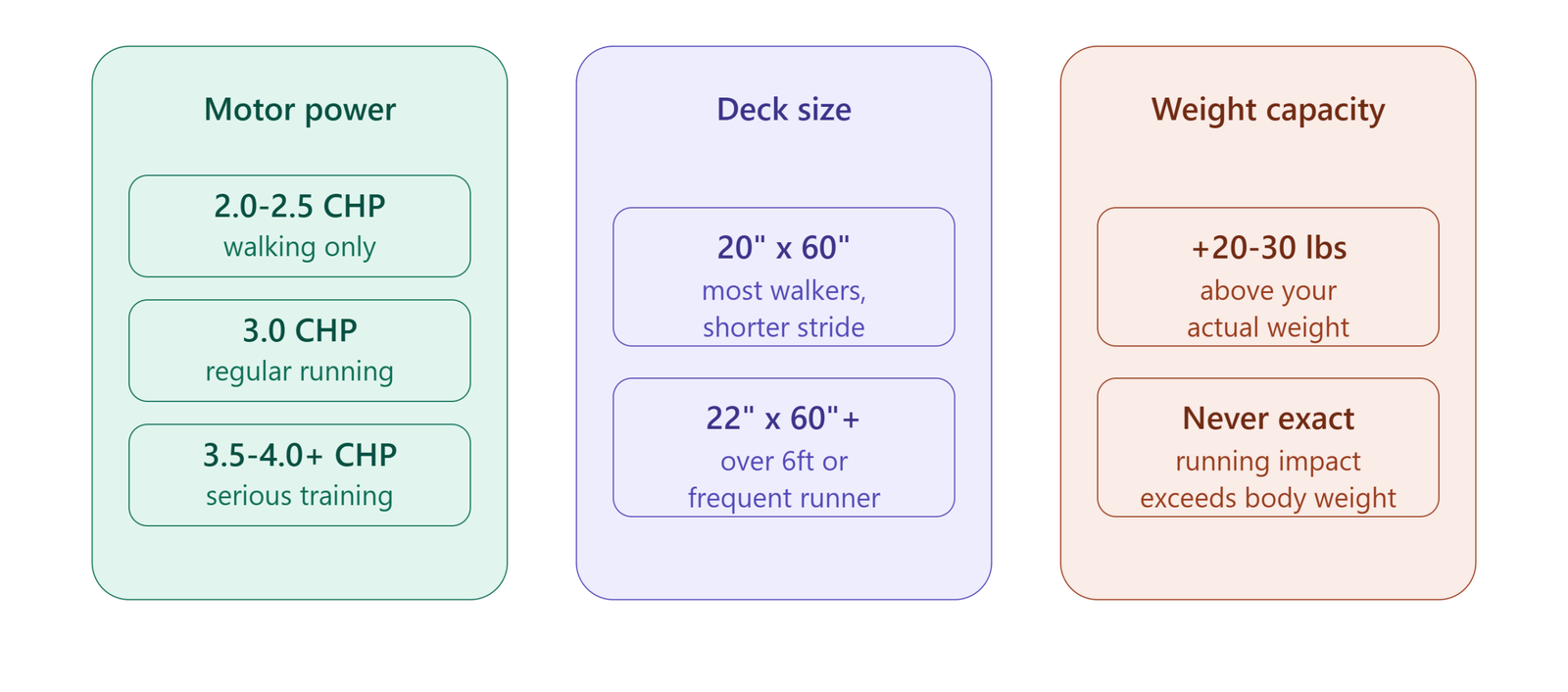
Quick Answer: Match your motor to your use case (2.0-2.5 CHP for walking only, 3.0 CHP for regular running, 3.5-4.0+ CHP for serious or marathon training), choose a deck at least 20″x60″ (22″x60″+ if you’re taller or run frequently), and pick a weight capacity 20-30 lbs above your actual body weight for genuine headroom. Everything else — screen size, subscriptions, entertainment features — matters far less than getting these three right.
Table of Contents
Step 1: Match the Treadmill to How You’ll Actually Use It
Start here, before looking at a single product. A treadmill built for occasional walking and one built for daily running are genuinely different machines, not just different price tiers of the same thing.
If you’re walking only: a 2.0-2.5 CHP motor is genuinely sufficient — you don’t need to pay for capacity you won’t use. If you run regularly: 3.0 CHP is the realistic minimum for sustained use without excessive motor strain. If you’re training seriously — marathon prep, daily high-mileage running, or multiple household users: look for 3.5-4.0+ CHP, since sustained higher speeds put meaningfully more demand on the motor over years of use. If your main goal is specifically weight loss through structured sessions rather than distance training, our treadmill workouts for weight loss guide covers how workout style should factor into this decision too.
Step 2: Get the Deck Size Right for Your Body and Stride
A 20″x60″ deck is adequate for most walkers and shorter-stride runners. If you’re over 6 feet tall, run frequently, or have a longer natural stride, look for 22″x60″ or larger — a cramped deck at running speed is both uncomfortable and a genuine safety concern if your foot strikes the edge of the belt.
Belt length matters more than width for most people, but width matters disproportionately if you’re a larger-framed user or tend to run with a wider natural stance. If you’re specifically shopping for a heavier-capacity machine, our treadmills for heavy people guide covers deck sizing alongside capacity in more detail.
Step 3: Weight Capacity — The 20-30 lb Headroom Rule
Don’t buy a treadmill rated exactly at your current body weight. A machine’s weight capacity accounts for the added force of foot strikes during running, not just static standing weight, so a genuine margin matters. Research on running biomechanics confirms that ground reaction forces during running genuinely exceed a runner’s static body weight with each stride, increasing further as running speed increases. The reliable rule: choose a capacity at least 20-30 lbs above your actual weight, not right at it.
This margin also tends to correlate with overall build quality — a treadmill rated for meaningfully more than the minimum is usually built with a sturdier frame throughout, not just a higher number on the spec sheet.
Step 4: Cushioning and Incline Range
Cushioning quality matters more than most buyers realize, particularly if you have any existing joint sensitivity. Look for zoned or variable-response cushioning systems rather than a single uniform deck — these adjust support based on where your foot lands during your stride, which genuinely reduces impact compared to a flat, uniformly-cushioned deck.
For incline: 0-15% covers the vast majority of home training needs, including popular structured workouts. If incline walking specifically is your main training method rather than an occasional variation, some specialized machines offer significantly higher ranges — worth seeking out specifically if that’s your priority rather than assuming any treadmill covers it well. Our best treadmill for walking guide covers models specifically built around this kind of incline-focused, lower-speed training.
Step 5: Plan Your Space Before You Shop
Measure your intended spot, including ceiling height if you’re taller or plan to use higher incline settings — you need real clearance above the deck, not just floor space. Check both the machine’s operating footprint and its folded dimensions if space is genuinely tight between uses.
Folding treadmills solve space constraints but typically trade off some stability and deck size compared to non-folding models at a similar price. If floor space is your primary constraint, our best treadmill for apartment guide covers models specifically built around this tradeoff.
Step 6: Features Worth Paying For vs. Skipping
A large touchscreen looks impressive in a showroom but doesn’t affect how well the treadmill trains you — and many screen-focused models lock full functionality behind a recurring subscription, which adds real ongoing cost beyond the purchase price. Decide upfront whether you actually want guided content, or whether you’d rather bring your own training structure and save the subscription fee entirely.
Genuinely worth prioritizing: Bluetooth connectivity to third-party apps (so you’re not locked into one ecosystem), quick-access speed and incline controls for interval training, and a display that’s actually easy to read mid-workout. These affect your daily experience far more than entertainment features do.
Step 7: Warranty Red Flags
Warranty length is a genuine signal of how confident a manufacturer is in their own build quality. A lifetime frame and motor warranty is the baseline to look for at any serious price point — anything shorter on these two specific components, even on an otherwise attractively priced machine, is worth treating as a caution flag rather than a minor detail.
Parts and labor coverage varies more reasonably by price tier, but pay attention to the gap between frame/motor coverage and parts/labor coverage — a machine with a lifetime frame warranty but only 90 days of labor coverage is telling you something about which components the manufacturer expects to actually need service.
How to Choose the Right Treadmill for Your Budget?
The right budget isn’t a fixed number — it’s whatever gets you the specific combination of motor, deck, capacity, and warranty that matches your actual use case from the steps above. Someone who walks 20 minutes a few times a week and someone training for a marathon shouldn’t be shopping in the same price tier, and that’s a feature of good buying, not something to feel pressured out of.
If you want a complete walkthrough of specific models matched to different training profiles, our best treadmill for home use guide applies this exact framework to seven tested picks across different budgets and use cases.
Whatever you choose, the CDC notes that consistent regular physical activity is what actually drives long-term health benefits — which means the best treadmill for you is ultimately the one specced closely enough to your real needs that you’ll actually keep using it.
Frequently Asked Questions
What’s the most important spec when choosing a treadmill?
Motor power (CHP) matched to your actual use case matters most, since it directly affects long-term durability and whether the machine can handle your training without excessive strain. Deck size and weight capacity headroom are close seconds.
How much horsepower do I need for running vs walking?
Walking-only use is comfortable with 2.0-2.5 CHP. Regular running needs at least 3.0 CHP. Serious or high-mileage training, including marathon prep, is better served by 3.5-4.0+ CHP for long-term motor reliability.
What weight capacity should I look for?
Choose a capacity rated at least 20-30 lbs above your actual body weight, not right at it. This headroom accounts for the added force of running impact, not just static weight, and tends to correlate with sturdier overall construction.
Is a folding treadmill worth it?
It depends on your space constraints. Folding treadmills solve genuine space problems but typically trade off some stability and deck size compared to non-folding models at a similar price point — a reasonable tradeoff if floor space is a real limitation, less necessary if you have dedicated space.
Do I need a treadmill with a large touchscreen?
Not necessarily. A large screen doesn’t improve training quality and often comes bundled with a required subscription for full functionality. Decide first whether you want guided content before paying for screen size and connected features you might not use.
What warranty length should I expect?
A lifetime frame and motor warranty is the baseline to look for at any serious price point. Shorter coverage on these two components specifically is a caution flag, even if the treadmill otherwise looks well-priced.
How much incline range do I actually need?
0-15% covers the vast majority of home training needs, including most popular structured incline workouts. Only seek out a machine with a significantly higher range if incline walking is specifically your primary training method rather than an occasional addition.
Should I prioritize price or specs when choosing a treadmill?
Specs matched to your actual use case should come first — an underpowered treadmill for your training needs will wear out faster or perform poorly regardless of its price. Once you know the right motor, deck, and capacity range for your needs, budget becomes the tool for choosing between qualifying options, not the starting point.
Affiliate Disclosure: myactivetribe.com is supported by its readers. When you purchase through links on our site, we may earn an affiliate commission at no additional cost to you.