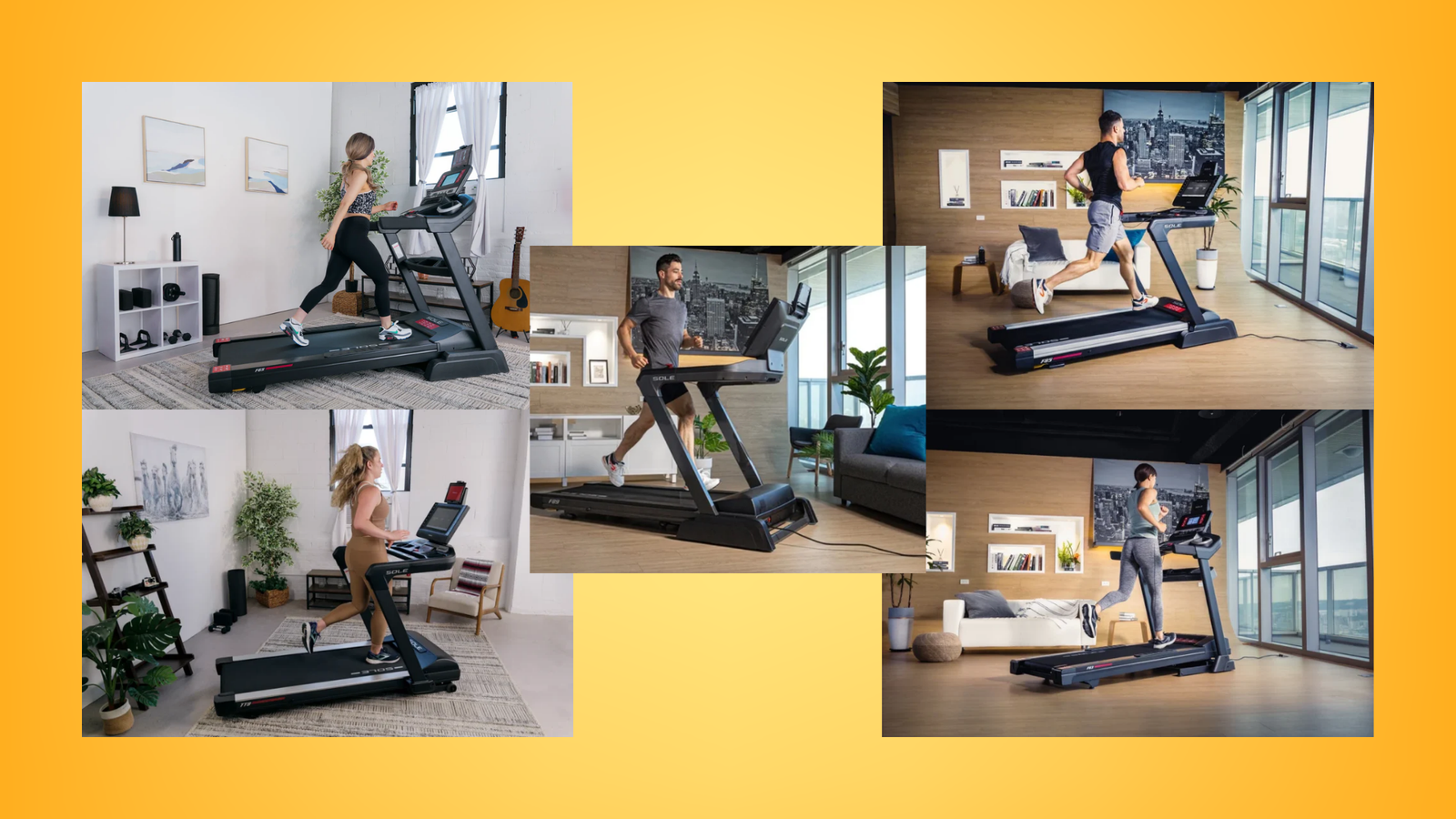
The best Sole treadmill for most home buyers in 2026 is the Sole F85 — 4.0 HP motor, 15.6″ touchscreen, 6-level decline, 375 lb capacity, no subscription required, and a lifetime warranty on the frame and motor at $2,299. For buyers who want maximum screen at a lower cost, the Sole F65 at $1,299 is the strongest value in the lineup — 22″×60″ belt, handrail speed controls, and the same lifetime warranty as every other Sole model. For heavy users or anyone who wants a commercial-grade non-folding machine, the Sole TT8 at $2,399 delivers 400 lb capacity, -6% to 15% incline/decline range, and a light commercial warranty. All models verified against the official Sole website as of May 2026.
I’m AnilKK — a certified fitness and nutrition coach (INFS) with 24 years of running experience and over 250 treadmills personally tested. I’ve followed the Sole lineup through multiple generations and have recommended their machines to clients across different budgets and training needs. This guide covers every current Sole model with verified specs from soletreadmills.com, an honest assessment of where each model fits, and the two questions most buyers ask before purchasing — whether Sole is worth the money and what the lifetime warranty actually covers.
Quick Answer: The best Sole treadmill in 2026 is the Sole F85 for most buyers — 4.0 HP, 15.6″ touchscreen, decline capability, 375 lb capacity, no subscription, lifetime warranty on frame and motor. Step down to the Sole F65 for the best value under $1,500. Step up to the Sole TT8 for commercial-grade construction without a subscription. Every Sole treadmill includes lifetime frame and motor warranty, the free Sole+ app, and no ongoing subscription fees — the strongest warranty-to-price ratio in the home treadmill market.
Sole Treadmill Lineup 2026 — Understanding the Series
Sole organises its treadmill lineup into three series, and understanding the difference between them immediately clarifies which price bracket is right for you. The model numbers are not arbitrary — they follow a clear logic once you know the system.
F6X Series — the F63 and F65 are Sole’s entry-level folding treadmills. Both fold, both carry the lifetime frame and motor warranty, and both are built for walkers and moderate runners. The F63 ($999) uses a 20″×60″ belt and a basic 6.5″ LCD. The F65 ($1,299) upgrades to a 22″×60″ belt, a 9″ display, and adds handrail speed controls. Neither has a touchscreen or decline capability.
F8X Series — the F80, F85, and F89 are Sole’s performance folding treadmills. All three have touchscreens, Z-shaped frames, 22″×60″ belts, and larger motors. The F80 ($1,799) has a 10.1″ touchscreen and no decline. The F85 ($2,299) steps up to a 15.6″ touchscreen and adds 6-level decline. The F89 ($2,699) has a 21.5″ touchscreen and the same decline as the F85 in a larger display package.
Non-Folding Series — the TT8 ($2,399) and ST90 ($3,999) are built for permanent placement and heavy use. The TT8 is a traditional belt, non-folding commercial machine with 400 lb capacity and a light commercial warranty. The ST90 is a slat belt machine — a fundamentally different running surface that mimics outdoor running more closely than a standard belt. The new C80 ($2,399) is Sole’s first curved manual treadmill, self-powered without electricity.
All Sole Treadmills 2026 — Quick Comparison
| Model | Series | Motor | Belt Size | Display | Decline | Weight Capacity | Roller Size | Price (May 2026) |
|---|---|---|---|---|---|---|---|---|
| Sole F63 | F6X | 3.0 HP | 20″ × 60″ | 6.5″ LCD | None | 325 lbs | N/A | $999.99 |
| Sole F65 | F6X | 3.25 HP | 22″ × 60″ | 9″ LCD | None | 325 lbs | N/A | $1,299.99 |
| Sole F80 | F8X | 3.5 HP | 22″ × 60″ | 10.1″ Touchscreen | None | 350 lbs | 2.36″ | $1,799.99 |
| Sole F85 | F8X | 4.0 HP | 22″ × 60″ | 15.6″ Touchscreen | 6 levels | 375 lbs | 2.75″ | $2,299.99 |
| Sole F89 | F8X | 4.0 HP | 22″ × 60″ | 21.5″ Touchscreen | 6 levels | 375 lbs | 2.75″ | $2,699.99 |
| Sole TT8 | Non-Fold | 4.0 HP | 22″ × 60″ | 10.1″ Touchscreen | 6 levels | 400 lbs | 3″ | $2,399.99 |
All specs and prices sourced directly from soletreadmills.com as of May 2026. Prices reflect current Memorial Day sale pricing — check the Sole website for current pricing. Every model carries a lifetime warranty on frame and motor for residential use. The F63 is available exclusively from Sole directly — not currently available on Amazon.
1. Sole F65 — Best Value Sole Treadmill
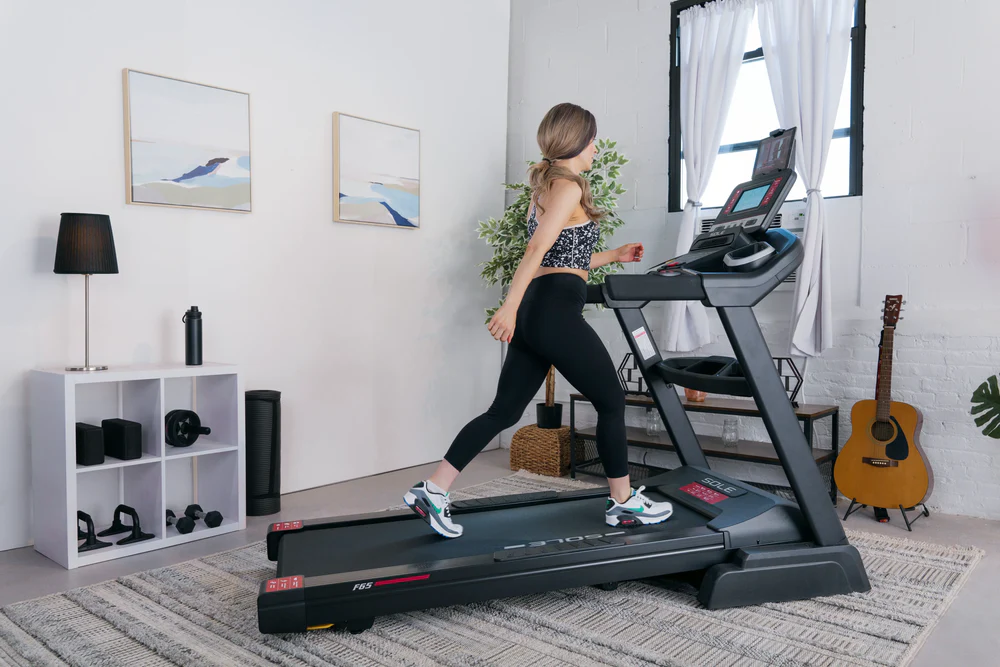
The Sole F65 is the strongest value in the current lineup — at $1,299, it delivers a 22″×60″ running surface (the full-width belt that most competitors charge $400 more for), handrail speed and incline controls for mid-stride adjustments, a 9″ backlit LCD display, and the same lifetime frame and motor warranty that Sole applies across every model. It is 40 lbs lighter than the F85, one inch shorter, and folds using a release lever mechanism that is slightly easier to operate than the F63’s kick release.
What Makes It Different
The 22″×60″ belt at this price is the specific differentiator. Most treadmills at $1,299 use a 20″ wide belt — the industry minimum that many runners feel constrained on at higher speeds. Sole’s decision to put a full 22″ width in the F65 means you are not sacrificing running comfort to stay under $1,500. The handrail controls — which let you adjust speed and incline without reaching for the console — are also absent from most competitors at this price and make a practical difference during interval training sessions.
The honest limitation is the display. A 9″ backlit LCD is functional but not the Android touchscreen experience of the F8X series. There is no streaming capability built in — you need to bring your own device and use the tablet holder. For buyers who want Netflix and YouTube built in without an extra device, the F80 or F85 are the appropriate step up. For buyers who are happy using their own phone or tablet, the F65’s display limitation costs nothing in practical terms.
Best for: Walkers and moderate runners who want a full 22″×60″ running surface with handrail controls at the best price per feature ratio in the Sole lineup.
- 22″ × 60″ running surface at $1,299 — full-width belt that most competitors charge $400–500 more to include
- Handrail speed and incline controls — mid-stride adjustments without reaching for the console, absent from most competitors at this price
- Lifetime frame and motor warranty — the same coverage as the $2,299 F85, the industry’s strongest warranty at this price point
- 40 lbs lighter than the F85 — meaningful difference for anyone who needs to move the machine occasionally
Cons: 9″ backlit LCD rather than touchscreen — no built-in streaming apps, requires your own device for entertainment. No decline feature — available only from the F85 upward. 325 lb weight capacity — lower than the F8X series.
2. Sole F85 — Best Overall Sole Treadmill
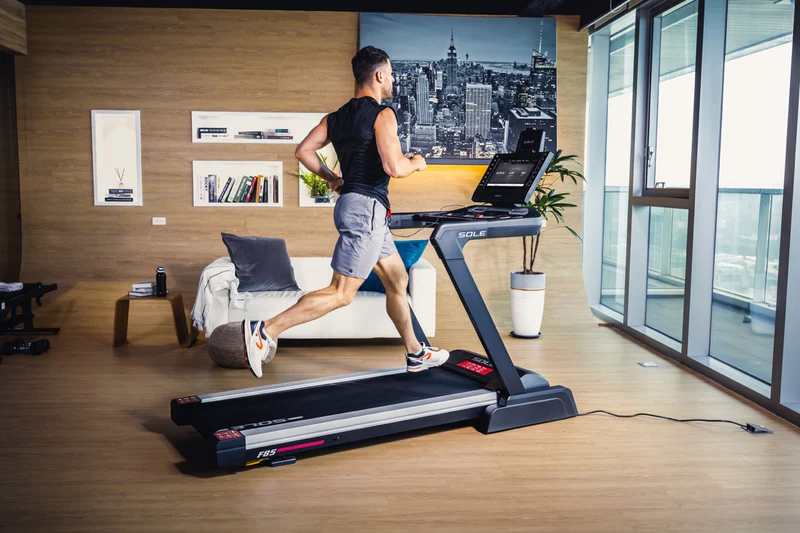
The Sole F85 is the model that best represents what Sole does differently from the rest of the home treadmill market. A 4.0 HP motor, 15.6″ HD touchscreen with built-in Netflix, YouTube, Disney+, and Hulu, 6-level decline from -6% to flat, 375 lb weight capacity, 2.75″ rollers, Z-shaped aluminum frame — all at $2,299 with no subscription required and a lifetime warranty on frame and motor. The combination of features, build quality, and warranty coverage at this price point is genuinely difficult to match from any other brand.
What Makes It Different
The no-subscription model is the F85’s most important differentiator in 2026. NordicTrack and Peloton both gate significant functionality behind monthly fees — iFIT costs $39/month, Peloton All-Access is $44/month. Over 36 months, that adds $1,404–1,584 to the total cost of ownership. The Sole F85’s built-in streaming apps (Netflix, YouTube, Disney+, Hulu, Amazon Prime, Spotify, ESPN) are installed and free — no ongoing payment, no server shutdown risk, no features withheld. The Sole+ coaching app is also free and includes thousands of workouts. This is not a marketing claim — it is a structural business model difference that directly affects the total cost of owning the machine.
The 2.75″ roller size is a quality signal worth understanding. Larger rollers reduce belt wear and motor strain by distributing the belt’s contact force more evenly. The F63 and F65 do not list roller sizes — the F85’s 2.75″ rollers represent a meaningful component upgrade over entry-level machines and indicate a machine designed for sustained high-mileage use rather than occasional workouts. After 24 years of running, I look at roller size as one of the most reliable durability indicators in any treadmill at this price range.
The decline feature deserves specific mention. Running downhill engages your quadriceps eccentrically — the muscle lengthening under load — which is the training stimulus that makes downhill running in races feel manageable. Training exclusively on flat surfaces or incline does not prepare your legs for the eccentric loading of descents. The F85’s -6% to 15% range covers the full training spectrum that flat-only machines cannot. For anyone training for races with significant downhill sections, or anyone doing rehabilitation work that specifically requires decline, this feature alone justifies the step up from the F80.
Best for: Serious home runners who want a commercial-grade feature set with no subscription, built-in streaming, decline capability, and the industry’s strongest warranty at the mid-range price point.
- 4.0 HP motor with 2.75″ rollers — commercial-grade motor paired with large rollers that indicate a machine designed for sustained daily running, not occasional use
- No subscription required — Netflix, YouTube, Disney+, Hulu, Spotify built in at no ongoing cost, saving $1,400+ versus subscription-based competitors over 3 years
- 6-level decline (-6% to flat) plus 15% incline — the full training range for eccentrically loaded downhill running, unavailable on the F80 and F65
- 375 lb weight capacity with lifetime frame and motor warranty — 50 lb more than the F65 with the same comprehensive warranty coverage
Cons: $500 more than the F80 for the same belt size — the premium is for the larger screen, decline capability, and larger rollers. At 300 lbs, professional assembly help is recommended — solo assembly is genuinely difficult at this machine weight.
3. Sole F89 — Best Screen in the Sole Lineup
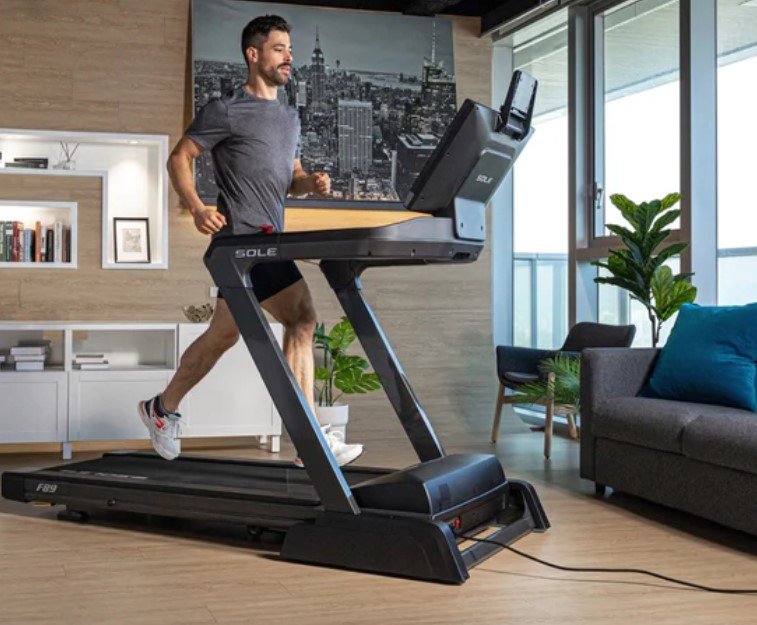
The Sole F89 is mechanically identical to the F85 — same 4.0 HP motor, same 22″×60″ belt, same 6-level decline, same 375 lb capacity, same 2.75″ rollers — but replaces the F85’s 15.6″ screen with a 21.5″ Android-powered touchscreen. That is a significant size upgrade — the difference between a laptop screen and a large monitor. The F89 runs at $2,699, a $400 premium over the F85 for the screen upgrade specifically.
What Makes It Different
The 21.5″ screen runs on an Android platform with full web browser capability — meaning you can access any streaming service, not just the pre-installed apps. It also has built-in Netflix and the Sole+ app, plus Kinomap compatibility for virtual route running. For users who spend 60–90 minutes per session on the treadmill and want the most immersive entertainment experience available in a home machine, the larger screen makes a genuine quality-of-life difference. Whether that difference justifies $400 over the F85 depends entirely on how much time you spend on the machine and how important the screen experience is to your daily use.
Best for: Buyers who spend long sessions on the treadmill and want the largest built-in screen available in a folding home machine — and for whom the $400 premium over the F85 is justified by the entertainment experience.
- 21.5″ Android touchscreen — the largest display in the Sole folding treadmill lineup, with full web browser access to any streaming service
- Mechanically identical to the F85 — same motor, belt, decline, capacity, and rollers means no performance trade-off for the screen upgrade
- Built-in Netflix, Kinomap, and Sole+ app — full entertainment ecosystem without any subscription requirement
- Same lifetime frame and motor warranty as every other Sole model
Cons: $400 more than the F85 for a screen upgrade only — buyers who are indifferent to screen size get identical performance from the F85 for less. At $2,699, it approaches the TT8’s price point, which offers a non-folding commercial build at the same price range.
4. Sole TT8 — Best for Heavy Users and Permanent Setups
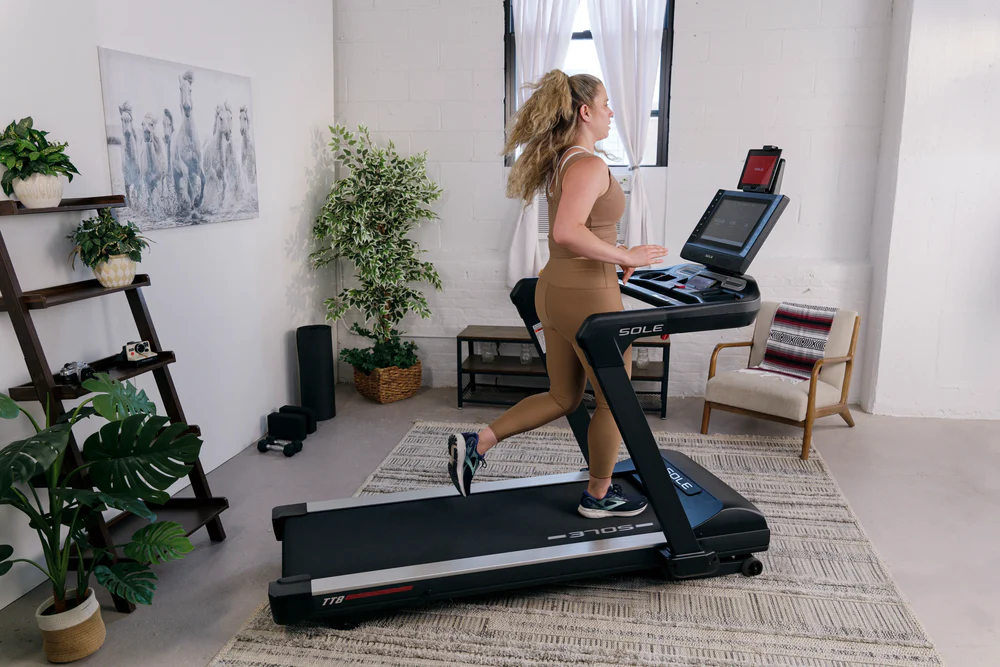
The Sole TT8 is the most capable machine in the lineup for anyone whose needs exceed what a folding home treadmill can deliver. At 326 lbs, it does not fold — this is a machine you place once and leave there. In return, you get 400 lb weight capacity (the highest in the Sole lineup), 3″ rollers (larger than the F85’s 2.75″), a 4.0 HP motor, full -6% to 15% incline/decline range, a 10.1″ touchscreen, and a light commercial warranty that covers 2 years on parts and labor plus lifetime on the frame and motor. The non-folding design eliminates the hinges and locking mechanisms that introduce wobble in folding machines — the TT8 is as stable as equipment you find in a commercial gym.
What Makes It Different
The light commercial warranty is the specific differentiator that separates the TT8 from every other Sole model. Residential warranties cover one user in one household. The TT8’s light commercial warranty is designed for environments where multiple people use the machine regularly — multi-person households, small studios, or anyone who runs high daily mileage. The 400 lb weight capacity is also the highest available in the Sole lineup, providing genuine safety headroom for heavier users that the F85 and F89’s 375 lb rating does not. For buyers who weigh over 300 lbs, the TT8’s capacity and commercial build quality make it the appropriate choice. Our guide on the best treadmills for heavy people covers the full weight capacity landscape across brands if you need to compare options beyond Sole.
Best for: Heavy users over 300 lbs, multi-person households, serious runners who want commercial-grade stability without folds or hinges, and anyone who can commit to a permanent machine placement.
- 400 lb weight capacity — highest in the Sole lineup, provides genuine safety headroom for heavier users that the F85 and F89 do not
- Light commercial warranty — covers multiple-user household use that residential warranties exclude, plus 2 years parts and labor
- 3″ rollers — larger than any folding Sole model, reduces belt wear and motor strain during sustained high-mileage use
- Non-folding construction — eliminates hinge wobble for a stability level that matches commercial gym equipment
Cons: Does not fold — requires permanent placement, cannot be stored away. 326 lb machine weight makes relocation very difficult once placed. 10.1″ touchscreen is smaller than the F85 despite being in the same price range — the premium goes to the commercial build, not the screen.
5. Sole F63 — Best Entry-Level Option (Direct from Sole Only)
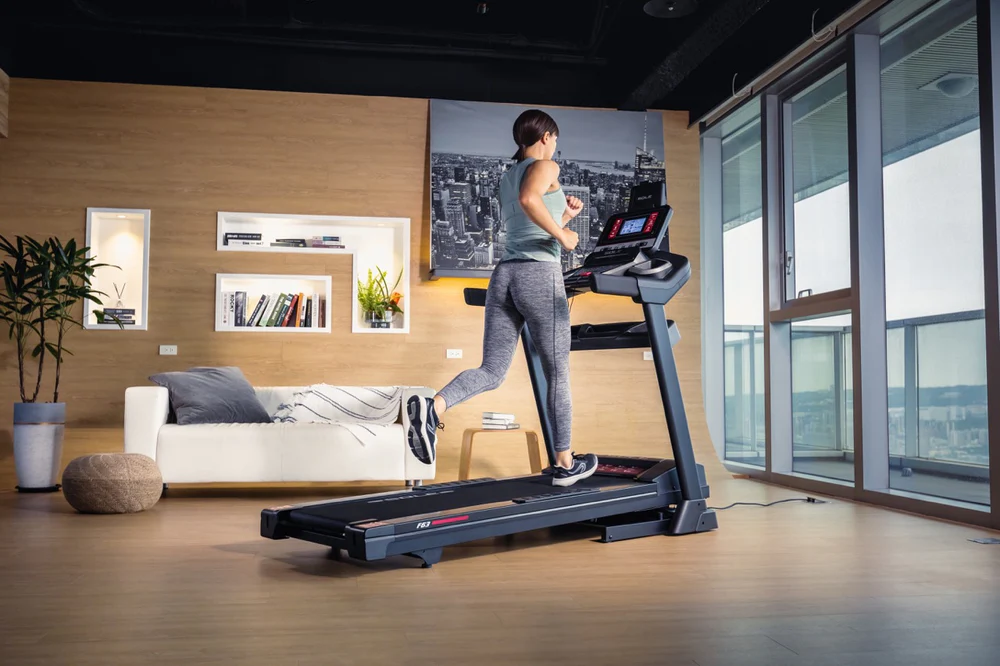
The Sole F63 at $999 is the most affordable way to get a Sole treadmill with a lifetime frame and motor warranty. It uses a 20″×60″ belt, a 3.0 HP motor, a 6.5″ backlit LCD display, 15 incline levels, 10 preset programs, and a 325 lb weight capacity. It folds using a kick-release mechanism and includes Bluetooth speakers, a tablet holder, and a USB charging port. It is a straightforward, no-frills folding treadmill that delivers Sole’s build quality and warranty at the entry-level price.
What Makes It Different
The F63 is the only sub-$1,000 treadmill available with a lifetime frame and motor warranty. At $999, most competing brands offer 2–5 year warranties on frames and 1–2 years on motors. Sole’s lifetime coverage at this price is a genuine differentiator — it signals manufacturer confidence in the build quality that is rare at this price point. The honest limitation to flag: the F63 is currently unavailable on Amazon. It is available exclusively from soletreadmills.com directly, where Sole often offers sales, free shipping, and no sales tax in many states. Purchase through the Sole website using your Flexoffers affiliate link.
Best for: Budget-conscious buyers who want Sole’s build quality and lifetime warranty at the lowest price — and who are comfortable purchasing directly from soletreadmills.com rather than Amazon.
- Lifetime frame and motor warranty at $999 — the only sub-$1,000 treadmill with this level of warranty coverage
- 3.0 HP motor on a 20″×60″ belt — adequate for walking and jogging up to 12 MPH for users up to 325 lbs
- Bluetooth speakers, tablet holder, USB charging — practical connectivity without a touchscreen premium
- Sole’s proven build quality and customer service — the same brand track record as the F85 at a significantly lower price
Cons: Not currently available on Amazon — purchase directly from soletreadmills.com only. 20″ belt width is narrower than the 22″ standard on all other Sole models — runners may feel constrained at higher speeds. No touchscreen, no decline, basic display.
Sole F80 vs F85 — Which Is Worth the Upgrade?
This is the most common decision point in the Sole lineup. The F80 and F85 are both F8X series machines with the same 22″×60″ belt and similar folding mechanisms. The differences are specific and worth understanding clearly before spending $500 more on the F85.
The F85 upgrades the F80 on four dimensions: motor (4.0 HP vs 3.5 HP), screen (15.6″ vs 10.1″), decline (6 levels vs none), and rollers (2.75″ vs 2.36″). The weight capacity also increases from 350 lbs to 375 lbs. If you run regularly above 8 MPH, weigh over 280 lbs, train for races with downhill sections, or want a significantly larger screen for entertainment during long sessions — the F85 is worth the upgrade. If you run at moderate paces, weigh under 250 lbs, and are indifferent to screen size, the F80 at $1,799 delivers everything you need without paying for features you will not use. One important note: the F80 showed as sold out on the Sole website at time of writing — check current availability before making a decision between the two.
Are Sole Treadmills Worth the Money? The Honest Answer
Yes — with a specific caveat. Sole treadmills represent genuinely strong value in the $1,000–2,500 range because of three things that competitors at the same price do not consistently offer: lifetime warranty on frame and motor, no subscription requirement, and commercial-origin build quality from a brand that started making hotel-grade equipment before entering the home market.
The caveat is the touchscreen experience. Sole’s screens are functional and the built-in apps work well, but the interface is not as polished as NordicTrack’s iFIT or Peloton’s software ecosystem. If a guided workout experience with instructor-led classes and adaptive programming is your primary motivation for buying a treadmill, NordicTrack or Peloton serve that need better — at a higher total cost once subscriptions are included. If you want a machine that performs reliably for years, carries the best warranty in the category, and does not charge you monthly to use features you already paid for — Sole is the right choice. After testing over 250 treadmills in 24 years, I consistently recommend Sole to clients who want durability and value over software ecosystems.
Sole vs NordicTrack — Honest Comparison
This is the most searched treadmill comparison for buyers in the $1,500–2,500 range. The honest comparison comes down to two different priorities: NordicTrack if you want the best guided workout software experience, Sole if you want the best hardware value with no ongoing cost.
NordicTrack’s iFIT platform is genuinely excellent — adaptive training, instructor-led workouts, global route running, automatic incline adjustment to match terrain. But iFIT costs $39/month — $468/year. Over five years that is $2,340 in subscription fees on top of the treadmill price. The NordicTrack Commercial 1750 at $1,999 plus 5 years of iFIT costs approximately $4,339 total. The Sole F85 at $2,299 with the free Sole+ app and built-in streaming costs $2,299 total over the same period. The $2,040 difference is real and worth calculating before choosing based on the purchase price alone. For a broader comparison across brands at different price points, our best treadmill for home use guide covers the full mid-range landscape.
Sole Treadmill Warranty — What It Actually Covers
Every Sole treadmill carries a lifetime warranty on the frame and motor for residential use. This is the most comprehensive standard warranty in the home treadmill market. What it means in practice: if the frame cracks or the motor fails under normal residential use, Sole replaces it at no cost — regardless of how old the machine is.
What the lifetime warranty does not cover: the deck, parts, wear items, and labor are covered for a fixed term that varies by model — typically 3 years on the deck and parts, 1 year on labor. The F63 has a shorter coverage period on these components than the F8X models. Cosmetic items (scuffs, console casing) are covered for 90 days. The TT8’s light commercial warranty extends to 2 years on parts and labor alongside the lifetime frame and motor coverage. Sole also offers a 30-day return policy across all models. For buyers who experience a motor or frame issue after 5+ years of use — which is rare given Sole’s build quality — the lifetime coverage means the most expensive component repair is always covered.
How to Choose the Right Sole Treadmill
If your budget is under $1,500: Sole F65. Full 22″×60″ belt, handrail controls, lifetime warranty. The F63 at $999 is also available direct from Sole if the F65 is over budget.
If you want no subscription and built-in streaming: Sole F85. Every Sole model is subscription-free, but the F85’s 15.6″ touchscreen with built-in Netflix and YouTube is where the no-subscription advantage becomes most tangible.
If you train for races with downhill sections: Sole F85 or TT8. The F65 and F80 have no decline. The F85 and F89 offer -6% decline in a folding machine. The TT8 offers the same decline range in a non-folding commercial build.
If you weigh over 300 lbs: Sole TT8 (400 lb capacity) or Sole F85 (375 lb capacity). Apply the 20–30 lb headroom rule — if you weigh 310 lbs, the TT8 is the appropriate choice. If you weigh 280 lbs, the F85 provides adequate headroom. For more guidance on treadmill selection for larger users, our best treadmills for heavy people guide covers this in detail.
If you want the largest screen: Sole F89. The 21.5″ Android touchscreen is the largest in the folding lineup. Mechanically identical to the F85 — the $400 premium is purely for the screen.
If you want permanent commercial-grade placement: Sole TT8. Non-folding, 400 lb capacity, light commercial warranty, 3″ rollers. Place it once and run for years.
For context on how the Sole lineup compares to NordicTrack, Horizon, and Bowflex across different price points and use cases, our best treadmill under $1,500 guide and best treadmill under $2,000 guide cover the full competitive landscape.
Frequently Asked Questions
Are Sole treadmills worth the money?
Yes — Sole treadmills offer the strongest warranty-to-price ratio in the home treadmill market. Every model carries a lifetime warranty on the frame and motor, no subscription is required to access built-in features, and the brand’s commercial-origin build quality consistently outperforms competitors at equivalent price points. The one area where Sole trails NordicTrack and Peloton is guided workout software — if instructor-led adaptive training is your priority, those brands serve that specific need better. If you want a durable machine with a lifetime warranty that does not charge you monthly to use it, Sole is the right choice in the $1,000–2,500 range.
Which is the best Sole treadmill to buy?
The Sole F85 is the best overall choice for most buyers — 4.0 HP motor, 15.6″ touchscreen with built-in streaming apps, 6-level decline, 375 lb capacity, 2.75″ rollers, and no subscription at $2,299. Step down to the Sole F65 at $1,299 for the best value under $1,500. Step up to the Sole TT8 at $2,399 if you need 400 lb weight capacity, non-folding commercial stability, or light commercial warranty coverage. Every model carries a lifetime frame and motor warranty — the choice between them is determined by budget, weight capacity needs, and whether you want decline capability and a built-in touchscreen.
Do Sole treadmills require a subscription?
No — Sole treadmills do not require a subscription to access any feature. The Sole+ app with thousands of workout classes is free with every purchase. The built-in streaming apps (Netflix, YouTube, Disney+, Hulu, Amazon Prime, Spotify, ESPN) on the F8X touchscreen models are pre-installed and available without any monthly fee. This is a fundamental business model difference from NordicTrack (iFIT at $39/month) and Peloton ($44/month) — Sole’s total cost of ownership over 5 years is significantly lower than subscription-dependent competitors at similar purchase prices.
What does the Sole treadmill lifetime warranty cover?
Sole’s lifetime warranty covers the frame and motor for the life of the machine under residential use — if either fails due to manufacturing defects or normal wear, Sole replaces it at no cost regardless of machine age. The deck, parts, and wear items are covered for a fixed term (typically 3 years on F8X models, shorter on F6X). Labor is covered for 1 year on most models, 2 years on the TT8’s light commercial warranty. Cosmetic items are covered for 90 days. The lifetime coverage on frame and motor is the most comprehensive standard warranty in the home treadmill category — most competitors offer 5–15 year frame warranties and 3–5 year motor warranties at equivalent price points.
Is Sole better than NordicTrack?
It depends on what you prioritise. Sole is better on warranty coverage (lifetime vs NordicTrack’s 10-year frame, 2-year motor on most models), total cost of ownership (no subscription vs iFIT at $39/month), and build durability for high-mileage home use. NordicTrack is better on guided workout software — iFIT’s adaptive training, instructor-led classes, and automatic terrain adjustment provide a more immersive training experience than Sole’s platform. If total cost over 5 years matters and you don’t need guided adaptive training, Sole wins. If the workout software experience is your primary motivation, NordicTrack serves that better at a higher total cost.
How long do Sole treadmills last?
Sole treadmills are built to last 10–15+ years with normal residential use and basic maintenance — belt lubrication every 3–6 months and periodic bolt checks. The brand’s commercial-hotel origin means the frames and motors are overbuilt for home use. The lifetime warranty on frame and motor provides a practical indicator of manufacturer confidence in longevity. In my experience testing over 250 treadmills, Sole machines consistently show less motor degradation and frame wear after high mileage use than most competitors at equivalent price points. Regular belt lubrication is the single most important maintenance step for extending the life of any treadmill.
Where can I buy a Sole treadmill?
Sole treadmills are available on Amazon (F65, F85, F89, TT8) and directly from soletreadmills.com (all models including the F63). Buying directly from Sole often includes sales pricing, free shipping, no sales tax in some states, and direct access to Sole’s US-based customer service team. The F63 is currently only available from soletreadmills.com — it is not listed on Amazon. The F80 was showing as sold out on the Sole website at time of writing — check current availability before purchasing.
All specifications and prices sourced directly from soletreadmills.com as of May 2026. Prices reflect Memorial Day sale pricing and are subject to change — verify current pricing on the Sole website or Amazon before purchasing. This article contains affiliate links — if you purchase through them, we may earn a commission at no additional cost to you. The F63 link goes to the Sole website directly; all other model links go to Amazon.